
Conducting 1 to 1s
Build Strong Relationships and Identify Future Superstars

In this article, we’ll focus on 1 to 1s, which provide a key opportunity every week (yes, every week) to engage with your staff on a deep, personal level. As a manager, you can have a tremendous impact on the performance and lives of your staff by doing 1 to 1s mindfully and to a high standard. Simply doing them isn’t difficult, but doing them well is an area that requires consistent focus.
When and Where
Cadence and regularity are key in these meetings. Book them in at the same time and place each week and commit to them. Do not move a 1 to 1 meeting unless absolutely necessary. Having a scheduled regular touchpoint brings predictability to your relationship and shows that you care about being there for your direct report week in, week out.
Hold the meetings in a private room — this point is critical. Do not hold 1 to 1s in a public area in the office, such as the breakout area or at the employee’s desk. Holding meetings in a public area prevents any private conversation from occurring and may even make your direct report feel like you would rather not hear what they have to say — and you absolutely want to. The same observation is true for managers who take their 1 to 1s outside the building to a nearby coffee shop. As nice as it is from a social perspective, the lack of formality and privacy in the conversation is detrimental to the quality of the conversation. After all, the meeting is about open and honest feedback and personal development. You owe it to each other to find a quiet, private place, rather than shouting over the top of the hissing milk wand.
The Most Important Meeting with Your Staff
So why are 1 to 1s so important?
Focus
Firstly, it is the one completely uninterrupted hour that your direct reports get to spend with you every week. In that time, neither of you is meant to be doing anything else; your primary purpose is to be present and to talk without distraction. Keep emails closed and don’t get interrupted by phone calls. The private element of the meeting makes it the ideal opportunity each week to talk about performance and developmental issues and to give the employee a chance to speak in a way that they wouldn’t in the public office space. For example, they can vent about a conflict with a colleague or raise concerns about an ongoing project.
Trust
Secondly, this private space is where you build rapport and trust. It is critical that you are approachable as a manager. Building a transparent and trusting relationship through these meetings ensures that your staff will feel safe approaching you if they are in need and will consistently be open with you. Having a good relationship with a manager is a vital factor for happiness at work.
Guidance
Thirdly, this is where you, as a manager, get to exercise your influence, which is exactly what your job is about. You can offer advice, opinions, coaching, and support in this meeting. You can nudge a variety of issues in a particular direction each week, and in the long term, your staff and their projects will be on the right track. Irregular 1 to 1s, or a complete lack of them, can cause staff to drift in their focus and performance, creating a much more difficult situation to rectify in the future. This is especially true of performance issues which, when left alone for too long, become nearly impossible to repair.
Conducting 1 to 1 Meetings
We’ve established that 1 to 1 meetings are critical to your team’s success. Now let’s look at what it takes to prepare for and conduct 1 to 1 meetings.
Preparing for 1 to 1s
Consider using a shared document between you and each direct report to manage 1 to 1s. With my own direct reports, I jot down notes about topics I’d like to cover as the week progresses. Depending on the person, there may be anywhere between 0 and 10 items. Some of my staff do the same, but not all — some prefer to come with paper notes. That’s fine, but I still keep the shared document as my reference guide. I can use it in the future if I ever need reminding about what events have occurred, and it is especially useful to review historically at performance review time.
When arriving at each 1 to 1, I’ve typically noted down a few points about the key project(s) they are working on so that I can get a brief update, included any information from the board or management meetings that they may find interesting. Occasionally there will be a prompt for some coaching or career conversation. However, I’m not fussed if the meeting strays from this, since…
It’s Their Meeting, Not Yours

Despite the fact that this is your best chance to positively impact your staff each week, the paradoxical stance you must adopt is that the meeting is theirs, not yours. You must keep the thought bubble over their head for as much of the meeting as possible. Ask leading questions, nudge the conversation in particular directions, and most of all, listen. It’s not your job to direct the conversation or pontificate in this meeting; it’s your job to absorb and guide.
Try and get your direct report to do 70 percent of the talking. If you feel like solving their problem for them, don’t. Ask another question and let them arrive at the conclusion themselves. Leading others to a solution is an art that takes some practice, although some are naturally good at this with little to no training.
Getting Updates, The Boring Part
The administrative side of the meeting involves getting updates on key projects, asking how work is going, and so on. It’s very easy for you to just nod and listen, but it can be helpful to ask some questions to provoke discussion: “
- How could we complete that exploration quicker?
- Is that the correct technical approach?
- Have you seen any open-source software that could solve that problem for us?
You may have absolutely no idea of the answers to any of these questions, but they work very well for stimulating discussion.
It’s worth clarifying that your 1 to 1s are not primarily there for you to receive updates on projects. They would be very dull if that was the only reason for 1 to 1s. Derive enough about the current projects to report upwards and feel happy, but don’t insist on every little detail. Keep most of the time in the meeting free to talk about personal development and wider coaching issues. You’ll both be happier using this approach.
Allowing Issues to Surface, Silence Is Golden
Time and time again you will find that if you let the conversation meander and if you stay relatively silent using subtle prompts, the best parts of the conversation are to be found. Get the updates over with and talk more broadly. Let your direct report discuss some issues that happened in the week, and let the conversation tail off, sometimes to silence. It’s in these moments that the potent issues can be found: “ …and that’s the issue, I guess: I just have no idea why that team isn’t helping us more. “
Once again, it’s their meeting: let the employee dig into their mind and surface the things that really matter. They’ll know.
Checking In On Their Goals
It’s worth keeping in mind your direct report’s goals and frequently stimulating discussion around them. How are they getting on? Goals may be technical, such as speeding up data processing in their service by 10X, or personal, such as becoming a more confident public speaker. Ask whether they made any progress in the last week, and if not, how they could find time in the next week to work on those goals. Checking back in on goals is another great way to show that you are thinking of their development and that you care.
Taking Notes and Assigning Actions
Throughout the 1 to 1, jot down notes in the shared document and assign actions. Review the actions at the end of the meeting. You can, of course, jot on paper or even keep things in your head, but you may forget things, and transcribing later to the shared document creates more work. You could sit around a laptop together, or both have the document open on your separate screens. Depending on the AV setup, you could display it on the computer in the room via HDMI, AirPlay, or similar. The point is that your notes are not a secret — they’re for both of you.
I typically use a bullet point format to arrange information, and any item in bold represents an action. Here’s a hypothetical 1 to 1 with Mary, who is not a real member of my staff:
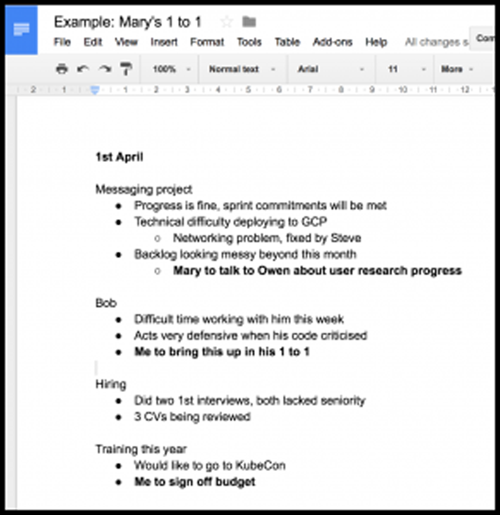
These notes become a wonderful historical reference as time passes. You can scan back over them when performance reviews are due to prompt yourself on what your staff has been doing. You know that you can dump notes in there at any time, and you’ll have them in front of you to talk about the next time that you meet.
In Summary
If you haven’t done 1 to 1s before, they may seem like a lot of work. But the variety of opinions gives you valuable insight into what is going on within your team. With time, you will find 1 to 1s allow you to make informed decisions more broadly and discover issues before they become serious.
Don’t underestimate the simple act of spending time with your direct reports either: you can build strong relationships with each other that can identify the future superstars in your organization.
Do you have a culture of 1 to 1s in your team? If not, why not? Share in the comments.
If you enjoyed this article, be sure to pick up James Stanier’s book from The Pragmatic Bookshelf:
Through the end of October 2021, you can save 35% on the ebook version using promo code jsengman_medium_35. Note that promo codes are not valid for prior purchases.
Further Reading
Also by James Stanier:
Stay in Touch
A great way to stay in touch with The Pragmatic Bookshelf is to sign up for our newsletter. You’ll be the first to know about new books for programmers, books in beta, and promo codes that give you discounts of up to 40%.