
avatarJames Stanier

Free AI web copilot to create summaries, insights and extended knowledge, download it at here

6411

Abstract

robably won’t be watched more than once.</li><li><b>Email </b>is where we start producing more permanent asynchronous artifacts. Email by nature is archival and searchable. We often use email for important information, like to deliver confirmation of a raise or to confirm that a payment has been set up. Some people reply to emails quickly, but some take many days to reply — and that’s okay.</li><li><b>A written document</b> requires some effort to produce and may be used as the cornerstone of a project or proposal. Theoretically, a well-written document can last almost indefinitely, assuming the reader knows the date and context for which it was created. Most online document software also allows collaborative editing and commenting.</li><li><b>Wikis and READMEs</b> are completely asynchronous, and typically have no interaction between the author and readers. If well-maintained, they can last and be useful indefinitely.</li></ul><h1 id="69e9">The Old World</h1><figure id="9125"><img src="https://cdn-images-1.readmedium.com/v2/resize:fit:800/1*DlA5yNJZmMVm8fdRiNUPhA.jpeg"><figcaption>Photo by <a href="https://unsplash.com/@louisnardsophie?utm_source=medium&amp;utm_medium=referral">Sophie Louisnard</a> on <a href="https://unsplash.com?utm_source=medium&amp;utm_medium=referral">Unsplash</a></figcaption></figure><p id="5b44">When we primarily work together in an office, convenience and habit dictate that we spend a lot of time on the left-hand side of the communication spectrum. After all, when all of our colleagues are sitting across the room, it’s easy to have a conversation in the moment.</p><p id="a7ad">Synchronous communication is perfectly normal; however, it isn’t suitable for remote working. Even in the office, the left-hand side of the communication spectrum severely limits collaboration for companies with teams across multiple locations.</p><p id="4f20">If you’ve worked in a large company, you’ve probably already seen the effects of synchronous communication as the default:</p><ul><li>Individuals sit with their teams physically in the same office.</li><li>Teams that collaborate frequently work from the same physical location.</li><li>The weakest bonds between parts of the organization occur across a geographical divide.</li></ul><p id="0dca">This arrangement can have a tangible and inconvenient effect on the software your company creates. <a href="https://en.wikipedia.org/wiki/Conway%27s_law">Conway’s Law states</a> that any organization that designs a system will produce a design whose structure mirrors the organization’s communication structure. When companies expand into different locations, opening another office to hire engineers might be an implicit design choice in how they architect their software — <i>they just don’t know it yet.</i></p><h1 id="8ba4">Shifting Right</h1><figure id="b49e"><img src="https://cdn-images-1.readmedium.com/v2/resize:fit:800/1*1aMIyTaw2vPZSiD-3-sbHA.jpeg"><figcaption>Photo by <a href="https://unsplash.com/@louisnardsophie?utm_source=medium&amp;utm_medium=referral">Sophie Louisnard</a> on <a href="https://unsplash.com?utm_source=medium&amp;utm_medium=referral">Unsplash</a></figcaption></figure><p id="0093">To fully embrace remote working, we need to shift our mindset and habits to the right of the spectrum.</p><p id="5045">Instead of choosing the convenient option, we need to choose to communicate in a way that enables an equal level of contribution from anyone, regardless of where they are located in the world.</p><blockquote id="7b80"><p><b>Shift right.</b></p></blockquote><p id="8b5c">That’s the habit that you need to instill in both yourself and your colleagues. Every time you communicate. Can you purposefully shift right so that you better serve the needs of remote work? For example, could you:</p><ul><li>Turn a face-to-face conversation into an exchange in the team’s chat channel instead? Via chat, more people have the opportunity to listen in on what is being said and contribute to the conversation.</li><li>Record a video call so that those who are unable to make it (or those who didn’t know it was happening) are able to watch it later.</li><li>Decide to stop a long chat exchange so you can write it up more thoughtfully and purposefully in an email?</li><li>Take an email thread that is proposing an idea and turn it into a more detailed written document so others can read it more easily in its entirety and then circulate it for comment and consensus?</li><li>Change an agreed-upon idea in a written document and turn it into a more permanent wiki page that serves as the cornerstone of a whole project?</li></ul><p id="3cef">Every single interaction is an opportunity to shift right, and by doing so you are having a much more dramatic impact than you may realize. You are making your workplace more suitable for remote work. You are giving more people the opportunity to discover what is going on and then have a route to contribute to the conversation. You are breaking down geographical silos and fighting the tide against Conway’s Law.</p><h1 id="39f5">Takeaways</h1><p id="c642">So, all more effective communication takes is a shift right. Here’s your homework to assess your own communication habits:</p><ul><li>Looking at the continuum diagram, work out what percentage of time you spend on each form of communication during a given week. Do you use specific methods for certain people or teams? Why?</li><li>What types of communication do you prefer? Has this preference changed over time?</li><li>Do you find any of these methods frustrating? Why is that? Is it the medium itself, or is it how that medium is being used?</li><li>Next week, apply the <i>shift right</i> mindset as much as you can. How does it affect your choice of communication medium and the responses you receive?</li></ul><p id="6eea">That’s all for now. We’ll build on this model next time by seeing how it correlates with the permanence of artifacts we create.</p><p id="b211">If you enjoyed this article, be sure to pick up James Stanier’s books from The Pragmatic Bookshelf:</p><div id="cf9a" class="link-block"> <a href="https://pragprog.com/titles/jsrw/effective-remote-work/"> <div> <div> <h2>Effective Remote Work</h2> <div><h3>The office isn't as essential as it used to be. Flexible working hours and distributed teams are repla

Options

cing decades of…</h3></div> <div><p>pragprog.com</p></div> </div> <div> <div style="background-image: url(https://miro.readmedium.com/v2/resize:fit:320/0*y0idvFkD3h196NKH)"></div> </div> </div> </a> </div><div id="b225" class="link-block"> <a href="https://pragprog.com/titles/jsengman/become-an-effective-software-engineering-manager/"> <div> <div> <h2>Become an Effective Software Engineering Manager</h2> <div><h3>Software startups make global headlines every day. As technology companies succeed and grow, so do their engineering…</h3></div> <div><p>pragprog.com</p></div> </div> <div> <div style="background-image: url(https://miro.readmedium.com/v2/resize:fit:320/0*MQt7yj3aG09utztd)"></div> </div> </div> </a> </div><h1 id="24f5">Further Reading</h1><p id="8a64">Also by James Stanier:</p><div id="40a3" class="link-block"> <a href="https://readmedium.com/managing-upwards-f3e710b5830b"> <div> <div> <h2>Managing Upwards</h2> <div><h3>Upwards?</h3></div> <div><p>medium.com</p></div> </div> <div> <div style="background-image: url(https://miro.readmedium.com/v2/resize:fit:320/1*TpILWcakmqmLCMeWWmIj3A.jpeg)"></div> </div> </div> </a> </div><div id="68bc" class="link-block"> <a href="https://readmedium.com/bringing-your-whole-self-to-work-4bf091340750"> <div> <div> <h2>Bringing Your Whole Self to Work</h2> <div><h3>Wow, This Is So Much More Tiring than Programming…</h3></div> <div><p>medium.com</p></div> </div> <div> <div style="background-image: url(https://miro.readmedium.com/v2/resize:fit:320/0*WLYp2B6leG5y3oHC)"></div> </div> </div> </a> </div><div id="d9a5" class="link-block"> <a href="https://readmedium.com/performance-reviews-31026c423643"> <div> <div> <h2>Performance Reviews</h2> <div><h3>It’s That Time of Year Again…</h3></div> <div><p>medium.com</p></div> </div> <div> <div style="background-image: url(https://miro.readmedium.com/v2/resize:fit:320/1*VHGMue5KQzy7shkcuV4Gzg.png)"></div> </div> </div> </a> </div><div id="1b8a" class="link-block"> <a href="https://readmedium.com/giving-feedback-f94b8e75ea60"> <div> <div> <h2>Giving Feedback</h2> <div><h3>Easy, Right?</h3></div> <div><p>medium.com</p></div> </div> <div> <div style="background-image: url(https://miro.readmedium.com/v2/resize:fit:320/1*sdRDAmeJu9o4BeC__NkIRQ.png)"></div> </div> </div> </a> </div><div id="07ff" class="link-block"> <a href="https://readmedium.com/conducting-1-to-1s-b25dc1f898e9"> <div> <div> <h2>Conducting 1 to 1s</h2> <div><h3>Build Strong Relationships and Identify Future Superstars</h3></div> <div><p>medium.com</p></div> </div> <div> <div style="background-image: url(https://miro.readmedium.com/v2/resize:fit:320/0*M1KQVKO6Kkw-xyPC)"></div> </div> </div> </a> </div><div id="d110" class="link-block"> <a href="https://readmedium.com/doing-interviews-48a2bf55f930"> <div> <div> <h2>Doing Interviews</h2> <div><h3>The Other Side of the Table</h3></div> <div><p>medium.com</p></div> </div> <div> <div style="background-image: url(https://miro.readmedium.com/v2/resize:fit:320/1*if1_F2OY2fgCLLsZznyNqw.png)"></div> </div> </div> </a> </div><div id="3dae" class="link-block"> <a href="https://readmedium.com/feeling-productive-23b2568996de"> <div> <div> <h2>Feeling Productive</h2> <div><h3>Why Do I Feel Like I Get Nothing Done?</h3></div> <div><p>medium.com</p></div> </div> <div> <div style="background-image: url(https://miro.readmedium.com/v2/resize:fit:320/0*UfH-y1zRpo03kqeO)"></div> </div> </div> </a> </div><div id="aa49" class="link-block"> <a href="https://readmedium.com/attracting-people-to-work-for-you-7a1d33c39ced"> <div> <div> <h2>Attracting People to Work For You</h2> <div><h3>It’s Not Just the Technology</h3></div> <div><p>medium.com</p></div> </div> <div> <div style="background-image: url(https://miro.readmedium.com/v2/resize:fit:320/0*GpiBeRGWcqrobBfT)"></div> </div> </div> </a> </div><p id="a930"><i>Become An Effective Software Engineering Manager </i>on Medium:</p><div id="3045" class="link-block"> <a href="https://readmedium.com/table-of-contents-e8bf453fe2b4"> <div> <div> <h2>Become an Effective Software Engineering Manager</h2> <div><h3>Become an Effective Software Engineering Manager — by James Stanier (0 / 96)</h3></div> <div><p>medium.com</p></div> </div> <div> <div style="background-image: url(https://miro.readmedium.com/v2/resize:fit:320/1*sZWA2wjCR6nEwnOk6qSejg.jpeg)"></div> </div> </div> </a> </div><p id="eb1d"><i>Originally published at <a href="https://www.theengineeringmanager.com/remote-working/the-spectrum-of-synchronousness/">https://www.theengineeringmanager.com</a> on February 4, 2021.</i></p></article></body>

Photo by tao he on Unsplash

The Spectrum of Synchronousness

How to Shift Communication for More Effective Remote Work

📚 Connect with us. Want to hear what’s new at The Pragmatic Bookshelf? Sign up for our newsletter. You’ll be the first to know about author speaking engagements, books in beta, new books in print, and promo codes that give you discounts of up to 40 percent.

Consider this: what’s one of the most impactful skills that you can improve as an engineer? Is it your programming? Maybe it’s your debugging? I’d like to make the case that it’s your communication.

After all, software isn’t built in solitude. It is imagined, designed, and implemented by teams of people. Being a better communicator will make you a better programmer. You write code for other humans. The compiler lets the computer understand it.

Communication skills will make you a better colleague, leader, or manager. You’ll be better able to find consensus around your ideas, designs, and proposed architecture. Communication skills allow you to build rapport with your colleagues so you can develop your skills through constructive critique and feedback.

This has always been true, but it has never been truer in a remote world. Not only do you need strong communication skills that underpin your work, but you also need to be able to pick the right tools and techniques to communicate the right way at the right times.

Effective Remote Work (now in beta), covers communication and the new skills required of a globally distributed workforce:

In the next few articles in this remote working series, we’ll explore some complimentary considerations for how and when to communicate. But we’ll start with looking at synchronous and asynchronous communication.

#define

Photo by Pisit Heng on Unsplash

Let’s start with some definitions.

  • Synchronous means existing or occurring at the same time. When you have a conversation with somebody face to face, the exchange of information is immediate.
  • Asynchronous is the opposite of synchronous. When you send somebody an email and they read and reply to it a few hours later, that communication is out of phase.

Typically, synchronous communication happens at the same:

  • Time. For the communication to take place, all parties must be interacting at the exact same time. Synchronous communication may occur without planning if two people meet in a corridor, or it may require scheduling a meeting.
  • Location. For communication to happen at the same time, it helps to be in the same location. The location could be a physical room, but it could also be a video call.
  • Format. To exchange information immediately, all parties will use the same format, such as their voice and body language.

Given that asynchronous communication is the opposite, we could imagine that it could therefore happen at a different:

  • Time. One person could send an email in the morning to another person in a different timezone — that person can then reply at their own convenience.
  • Location. You might compose a message on a phone from a bus in Berlin; the recipient could reply via an email client on a laptop in New York.
  • Format. That same email could generate some further thinking, which then generates a longer written proposal document to continue the discussion.

There’s another important distinction to be made first: it isn’t a binary choice between the two modes. It’s a continuum.
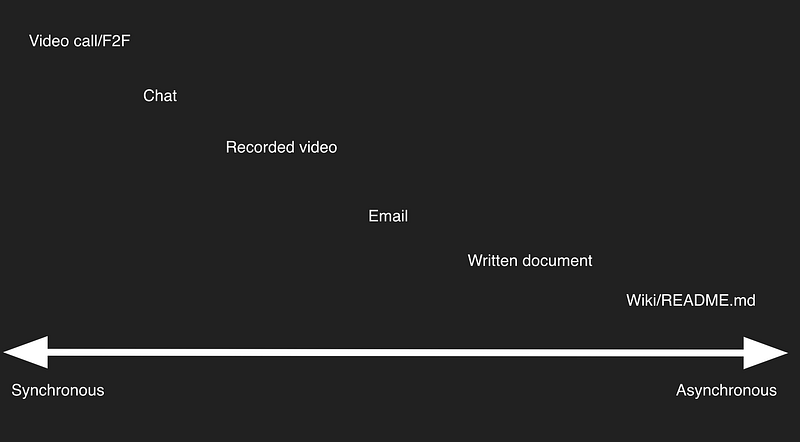
The continuum of communication by author James Stanier

As you can see from the diagram, it’s rarely the case that something is purely synchronous or asynchronous. Often, it’s somewhere in between.

  • Video calls or face-to-face chats are completely synchronous. Everybody involved needs to be somewhere at a specific time since the communication typically happens via voice and body language in the moment.
  • Chat is written and is, therefore, less synchronous than a video call since it can be read later. However, chat has a short half-life because it implicitly carries a temporal dependency. Are you catching up on a chat from a few hours ago? Sure, that makes sense. But are you reading through a chat from two months ago? Now it’s mostly irrelevant and noisy.
  • Recorded video can be viewed later and requires more preparation than a chat; however, its relevance decays fairly quickly (it’s also not searchable). A recording of a meeting from a few weeks ago, or a video updating everyone on the progress of an initiative probably won’t be watched more than once.
  • Email is where we start producing more permanent asynchronous artifacts. Email by nature is archival and searchable. We often use email for important information, like to deliver confirmation of a raise or to confirm that a payment has been set up. Some people reply to emails quickly, but some take many days to reply — and that’s okay.
  • A written document requires some effort to produce and may be used as the cornerstone of a project or proposal. Theoretically, a well-written document can last almost indefinitely, assuming the reader knows the date and context for which it was created. Most online document software also allows collaborative editing and commenting.
  • Wikis and READMEs are completely asynchronous, and typically have no interaction between the author and readers. If well-maintained, they can last and be useful indefinitely.

The Old World

Photo by Sophie Louisnard on Unsplash

When we primarily work together in an office, convenience and habit dictate that we spend a lot of time on the left-hand side of the communication spectrum. After all, when all of our colleagues are sitting across the room, it’s easy to have a conversation in the moment.

Synchronous communication is perfectly normal; however, it isn’t suitable for remote working. Even in the office, the left-hand side of the communication spectrum severely limits collaboration for companies with teams across multiple locations.

If you’ve worked in a large company, you’ve probably already seen the effects of synchronous communication as the default:

  • Individuals sit with their teams physically in the same office.
  • Teams that collaborate frequently work from the same physical location.
  • The weakest bonds between parts of the organization occur across a geographical divide.

This arrangement can have a tangible and inconvenient effect on the software your company creates. Conway’s Law states that any organization that designs a system will produce a design whose structure mirrors the organization’s communication structure. When companies expand into different locations, opening another office to hire engineers might be an implicit design choice in how they architect their software — they just don’t know it yet.

Shifting Right

Photo by Sophie Louisnard on Unsplash

To fully embrace remote working, we need to shift our mindset and habits to the right of the spectrum.

Instead of choosing the convenient option, we need to choose to communicate in a way that enables an equal level of contribution from anyone, regardless of where they are located in the world.

Shift right.

That’s the habit that you need to instill in both yourself and your colleagues. Every time you communicate. Can you purposefully shift right so that you better serve the needs of remote work? For example, could you:

  • Turn a face-to-face conversation into an exchange in the team’s chat channel instead? Via chat, more people have the opportunity to listen in on what is being said and contribute to the conversation.
  • Record a video call so that those who are unable to make it (or those who didn’t know it was happening) are able to watch it later.
  • Decide to stop a long chat exchange so you can write it up more thoughtfully and purposefully in an email?
  • Take an email thread that is proposing an idea and turn it into a more detailed written document so others can read it more easily in its entirety and then circulate it for comment and consensus?
  • Change an agreed-upon idea in a written document and turn it into a more permanent wiki page that serves as the cornerstone of a whole project?

Every single interaction is an opportunity to shift right, and by doing so you are having a much more dramatic impact than you may realize. You are making your workplace more suitable for remote work. You are giving more people the opportunity to discover what is going on and then have a route to contribute to the conversation. You are breaking down geographical silos and fighting the tide against Conway’s Law.

Takeaways

So, all more effective communication takes is a shift right. Here’s your homework to assess your own communication habits:

  • Looking at the continuum diagram, work out what percentage of time you spend on each form of communication during a given week. Do you use specific methods for certain people or teams? Why?
  • What types of communication do you prefer? Has this preference changed over time?
  • Do you find any of these methods frustrating? Why is that? Is it the medium itself, or is it how that medium is being used?
  • Next week, apply the shift right mindset as much as you can. How does it affect your choice of communication medium and the responses you receive?

That’s all for now. We’ll build on this model next time by seeing how it correlates with the permanence of artifacts we create.

If you enjoyed this article, be sure to pick up James Stanier’s books from The Pragmatic Bookshelf:

Further Reading

Also by James Stanier:

Become An Effective Software Engineering Manager on Medium:

Originally published at https://www.theengineeringmanager.com on February 4, 2021.

Jsrw
People
Articles
Remote Work
Productivity
Recommended from ReadMedium