
The Paradox Of Harming By Helping Loved Ones With OCD
“Honey — please check again 3 more times that the oven is off.”

Imagine witnessing a loved one drowning in a lake.
Your gut would twist. Your heart would race. You might go suddenly speechless. You might jump in, desperately hoping you could save their life — even if you are hurt in the process, too.
The same horrifically helpless feelings are similar to the first-hand reports I have heard from spouses of psychotherapy clients in treatment for OCD. Spouses can see the nightmare playing on repeat, but feel they can do little to change the situation.
Helping with rituals
“Honey — please check again 3 more times that the oven is off. I’m about to have a panic attack — please, I need reassurance that it is off.”
Relatives — especially romantic partners — are commonly recruited to help complete OCD rituals. What does that look like? A man with obsessions about checking a doorknob may ask his wife to check it again for him. This is called “family accommodation.” The great irony of family accommodation is that it may feel like it’s helpful.
However, research shows us individuals battling OCD experience marital distress. This is the result of the client’s struggles spilling over into the relationship. When anxiety shoots up during an OCD flare-up, spouses are often the closest people to the situation.
The cycle of OCD acts like a flywheel — it’s kept spinning by rituals that reduce anxiety. Partners of those with OCD may feel a sense of proxy relief as their partner feels relief from intrusive thoughts. The problem is that relief from the distress the thoughts cause is always temporary.
“I pray 14 times a day. It helps me reduce my anxiety when I check that I’m following religious teachings — knowing I’m a good believer. But the worries always come back eventually.”
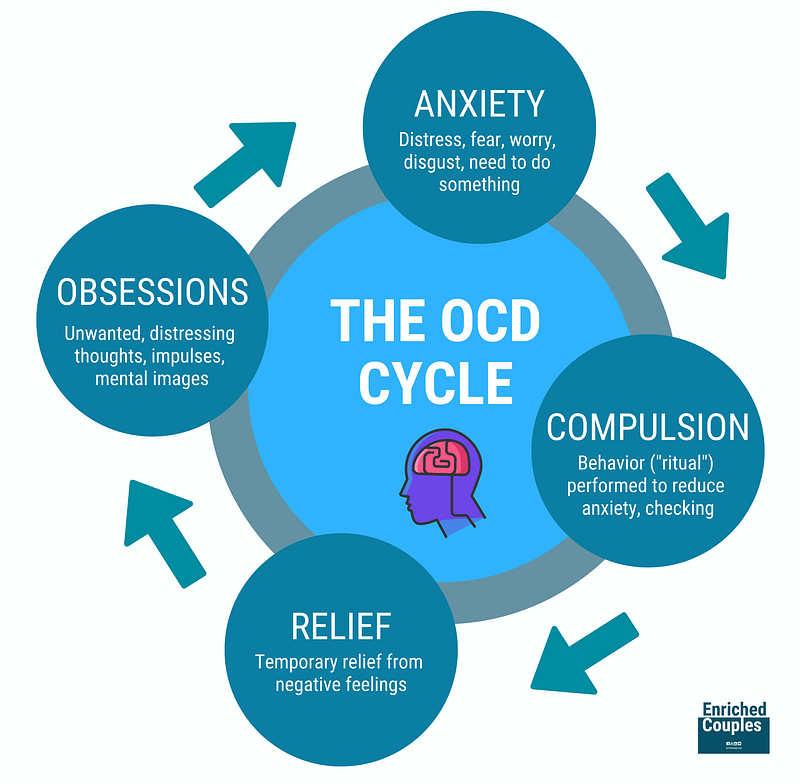
The velocity of the flywheel influences how often romantic partners are involved in rituals. As OCD symptom frequency increases, well-intentioned partners may become emotionally burdened as well.
Obsessive-Compulsive Disorder (OCD) is frequently misunderstood. I recently wrote about common misconceptions about OCD because of that. In reality, it’s not funny at all — it’s a highly distressing disorder that can cause significant impairment in many domains of life.
This includes work, home, school, and relationships. It has two core symptoms, defined by NIMH as (1) Obsessions — repeated thoughts, urges, or mental images that cause anxiety; (2) Compulsions — repetitive behaviors that a person with OCD feels the urge to do in response to an obsessive thought.
Recent research shows partners to those with OCD experience distress due to the demands of the disorder in everyday life. The phrase “walking on eggshells” comes to mind. No supportive partner would want to trigger an episode of OCD unplugged. Paradoxically, this may hinder every day (“in vivo,” meaning real-world conditions) exposure folks with OCD need.
A natural consequence of this cycle of habits is that partners voice their frustration. This can unfold in a number of ways — arguments, feeling misunderstood, concern. It can also increase trust and intimacy through vulnerability and self-disclosure if managed constructively.
I write often about partnership and teamwork in relationships. Feeling misunderstood by our partners a painful experience for anyone. That feeling can come up for any reason — OCD, money, in-laws, wedding planning, or redecorating.
Over time, this sometimes leads to the partner with OCD hiding their rituals. That’s understandable. The function of rituals is to alleviate anxiety, to feel better. Desperation for emotional respite can motivate secrecy, even in the most secure of relationships.
Unfortunately, there are two more problems hiding rituals can create for the partner with OCD. First, it drives clandestine behaviors. That may cause guilt, shame, and extra anxiety or depressive symptoms. These could be as stressful as the intrusive, unwanted thoughts that themselves drive OCD. Second, it may erode trust between partners.
For the partner without OCD, it may seem symptoms are clearing up as their partner asks for less and less help with rituals. This can lead to false hope, only to lead to feeling hurt when they discover their partner has been hiding things from them.
This leads to a complex, double-sided cycle that feels impossible to escape.
Partner-assisted exposure therapy
As a couples therapist, it was meaningful and rewarding to work with married clients to break that cycle.
OCD is fascinating and complex on its own. The added social and psychological complexities of a relationship system around it create challenges in each relationship uniquely. Shame is frequently a factor, however. Shame is so powerful it can cripple an individual’s faith that they deserve love. That’s true even when their partner or other family members say otherwise.
Partner-assisted exposure therapy is particularly interesting for that reason. Couples are working together to confront what’s often existentially frightening. It requires trust that both are acting in good faith. And, it necessitates vulnerability. Partner-assisted exposure therapy is the opposite of ritual-hiding. It draws obsessive thoughts out into the light of day for examination and acceptance.
For a first-hand point of view on what it’s like to have OCD, fellow Medium writers like Madeline Dyer describe their personal journeys. I appreciate her granular descriptions of Exposure and Ritual (EXRP/ERP) Prevention treatment.
Treatment options for OCD are improving by leaps and bounds, often in unexpected ways. I spent my first summer treating OCD sticking my hand in toilets alongside clients. But, in 5 years students like me may help clients using Virtual Reality Graded Exposure Therapy (VRGET) or similar technologies.
“VRGET is more effective than conventional imaginal exposure therapy and has comparable efficacy to in vivo exposure therapy for the treatment of specific phobias, agoraphobia, panic disorder, and PTSD,” says James Lake, MD, of Psychology Today. “Like in vivo and imaginal exposure therapy, VRGET desensitizes the patient to a situation or object that would normally cause anxiety or panic.”
- Virtual Reality Graded Exposure Therapy (VRGET) is Changing PTSD
By 2025, psychotherapy may leap ahead in the adoption of virtual reality and other innovative tools. That is my hope. Technology can make the difference between partner-assisted exposure therapy access nationwide and allowing families to stay stuck in the cyclone of OCD.
Annette Miller is the Cofounder and CEO of Enriched Couples, a financial therapy platform that uses psychology to guide couples through unifying their values, financial priorities, and future goals.
Recommended
- OCD Symptom Checklist. Listed on the Anxiety and Depression Association of America (ADAA), this screener can help support discussion with your mental health provider. This page by Mental Health America (MHA) also has screeners (similar to quizzes) for depression, anxiety, eating disorders, and others.
- Treatment. Research shows Cognitive-Behavioral Therapy (CBT) and Exposure and Ritual Prevention Therapy (EX/RP) have high effectiveness in treating OCD. The American Psychological Association (APA) has a listing of Licensed Psychologists. Another popular resource for finding licensed psychotherapists of all types if Psychology Today.
- Family support. For families of individuals suffering from OCD, a top resource is IOCDF.org — the International OCD Foundation. They put on a conference each year and, unlike most academic conferences, families are invited to attend this mixed-audience (researchers, therapists, persons with OCD) event.
- Books. Search under Categories for OCD on the Association for Behavioral and Cognitive Therapies (ABCT). This organization is the association for most clinical psychologists. Additional self-help resources are listed by the Association for Contextual and Behavioral Science (ACBS).