
OCD Is Not What You Think It Is
Obsessive-Compulsive Disorder, explained by a mental health professional trained in its treatment.

Clinical definition
As a mental health professional with specialized training in evidence-based treatment of Obsessive-Compulsive Disorder (OCD), I’ve learned the public largely misunderstands what OCD is — and is not.
For example, OCD is not perfectionism. It is not generalized anxiety. It is not Autism Spectrum Disorder.
OCD is a highly distressing disorder that can cause significant impairment in multiple domains of life, including work, home, school — and relationships. As with any clinical psychological disorder, distress is a critical factor in diagnosis. In other words, obsessions and compulsions typically cause great distress and interruption in daily living.
Two core symptoms distinguish OCD:
- Obsessions — repeated thoughts, urges, or mental images that cause anxiety (as defined by NIMH)
- Compulsions — repetitive behaviors that a person with OCD feels the urge to do in response to an obsessive thought (as defined by NIMH)
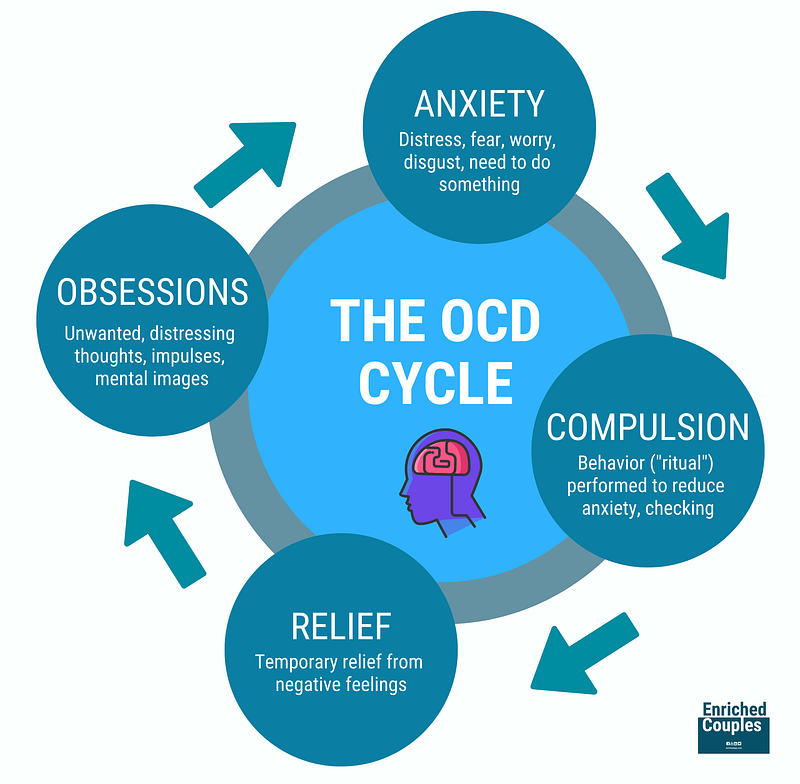
Obsessions and compulsions are generally understood to behave cyclically. However, debate is ongoing among researchers about the requisite presence of compulsions (some rituals are performed mentally — such as saying a prayer — rather than as a physical behavior — attending spiritual service, for example). Because of this, OCD can be diagnosed as obsession-only.
What OCD looks like — in understandable examples
What does OCD look like in real life? To move away from scientific and clinical jargon, the examples below contrast common things people say which more likely reflect personality traits — neuroticism, contentiousness, and others— rather than clinical OCD.
In a formal psychological assessment, psychotherapists would investigate these narratives to understand how the client experiences symptoms in daily living.
Not so much this
- “It’s a running joke in our family that we check our home security camera batteries all the time. Since my husband and I adopted a baby, he and I are a little more careful than before we were dads.”
- “I’m totally OCD about being on time for meetings. People respect punctuality, so I make it a priority.”
- “He’s so OCD about folding the laundry a certain way so it fits in the closet neatly and the towels don’t wrinkle.”
- “I always get the flu shot. Experts recommend it — everybody really should get one.”
- “My partner checks their retirement account balance every day; I think it’s silly, but I think they do it as a sort of fantasizing about retirement.”
- “Occasionally I think I’m not a good believer because I don’t go to church very often.”
It’s more like this
- “I need to check that the stove is off 46 times before leaving the house or I can’t stop thinking about the house burning down. I have these really intense fears about something catastrophic happening and hurting my family due to carelessness.”
- “She always leaves for appointments 2 hours early and worries for days ahead of time that she will be late due to this or that. There’s also a ritual where she checks the car for problems before she leaves the driveway.”
- “He needs constant reassurance that I’ve used the right detergents and bleach and in the right amounts. He’ll ask me to rewash the bed sheets if he has a ‘feeling’ he can’t quite explain about them being dirty.”
- “My wife constantly washes her hands to the point that they get cracked and bleed, but it’s the only way she can calm down her fears.”
- “My partner will have meltdowns worrying that we will lose all our savings. They will beg me to reassure them that we have a stable financial future and our investments are fine. It really upsets me to see my partner like that.”
- “I pray 14 times a day. It helps me reduce my anxiety when I check that I’m following religious teachings — knowing I’m a good believer. But the worries always come back eventually.”
Types of OCD
OCD has sub-types, clustered around obsession themes.
I pray 14 times a day. It helps me reduce my anxiety when I check that I’m following religious teachings — knowing I’m a good believer
The most known in pop psychology focuses on health — hand-washing and germ obsessions, for example. Some individuals have recurring obsessions about blood, viral diseases, and cancer. However, this is not the only type.
Some subtypes bear extreme shame — and are still poorly understood by many psychotherapists, unfortunately. These sub-types include concerns about:
- Religion — one’s spiritual activities or beliefs, sometimes including scrupulosity or excessive worrying that an individual is constantly sinning when they probably haven’t
- Pedophilia — the possibility of being a pedophile, often experienced by parents worrying they could spontaneously, inappropriately touch their own child
- Violence — self-harm or harming others, sometimes with worries about spontaneously picking up a knife and stabbing a loved one for no reason
- Sexual orientation — the possibility of being queer, typically in spite of no same-sex attraction or commensurate history of sexual behavior
Author’s note. The authors of Amalgam affirm all sexual identities are valid and equal. We feel this is of critical importance to assert as Sexual Orientation OCD is sometimes misunderstood as a criticism of lesbian, gay, or bisexual identity — this is not the case. Clinical measures to evaluate SO-OCD are extremely new. In SO-OCD, an individual may fear they are secretly gay and don’t know it. This is driven frequently by fear of rejection by their spiritual community or deity (Religious OCD). For additional information or research regarding this topic, please contact the author of this article, Annette Miller.
Common misconception #1 — it may be personality
The misconception I encounter most frequently is the conflation of neuroticism — a personality trait — with clinical presentation of OCD.
Someone high in neuroticism would often be described as high-strung, “type A,” (that’s not a thing, scientifically speaking), or anal-retentive. Neuroticism is a measure of emotional stability or reactivity and negative emotions, particularly in response to frustration or loss. Mood swings, irritability, inability to relax, and constant worrying are common behaviors of someone high in neuroticism.
Neuroticism is not the same as distressing, unwanted, obsessive thoughts.
Also measured in the Big 5/OCEAN model which can be misunderstood to be OCD is contentiousness — another personality trait. Someone high in contentiousness may have exceptional attention to detail, love to plan ahead, set goals, and follow social norms or rules.
Contentious behavior is not the same as compulsive behaviors and rituals.
Another personality consideration is Obsessive-Compulsive Disorder Personality (OCDP) — a separate disorder from OCD altogether.
Common misconception #2 — it may be anxiety
Unsurprisingly, anxiety has been linked for over four decades to neuroticism. Personality influences mood disorders — and anxiety disorders are a family unto themselves. Perhaps for this reason, neuroticism has a known impact on relationship health and satisfaction and public health.
Generalized Anxiety Disorder (GAD) is a mood disorder that does have a strong relationship to OCD. In fact, OCD has been grouped with anxiety disorders in the Diagnostic and Statistic Manual (DSM) — the official guide book used in the U.S. for diagnosing mental health disorders.
Annette Miller is the Cofounder and CEO of Enriched Couples, a financial therapy platform that uses psychology to guide couples through unifying their values, financial priorities, and future goals.
Recommended
This post contains OCD-specific resources — symptom checklist, info on support communities, how to find treatment, and more.


