
The Horrific Prophecies of ‘You’ve Got Mail’
Forget the cheesy romcom aspects, those have been critiqued to death: ‘You’ve Got Mail’ was an unwitting oracle of New York City’s demise, Internet culture, and technology as a whole
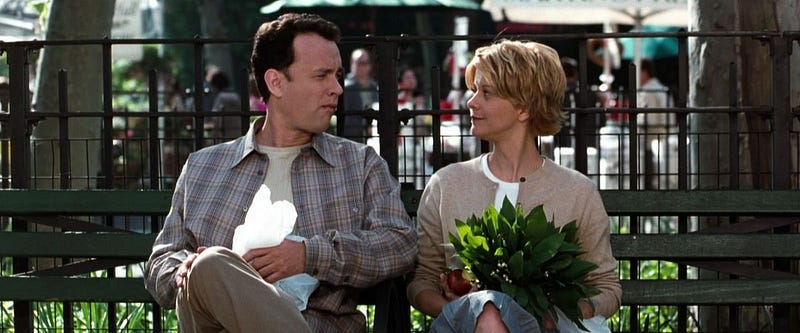
The Internet tasked me with ranting about You’ve Got Mail after I snarked on Sleepless in Seattle.
Okay fine, just a couple shitposters on Twitter did.
What can I say, I love writing for Fanfare because I can pick whatever media I want and write it off my taxes because I generate royalties from the whole shebang. Lockdown isn’t over yet and I apparently love torturing myself, so I pulled up You’ve Got Mail after numerous Twitter mutuals said I should watch it.
I was honestly curious after hearing the buzz. After all, I’m writing a period piece taking place between 1999–2001. I figured it couldn’t hurt to dive into an artifact of the late 90s to get in the proper headspace for a story that indeed centers an unlikely friendship forged in the fires of The Spark (which is getting a copyright-friendly name change in Lift Me Up) and AOL Instant Messenger.
While Sleepless in Seattle subverted my expectations, I figured that the very name You’ve Got Mail was a reference to AOL (America Online for you whippersnappers born long after my time) given that I’m an elder Millennial who recalls that very sound bite emanating from our PowerPC’s speakers during my tween years before my dad switched the family account to ClarisWorks, so I wasn’t a habitual AIM user until college and it felt SO gleefully rebellious.
Now I’m going to subvert YOUR expectations: this is not a critique of the predictably schmaltzy love story within You’ve Got Mail.
Sure, I’ll touch upon some of the story and production aspects a little, but that’s not my focal point here. I mean, it’s got Tom Hanks and Meg Ryan, was made in the 1990s, and was written and directed by Nora Ephron. So you know it’s going to be sappy and utterly unrealistic, a fantastical slice of the late 90s that most of us didn’t experience and is laced with incredibly questionable behaviors in the name of romance.
Rather, I’m going to use it as a springboard to examine how this movie strangely predicted downfalls from both tech and gentrification!
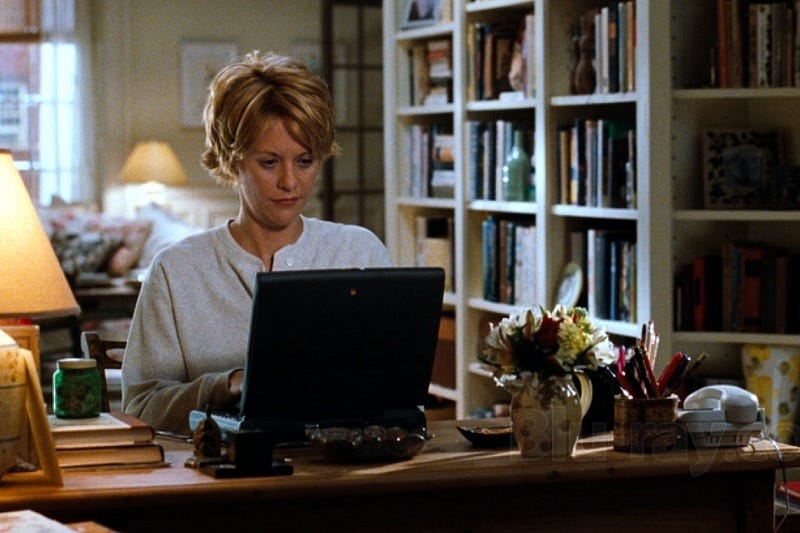
Because holy toad tits on toast, people: this movie had some scarily accurate predictions and observations on Internet culture that just made me gasp out loud as I watched.
Obviously, your perspective on a movie from a bygone era is going to be dramatically different when you watched it in that time compared to seeing it in the current age. This is doubly so if you have living memory of that particular era. So I have that perspective as someone who remembers both New York and Internet culture in the mid-late 1990s, but didn’t actually see this movie when it was still recent.
Despite some adherence to romcom cliches in addition to subverting them — ie, Kathleen and Joe meet in person WAY sooner than you’d think for a setup like this— it’s really the setting and anachronisms of this story that have me so hellbent on disseminating it.
The Degree of Anonymity Afforded to Being Online
What demarcates elder Millennials from the younger end of the generation, and pretty much every other generation come to think of it, is that we’re the last group to remember the Internet being an escape.
I suppose for some it still is today. But bear in mind, if you grew up in the time and place I did where it was considered weird to spend a lot of time on a computer and people looked at like you like you had three heads for meeting someone from the Internet? It can be a little jarring knowing you can just access the Internet in your pocket and you’re now expected to communicate this way instead of the slower methods that helped foster stronger intimacy in that time.
Going online was a process, Internet communication wasn’t instantaneous unless you were signed into AIM, ICQ, or a chatroom. Web communication was as slow and involved as the phone. There was a notable distinction between being online and offline. And now people look at you like you got three heads if you don’t want to subject yourself to endless, futile swiping in hopes of finding a mate.
What’s so interesting about “Shopgirl” talking to “NY152” is the amazing degree of anonymity they have with each other at first. They’re aware they’re both over 30 and in the same city, as they met in a dedicated AOL chatroom for the 30+ crowd. But they otherwise do not know each others’ names, what they look like, what the other does for a living, or pretty much any key identifiers, yet they have these frequent private exchanges through email and AIM chat!
It’s even directly lampshaded very early on, when we see Joe’s email to Kathleen that establishes they’ve been chatting for some time and he offers to send her pencils if he knew her name and address, but “not knowing has its charms”. We know that “Shopgirl” is a lampshade of Kathleen’s occupation and 152 refers to Joe’s building on 152 Riverside Drive, a minute detail you could easily miss but is expounded upon near the climax in a cheesy, over the top date scene.
Kathleen and Joe have so many near-misses in the very neighborhood they both live in, along the slowly-corporatizing environs of West 72nd Street. We expressed shock and horror at that Starbucks in 1998 and the homogenization it would bring both the city and culture in general, but if you look at it today? Well, there’s a whole other section on that coming soon.
After all, this movie was a then-modernization of the first iteration of the story, the 1937 Hungarian play Parfumerie by Miklós László, which was then adapted into The Shop On the Corner in the 1940s and Kathleen’s bookstore’s name is a tongue-in-cheek reference to the two business rivals who fall in love. The sheer anonymity of late 90s Internet provided an even more plausible way for two business rivals to develop intimacy and a febrile degree of limerence that went two ways, with no idea they were interacting in person all along.
Today, you probably wouldn’t have two people be this anonymous for this long. If you’ve been interacting in person, you’d likely find some clue or another that would lead you to an online presence unless they went out of their way to be totally inaccessible. Even if you met off a forum, Reddit, or some other means that didn’t instantly give away your identity, you’d probably be exchanging Twitter, Facebook, or Instagram handles once the conversation took off. Even email would have your real name attached, in most cases.
It’s interesting that Kathleen asks her employee, Christina, if it constitutes infidelity to be talking to another man via email. Today, people who are in committed relationships but foster intimate friendships through social media that could cross into romantic or sexual attraction, or still have active dating app profiles, could partake in “emotional cheating” but generally, the line isn’t crossed until your intent changes. Christina asks if they’ve had sex, meaning cyber sex, and says not to do it or else he’ll lose respect for her. This part admittedly made me chuckle, remembering when “wanna cyber” was frequently bandied about on Chathouse if you didn’t have AOL.
The limerence that forms between Kathleen and Joe is equally fascinating. Limerence in online romances, whether it goes in one or both directions, is more common today and it can make you fall for people you may not have under more normal circumstances. Sleepless in Seattle actually shows a deeper and more sinister form of one-way limerence where Annie is so infatuated with the IDEA of Sam and his undying loyalty to his dead wife, at least it makes more sense between Joe and Kathleen who do talk to each other through AOL frequently and form an actual bond.
You can still find anonymity on the Internet. But 1998-degree anonymity is just never coming back.
Joe Fox’s obsession with his AOL penpal’s physical beauty
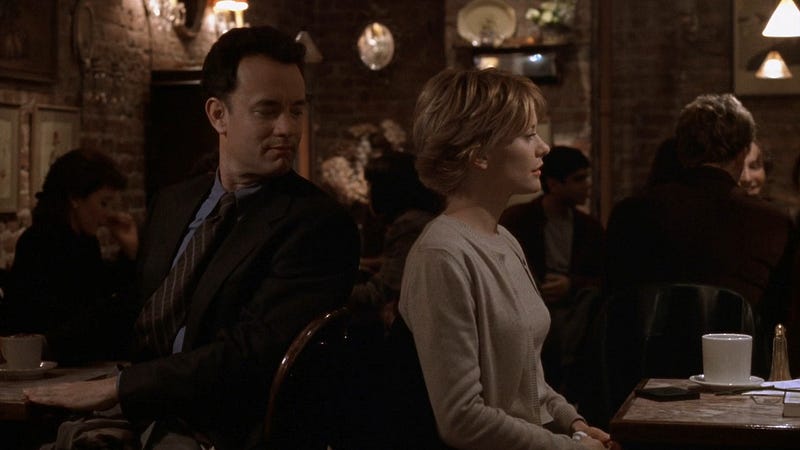
So there’s context in mind with this particular scene, even though it stood out to me. Meeting people off the Internet was still pretty rare in 1998, plus the extreme anonymity and technological reality at the time meant Joe would drive himself apoplectic wondering what Kathleen looked like and vice versa.
Scanners and digital cameras weren’t very commonplace in homes unless you were particularly tech-savvy, or worked in photography or a related field at this point in time. By the time I came of age about five years later, digital cameras were more readily available and it was easier to take early selfies and plaster them on MySpace and Livejournal. It took far more legwork to upload pictures in 1998, so it’s equally maddening and enticing that Joe has no idea what Kathleen looks like. (Well, he does, he just doesn’t know Shopgirl is her.)
When Joe is accompanied by his sidekick Kevin to meet Kathleen for coffee, the latter warns him she “might be a real dog”. Even though people can share pictures of themselves instantly today, this is still the main concern of a lot of men who date women, whereas for most women, our biggest fear in meeting men off the Internet is that they could kill or rape us. Decades later, it’s still considered the most offensive waste of HIS time if we’re not as thin and/or pretty as we seemed in our photos.
This entire scene is just depressing as fuck. It’s all about how PRETTY she is once Kevin looks inside for a woman carrying the book with a flower pressed in the middle, and Joe nervously awaits his verdict. What makes it worse is that he declares he loves their AIM conversations so much that he’d be a fool not to at least go for coffee even if she’s “uglier than a mailbox” (this line doesn’t even make sense?! Public services are beautiful!) then he jumps for joy at Kevin’s news that the woman waiting at Cafe Lalo is incredibly attractive, business rivalry be damned.
I suppose that the more some things change, the more they stay the same.
Questioning if technology has done more harm than good
Maybe it was just my optimism as a youngling dying to get away from a shitty dysfunctional home life, and finding respite in both the plethora of alt cultures downtown and in computing at a time when those two things were NOT common to coexist together: but I remember how the 90s and early 2000s really seemed like this hopeful era, that all this tech we grew up with was now evolving at ever-quickening paces and would usher in a new freaking millennium that would practically lead to luxury space communism. We’d have the stability and prosperity of the 1990s, but with even more convenience, innovation, and individual and shared wealth.
Suckered in by colorful iMacs, newfangled CD burners that would eclipse mixtapes, and web-based email made it look like my generation was going to graduate to this dreamworld where we could accomplish anything. (LOLSOB go the elder Millennials after dot-com crash, 9/11, Great Recession, and COVID-19).
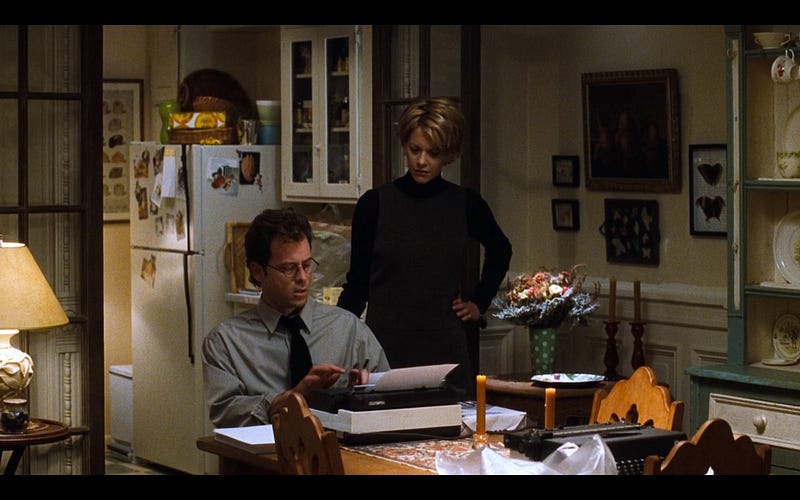
Kathleen’s likeable boyfriend, Frank, a reporter shown to express fondness for working with a typewriter, opens the movie by saying that the Virginia government workers who had to have solitaire deleted from their computers because they hadn’t done any work in six weeks was the harbinger of “the end of Western civilization”. He inquires, “Name me one thing that we gained from technology!” before warning Kathleen that she thinks her Macbook is her friend but it’s not.
So when I saw this right at the beginning of this movie, I knew I was in for an archaeological dig of sorts.
Because yes. The technological gains we reaped came at a massive price. Frank’s not wrong to question this, and his foreboding statement against a laptop computer coupled with the blatant reference to AOL in the title basically tell the audience he doesn’t want to move onto this tech-driven age. Kathleen literally has to wait until Frank is out of the building and down the block before she feels safe starting up the machine and logging into AOL!
I also almost died laughing when Christina asks her co-worker George, “Are you online?” because it just had a completely different context in 1998 yet still remains the same today. Except now we’d use “very online” to describe someone who knows of all the Twitter discourse, YouTube feuds, and latest memes. George simply responds, “As far as I’m concerned, the Internet is just another way of being rejected by women.” I sat there stunned, thinking about how it definitely took a certain kind of person to go online at this point in history, let alone use the Internet to meet potential dates…and how a lot of men online still can’t take this kind of rejection and often send us unwanted gifts of the Jeffrey Toobin variety just to get a reaction.
Women rejecting men over the Internet can still lead to violence, just like it does in real life. But it’s interesting that dating sites wouldn’t be on the radar for another couple years, then not be mainstream until about 10 years later, yet this is George’s gut reaction.
The steadfast small business owner against the “mallification” of New York
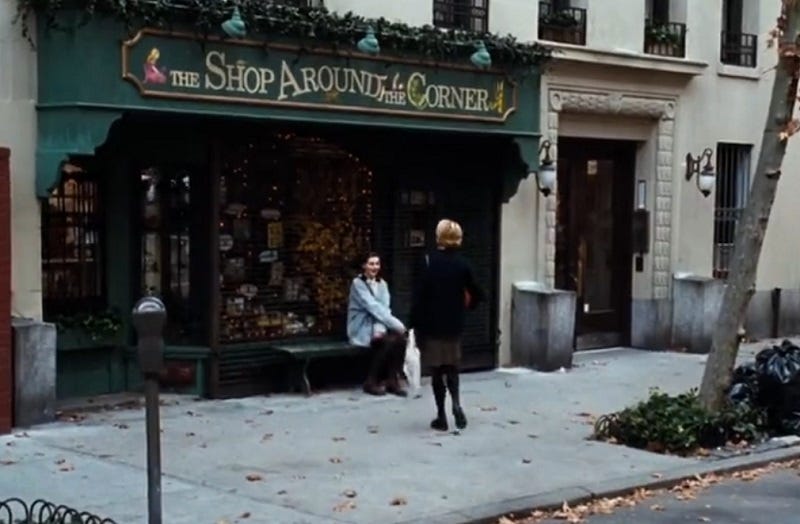
As a New Yorker of a certain age, I have much to grieve. Although no matter where you’re from, you grieve people, places, concepts, and opportunities (missed, stolen, or never offered) and it makes you want to start over elsewhere. But having decades, or even centuries, of context for a place gives you this indescribable, all-consuming sense of grief that could only come from having so much history in such a storied city.
My personal aspects are all in that essay I linked, but I’m going to focus on the corporatized gentrification of the Upper West Side here. “Hyper gentrification”, as Jeremiah Moss of Vanishing New York puts it.
It’s both shown and told to the audience that Kathleen has a great deal of history on the Upper West Side, and that the shop initially belonged to her mother, who was a fixture of the neighborhood. Not many “world cities” have that incredible duality New York has where the sheer size can lend you anonymity you wouldn’t get in a smaller city or non-urban area, but neighborhoods can feel like small towns in and of themselves.
Much like the now-unrecognizable Lower East Side, the Upper West Side had pretty high crime rates and a tough reputation to go with it. This was even exemplified as late as the early 1990s in movies like Home Alone 2: the scenes on the Upper West Side are a stark contrast to the shiny, tourist-dense regions Kevin visits earlier. Unlike that other uptown neighborhood on the opposite side of Central Park, the UWS wasn’t a place you wanted to go until gentrification slowly steamrolled it in the 80s. But the reputation persisted well into the 90s.
Almost everyone I know around my age could only describe the Upper West Side of the 1990s and 2000s as nice. It was a simple descriptor that spoke multitudes because it wasn’t especially wealthy, poor, or even middle class. It just existed in this oddly classless plane that made it a desirable place to live if you still wanted the chaos and density of the city, but not as wild of an experience as you’d get below 23rd Street. A great place to raise a family, be an intrepid young couple or settled old couple, friends splitting a brownstone together, or be single and open to whatever went down at Dive Bar or just chilling in the park. Where housing projects were a stone’s throw from mansion-like co-ops with multiple doormen who protected the privacy of famous actors, artists, and restaurateurs. A $5 dress could be found on the same rack as a $500 designer one at one of many specialty boutiques.
The portrayals of the Upper West Side in Seinfeld, Sex and the City, and You’ve Got Mail only made it into an even more appealing neighborhood for would-be New Yorkers with its wide streets peppered with greenery and park benches, majestic brownstones, and charming mom and pop shops and restaurants that boasted plenty of space on one block then were packed like sardines on the next. It didn’t reek of old money like its Upper East Side counterpart but there was this feeling of prosperity netted with realness. The glittering Hudson abutting Riverside Park that gave the area a more peaceful vibe than the artistic petri dish, crime, and crowding of its downtown counterpart? That didn’t go unnoticed so it wasn’t long before gentrification was full speed ahead and developers looked to kick rent-stabilized tenants out and bulldoze small businesses, sanitizing another character-rich neighborhood into prime real estate to be picked clean by private equity vultures.
It’s very much exemplified when Christina laments that she’ll have to move to Brooklyn if the store goes under and she loses her job because she can’t afford to live in the neighborhood anymore. This seems darkly hilarious in hindsight, given that Brooklyn is now on a trajectory to become more expensive than many parts of Manhattan — especially pandemic-era Upper West Side.
George crows about his cheap six-room apartment that he likely inherited from his parents under NYC rent control laws: another endangered species thanks to the rapacious real estate developers who thrived like black mold under Guiliani and Bloomberg, then remained unchecked under de Blasio.
So sure, the Upper West Side was gentrified and had been headed that way since the 1980s. But well into the 2010s, you could walk up Columbus Avenue and have this distinct feeling you were in a neighborhood. Even 30 years after that first wave of gentrification, something about the Upper West Side still felt so much like the real New York I recalled from my childhood. As in, this wasn’t an area where tourists ventured much. You’re pretty much only here if you live or work somewhere within the city’s bounds, one of the last vestiges of the real core Manhattan. Most of the nightlife is downtown, if you don’t live in the city then you’re only up here if you got a friend or date waiting at one of the neighborhood bars. The Upper West Side eventually suffered blight, but I recall when those streets were filled with small shops and restaurants. There were chains too, but not to the degree you see now.
‘You’ve Got Mail’ totally prophesied what would come: that the city would feel like a strip mall, and the Upper West Side was absolutely no exception.
Looking at the familiar intersections in this movie, the various iterations of 72nd Street that I knew, Kathleen’s declaration at the protest seems so innocent compared to how conglomerates would eventually bulldoze most of this city.
It’s truly frightening how I can think of more chains around that subway station and further up Broadway than I can think of small businesses that still exist there. It’s apropos to Joe and his father and grandfather celebrating another independent bookstore closing so their company Fox and Sons, a stand-in for Barnes and Noble, can go clean them out. How ironic that 23 years after this movie came out, all the city’s Barnes and Noble and Borders stores (RIP Brentano’s Books, if you were a 90s kid) were basically decimated by Amazon, then an uprising of independent bookstores throughout Manhattan and Brooklyn plus Lit Bar in The Bronx. (Which was something to celebrate until the pandemic added independent bookstores to its casualties.)
With spreading blight and landlords maniacally raising rents to unaffordable levels as mayor after mayor refused to pass any commercial rent control laws, beloved restaurants became yet another fucking Dunkin Donuts, Starbucks, or Chipotle. Bars and clubs that forged communities, friendships, love and sex lives? Wells Fargo and Chase really needed more branches SO badly, in an era where more people are using cashless payments and you can deposit checks with your phone. Even regional chains I never saw outside of the five boroughs, like Duane Reade which then became Walgreens, and Strawberry that became H&M or Forever 21, soon fell to these real estate mega-conglomerates that were now concentrating wealth into fewer and fewer hands.
To paraphrase that Vanishing New York post, this is the core of why most people thought the Upper West Side was so “nice”:
Many New Yorkers today, across racial and class lines, do wish for old-fashioned gentrification, that slow, sporadic process with both positive and negative effects — making depressed and dangerous neighborhoods safer and more liveable, while displacing a portion of the working-class and poor residents. At its best, gentrification blended neighborhoods, creating a cultural mix. It put fresh fruits and vegetables in the corner grocer’s crates. It gave people jobs and exposed them to different cultures. At its worst, gentrification destroyed networks of communities, tore families apart, and uprooted lives. Still, that was nothing compared to what we have today. — Jeremiah Moss, Vanishing New York
He states that gentrification itself has been gentrified, and the Upper West Side is an excellent example of this.
It went from a simply nice place to live, a fun and diverse neighborhood that had something for every kind of New Yorker, to an intensely expensive place to live where the goal was to get the rent-stabilized working class out. And now even the more upmarket small businesses are being chain-choked into the same corporate morass that shoved the Lower East Side, Chelsea, and most of western Brooklyn down its insatiable gullet.
Seeing the neighborhood protest a Barnes and Noble type store feels so innocent to me now, as we numbly watch one institution after another fold and it becomes a 7–11.
The love interests represent what the city was and what it became.
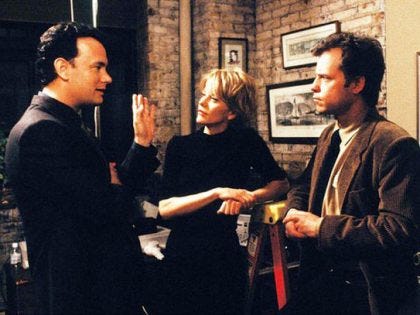
In a sense, Frank represents the New York that was: the creative visionary who has an unabiding love for the working class who made the city’s heart beat and birthed the cultures that made it such a desirable place to be to begin with. But he also clings to the past and cannot move forward.
Joe represents what would come: the cold and corporate face of homogenization and hyper-gentrification that greedily sucks up what was meant for everyone, like the caviar at that party. But while we see his blatant evil now, the allure of modernization was still a temptation at the time.
Joe shows some redeeming qualities as a character: he’s a devoted father, he’s wealthy and a calculating businessman but his soul hasn’t been completely sucked out. He represents the idea that perhaps gentrification and homogenization is something people can find appealing. He’s mallification personified, but actually feels hurt when Kathleen calls him an empty suit.
When Kathleen reveals that she didn’t vote in the last election — the 1996 mayoral election that Guiliani won, which ultimately paved the way for New York City’s destruction into this overly-sanitized Disney World version of its former self — it felt like I was watching what was the last bit of hopeful obliviousness of both the 1990s and what my city was.
It’s probably because I was so young, but those three years between this movie’s release and 9/11 feels like this wide gulf. It was the very last of the city’s authenticity, we all know Guiliani wouldn’t have won that second term if it hadn’t been for 9/11. Kathleen was just so deeply entrenched in her Upper West Side dreamworld where it seemed that nothing could go wrong, that she didn’t feel any compunction to do so much as vote, let alone be more involved in local politics like her local Community Board which can sometimes be a stopgap against corporate bulldozing.
Huge corporate developers won out in the end: but was it that false sense of security or feeling Goliath would crush David that led to the further destruction of our communities at this tenuous point in history?
It even feels lampshaded yet again when Kathleen hits her low point after closing the bookstore and breaking up with Frank, and tells Joe through AIM that “people tell you change is a good thing, but all they’re really saying is that something you didn’t want to happen at all has happened”.
Because that’s exactly what happened with technology and the hypergentrification that killed New York. How much horror did those changes unleash in exchange for the good they brought? I’ll happily take being able to run my own business anywhere in the world, but I miss having a real community in the city my family called home for over 120 years because it got paved over for a shitload of banks and Chipotle. Cities change, yes, but it wasn’t supposed to change like this. Technology changes our lives: but weren’t these devices supposed to free us, not keep us chained to our push notifications?
I felt the waterworks turn on when Kathleen laments that her store is likely to turn into a Baby Gap, and she feels that part of her has died as she laments her dead mother in turn. While she decides to use this transitionary period in her life to write children’s books rather than sell them, we stop seeing Joe’s slimy corporate side and just watch him gaslight her into talking to his online persona without ever revealing it’s him until the very end. It’s the multi-tentacled conglomerate sucking out the remaining character of this city with the false promise of love.
And that, friends, is how this movie was scarily prophetic: the promise of shiny things caused us to pay a blood price. In the wake of the pandemic, NYC is going to either have a massive cultural renaissance unseen in at least a century, or there’s going to be nothing but Target and Chipotle. We should’ve heeded the warning of the worn-down dopamine receptors yearning for the tinny call of “You’ve got mail!”


