
The Deer’s Cry of Archibald Knox
Contemplating the meticulous, meditative, and possibly magical, Art Nouveau calligraphy of Manx designer, Archibald Knox.
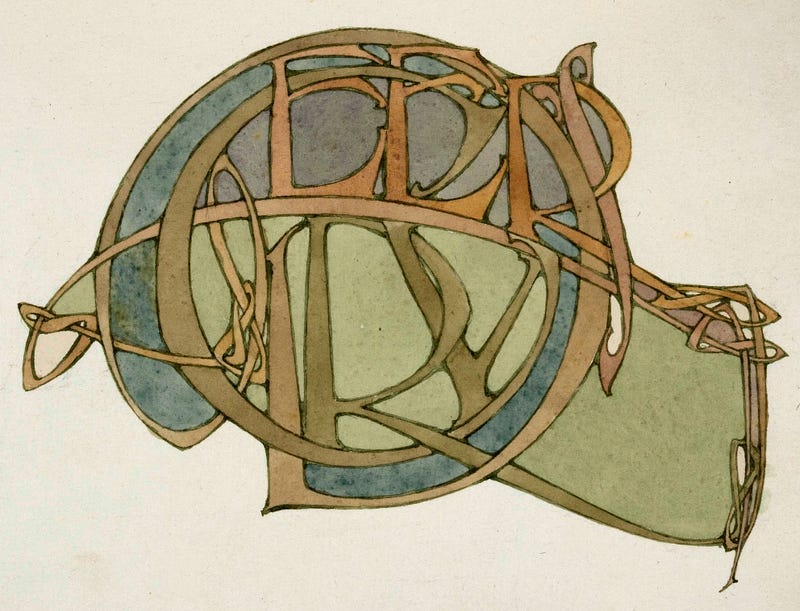
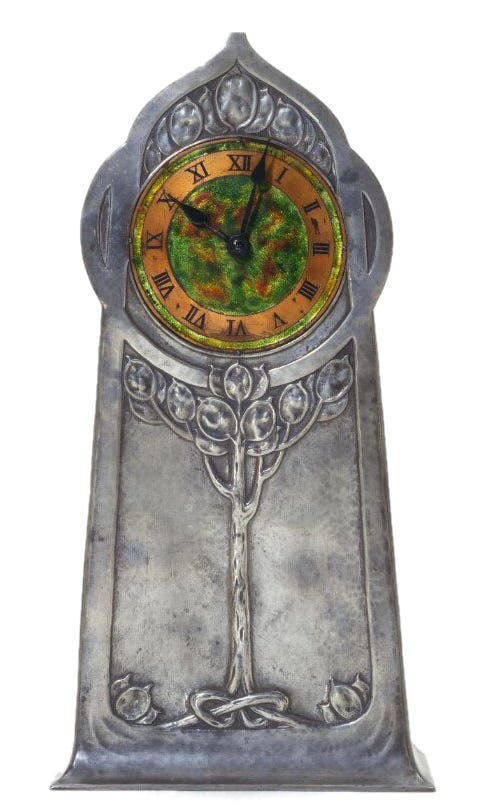
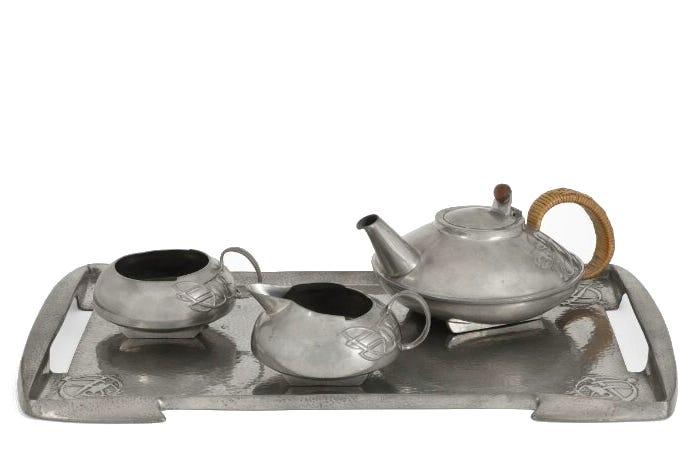
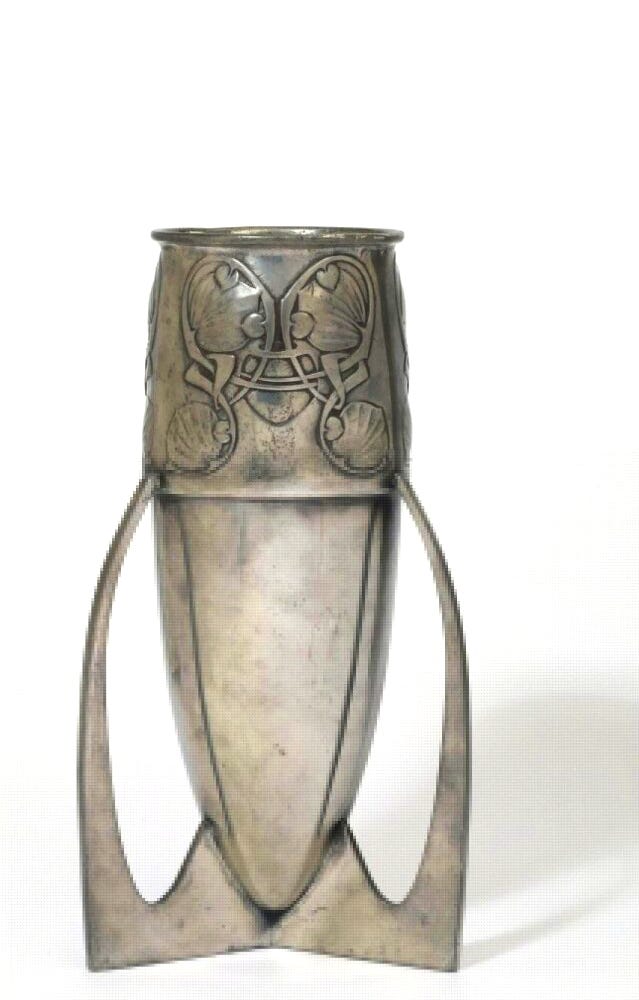
Archibald Knox is best remembered as a silversmith, jeweller, designer of tableware, clocks, broaches, and decorative buckles. Although, it’s a love of calligraphy and hand-rendered typography that connects his entire career. He was a notable influence in the British Arts and Crafts movement of the late nineteenth-century, developing a distinctively British response to Art Nouveau. Interestingly, he had trained with Christopher Dresser, the designer who played a significant role in defining Art Nouveau and who was responsible for creating a few of the first objects to be referred to as such.
Another trait Knox shared with Dresser was a focus on functionality and a tendency to simplify whilst recognising that part of an object’s function may well be decorative. Along with their colleagues associated with the Arts and Crafts movement, they celebrated traditional artisan techniques but also welcomed industrial processes, such as metal casting, stamping, and enamelling to reproduce individual yet similar items that remained more ‘affordable’. Together, they are often credited for modernising Fin de Siècle style into something uniquely British and along with Charles Rennie Mackintosh became the triumvirate most influential in the transition from Nouveau through Deco to Modern.
After teaching art and training as a silversmith in London, becoming one of Liberty’s principal designers, Knox returned to the Isle of Man where he continued to work for the store at the vanguard of London’s design and fashion scene. Being back in his homeland didn’t seem to affect the rate of commissions and by 1904 he’d produced some 400 designs including jewellery, tea services, lamps, and the clocks that are still much sought-after by collectors.
Archibald Knox was a passionate antiquarian interested in the Celtic revival, propelled by the Romantics and Pre-Raphaelites. He was a central figure in what became known as ‘The Manx Renaissance’ for delving deep into the heritage of his native Isle of Man. His fellow antiquarians were keen to revive fading traditions, rediscovering and reinterpreting their local history from a distinctly Manx-centric cultural perspective. Knox used his considerable artistic skills to visualise and reinforce that identity. He celebrated the island’s sublime landscapes in watercolours and many of these were sold to fund the expansion of the Manx Museum, in turn promoting Man as a desirable holiday destination. He also pursued his love of graphic design, illustration, and calligraphy, working for local publishers and designing stationery for Douglas Council.
Norse runestones and Celtic crosses were ubiquitous in the Manx landscape and their entwined knotwork designs were inspirations for Knox since his childhood. Some of his earliest major commissions were for memorial stones and, in 1917, he was selected to design the tombstone and a large Celtic-style stone commemorative cross for Arthur Lasenby Liberty, the founder of Liberty & Co.
During the First World War, Archibald Knox was working at the Knockaloe internment camp which housed thousands of German nationals who found themselves stranded in the UK and labelled as ‘possibly hostile’ aliens. Among his duties was to read and censor correspondences to and from the camp and produce graphics for information leaflets, posters, and the town’s journal, The Knockaloe Knews. The fusion of Celtic knotwork and the lettering of medieval illuminated texts was already evident in the ostentatious curlicues that extended his letters and wove his words together. It’s generally accepted that he had seen and studied the Book of Kells during visits to Dublin where the historic tome is displayed in the Trinity College Library.
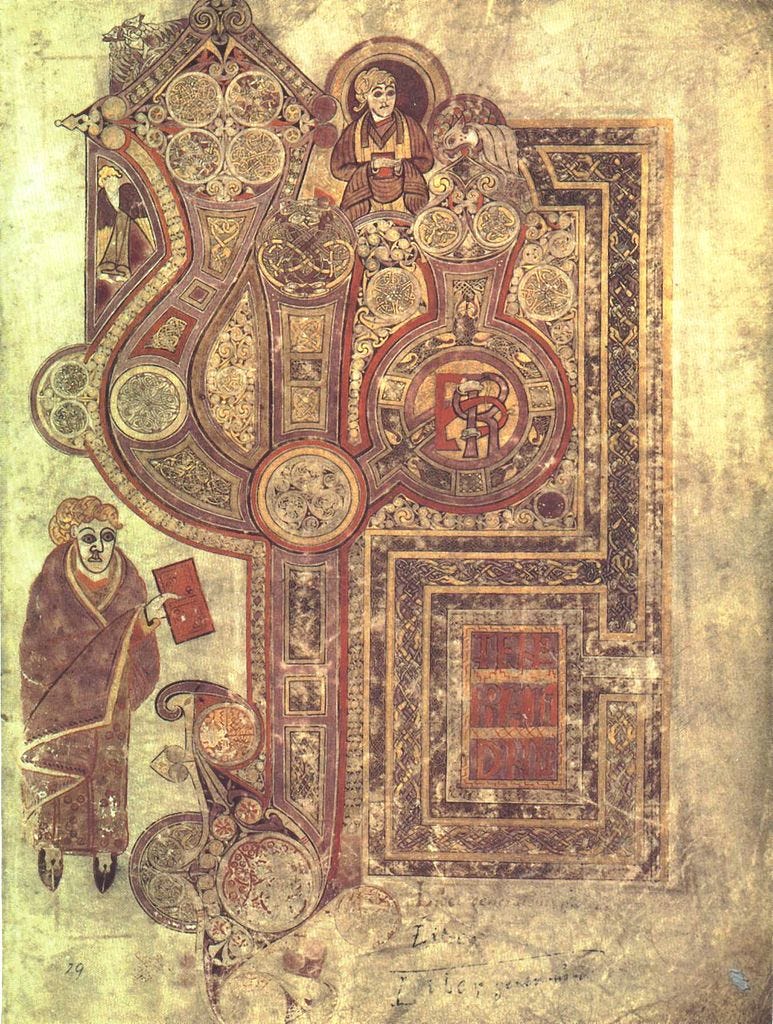
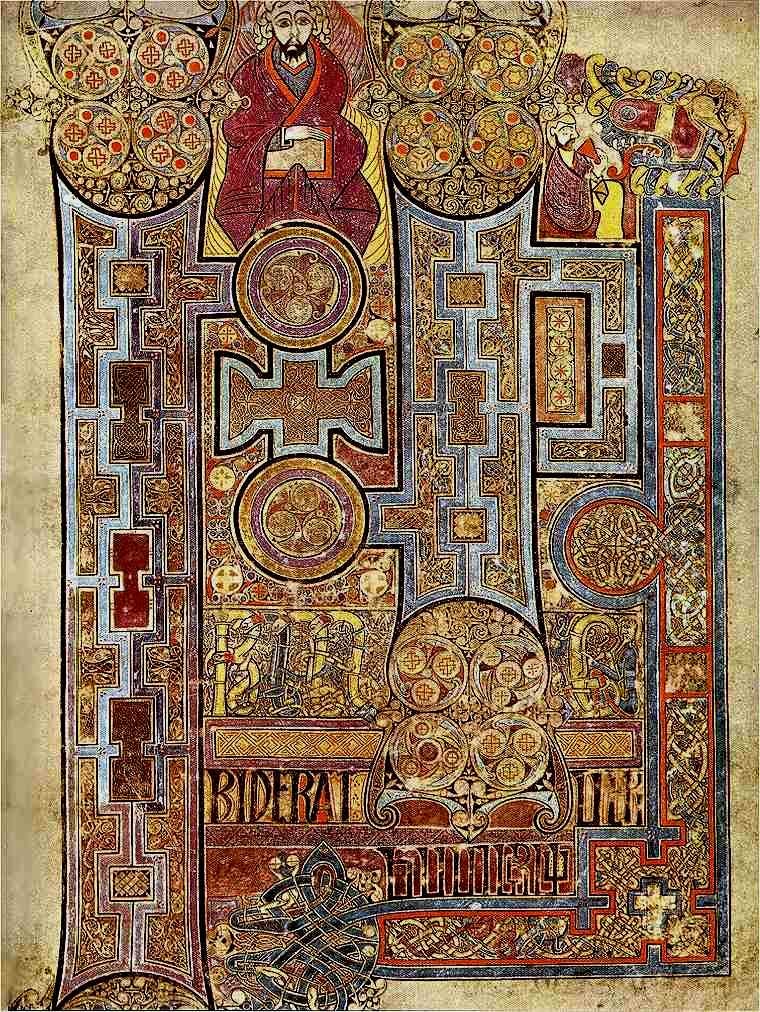
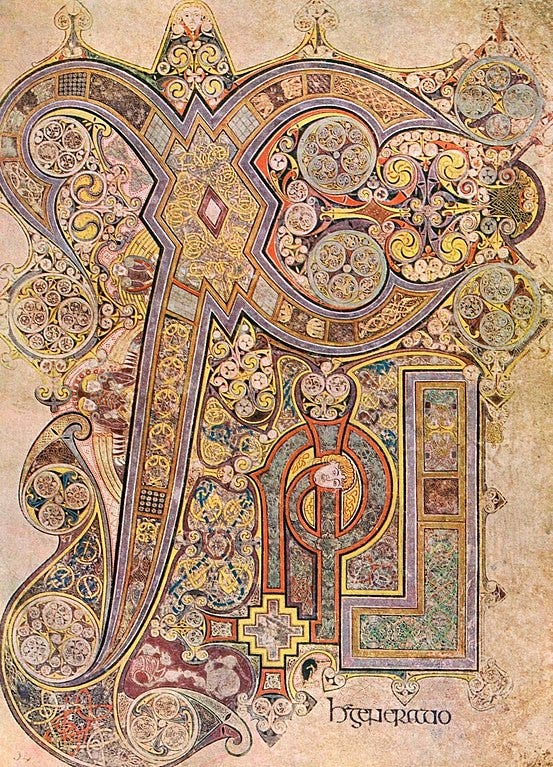


The Book of Kells is an early Celtic-Christian manuscript produced by the Monks of the Iona community during the ninth-century. This was devotional art and was produced as an act of prayer. The depiction of the human form was ‘frowned upon’ by many religious orders and so elaborate designs containing rich symbolism were widely used in religious texts and church decor. This was long before any printing presses and members of many religious orders spent most of their waking lives copying texts by hand. The designs used by the Celtic-Christian culture were developed from pre-Christian swirls and knotwork motifs used by the Britons as well as the Celtic migrants and similar biomorphic designs seen in art distributed by Viking traders.
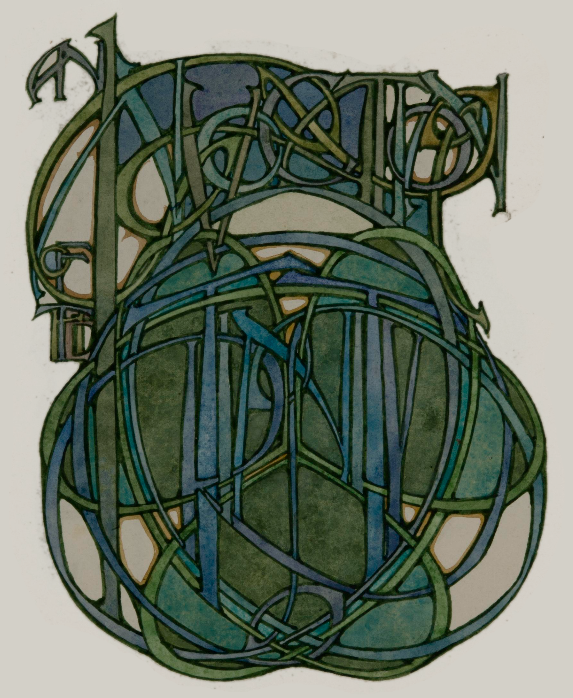
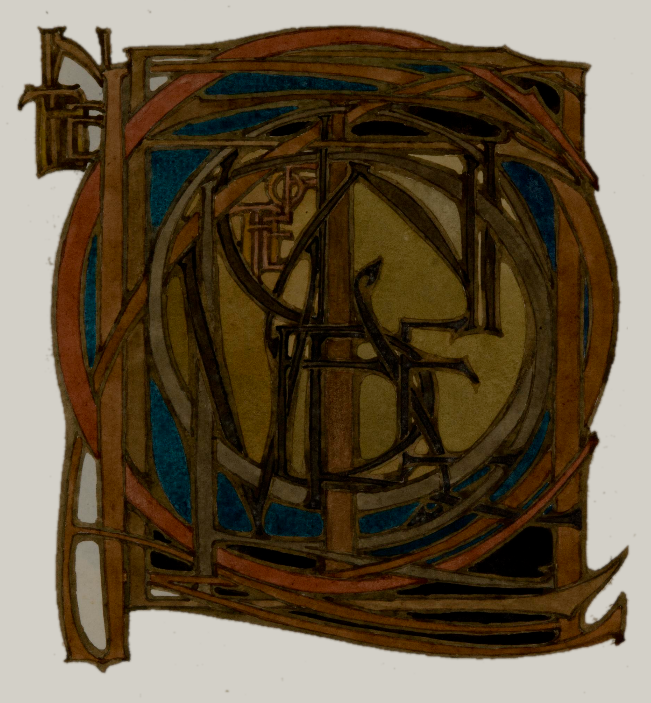
It is thought that Knox had started his own epic illumination of The Deer’s Cry prior to the First World War as a form of meditation and act of personal prayer and produced much of it during the War years. What eventually became his most beautiful and noteworthy calligraphic work wasn’t initiated for any commission and had no patron but himself. It evolved into a stanza by stanza rendering of the prayer of protection known as Saint Patrick’s Breastplate. Originally attributed to the Patron Saint of Ireland and thought to be penned in the late-fourth- or early-fifth-century, it has since been surmised by scholars to have originated in the eighth- or early ninth-century, roughly contemporary with the Book of Kells. The version we now know was translated into English in the nineteenth-century when medieval poetry was en vogue among the British Romantics.
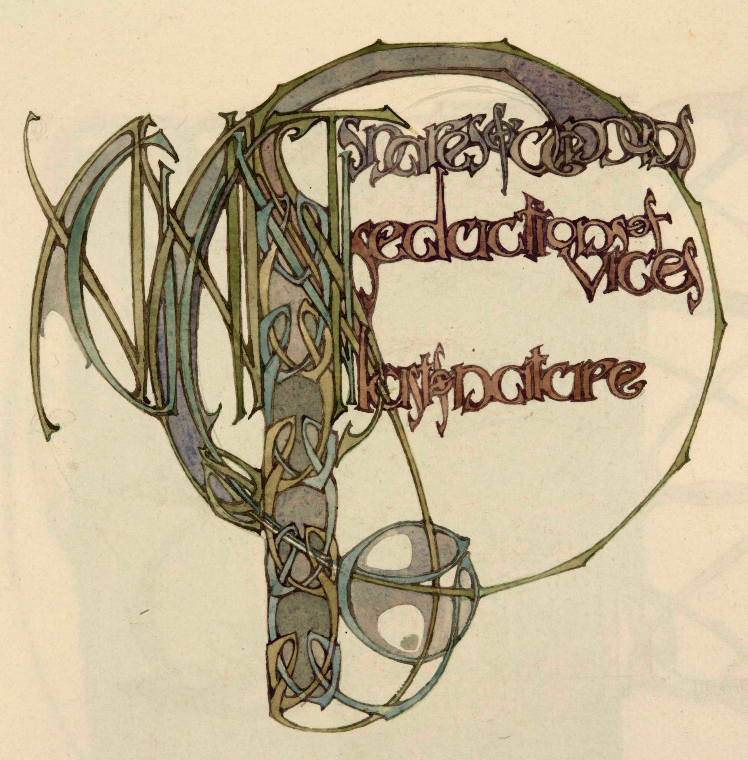
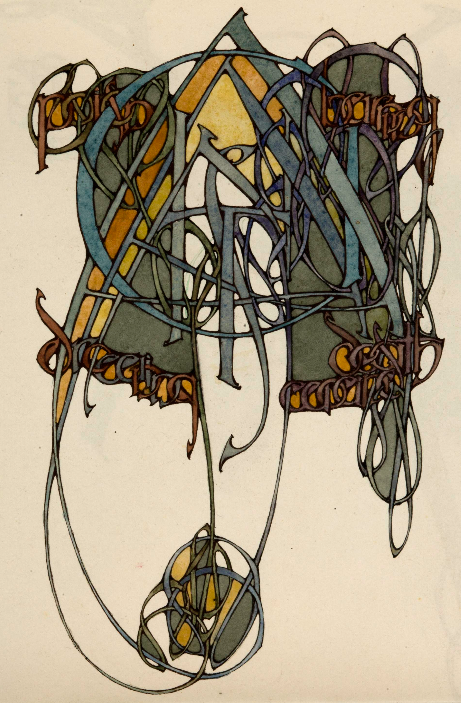
The alternative title used by Knox, The Deer’s Cry is thought to relate to a folkloric telling of how the Saint used the incantation to metamorphose himself and his acolytes into deer so they could pass through a stretch of forest where enemies lay in wait to ambush them. It has also been suggested that the eleventh-century title given in Irish as Faeth Fiada was mistranslated and etymologists now think the corrected Féth Fíada refers to a magical mist of concealment that could be evoked by the Tuatha Dé Danann, the Fairy Folk of ancient Ireland, harking back to those earlier times when Celtic-Christianity embraced the wisdom of preceding pagan philosophies.
This interpretation seems likely to have been favoured by Knox who studied folklore and also illustrated collections of Manx fairy-tales. It seems he approached the typographic treatment as a way of creating a series of intricate designs that contained his own interpretations of the lines from the invocative poem yet did not immediately disclose them, presenting instead cohesive compositions that work on their own purely visual terms.
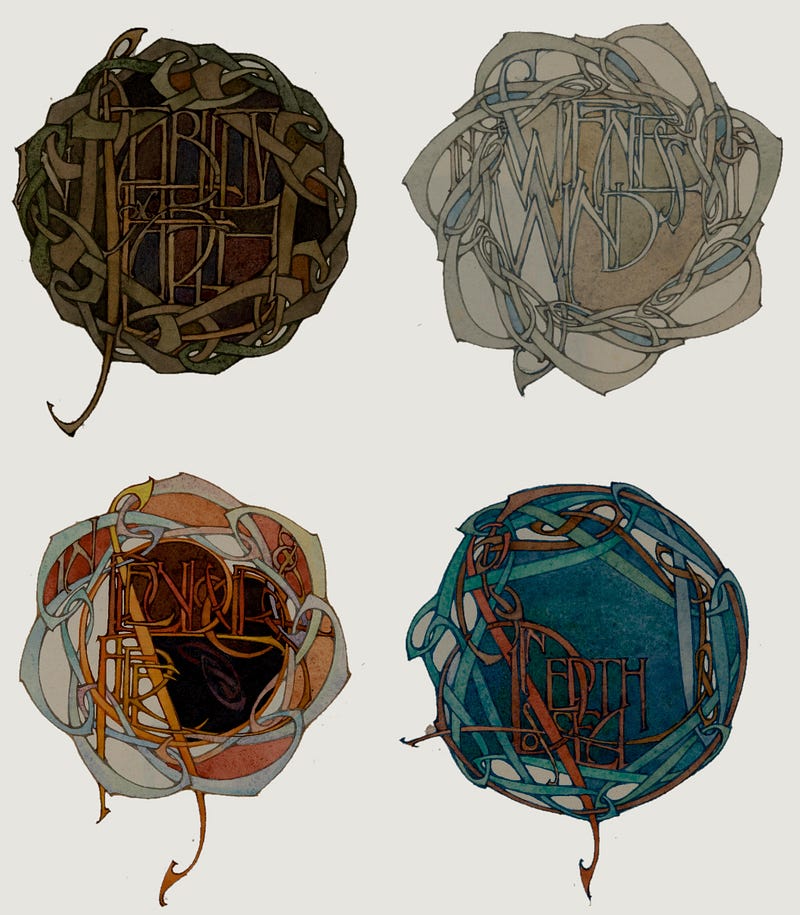
On first seeing each motif, the viewer is coaxed into a mood, or different state of consciousness, guided by the colour palette and the often mandala-like patterns. They initially operate as a form of geometric abstraction. Meanings are suggested before the rational mind manages to identify and read the quote embedded into the complex knotwork. Intuitive interpretation has already been asserted before literal meaning emerges to create a synthesis. In turn, hinting at the intangible realms of Pagan magic and Christian faith as they swirl and bind together. The resemblance to stained glass windows adds to and supports such spiritual connotations.
Perhaps Knox knew that visual art could part the veils of perception better than rational words, and that prayer, along with other forms of magic, were spiritual rather than literal practices. Yet each design has been meticulously planned and laid-out using the mathematical precision of the draughtsman and well-honed practical design skills — an illustration of the bond between the realms of the imagination and the real — the co-dependency of the spiritual and the corporeal.
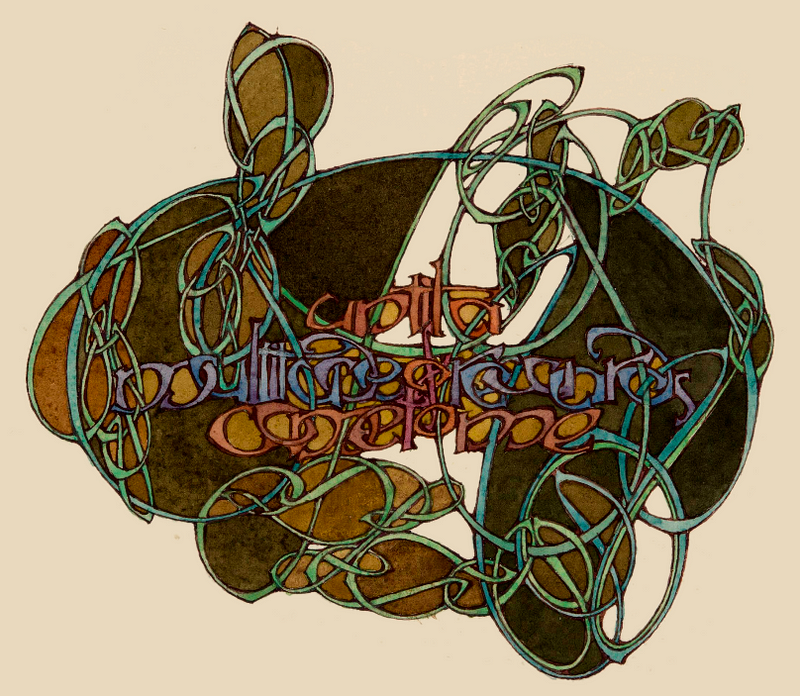
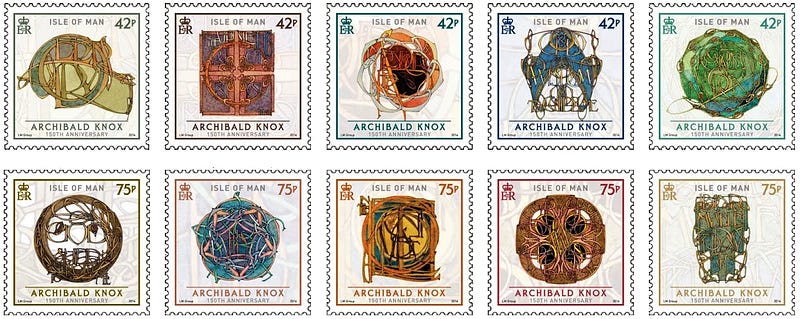
Archibald Knox was to sever that bond before he completed his magnum opus. Pages of The Deer’s Cry were publicly exhibited once, shortly before his death in 1933. He bequeathed the ultimately unfinished work to Thie Tashtee Vannin (The Manx Museum) on condition that it was bound as a single volume for posthumous display. His wish was honoured and the handsomely bound volume is now shown at the Manx Museum and scans of the completed pages and some preparatory sketches can be viewed online via their i.museum portal.
A common translation of ‘Saint Patrick’s Breastplate’ aka ‘The Deer’s Cry’
I bind to myself today The strong virtue of the Invocation of the Trinity: I believe the Trinity in the Unity The Creator of the Universe. I bind to myself today The virtue of the Incarnation of Christ with His Baptism, The virtue of His crucifixion with His burial, The virtue of His Resurrection with His Ascension, The virtue of His coming on the Judgement Day. I bind to myself today The virtue of the love of seraphim, In the obedience of angels, In the hope of resurrection unto reward, In prayers of Patriarchs, In predictions of Prophets, In preaching of Apostles, In faith of Confessors, In purity of holy Virgins, In deeds of righteous men. I bind to myself today The power of Heaven, The light of the sun, The brightness of the moon, The splendour of fire, The flashing of lightning, The swiftness of wind, The depth of sea, The stability of earth, The compactness of rocks. I bind to myself today God’s Power to guide me, God’s Might to uphold me, God’s Wisdom to teach me, God’s Eye to watch over me, God’s Ear to hear me, God’s Word to give me speech, God’s Hand to guide me, God’s Way to lie before me, God’s Shield to shelter me, God’s Host to secure me, Against the snares of demons, Against the seductions of vices, Against the lusts of nature, Against everyone who meditates injury to me, Whether far or near, Whether few or with many. I invoke today all these virtues Against every hostile merciless power Which may assail my body and my soul, Against the incantations of false prophets, Against the black laws of heathenism, Against the false laws of heresy, Against the deceits of idolatry, Against the spells of women, and smiths, and druids, Against every knowledge that binds the soul of man. Christ, protect me today Against every poison, against burning, Against drowning, against death-wound, That I may receive abundant reward. Christ with me, Christ before me, Christ behind me, Christ within me, Christ beneath me, Christ above me, Christ at my right, Christ at my left, Christ in the fort, Christ in the chariot seat, Christ in the poop-deck, Christ in the heart of everyone who thinks of me, Christ in the mouth of everyone who speaks to me, Christ in every eye that sees me, Christ in every ear that hears me. I bind to myself today The strong virtue of an invocation of the Trinity, I believe the Trinity in the Unity The Creator of the Universe.
* All images are used with license, or presented here for educational purposes under fair usage policy. The decorative ‘A’ used throughout this article is part of an illustrative alphabet designed by Archibald Knox and features two falcons.