
The Creative Dilemma: Embrace AI Or Kiss Your Job Goodbye
Strategies for Creatives to Stay Ahead of the Curve
Here’s the bitter truth: If you work in the creative industry, there’s a good chance that artificial intelligence will make your job obsolete. Not in some dystopian, far-off future, but very soon. Maybe in just a few months.
Now, before we collectively close up stores and go to therapy, let’s examine our chances of using the AI revolution to our advantage. Below, you’ll learn how I think we as creatives can prepare for the “creative dilemma” caused by AI.
The Future: Anyone Can Do Anything
Who knows, it may even happen sooner than we expect. The speed at which AI tech is developing is absolutely mind-blowing: we see a new breakthrough almost every day and there is little doubt left that AI will fundamentally change our lives.
In terms of human creativity, AI has the potential to give everyone the ability to create anything. I’m not even exaggerating: if you decide that folding proteins is your new thing or if you decide to make movies, AI will allow you to do so without having to study biology or go to film school.
Now, some might argue:
“Wait a minute! The synthesizers didn’t make musicians obsolete, did they?”
That is true. They didn’t. But only because synthesizers were just a new interface for sound creation. You still had to sit down and learn some music theory to be able to compose, or build muscle memory through endless hours of practice to play like a virtuoso.
With AI it’s different because it is not just a new interface.
It is a completely new tool. It will change everything. For example:
- With AI, you can compose, play and create new sounds in seconds. Without having to study music theory or memorize a fingerboard.
- AI will allow you to write a book or screenplay in any style without you having to study storytelling devices or dramaturgy.
- etc…
And yes, the world will be flooded with clichéd tunes and stories, boring scripts, and mediocre virtual DJs.
Sounds bad? Well…
What It’s Like To Become Obsolete
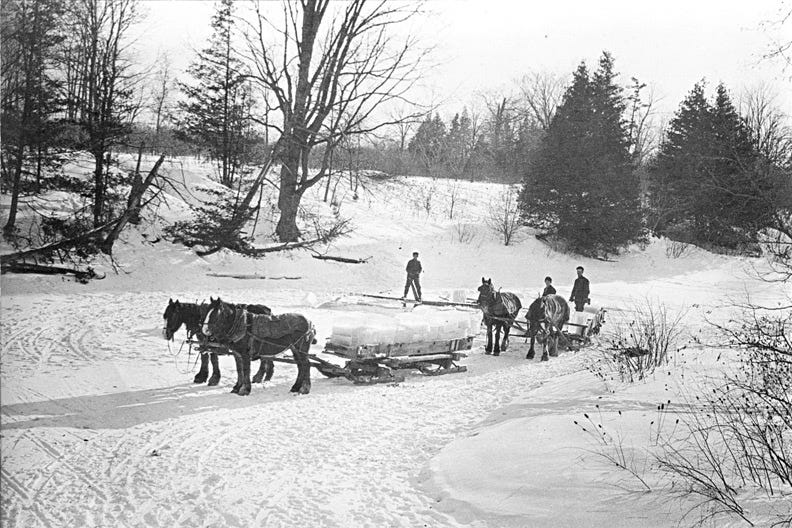
You know, there was a time before there were refrigerators.
People had to go out onto frozen lakes and rivers and harvest enough ice to sell throughout the year. It was physically demanding work in harsh winter conditions: you had to stand in the cold for hours and cut through thick layers of ice with large saws before the ice melted or the weather conditions worsened.
We called these people ice cutters.
Fast forward to the future of humanity. A time when we, my friends, will be remembered as those who lived during the dawn of the AI age:
“There were people who had to produce enough content to sustain their careers throughout the year. Mentally demanding work that required intense concentration and a lot of time to produce quality work, often under difficult conditions. They used their tools — pen and paper or keyboard and screen — to work out their ideas before inspiration faded or external factors impeded their progress.
We called these people [insert your creative job].”
AI is a new cognitive tool with transformative potential that is absolutely mind-blowing and underestimated by everyone. In fact, like the ice cutters, many of us will lose our jobs. But maybe there is a strategy to survive as a creative professional…
The Creative Dilemma
You are a screenwriter, novelist, illustrator, or painter, etc.?
Your job will be obsolete.
Because here’s the thing: AI will take over creative professions to an extent we probably can’t even imagine. And it will make a lot of us redundant. But then, it will also create new job opportunities for creative minds willing to work and co-create with AI.
The dilemma is this: we need to embrace AI to survive as creatives and transform our craft into a professional activity that we don’t even know what it will look like.
If you were to ask ice cutters on the day refrigerators took over where they saw themselves in a few years, they probably wouldn’t know either. Their old job was done by a machine. But then — and I might overstretch the analogy quite a bit here — these heavy machines had to be built, transported, and set up somewhere. For this, again, strong people who were used to adverse conditions and lifting things were well suited…
Creative Diffusion
Screenwriters, for example, are able to recognize plot points and dramaturgical elements, whereas a layperson receiving a script written by an AI could not.
The same is true for illustrators or designers, who are able to recognize principles and subtle details in composition, or musicians, who recognize musical techniques and effects that contribute to the emotional impact of a piece of music.
This might just be the track for us to follow: guiding and curating AI.
If you live in a remote area and have the skills to cut ice to preserve food, that can make survival a lot easier. Similarly, in the future, we could probably see a niche of traditionally creative professions that don’t use AI tech at all. And those guys will be amazing at what they do because they’d be measured against all the fancy AI stuff that populates the entertainment industry.
Who knows, maybe we might see a niche group of strictly analog filmmakers who occasionally create something that surprises an audience that mainly consumes AI films. It would be like being around a nostalgic ice cutter who works as a tourist attraction in an open-air museum, surrounded by a surprised audience of stout family men saying: “Wow, how did he do that?”
Nobody Can Tell The Future, But …
… it’s very likely not about “AI vs. creatives”, but rather about:
“creatives using AI and creatives not using AI”.
However, many of the latter will eventually disappear; those that survive will work in niche or nostalgic fields.
The way I see it, we can use the following as a guide toward our new and unknown destination as creative professionals:
- AI will create new jobs that we cannot yet fully anticipate
- Creatives will play an important role in guiding and curating AI-generated content
- Creatives can find work as consultants and tutors at the intersection of AI and creativity/education
- Creatives embracing AI, can boost their output, gather information and find inspiration like never before.
- Creatives can also help others bring their ideas to life. Teach them how to guide something like chatGPT to write a book together, or how to use Midjourney to create images, pitch decks, or fashion products.
- Creatives can also start a business by using AI to become their own film studio, art gallery, or head of their own creative company.
For more information about Ai & Creativity, follow me on Twitter or Medium (use my referral link to get full access to all my articles and those of thousands of other writers).
If you like my content, why not leave a “clap” at the end of this article, so more people can see it?


