
ENTREPRENEURSHIP
The Age of Discontinuity Is Here
A story about courageous misfiring misfits

Peter Drucker foresaw the “age of discontinuity” in the late 60s, predicting the onset of constant change in the world.
That was almost 60 years ago.
Decades after Druckers’ prediction, Beckhard and Harris proposed a simple tool to measure the likelihood of change occurring, a key ingredient for true innovation. In 1997 they presented a formula to predict the probability of change, as follows:
Change = (Dissatisfaction) x (Vision) x (First Step) > Resistance
Why is this important?
Simple. The Beckhard and Harris formula above identifies key entrepreneurial components.
№1 — Vision
Vision is a vital ingredient. Beckhard and Harris convince that change is unlikely to occur in its absence.
№2 — Dissatisfaction
Dissatisfaction captures the ethos of entrepreneurship. In 1978 Derek Abell wrote about the existence of this ingredient in his article Strategic Windows, a piece that introduced the importance of timing, compelled by dissatisfaction (Abell, 1978).
№3— Timing
Abell proposed that individuals with a flexible approach rapidly adapt in a constantly changing world. Bootstrapping outliers, with an entrepreneurial-agility, that enables entrepreneurs to identify and exploit timely opportunities with precision.
In fact, Abell encouraged discomfort; rejecting satisfaction in exchange for a constant state of dissatisfaction. He implied that dissatisfaction, guided by a vision, is the primary driver for human evolution and innovation.
“Be comfortable with discomfort.” — George J. Ziogas
Entrepreneurs, by their nature, tend to be dissatisfied, their mental existence is fueled by an urgency for innovation and transformation.
This article is about the inventors of tomorrow — entrepreneurs.
Entrepreneurial Kryptonite
Michael Dell said that “the only constant in our business is that everything is changing.” He urged that “we have to take advantage of change and not let it take advantage of us.”
Like Abell and Drucker, Michael Dell indicates that “satisfaction” is a kind of “entrepreneurial kryptonite”, a disease that has the potential to neutralize or arrest our super-self.
For those who don’t know what Kryptonite is, let me explain: Kryptonite is a mineral from Superman’s home planet, Krypton, which has a debilitating effect on Kryptonites like Clark Kent.
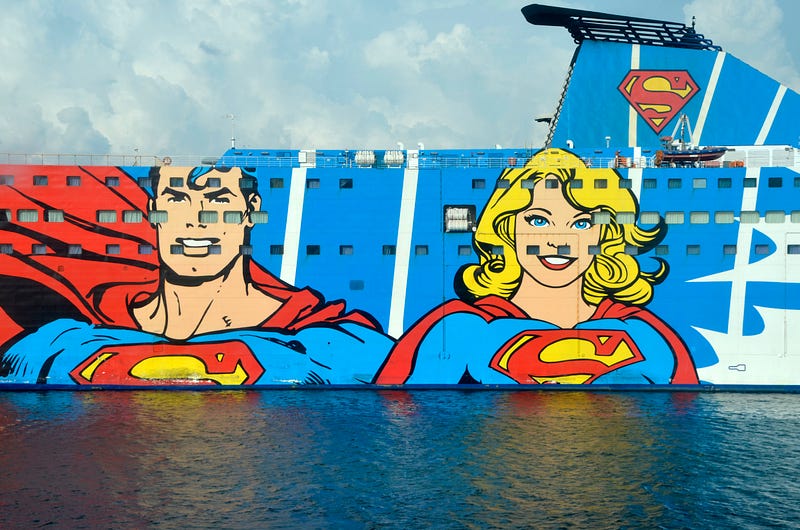
Is Kryptonite real?
Who knows, but the word has meaning, in the entrepreneurial world Kryptonite = giving up.
Who are Entrepreneurs?
At the core of entrepreneurship lies invention, a creative mind that fights tooth and nail for innovation. Don't believe me? Ask Dr Mehmet, a man who appreciates the words of Schumpeter:
“Destructive Innovation” — (Schumpeter, 2011)
“Destructive innovation” is entrepreneurial-invention in motion. It can be uncomfortable, painful even, but necessary for progress.
Digital transformation
In a relatively short space of time “digital technology has transformed economies”, inventing value in abundance with products and services available on-demand today (McDonald, 2014).
Technology has radically changed the face of society and the modern business world. The application of digital tech, in trade, mirrors traditional exchanges but does so virtually and on a global scale.
“Technology has made it possible for any small business to find a market globally, to access factories, to build a brand, to be open for business 24/7 and to innovate” — (Priestley et al, 2013)
The implications of digital transformations are evident everywhere. In the last 20 years, inventors have removed barriers and dissolved boundaries on a scale never witnessed before. Accelerating entrepreneurship. Incubated by innovative destructors (entrepreneurs), the driving force behind evolutionary strides this century.
The entrepreneur
Google lists 850 million search results for the word “Entrepreneur.” With definitions in abundance, I think Darwin captured it perfectly:
“It is not the strongest of the species that survive, nor the most intelligent, but the one most responsive to change”
Entrepreneurs invent change through dissatisfaction. The innovators among us who create “change” with a visionary dream for tomorrow. Individuals who strive to fulfill a vision despite barriers. Entrepreneurs see obstacles as nothing more than a hurdle to the future. A roadmap. They sacrifice themselves for the greater good.
But entrepreneurial inventors are often discredited, sabotaged by others. Their desire to break things is undesirable by the masses, but they endure.
Entreprendre is a French word that refers to a person who undertakes risk to give birth to new ventures. As such an entrepreneur exhibits courage, their endeavors are not blighted by nay-sayers.
“A person who organises and manages any enterprise, especially a business, usually with considerable initiative and risk.” — Dictionary.com
My fellow countryman, George Bernard Shaw, distilled the qualities of a true entrepreneur in a few words when he wrote:
“The reasonable man adapts himself to the world; the unreasonable one persists in trying to adapt the world to himself. Therefore all progress depends on the unreasonable man.”
The entrepreneurial journey is often ridiculed, deemed impossible by some. Despite failures and setbacks the resilience of the entrepreneurial spirit somehow keep those, who embody radical-invention, moving forward.
Entrepreneurs believe in a dream, a vision with conviction to build anew. They are born this way, afflicted with “a primordial urge, independent of product, service, industry or market.” (Forbes.com, 2012)
Occupational hazard
Entrepreneurs “create new sources of competitive advantage, products, and services, firms, industries, jobs and wealth, at the same time they also ‘destroy’ firms and jobs in now out-of-date activities” (Westhead et al, 2011).
Destructive innovation is the offspring of entrepreneurial-invention, born of a curious mind, by creatives dissatisfied with how things are.
Tradition is no more than an aged legacy, ripe for cannibalization. Future generations, with an entrepreneurial appetite drenched in dissatisfaction, are the architects of change who will sculpt tomorrow.
Infant start-ups are the disintermediators of traditional business models as opposed to existing entities, who clasp to relevancy with clumsy despair as if it's their final breath … for some, it is.
Misunderstood misfits
Entrepreneurs are often misunderstood — marginal inventors that lurk in the shadows in all corners of the world.
Overlooked. Pensionless. Misfiring misfits.
Entrepreneurs are not bound by social constraints to conform. This is not an Achilles heel, rather a Trojan horse, a vehicle underpinned with the courage to think differently and fail.
Courage is what sets them apart.
They don't believe in luck. Entrepreneurs are lucky because they failed a thousand times to succeed just once.
Think of serial-entrepreneurs like Steve Jobs, Jack Dorsey, or Elon Musk:
“If success were mostly a matter of luck, these kind of serial entrepreneurs probably wouldn’t exist” —Peter Thiel
To understand entrepreneurs, replace the word luck with determination, resilience, and relentlessness drive.
Nature or nurture
In the book Rich Dad, Poor Dad, author Kiyosaki said:
“In school we learn that mistakes are bad, and we are punished for making them. Yet if you look at the way humans are designed to learn, we learn by making mistakes. We learn to walk by falling down. If we never fell down, we would never walk.”
In society, failure is discouraged. The implication is the worst kind of failure, avoidance. Kiyosaki said that “you’re only poor if you give up. The most important thing is that you did something. Most people only talk and dream of getting rich. You’ve done something” (Kiyosaki, 2011).
Take necessity for instance. People from emerging nations “tend to be more entrepreneurial” because their life depends on their ability to invent ways to generate an income.
Let me remind you of an age-old quote:
“Necessity is the mother of invention.”
Entrepreneurs from wealthier backgrounds do have an advantage over those from poorer backgrounds, like access to money and networks. But in some parts of the world entrepreneurship is the only avenue. In many of the poorest countries in the world, entrepreneurship far exceeds that of the developed world:
“66.9 percent in Ghana, 75.4 percent in Bangladesh, and a staggering 88.7 percent in Benin.” (Wider.unu.edu, 2015)
This proves that entrepreneurship is learned and not born.

As such, an entrepreneurial spirit resides in every one of us. In the book Profit First, author Mike Michalowicz describes this as the “Toilet-roll entrepreneur”, a crude but unique analogy that captures the essence of necessity.
Michalowicz said:
“If you’re sitting on the toilet, with only three sheets left, you’ll make it work.” (Michalowicz, 2014).
Michalowicz’s “three sheets” method defines entrepreneurship.
Final Thoughts
In reality, the entrepreneurial journey that inventors embark upon is one that few have the courage to traverse.
For innovators, rejection, criticism, and failure are par for the course.
Entrepreneurship is a storm-tossed venture. An ocean where calamity far outweighs calm waters.
The true measure of entrepreneurship is displayed by Individuals who endure the relentless onslaught of risk, with a curious resilience.
Entrepreneurs are warriors of the soul. Their courage ignites the human spirit.
Win or lose, they stand tall among us. Their sheer determination raises our collective human consciousness to a higher level.