
BUSINESS | LIFE
Most People Fail, Get Used to It
5 lessons about failure for business and life
Extinction is part of the circle of life. As such failure is guaranteed.
“Great success is built upon failure. That’s why today’s most successful entrepreneurs didn’t let their missteps stop them.”
— Joe Locascio
Accepting failure is part of life too. A function of evolution. If you embrace failure you strengthen your position to succeed now and in the future.
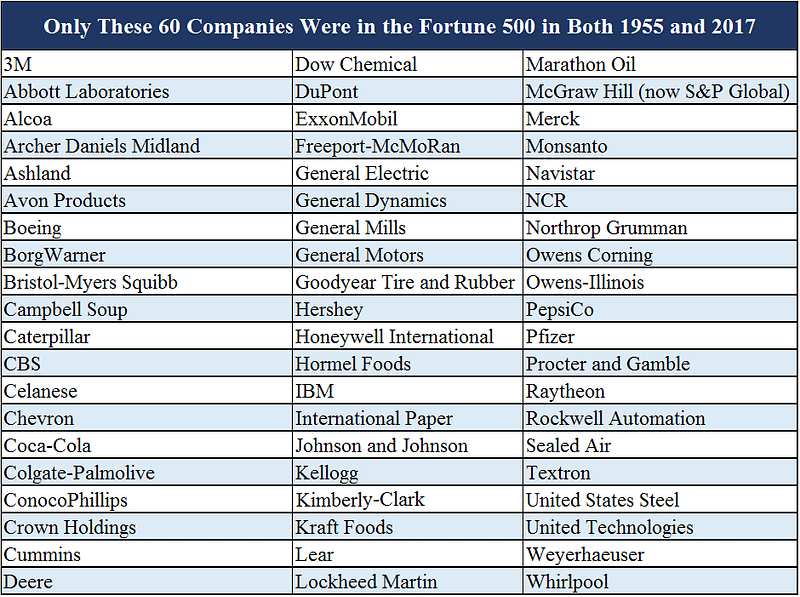
Over 90 percent of organizations that existed a hundred years ago have disappeared. Proof of this trend is evident from the Fortune 500 list in 1955 compared to 2017.
In a hundred years from now, by 2120, it's possible that up to 99 percent of all organizations today will have transformed into a completely different business or will have disappeared entirely.
Failure is not a bad thing. Companies that fail hold a treasure chest of lessons for the next generation to learn from.
Failure makes way for the new by clearing out the old.
Failure forces industries and organizations to change.
Failure maps the way for Startups and radical innovation.
Failure is therefore a good thing for society, people, and companies.
Failing to fail
Problems tend to arise by how failure is perceived by people, and organizations.
- If failure is not part of your DNA you risk defective thinking
- If you fail to pivot when you know a product or service is doomed
- If you don't regularly experiment with failure valuable lessons are lost
Some companies celebrate failure. They see prototypes, features, and functions that didn’t make the grade, as a stepping stone to success.
Failure resides at the border of what’s impossible today and imagination — a gateway to tomorrow.
Anyone can replicate the possible. Whereas the path towards the impossible is littered with failure. It takes courage. “Only the brave” work beyond the border of what’s possible today and imagination.
The impossible is the playground for Entrepreneurs and Startups.
5 Lessons About Failure
Here are 5 lessons on failure.
Lesson №1 — Learn from failure
Accepting how important failure is, allows you to see things in a new light. So seek out the lessons in your work rather than writing them off when things go wrong.
The first car, aircraft, light bulb, or computer began as a succession of failures by those who learned to harness past failures. Therefore, failure is the best way to learn. For example:
- You learn what doesn’t work
- Avoid wasting your time on risky exploits
- Quickly identify what's likely to work
- Find new ways of doing something
- Gain knowledge and expertise
- Take a step closer to the impossible
- Leave a roadmap for future generations to learn
No one likes to fail. But understanding what failure is and what it means is highly valuable. So pause and reflect every now and then.
Lesson №2— Stay the distance
The disappointment of failure hurts those who are emotionally invested in their venture. After weeks or months of work, it can hit hard.
“Everything you want is on the other side of fear.”
— Jack Canfield
Failure is not the end. Failing fast and often is the best approach. So learn to fail, pick yourself up, and get back in the game.
Lesson №3 — Perception
How you view failure depends on your mindset, your environment, or your company culture.
People in autocratic cultures often come to the conclusion that they’re just not that good. This type of environment breeds low-esteem, leading to people to cover up or hide from the problems that they discover. They seek appraisal and avoid conflict, not solutions, further eroding esteem.
“Failure isn’t fatal, but failure to change might be.”
— John Wooden
High esteem cultures empower people to approach problems despite failure. They encourage failure. They believe that there is a solution, and with the right support, failure will light the way to a solution.
Lesson №4 — Beware of complacency
Past successes are not a predictor of future success. People are praised for results today that derived from past decisions. At the moment you’re enjoying a great ‘win’, you’re more susceptible to poor decision making due to overconfidence creeping in.
“It’s failure that gives you the proper perspective on success.”
— Ellen DeGeneres
Take praise with a pinch of salt. Enjoy it, yes, but let it go when the moment passes. If you let praise go to your head you risk making poor decisions due to false beliefs that can cloud your judgment.
Complacency is a breeding ground for extinction, the enemy of success, so keep your feet on the ground at all times.
Lesson №5 — Innovate to compete
Competition is healthy for business. It keeps you sharp. It forces you to innovate to stay ahead of the curve, to stay relevant.
“Competition is always a good thing. It forces us to do our best. A monopoly renders people complacent and satisfied with mediocrity.”
— Nancy Pearcy
Some of your competitors will fail, but others will succeed. Both bring about challenges. Some have to fail to compete. To learn. To evolve. Every company faces this challenge. The point is threefold:
- Know your customers
- Know your competitors
- Focus on value
Success boils down to how well you serve the marketplace and your customers compared to your rivals.
Final Thoughts
Past success is rarely an indicator of successful outcomes in the future. Failing in the present is. The world is changing at such a rapid pace, so what you did yesterday may not even be relevant tomorrow.
To conclude, allow me to summarise the 5 takeaways on failure:
- Learn from failure — There are lessons everywhere, so take notice
- Stay the distance — Develop your resilience to bounce back
- Perception — Mind your mindset and challenge your thinking
- Beware of complacency — Avoid getting comfortable
- Innovate to compete — Create value at every opportunity
Robert Kiyosaki, the author who wrote Rich Dad, Poor Dad said: “Failure is part of the process of success. People who avoid failure also avoid success.”
Failure is your friend, so don't fear it, embrace it!


