
Student Loans Cost the Government Billions of Taxpayer Dollars.
The lie. The truth. And the cover-up.
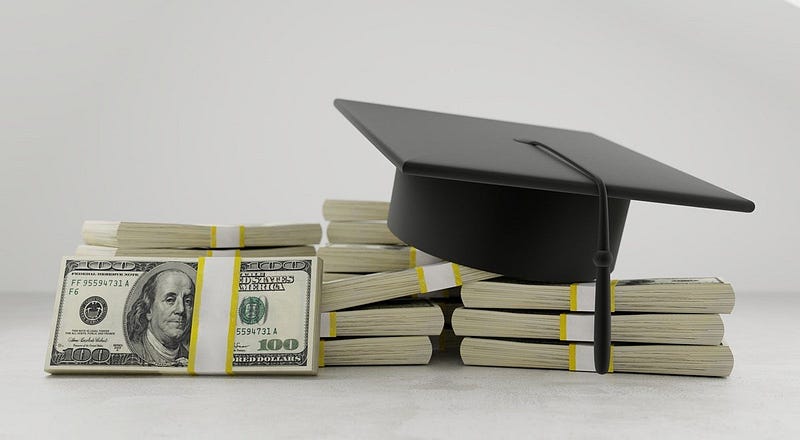
In yesterday’s article, I wrote that cancelling student loan debt, even just at the $10,000 level, might actually save the government money in the long run. The reason is that the government loses money by servicing student loan debt.
Let that sink in for a minute.
The government, an entity with an uncanny knack for bringing in revenue through taxes (well, when it wants to), is losing money by giving out loans, which are legally binding contracts to pay the government back, with interest.
How the hell is this happening, and why don’t we hear more about it?
How Student Loans Lose Money
On the surface, student loan look like a solid business case.
- Lend students money to attend college.
- The student graduates, earning higher lifetime earnings with lower unemployment rates than non-graduates.
- Reap the profit during the payback period.
That would be a great plan if everything went according to plan. But it doesn’t.
Life Happens
The money from student loans would fall from the heavens…if all students actually graduated. Or earned more. Or didn’t lose a job. Or didn’t didn’t have bad luck (such as dealing with the pandemic, the Great Recession, and, for some, the post-9/11 economy in quick succession).
But life does happen, and students do fail to graduate, or lose a job, or make bad decisions, or whatever.
So what happens to those loans?
- Deferment, where payments stop but interest accrues.
- Forbearance, where both payments and interest stop.
- Rehabilitation, which is extremely hard to complete when you are already in financial distress.
- Acceleration, where the entire balance and interest comes due immediately.
- Or the borrower just stops paying, which is disastrous for both the borrower and the lender (the US).
All of these cost money…much more money than the 10-year repayment costs.
Many borrowers who are paying cannot afford the 10-year plan, so they are on one of the several income-drive repayment (IDR) plans. However, these plans can have payments that are less than accrued interest, increasing the outstanding balance and risk of default.
Student Loan Forgiveness
I’m not talking about the pipe dream of mass forgiveness here. Instead, I’m talking about the myriad programs available to receive student loan forgiveness.
From PSLF and TEACH grants, to the “end-of-life” forgiveness for IDR plans, a whole bunch of borrowers are going to have a whole bunch of debt forgiven, cutting out the repayment of the principle.
I am the poster boy for student loan forgiveness through PSLF.
- Total borrowed through December 2014: $107,579
- Total owed as of May 2021: $137,537
- Total projected payments through forgiveness in December 2025: $45,000
Not only is the government losing out on over $60,000 in principal, but they are also losing out on the profit that was supposed to be generated from my 6.25% interest rate. By comparison, I just purchased a home with a mortgage rate of 3.25%.
By the way, don’t believe the naysayers about the problems with PSLF. While the first cohort faced some major systemic hurdles, the next wave of applicants are going to be much more successful.
Even now, PSLF and TEPSLF success stories are all around: $145k, $123k, $160k, $208k, $31k, $82k, $212k, $38k.
The Government is Losing How Much?!?
The Congressional Budget Office (CBO) reports on how much student loans are making or losing for the government. A recent report projected a savings of $135 billion from 2014–2025.
In other words, the government is making money of student loans, which is how you would expect a bank (in this case, the Department of Education) to work.
The problem is that this is complete nonsense.
CBO Problems
I write about this more here, but the short explanation is that the accounting process used to reach this surplus amount vastly overstates a borrowers ability to repay the loan.
Using the fair-value system, which just about everyone else on the planet uses because it provides more accurate data, student loans will actually cost the government $88 billion.
That’s a $223 billion swing.
These numbers may pale in comparison to the recent trillion dollar stimulus packages, but let’s put this in perspective.
The Navy’s newest Gerald R. Ford-class aircraft carriers cost around $13 billion each. The money lost from servicing student loan could purchase 6 of these ships over the next decade, and still have $10 billion left over.
Adding salt to the wound, the CBO knows this is a problem and actually reports on this. Both numbers above come from a CBO report produced by CBO accountants and uploaded to a CBO website.
Come to find out, the $88 billion loss is a conservative estimate.
Wall Street Journal
In late 2020, the Wall Street Journal published an article estimating that losses due to student loans would clock in at $435 billion, almost five times as large as the CBO estimate.
The WSJ included two major assumptions that the CBO leaves out.
- They included the entire lifetime of the loan, not just the next decade.
- They included government-backed private loans.
Why is this important?
First, student loans are oftentimes paid back over a much longer timeline than the standard 10 years.
Case in point: me.
I’ve been paying back student loans in some form or fashion since 2003, and I still have another 5 years until I’m done.
Second, some private loans are fully backed by the US government, but these loans have proven much riskier than Direct Loans, leading to higher losses.
To put the WSJ number in perspective, consider this: the total losses by private home lenders during the financial crisis was around $535 billion, and that caused the worst economy since the Great Depression.
I understand that private mortgage lenders and the federal government are two different things, but private mortgage lenders also didn’t have other things to care about, like roads, Medicare, and defense spending.
The Trump Report
If the CBO report was bad, and the WSJ report was worse, an internal review by the Trump Administration might prove to be downright calamitous.
Here’s the background.
In 2018, Betsy DeVos ordered a review of the student loan program, with a specific focus on why revenues were consistently lower than projected. At the suggestion of Jamie Dimon, she brought on Jeff Courtney, a former JP Morgan exec in charge of their private student loan division.
(I realize that the combination of DeVos, Dimon, JP Morgan, Trump, and the Wall Street Journal sounds like a toxic mix, but stick with me.)
In the course of his research, Courtney found that the government had not kept up with reality, and that student loans were defaulting at a precipitously higher rate than the calculations allowed.
According to a report he later produced, over three decades, Congress, various administrations and federal watchdogs had systematically made the student loan program look profitable when in fact defaults were becoming more likely.
The result, he found, was a growing gap between what the books said and what the loans were actually worth, requiring cash infusions from the Treasury to the Education Department long after budgets had been approved and fiscal years had ended, and potentially hundreds of billions in losses.
After updating the CBO numbers, Courtney calculated that losses, “could amount to more than $500 billion, exceeding what taxpayers lost on the saving-and-loan crisis 30 years ago.”
Not good at all.
A Potential Cover-up?
With all of this information out there, you might think that the Biden administration would pounce on these reports and make some changes. Well, if not pounce, at the very least point to all the data and make some vague claim about wanting to revamp the system to a) save taxpayer dollars and b) help borrowers repay sooner and avoid default.
What did they actually do?
They shut down his research and disparaged his reporting and “incomplete” and “inaccurate”.
It seems a little weird that an administration that has touted student loan reform as critical to the economy would so strongly dismiss such a glaring issue.
It’s weird until you realize the impact. From the WSJ article:
Before [1990], the budget treated student loans as an expense. If the government lent $1 billion, the deficit rose by that amount, absent offsetting measures.
The law changed in 1990 to incorporate expected future repayments. Suddenly, [student] loans became a potential source of profits, by assuming that most borrowers would repay with interest.
This created an incentive for Congress to expand student lending. Doing so would increase access to higher education either at no cost to the government or with a gain in federal revenue, at least on paper.
As you may know, the government loves a source of revenue, especially one that also has a “benefit to society”. Congress went crazy over the ensuing decades.
- 1992: Loans available to upper-income households.
- 1992: Interest accrues while in school, not waiting for graduation.
- 1993: Income-Contingent Repayment (ICR) plans are created, extending repayment and encouraging students to take out bigger loans.
- 2005: GradPlus loans eliminate borrowing limits.
- 2009: Income-Based Repayment plans are introduced, with 15% max payment.
- 2010: Lowered IBR cap to 10%.
PAYE and REPAYE or undergrad and grad students, respectively, further incentivized larger loans.
All told, “[t]he federal government extended $1.3 trillion in student loans from 2002 through 2017. On paper, these would earn it a $112 billion in profit.”
Push back on the alternate analysis came even before the election, with “[s]ome OMB staffers voic[ing] concern Mr. Courtney’s project would undermine the president’s budget proposals, potentially forcing the government to come up with hundreds of billions of dollars to balance the books…”
When your president has vocally supported the student loan program and wants the federal government to remain the main source of student loans, then you can’t just tell everyone that the program is a loser.
The Takeaway
I’m no fan of Trump, but it’s shit like this that makes me want to throw my hands up in the air and give up.
Maybe that’s what they want. Or maybe they just don’t care.
Either way, student loans are a burden not only to those who have them, but also to every taxpayer who is subsidizing their very existence.
- If you have student loans, learn to play the game and pay as little as possible.
I normally wouldn’t say this about any other type of loan, but this is different.
College degrees, in general, do pay for themselves over our lifetimes. But not all of them, and not for everyone.
There has been a disinformation campaign by both the federal government and higher education to get more students signed up to pay higher fees and falsely pad the federal budget. It has to stop.
- If you are thinking about taking on student loans, take a hard look at the payoff.
Is there an alternate way to fund your education?
Is there an alternate education that would be just as good?
While there are many financial means to pay off your loans, the psychological toll can be devastating. Try your best to avoid getting into debt (always good advice), especially if the payoff just isn’t there.
Related Stories
- Could Cancelling Student Loans Actually Save Money?
- There is No Student Loan Crisis
- Student Loan Forgiveness Will Never Happen
- Conquer Your Student Loans
- 6 Quick Wins to Tame Your Student Loans
- Don’t Pay Off Your Student Loans
- How I Still Have $135,000 in Student Loan Debt (Even After 21 Years)
Most Recent Stories
- Biden’s $400 Billion Blunder
- I Just Found the Most Amazing, Honest, and Complete Report on US Government Finances
- Falling Birth Rates Will (Probably) Destroy the Economy
- The Forgotten Impact of the Booming Housing Market
- Biden’s Next “Big F***ing Deal”
Don’t miss my next article! Click here to get notified when I publish new material.
If you love the articles published in Money. Daily., then become a member of the Medium community and get full access to our full archives.
This article is for informational purposes only, it should not be considered Financial or Legal Advice. Not all information will be accurate. Consult a financial professional before making any major financial decisions.