
I Just Found the Most Amazing, Honest, and Complete Report on US Government Finances
It’s the most apolitical information coming out of Washington.

I just found the most amazing thing.
The United States government, specifically the Bureau of Fiscal Services, which is part of the Department of the Treasury, creates and publishes an annual report on the overall financial state of federal government operations: The Financial Report of the United States Government.
Why is this report so amazing?
- It carries no message other than what the numbers are saying.
- It’s a brutally honest, eye-opening report that takes away all the political spin, putting the actual revenue and spending amounts in stark relief.
- It’s reporting that is held to the same standard that private industry is held to, which is enforced by the Securities and Exchange Commission.
Before we dive in and see what goodies we can find, we need to be crystal clear on something.
The Financial Report is Not the Budget
So often, we hear about the budget, whether there is surplus (yeah, right) or a deficit, and how tax codes will change revenues. The budget is basically a statement of cash flow, and it reported on by the Treasury in a monthly update called The Monthly Treasury Statement of Receipts and Outlays of the United States Government (MTS).
On the other hand, the Financial Report accounts for revenue earned (not just cash received) and liabilities owed (not just cash spent). This makes the Financial Report a much better gauge of the health of the federal government.
Here’s the complete explanation, as written by the Bureau of Fiscal Services:
The Budget and the Financial Report present complementary perspectives on the government’s financial position and condition.
The Budget is the government’s primary financial planning and control tool. It accounts for past government receipts and spending, and includes the President’s proposed receipts and spending plan. Receipts are cash received by the U.S. government and spending is measured as outlays, or payments made by the federal government to the public or entities outside the government. In simple terms, when total receipts are greater than outlays, then there is a budget surplus; and when total outlays exceed total receipts, then there is a budget deficit.
The Financial Report includes the government’s costs and revenues, assets and liabilities, and other important financial information. It compares the government’s revenues (amounts earned, but not necessarily collected), with costs (amounts incurred, but not necessarily paid) to derive net operating cost.
The Deficit More Than Tripled
Thanks to the pandemic and associated emergency spending, the US overspent by more than $3 trillion last year.
Looking at the net operating costs, which accounts for both assets and liabilities, the situation is even worse.
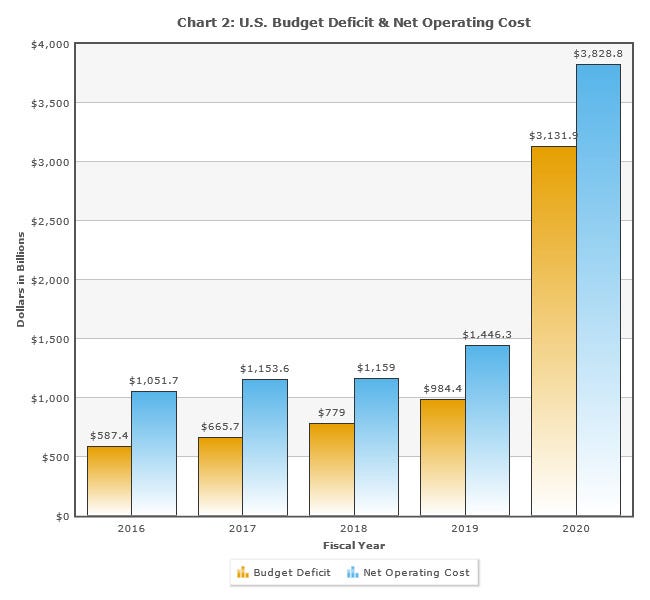
The good news is that the difference between the 2020 deficit and the 2019 is less than pandemic spending.
- 2020 deficit increase: $2.15 trillion
- 2020 pandemic spending: $2.6 trillion
All things being equal, the deficit would have actually dropped by $450 billion.
We are Drowning in Debt
You might have recently heard that the total US debt is $20-something trillion, and rising.
That is only partially true.
Our total liabilities is in the low $30 trillion range, but the current asset of about $6 trillion “reduce” the debt amount.
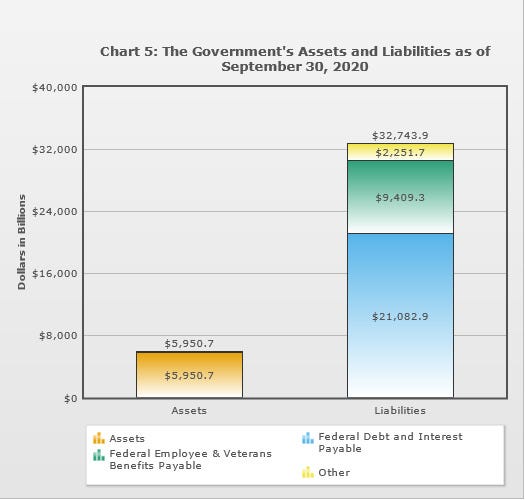
In addition to the federal debt of just over $21 trillion, there is also another $6 trillion in intra-governmental debt that is not reported here but is added to the overall “gross federal debt”, which is subject to the debt limit.
- On March 9, 2019, the statutory debt limit was increased to $22.0 trillion.
- On August 2, 2019, the statutory debt limit was suspended until July 31, 2021.
July is not that far away, and we were already $5 trillion over the most recent debt limit. And that’s before the American Rescue Plan ($1.9 trillion) was passed, with both the American Jobs Act ($2.7 trillion) and the American Families Plan ($2.5 trillion).
No wonder everyone’s freaking out about the low birth rate.
People Pay More Tax Than Companies
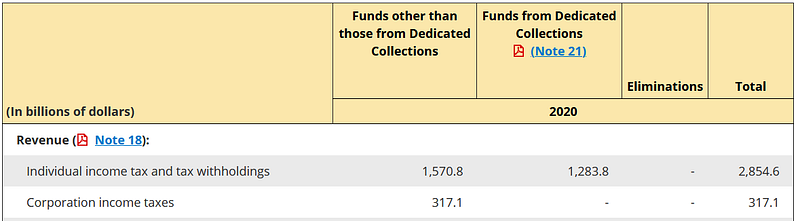
In 2020, individuals paid just over 9x the total amount of taxes as corporations did. There may be a few reasons for this, including:
- There are many more people than corporations
- Corporations have access to tax benefits that people don’t
- The corporate tax brackets are lower
Whatever the reason, this is a huge difference in revenue for the country.
The Trust Funds are in the Red
Social Security and Medicare are in trouble in the coming years, as I’ve written about before. To show just how bad it is, the Financial Report makes 75-year estimates of income and outlays, then values it in today’s dollars.
- If a program is cost-neutral, the net present value (NPV) is 0.
- If a program take in more than it spends, the NPV is positive.
- If a program spends more than it takes in, the NPV is negative.
Here is the NPV of Social Security over the past five years, in trillions of dollars.
- 2016: -14.1
- 2017: -15.4
- 2018: -16.2
- 2019: -16.8
- 2020: -19.7
And here is the NPV of Medicare — Part B over the past five years, also in trillions of dollars.
- 2016: -20.0
- 2017: -22.4
- 2018: -25.1
- 2019: -28.8
- 2020: -33.1
Both program are losing money, and those losses are accelerating.
The Takeaway
The Financial Report is a gold mine of solid, factual information about the status of the United States’ financial affairs.
Regardless of what the politicians say, every citizen can look at the numbers and make an unbiased decision. All it takes is a little work.
The biggest takeaway from the report is that the government’s finances don’t look so hot. In fact, they would look downright horrible if the US didn’t enjoy the largest economy in the world, the dollar wasn’t the global reserve currency, and interest rates were almost 0%.
The Report itself has a section entitled, “An Unsustainable Fiscal Path.”
I feel like a broken record on this one, but no one under 55 can count on Social Security and Medicare during their retirement any more. We’ll probably have to self-fund most everything.
Prepare your finances accordingly.
- If I’m wrong, then you’ll have extra income and health coverage.
- If I’m right, then things are going to be lean for those who didn’t plan.
Remember, while outright panic in the face of an oncoming crisis isn’t helpful to anyone, but overreacting by over preparing just means you have a bigger cushion that expected.
Most Recent Stories
- Falling Birth Rates Will (Probably) Destroy the Economy
- The Forgotten Impact of the Booming Housing Market
- Biden’s Next “Big F***ing Deal”
- April’s Jobs Report Was a Disaster
- Student Loan Borrowers Just Got a Friend in the White House
Don’t miss my next article! Click here to get notified when I publish new material.
If you love the articles published in Money. Daily., then become a member of the Medium community and get full access to our full archives.
This article is for informational purposes only, it should not be considered Financial or Legal Advice. Not all information will be accurate. Consult a financial professional before making any major financial decisions.