
Social Media Gave People The Power to Destroy Themselves
And The World Is Not Prepared
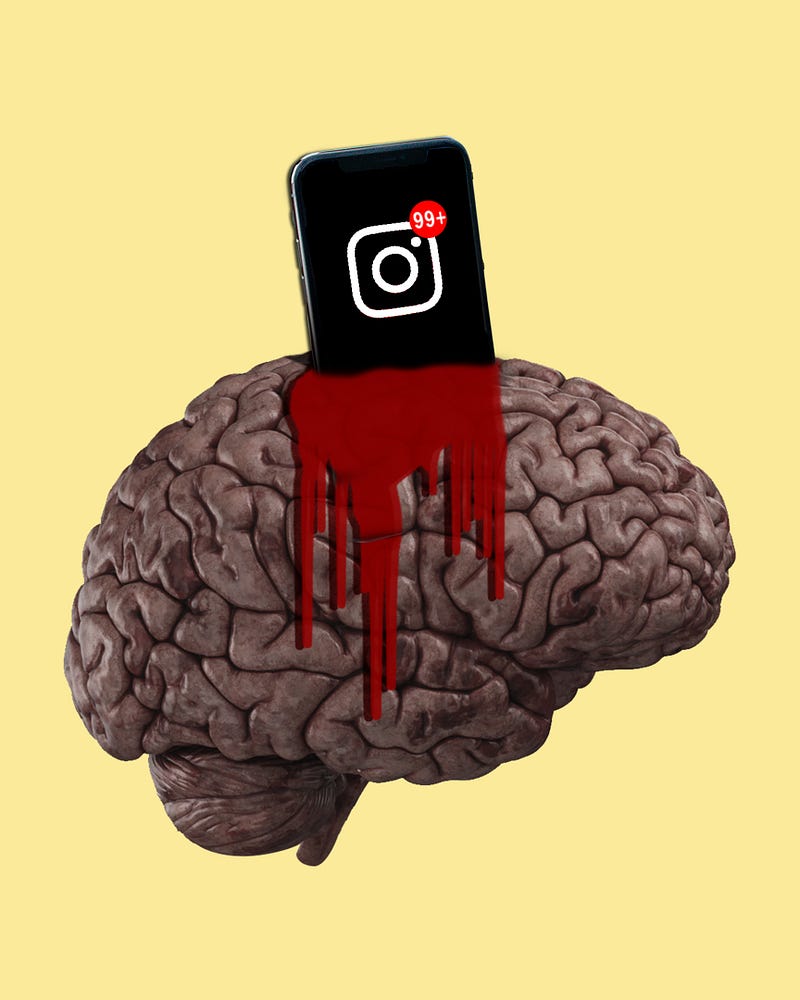
Ever since the rise of Facebook — and, by some accounts, even before that — social media has been a questionable forum, to say the least.
With the emergence of other viral platforms, such as Instagram, Twitter, Reddit, TikTok, and others, the Online Empire of Hatred and Cringiness has become something of a natural force whose seismic waves regularly result in telluric impacts that are actively shaking and transforming the world we live in.
As somebody who is not (and has never been) keen on social media, the complete portrayal of its toxicity and, above all, bottomless ignorance, has only fully hit me in the last week. And the circumstances surrounding the how and why are more than disturbing.
I assume most of you have either heard of or already watched the movie Barbie, based on the iconic Mattel doll and directed by American film director Greta Gerwig. What you might not be familiar with is the way that this summer blockbuster has prompted a cultural divide which, in turn, seems to have given its admirers the unapologetic right to insult, bully, and otherwise harass those who did not enjoy the movie and publicly expressed their reservations or disappointments in regards to it.
If you want a full picture of the debate regarding the Barbie movie and my stance on it, please refer to the following article:
In the aftermath following the re-publication of the article on social media, I received a backlash the likes of which I had never experienced before, not even when making the questionable decision of engaging in political discussions on the Internet. Even more interestingly, the backlash came, first and foremost, from women identifying as feminists. The “comments” that I received ranged from being called “an idiot” and somebody with “less than two brain cells” to some more elaborate insults along the lines of “I thought you looked smart enough to get it [the “message” of the movie], my bad”. Some of these complete strangers who happened to randomly stumble across my take on Barbie then proceeded to stalk my social media accounts and leave more insults under my other, completely unrelated posts. And, once again, all these comments came from women who self-identified as “feminists” and who hailed Barbie as being a vessel for the championing of women’s rights.
This rather specific example of cyberbullying and harassment will come as no surprise to some. In fact, I can hardly think of anyone who has never been gratuitously insulted and/or bullied on social media, or even imagine anyone who hasn’t. Statistics from the Megan Meier Foundation tell us that, in 2018 alone, 59% of U.S. teens have been bullied or harassed online. And that is but a small fraction of the U.S. demographics, not to mention an infinitesimally small fraction of the world population. The list of people who have committed suicide as a direct result of cyberbullying is abysmally long*.
Bullying and aggression on social media come as a consequence of the “veil” of protection that virtuality offers. Unlike face-to-face confrontations, people on the Internet can say whatever they want without having to face any real consequences. This, in turn, offers the chance to vent one’s suppressed rage and frustration onto easy targets, in a cruel form of projection and scapegoatism that offers short-lived relief.
In other words, social media is the perfect medium for non-physical assault on other humans, and its power is fuelled by anger, frustration, hatred, and the unabashed desire to attack others; all things which can be reduced to one primordial element: ignorance.
Social media is the perfect medium for non-physical assault on other humans, and its power is fuelled by anger, frustration, hatred, and the unabashed desire to attack others; all things which can be reduced to one primordial element: ignorance.
Social media allows ignorance to thrive in a myriad of different forms, from the spreading of conspiracy theories and fake news to systematic practices of discrimination.
Social media allows ignorance to thrive in a myriad of different forms.
Most social media users are quick to judge, bully, insult, shame, and attack complete strangers for as little as expressing an opinion that differs from the majority’s. Sensitive listeners and articulated arguments are virtually non-existent. It is an Empire of Hatred and Ignorance.
This seems to beg the question:
Is social media inherently “bad” and poisonous to humanity as a whole?
Social Media as a Tool of Destruction
Social media, by itself, is no more of a problem than most inventions that have been created by mankind. It is the use of social media that is the problem. Mankind can be given the greatest power of all, but if they don’t know how to harness it, it can and will be the cause of harm and destruction.
Any man-made instrument that could possibly serve as a weapon is, in itself, innocuous, until it falls into the wrong hands.
There are countless examples of this phenomenon in history. There are even countless examples of this in fiction (anybody here a Tolkien fan?).
Even the ancient Greek myth of Pandora’s Box serves as an example of this. As Hesiod relates, Zeus ordered the creation of a woman named Pandora and gave her as a “gift” to Prometheus’ brother, Epimetheus. Zeus also entrusted a jar-shaped object to Pandora — which, in the English translation of the myth, became known as “Pandora’s Box”. Unbeknownst to Epimetheus, Zeus’s gift was actually a planned revenge against Prometheus for stealing fire from the Gods and gifting it to humankind. As the myth goes, Zeus had filled Pandora’s box with all possible evils, including disease, hatred, greed, poverty, war, and death. He had also warned her “never to open it”. Needless to say, Pandora ultimately opened the box, thus unleashing all evils in the world.
It was Pandora’s hubris that led to the birth of all evils that have since afflicted mankind. And while the box had been created by the Gods as an instrument of vengeance, it was the hand of a human that caused it to spread all over mankind.
Pandora’s hubris led to the birth of all evils that have since afflicted mankind. And while the box had been created by the Gods as an instrument of vengeance, it was the hand of a human that caused it to spread all over mankind.
As Pandora’s example illustrates, it seems that the main propeller for the damage that social media has perpetrated is the same issue that’s to blame for most of humanity’s downfalls: ignorance.
Ignorance and, specifically, lack of education are two of the major issues afflicting contemporary society. Additionally, they are two issues that, paradoxically, seem to especially afflict the most developed countries, those where one would expect education to be the least of problems, especially when so much information — and methods of verifying information — has been made free to the general public. And yet, everywhere we look, ignorance and lack of education are rampant.
Let’s consider for a moment French philosopher Jean-Jacques Rousseau’s immortal words:
Man is born free and yet everywhere he is in chains.
Aside from its most literal significance, Rousseau’s statement is a perfect metaphor for the intellectual state of mankind. In most countries across the globe, all individuals have access to at least some sort of education, or free resources to educate themselves. Nobody is born without the basic abilities to learn and understand, and very few people are born without the ability to feel empathy towards others, which is one of the main reasons that propel us to educate ourselves. And yet, everywhere across the globe, man is chained by ignorance. By ignorance, and by everything that stems from it: prejudice, discrimination, aggression (either physical or verbal), etc.
Man is born free to learn and grow, and yet everywhere he is chained by ignorance.
And while some may argue that some inventions would definitely ensure a destructive effect, regardless of mankind’s use of it, a number of more nuanced inventions seem to fall into the “gray space” between good and evil. Aside from social media, another possible example of this might be democracy.
Back in Ancient Greece — the original birthplace of democracy — a few intellectuals expressed their less than enthusiastic opinion about the newborn form of government. In fact, one of its most outspoken critics was none other than Plato himself, who described it as the ideal instrument for the rise to power of tyrants, demagogues, and dictators. And a quick look at the 2016 U.S. elections would prove him most definitely right…
However, when taking into consideration Plato’s words, the problem with democracy seems to be the same with social media (which is, ironically, yet another open space for public discussion): ignorance.
With proper instruments of critical thought and, among other things, knowledge of history, demagogues would be very unlikely to rise to power by resorting to populist rhetoric.
Unfortunately, as others have pointed out, critical thinking can be as rare and underdeveloped as a “proper” education, whose very cornerstone should, ideally, be the ability to think critically and independently.
It is, once again, the general lack of education that gives an otherwise innocuous instrument the power to be wielded as a weapon and to cause harm and destruction.
And while spaces for public discussion such as social media and democracy will inevitably involve differences in opinion and clashes of ideas, such clashes do not have to be violent. One’s resort to personal attacks is often a way to mask a lack of proper arguments or the ability to articulate one’s point of view. But nowadays most social media platforms resemble a bloodthirsty mob gathering around the gallows to witness a public execution, rather than a Greek democratic assembly. It is the promise of the spectacle of violence that attracts the masses in the largest numbers.
Nowadays most social media platforms resemble a bloodthirsty mob gathering around the gallows to witness a public execution, rather than a Greek democratic assembly.
A change in the way that we perceive education and lack thereof is necessary and instrumental if we are to build a better society, and social media might just be the living proof of it: just as one cannot extinguish a fire with more fire, one cannot fight ignorance with more ignorance. The only way to defeat ignorance, and all the evil that comes with it, is to promote and value education. Until then, the fire will keep raging, and it will keep destroying.
* Strangely enough, most online statistics exclusively focus on teen suicides but leave out percentages related to adult suicides caused by cyberbullying and/or online harassment.
Want to keep reading? Check out these similar articles!
Sign up for Medium through the author’s affiliate link and get instant access to unlimited articles, or show the author your support and appreciation by buying her a coffee!


