
We All Wish We Had Our Own Truman Show
Our generation’s voyeuristic obsession with observing and being observed
I recently witnessed something on social media that deeply disturbed me. That, by itself, is hardly news. And yet, this was incredibly disturbing even by social media standards. And the more I thought about it and what it meant, the more I became terrified by my conclusions and the story those conclusions told about myself and my generation.
Without giving away too much information, I will simply say that I witnessed a female content creator and self-proclaimed feminist completely annihilate her own personality and replace her entire social media brand — which was initially dedicated to her own, genuine persona, interests, ideas, and professional experience — with one that literally revolved around her man and her relationship with him. And I witnessed her abandoning multiple projects and activities she had invested an enormous amount of time and effort and personal growth in, just to dedicate herself full-time to the “brand” she had built, the brand that was her seemingly ideal romance with this one man. To me, this was shocking and disturbing, but even more disturbing was the fact that, no matter how hard I tried to deny it, this spoke volumes of truth about countless young women, including myself, and about Millennials and Zoomers alike.*
One part of me was particularly disturbed by this because, no matter how “morally superior” I positioned myself in comparison to this woman (“I would never let my partner become the revolving center of my life”), it wasn’t hard for me to recognize that I could’ve fallen into the same trap. A great partner and a seemingly ideal relationship are what our voyeuristic, Truman Show-aspiring, social media-hypertrophied brains secretly long for. Why? Because we have been exposed to social media, willingly or otherwise, for so long and in such copious amounts, that we’ve started to believe that life is supposed to look a certain way.
A great partner and a seemingly ideal relationship are what our voyeuristic, Truman Show-aspiring, social media-hypertrophied brains secretly long for. Why? Because we have been exposed to social media, willingly or otherwise, for so long and in such copious amounts, that we’ve started to believe that life is supposed to look a certain way.
Even those of us who try not to pay attention to the ever-growing, ever-horrifying influencer culture can’t help but notice how pretty that one picture of a luxurious, exotic vacation in some remote tropical island looks. We can’t help but look at that perfectly captured picture of a luscious brunch on a beautiful Sunday morning and wish that was us, and assume that if it was, we would finally feel that rush of serotonin and endorphins we’re so desperate for. We can’t help but long for something that’s as idyllic and carefree as that one, perfectly airbrushed Instagram picture. We want that eye-pleasing appearance that gives us the comfort and illusion that life might actually be that glossy, pretty, and picture-perfect.
We can’t help but long for something that’s as idyllic and carefree as that one, perfectly airbrushed Instagram picture. We want that eye-pleasing appearance that gives us the comfort and illusion that life might actually be that glossy, pretty, and picture-perfect.
What seems to currently define our generations — Millennials and Zoomers — in the eyes of older generations are two elements: our social media presence (or addiction, depending on your persuasion) and our sharp statistical increase in mental health issues. Someone, somewhere, is telling us that those two things are linked.
In an age where everybody can get their fifteen minutes of fame, where everybody can put their faces out there and display their more or less artificial lifestyle, our expectations as to what life is supposed to be and look like are beginning to shift. We gradually begin to lose touch with what is real and what is a carefully crafted image of reality, a hologram.
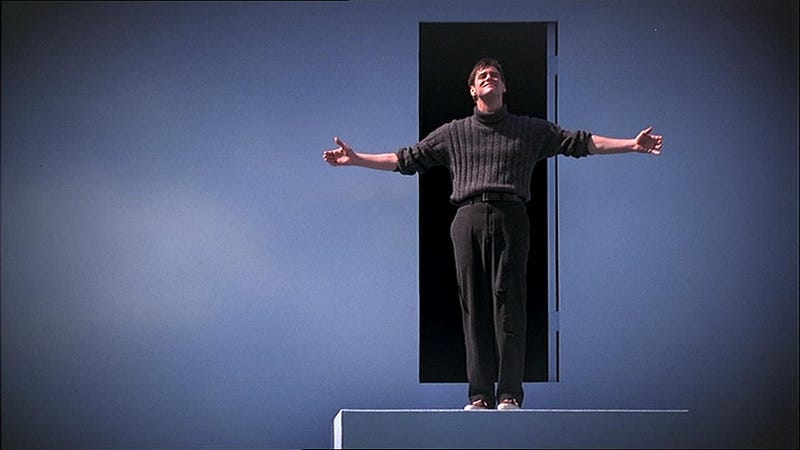
We are not trying to escape from The Truman Show, we are trying to build one, to “create our own brand”, that is, a reality where people are looking at us and our photogenic lifestyle with active interest, curiosity, and even awe. Because, in an age where everybody can become famous, we don’t want to be a no one.
In a way, social media has become to our generation what advertisements were to the average American family in the late 50s-early 60s: a blueprint for what society expects us to be. And, considering that those same, repetitive images of smiley couples and too-perfect-to-be-true bodies are everywhere, we can’t help but feel the need to conform in order to belong.
And again, this is mostly due to the aesthetic appeal of it all: we can’t help but notice how pretty, how appealing, how perfect it all looks. As if the promise of happiness was laying right there, in those frozen smiles and photoshopped pictures. It almost looks too good to be real. And guess what? That’s because it’s not.
We are not trying to escape from The Truman Show, we are trying to build one, to “create our own brand”, that is, a reality where people are looking at us and our photogenic lifestyle with active interest, curiosity, and even awe.
Not that long ago, I read an article where the author drew parallels between the 1998 classic The Truman Show and what our lives have become. However, the author interpreted this social phenomenon as a dystopia that had been enforced upon our young and naive minds. I would like to offer a different perspective: I believe it was our generation who actively embraced the idea of a customized Truman Show and gave it the power it currently holds over us. We want to be looked at, because we believe that being looked at means that we matter. It is our fragile egos that have contributed to creating the voyeuristic world we now live in, and, for some of us, it is unimaginable to forfeit that world.
We all, secretly want our own Truman Show. We want to be looked at, approved of, loved, and even worshipped at times. It is by acknowledging this unsavory reality that we can begin to move away from it.
* I had the dubious privilege of being born in 1996, the year that just so happens to have been placed by sociologists on the borderline — I hate that word but that’s a story for a different time — between Millennials and Zoomers. Therefore, there is no general consensus as to whether I, or people born in the same year as I, are Millennials or Zoomers. When looking at myself and the way I’ve been raised, I definitely see elements of both. Which is also terrifying.
Want to keep reading? Check out these similar articles:
Sign up for Medium through the author’s affiliate link and get instant access to unlimited articles, or show the author your support and appreciation by buying her a coffee!