
We’re Living in a 1990s Science Fiction Movie— And It’s Not The Matrix.
Social media has changed everything… even real life
I was born in 1992.
As such, I was lucky enough to experience the world before and after the invention of social media.
From adjusting rabbit ears on tube televisions to streaming hours of content with the tap of a finger, I’ve seen the world evolve into the semi-fictional blip in time we call the present.
Social media has not only changed the way we consume media — but the world around us.
It’s allowed muted voices to be heard and expanded the horizons of talented entrepreneurs around the world. But, it’s also split our current reality in two — bringing with it a litany of mental health hurdles.
Here’s how being born pre-1997 makes you a trailblazer, as we look to navigate this new world. And how it’s become terrifyingly reminiscent of a 1990s science fiction classic.
Growing up, Fridays were movie nights.
For as long as I can remember, after dinner on Fridays, we’d head over to our local Blockbuster to pick up movies for the evening. My parents divorced when I was young, so each week offered a different flavour:
- At Dad’s, we watched action thrillers, comedies, and Kung-Fu classics
- At Mom’s, we stuck to romantic comedies and 1800s period pieces
But one movie fell somewhere in the middle — and changed everything for me.
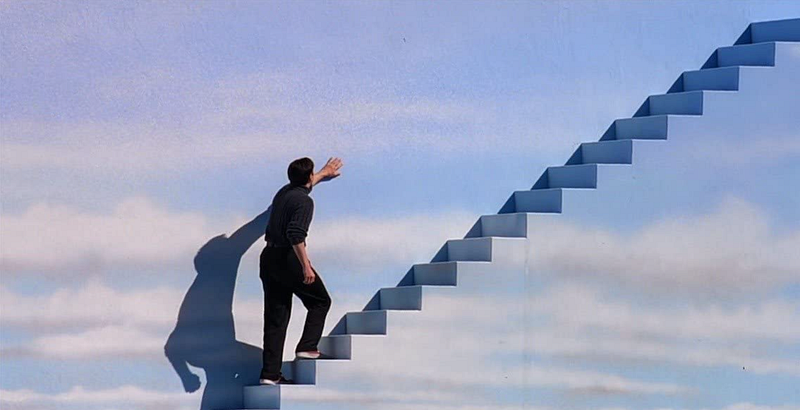
“The Truman Show”, starring Jim Carey, foreshadowed a fictional world that would soon become our reality.
If you’ve never seen the 1998 classic, here’s a quick synopsis:
Truman Burbank is a 30-year-old insurance salesman, living a mundane existence in the suburbs of Seahaven Island. The only interesting thing about him is that his entire life has been unknowingly built and broadcast for the entertainment of millions of viewers around the world. As Truman begins to uncover the truth, he is tasked with a difficult choice. Accept his reality — or fight against the only world he has ever known.
Although at the time, the movie seemed like a fantasy world, cleverly conjured up by creative writers, it’s amazing how true it rings, today. With more of life existing virtually, the idea of privacy is slowly fading away.
In the past, the idea of large corporations spying on you and using your personal information to manipulate your habits, was reserved only for tin-foil-touting, Orwellian conspiracy theorists.
But today, we accept it as a cost of living online, with social media bringing new meaning to the word convenience.
Any time we visit a new website or download a new app, we accept cookies, allow tracking software to sell our information, and hand our attention over to an algorithm.
It’s what Tristan Harris in, “The Social Dilemma”, calls surveillance capitalism.
Although, unlike Truman, most of us are aware we’re being watched, we’re only beginning to understand the danger of our complicit behaviour.
Here’s how social media has turned society into a real-life Truman Show — and how you can escape from Seahaven Island.
Social media changed everything.
In the past, playing indoors was considered an escape.
Parents would urge their children to get outside and experience the world. Interacting with others, making mistakes, and learning about life — all of this was considered, the real world.
But now, one can exist not only solely inside, but behind a screen:
- You can make friends
- Earn a living
- Order food
- Date
I remember being 12 and interacting with my first girlfriend— it was only ever via MSN Messenger.
With social media being addictive, convenient, and incredibly profitable, it has become the perfect trifecta of irresistibleness. And, has naturally, become ingrained into our society.
Whether it’s applying for jobs, dating, ordering food, or building a business, you must use social media, in some facet, to survive. Although it’s unnatural to interact with thousands, if not millions, of people simultaneously — it has become a part of everyday life.
And for those born into a post-social-media world, it’s begun to wreak havoc on their young minds. A recent study at ORIGIN showed,
“48% of Gen Zers say social media makes them feel anxious, sad, or depressed.”
It also revealed that 61% plan to take a social media break in the near future. The problem is, social media has become so ingrained into our culture, these breaks are often short-lived.
The ability, and necessity, to record, share, and monetize our lives is at an all-time high. Making it more difficult to remain authentic than ever before.
Once a serendipitous green thumb allowing for human life, Earth has now become a set — to film, promote, and market real life.
The world has become a backdrop for the next viral post.
But, there’s good news.
Just as Truman was able to trust his gut, notice patterns, and ultimately escaped from Seahaven Island, so can you.
And, those who remember the world pre-social media can lead the charge as we rebuild the idea of the real world.
Earth is now Seahaven Island.
The Truman Show undoubtedly planted a seed in my young mind.
After watching Truman uncover the string of conspiracies that made up his life, I too became skeptical of my surroundings.
I began living as though I was being watched. When I misbehaved, I looked up at the sky and explained myself to the millions of potential viewers watching. And, during hard times, I trudged on, imagining myself being an inspiration to young people around the world.
While overcoming adversity, I’d stare off into the distance, imagining a close-up of my stoic face.
Although most of this is entirely embarrassing, and on par with the entitled mindset of a young millennial, it helped me adapt to what the world would become. Now, being 30, just as Truman was, I’ve begun seeing patterns in our current reality.
Today, the world is Seahaven Island.
It’s human nature to feel as though we’re the main character of an epic story, even though most of us are nothing more than NPCs (non-playable characters).
That said, regardless of your place in life, if you use technology, chances are, you’re being watched:
- Your search history
- Geographical location
- Who and what you interact with
Today, this may seem like harmless information to give up. But, it’s impossible to tell how it will adapt in the future.
Crimes are already being solved by accessing phone usage data. And expert Geo Mappers can pinpoint where videos were filmed by analyzing street signs and star formations. The information you give up today could be used against you, tomorrow. We see this already, with public figures’ old social media posts being judged by today’s standards.
And, although worrying about the future is not conducive to enjoying the present, it’s important to be aware.
To learn how to use social media — without being used by it.
Here’s how to use social media.
Without being used by it.
The first social media platform ever invented was called Six Degrees. It came out in 1997 and changed everything.
Since then, the rise of social media has allowed nearly everyone on Earth to connect via one platform or another.
Here are 7 social media milestones that shaped our current reality:
- [2003]: “MySpace” allowed regular people to become celebrities based on their style and musical taste. That same year, LinkedIn turned job searching into social media.
- [2005]: YouTube created a hub for the world to share videos. Its partner program would go on to create the first career influencers.
- [2006]: Twitter was born, allowing anyone with a voice to be heard.
- [2007]: Facebook Ads gave marketers advanced insight into their customers, spawning a new age of surveillance capitalism and digital marketing.
- [2009]: the first dating app, “Grindr”, was created. Making online dating more accessible than ever.
- [2014]: GrubHub revolutionized takeout, allowing you to order food to your door.
- [2016]: Instagram introduced stories, making posting more accessible than ever. It’s also, arguably, responsible for the short-form content that dominates the current social media landscape.
And, I’d be remised if I didn’t include one honourable mention. In 2018, TikTok was released in North America, completely changing the way we consume content.
It’s amazing to see how far technology has come today. And, how social media is beginning to re-wire the brains of future generations.
The problem is, human brains aren’t designed for mass interaction. And, so much input causes sensory overload, resulting in heightened levels of stress, anxiety, depression, and lowering our dopamine baselines.
But, if you remember the world pre-social media, you have a leg up in the fight against social media.
In hindsight, my odd obsession with the idea of a real-life Truman Show helped relieve my anxiety when using social media. I don’t worry about my shady search history or old, off-colour Tweets, because, for the majority of my life, I thought I was being watched.
And, since I was young, I’ve made a concerted effort to use social media — instead of being used by it.
Although I got the audience wrong, this early childhood revelation has served me well. Here’s how you can benefit from all the positives of social media, without becoming a prisoner to it.
#1. Don’t abstain:
The truth is, quitting social media, completely, is not an option for most people. Abstaining from social media for short detoxes is great, but inevitably, you’ll find yourself needing it again:
- YouTube is one of the fastest ways to learn anything
- If you’re dating, your social media profiles will be taken into account — and emoji use is a vital skill
- Background checks routinely take social profiles into account. In fact, 74% of employment is now found through social media
Today, not having an online presence is looked at as a red flag, by most people.
And, if you can’t avoid social media, you might as well learn how to use it for good — without relying on it.
You can do this through the following steps…
#2. Get to the root cause:
I’m a big believer in taking holistic approaches to most aspects of life — combining logic, reason, and intuition.
If I find myself addicted or reliant on anything, I first try to dig into the root cause — to find the ‘why’. Then, I zoom out to figure out a healthier alternative.
For example, if you find yourself unable to sit with your own thoughts. Or, getting lost in hours of doom-scrolling, start by asking yourself the simple question, “Why?”
The answer will quite often come out in a jumbled, defensive mess. So, ask it again. “Why?”
I like to do this as a journaling practice I call “The Why Dig”. I write each answer down, then dig a little deeper. After 5–10 rounds, I usually get to the root cause.
It always comes down to 1 of these 2 things:
- Avoiding pain
- Chasing pleasure
**Discovering the root cause of an issue won’t solve it, altogether. But it creates a healthy foundation for healthy habits to be built on.
#3. Dive in, then tread water:
Discovering your ‘why’, is a great starting place to begin healing and enact positive change. But, simply understanding the root of a problem is generally not enough to solve it.
Often, drastic change is needed to create positive momentum. You can do this by diving in first, and then learning to swim.
When I was 25, I quit social media.
Being a naturally sensitive human, I’ve always found the overwhelming anxiety attached to social media to outweigh its positives.
So, after trying my hand at the influencer lifestyle, only to plummet into a dark bout of depression, at the age of 25, I felt it was necessary to put myself in a mental rehab — to learn how to appreciate real life.
So, I went cold turkey.
I deleted my social apps from my phone, stopped replying to nearly everyone in my life, and went dark. Surprisingly, I didn’t feel a strong pull to keep up to date on what others were doing — instead, I felt a deep panic about what others thought about me.
I was sure I would lose friends, followers, and be quickly forgotten about. As if the world would hold a round table event to discuss my absence.
But, any time I did nervously download Instagram or check Facebook Messenger, I noticed that… nothing was really happening. Sure, I missed some DMs and had to update a few friends on my absence, but my day-to-day life didn’t change.
In fact, it got better.
For the next 3 years, I existed without social media.
Without the anxiety of keeping up an online appearance, I allowed myself to grow, develop, fail, and ultimately blossom into the person I am today — a more authentic, centred me.
I learned how to live again — to exist in the real world.
Slowly, I reintroduced social media into my life, understanding its necessity socially and in building one’s career.
This time, with a practical set of rules to keep me from drowning…
#4. Make it your job:
Something I’ve learned over the years is, retirement is a myth.
Humans need purpose — and for that reason, I don’t see myself ever retiring from work. That said, the ultimate goal is to be financially stable so as to choose what purpose you fulfill, instead of being bound to the mighty dollar.
From a biological standpoint, humans are happiest just before reaching a goal. It’s with this, that you can say that a fulfilling life is found along the journey — not by reaching a destination.
And, since you can’t avoid social media, use it to fulfill your purpose.
One of the most positive aspects of social media is how it’s allowed artists to promote themselves — to fund a life of creativity. The idea of the starving artist is slowly fading thanks to the boosted word-of-mouth social media provides.
If you’re passionate about something, there are now one-million-and-one ways to monetize it. And, although money can’t buy happiness, it makes it a whole ‘lot easier to find.
Instead of giving your time and attention away for free, start selling it.
#5. Practical applications:
With everything I’ve just outlined, there’s still one thing missing — ‘how’.
So, combining all the metaphorical concepts about social media (above), here’s how it looks in a practical, everyday sense…
- Use it with purpose: one of the most dangerous aspects of social media, is its ability to prey on our base instincts. It’s how checking your email while sitting down on the toilet turns into 20 minutes of mindless scrolling.
Every time you go to open an app, ask yourself one simple question: “Why am I doing this?” If you don’t have a good answer, don’t do it.
2. Remove temptation: we’re all human. And, sometimes you just can’t stop your fingers from habitually tapping open Instagram or TikTok just so they have something to do.
If you find yourself unable to control your base desires, simply remove the app from your phone. Sure, you’ll likely download it the next time you get bored, but adding in an extra step forces a constant dialogue with yourself. One that will eventually lead you in the right direction.
3. Create what you consume: if you want to be successful creating online, you must know what works and how to speak to your audience. It’s for this reason that creation inevitably leads to consumption.
So, if you don’t want to consume certain types of content, don’t create them. The internet is big enough to find a profitable niche on just about any platform you choose. There’s no need to sacrifice your mental health to be an online creator, anymore.
4. Exploit A.I.: when ChatGPT first came out, it scared the heck out of me. But, as I dive deeper into the world of A.I., I’m learning that there are numerous tools with endlessly positive applications.
One of the biggest for me, is the ability to streamline mundane social media tasks:
- Creating clips out of long-form videos
- Condensing articles into Tweets
- Video/audio editing software
- The list goes on…
Social media is now a part of life, but it doesn’t have to take away from the quality of yours.
Final thoughts: the world is an ever-evolving canvas.
And you hold the paintbrush.
Although our ever-changing world can feel scary at times, know that you always have control over one thing — how you react. Instead of waiting to see how the future will unfold, use the technology at your disposal to paint your dream life.
To summarize — here’s how to use social media for good:
- Humans are the root of all social media
- A.I. can be used as an accessory to human life
- Social media has built a new world — accept it and use it to your advantage
- You can escape from Seahaven Island — but first, you must realize your reality
- Trust your gut to use social media without being used by it.
Lastly, we’re living in strange times. But, every generation feels that way.
Hi, I’m Hudson! I hope you enjoyed this story. If you did, consider becoming a Medium member. For $5 a month, you’ll get unlimited access to stories like this one. Plus, you’ll be helping support me as a writer, as I will receive a portion of your membership fee at no extra cost to you. Click here to get started (+1,000 karma points). ❤️🙏
💸 Join 500+ people who enjoy getting free stuff (online store). 🧘