
I Used ChatGPT to Compete With My $200+ Article. Here’s What Happened.
And what I learned about the future of writing.

A few months ago, the world exploded with the release of OpenAI’s new question-and answer-platform, ChatGPT.
Immediately, speculation erupted as to what it would mean for writers.
With the free platform’s ability to write smart words succinctly while solving complex human problems, many writers feared for their jobs.
So, not wanting to live in fear, I decided to acquaint myself with the new platform on the block — to see if it could really write me out of a job.
Here’s what I learned about artificial intelligence and the future of writing after testing ChatGPT’s article-writing capabilities.
Putting it head-to-head with one of my own.
First, what the heck is ChatGPT?
If you haven’t heard of ChatGPT, it’s the first 100% free text-based artificial intelligence (A.I.) platform — open to all consumers.
The company behind its release is called “Open AI” — a research lab turned consumer A.I. technology company based in San Francisco, California. The company initially launched in 2015, gaining mainstream notoriety for receiving an initial investment from Elon Musk.
**In fact, Elon even sat on its board of directors until 2018 — leaving to avoid a ‘conflict of interest’ with Tesla.
Although A.I. writing tools have been around for years, ChatGPT’s launch revealed one thing to the world — the power of text.
Upon its launch, in November 2022, savvy consumers begin testing ChatGPT’s capabilities — some using it to code entire websites in a matter of minutes. Others, asking it to scour the web for security vulnerabilities in major banks. Since then, Open A.I. had to make adjustments to the platform, realizing the world was not quite ready for such a powerful tool.
ChatGPT also revealed that writing tasks like newsletters, scripts, even blog posts, could be performed in a matter of seconds.
So, I decided to try it for myself — to see if there was anything worth worrying about.
I used ChatGPT to compete with one of my articles.
I’ll be honest — I’ve been resisting A.I. for years.
Being a proud human, I’ve always scoffed at the idea that a computer could do anything (especially creative) better than myself. Then, I stumbled across A.I. art.
**I won’t go too deep here, but programs like MidJourney or Dall-E 2 can create visually stunning pieces of art with a few clever prompts.
And if you think about it, most of our current technology runs on A.I. in some capacity:
- When you’re driving, you ask your Virtual Assistant (Siri or Bixby) to make a call for you
- When you need to find information quickly, Google can pull up a summarized answer for you in a matter of seconds
With this change in perspective, I began looking at ChatGPT differently — not as a competitor, but as a Virtual Assistant.
So, like hiring any new employee, I did a little due diligence.
The first thing I did was asked ChatGPT to write me a list of trending topics for articles. Its response:
“I’m sorry, I am not able to provide you with a current list of trending topics as my training data only goes up to 2021 and my ability to access external information is limited. However, some general topics that are often considered trending include technology, politics, entertainment, and current events.”
Then, I asked it to find me a list of quotes from the book“The War of Art” by Steven Pressfield.
It provided me with an amazing list, but they were inaccurately summarized.
So, I dialled it back a few notches.
I had it re-write an article I had previously written.
The article below — to see how well it could capture a human tone.
**For reference, the article took me 4–6 hours to write, and as of today, has earned just over $200.
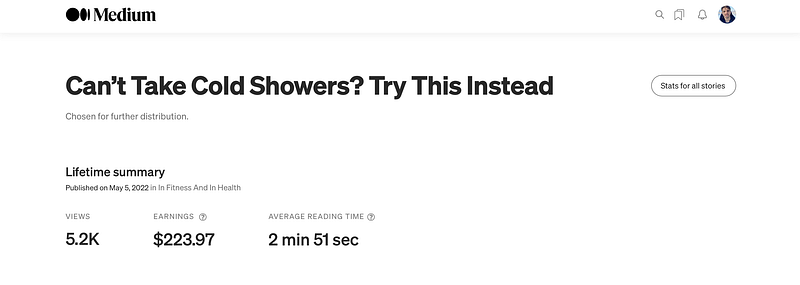
Essentially, the experiment consisted of me having ChatGPT re-write my article, section by section. For example:
- “Write a headline on ______.”
- “Write an introduction on _______.”
- “Write a subheading and paragraph on _______.”
Although ChatGPT is capable of writing entire articles with a single prompt, I wanted to make the end result to be as close to mine as possible.
Then, I would post it on Medium to see if anyone could tell the difference.
👉 If you’re interested in seeing the process in action, you can check it out here.
Here’s what happened.
Initially, I noticed that, like anything in life, there’s an art to writing A.I. prompts.
Writing an article in seconds isn’t as easy as asking it to do so — despite what most YouTube tutorials will tell you.
Just like training a new employee, or teaching a child a new skill, communication with A.I. is its own form of… well, communication. In my first few attempts, I was too general (not to mention polite) with my commands. I’d ask it things like,
“Can you please write an article on the benefits of palm cooling?”
And naturally, the results would be a jumbled mess. Eventually, I got the hang of things and formulated a prompt that worked for almost every piece of writing:
“Write a [type of writing] on [the topic] in a [this tone of voice].”
I also found it helpful to be as specific as possible:
- “Include studies to back up information.”
- “Keep [paragraphs] to a maximum of 300 words.”
- “Write [paragraphs] in a casual, yet educational tone.”
With these commands, ChatGPT actually did a pretty good job:
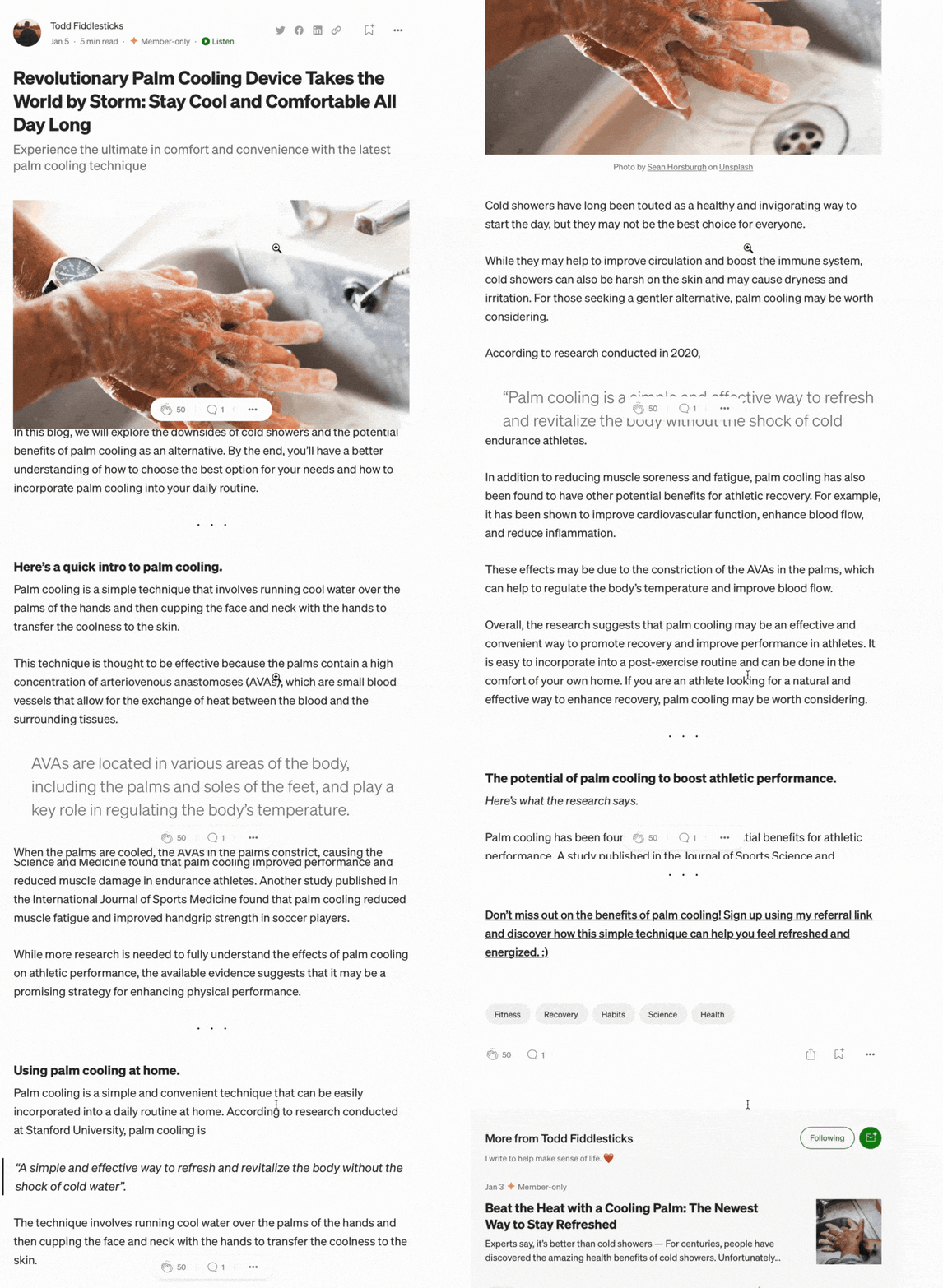
In about 10 minutes, I completed my first draft and copied it over to Medium. I then went through and adjusted formatting, headings, and editing — you know, giving it a human touch.
All in all, it took me about 20 minutes to create this article, using the following free tools:
Here’s what I learned.
All in all, I was quite happy with the result of this experiment, for 2 reasons:
- ChatGPT has some amazing capabilities
- I wasn’t able to produce anything close to quality human work
Yes, it got the job done — but it wasn’t anything I hadn’t seen before.
Exploring ChatGPT’s capabilities has been eye-opening to say to least. Here are my 3 biggest takeaways…
#1. It’s closing the door on one sector of writing jobs:
For blog or e-commerce store owners looking for simple $5 Fiverr articles, ChatGPT may be a cheaper alternative. And, in turn, those who make a living writing basic pieces of writing:
- Re-writing existing blogs
- Simple, informational articles
- Social media posts, listicles, newsletters, etc.
… may be in trouble.
**But, with any new technological innovation comes new opportunities. Those looking to create quick content in mass, may be able to charge for their services of creating bulk content using ChatGPT or other A.I. platforms.
#2. It’s opening doors for creative writing:
Personally, I don’t enjoy writing basic articles, and spent the beginning portion of my freelancing career writing pieces of work I felt could have been outsourced to a computer.
So, to me, the ability to outsource simple, mindless tasks to a computer, is an opportunity for humans to explore more… well, human skills:
- Storytelling
- Creative expression
- Conveying human emotion
I look forward to a world where there is more emphasis on deep thought — and telling unique, human stories. Something A.I. may never achieve.
#3. How you can embrace it to save time and mental energy:
As Charles Duhigg talks about in the book, “The Power of Habit”, one of the reasons why humans gravitate toward habits so much is to save mental energy. And if anything, I look at artificial intelligence tools, such as ChatGPT, as a way to free up mental energy for creative thought.
To act as a free Virtual Assistant for:
- Writing newsletters
- Creating social media posts
- Brainstorming content ideas
I’ve even found it to be a great teacher, offering a path when you feel lost. For example, one of the questions I get asked the most on social media is, ‘How do you get started writing on Medium?’
My answer is not too different than ChatGPT’s:
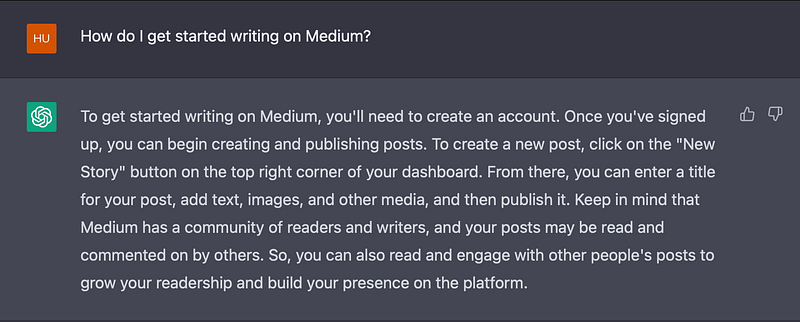
Writing can be isolating at times, and platforms like ChatGPT can act as someone (something) to bounce ideas off of. Having access to the whole of the internet, it can provide you with endless inspiration.
Regardless of if you use the ideas it provides, differing perspectives inspire creative thought. Even if the seed is provided by a computer, it can help you develop original, human ideas.
If you’re interested in using ChatGPT yourself, I made a YouTube video showing exactly how I wrote the A.I. article above. You can watch it, here.
👉 And if you find it helpful, I’d love for you to subscribe to my channel. 🙂
Final thoughts: what it means for the future.
New technology can be scary — especially if it has the potential to make your passion obsolete.
So, I hope after reading this article, you can let out a sigh of relief.
To summarize: ChatGPT has many impressive applications, but deep creative thought is not one of them…
… at least not yet.
That said, ChatGPT can act as a great, free assistant for tasks like:
- Brainstorming ideas
- Writing mass content
- Creating social media posts
- Freeing up mental space to be creative
As the age-old expression goes, ‘If you can’t beat ’em, join ‘em.’ And after my brief experiment, I’m happy to welcome the new writing platform to the block.
To help me do what I love — develop as a writer.
Hi, I’m Hudson. I write about living healthier, happier, and more mindfully… and sometimes writing. To have stories sent directly to you, subscribe to my newsletter.👇
I also share writing tips on my YouTube channel. I’d love for you to subscribe. 🙂🎥


