
18 Years Ago, YouTube Was Born. Since Then, It’s Been A Labour Of Love For Creators.
Here’s a brief history of YouTube.
February 14th, 2023, marks the 18-year anniversary of YouTube.
And, as the mega platform moves on from its adolescence, past its awkward teenage years, and into adulthood, it’s gained valuable life experience:
- What it likes
- Who it wants to be
- How to make money
And, although it can’t vote in the literal sense, Google’s $300-billion prodigal child now controls the media ballots of almost every major political event.
Here’s a brief history of Youtube — where it’s been and where it’s going.
It all started with a trip to the zoo.
Today, YouTube is a mega player in the social media space.
In fact, in 2023, YouTube is the 2nd most-visited website in the world — behind only Google Search, itself.
With 2.2 billion monthly active users, it’s hard to imagine a world where YouTube didn’t exist. But, less than 2 decades ago, it was just another startup walking on shaky legs.
Here’s how YouTube was born.
YouTube was founded in 2005, in Mateo California, by 3 ex-PayPal employees: Steve Chen, Chad Hurley, and Jawed Kari. And, although the trio still can’t agree on where the idea for YouTube came from, it would go on to divide, conquer, and connect the entire world:
- Chad and Steve remember coming up with the idea for YouTube in early 2005, after having difficulties sharing videos taken at a dinner, at Steve’s San Francisco apartment.
- Karim recounts things differently (as he wasn’t present at the dinner). He remembers looking for, and not being able to find, video footage of the infamous Janet Jackson/Justin Timberlake Superbowl #38 halftime controversy being the catalyst.
Regardless of who, how, or what sparked the idea for YouTube, it undoubtedly came from a desire to create a better video-sharing experience.
**From left to right: Chad Hurley, Steve Chen, and Jawed Karim:
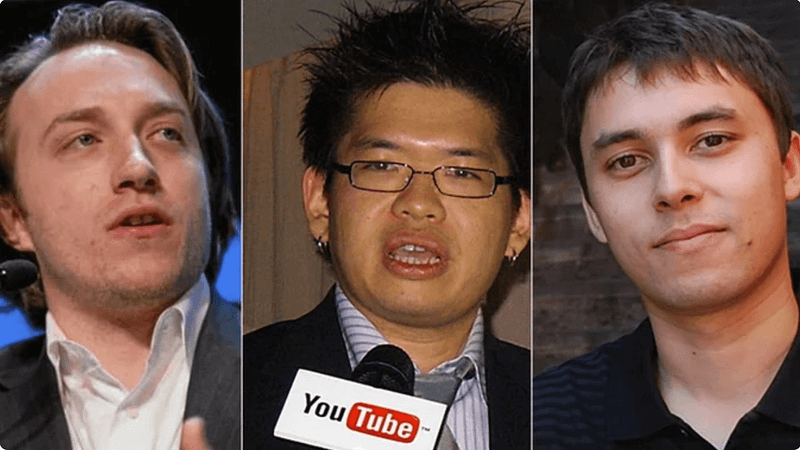

After a mass exodus at PayPal (after being purchased by eBay), the trio decided to start their own business. Although Jawed admits,
“We had no idea how to do it.”
Months after the launch of YouTube, thanks to an initial investment of $3.5 million, from Sequoia Capital, the startup was up on its feet.
On April 23rd, 2005, Jawed Karim, uploaded the first ever video to YouTube, titled “Me at the Zoo.” The script of the entire 18-second clip, filmed at the San Diego Zoo, goes as follows:
“Alright, so here we are in front of the elephants. The cool thing about these guys is that they have really, really, really long trunks, and that’s cool… and that’s pretty much all there is to say.”
Although YouTube wasn’t the first video-sharing platform, it was the most accessible. And, with great marketing and an even better domain name, the website took its first few steps quicker than anyone expected.
In 2006, just one year after its inception, Google announced its acquisition of YouTube for $1.65 billion. With strong corporate legs to keep YouTube moving forward, Google executives brainstormed ways to earn back their investment.
The first, was introducing new methods of monetization such as YouTube Premium and Google Adsense.
A pairing that would go on to change the creator economy, forever.
YouTube’s fruitful adolescence.
With the backing of the largest search engine in the world, YouTube’s rise was nothing but monumental.
And with such a large investment to recoup, it immediately began brainstorming ways to monetize the free platform:
- Premium content
2. A revenue-sharing program
One of YouTube’s keys to success over the years has been its focus on creating an economy of creators. Although platforms such as Twitter, Facebook, and MySpace were popular at the time, the split between creators and consumers was lopsided. With only a few key creators, and the vast majority of people simply logging on to consume content.
YouTube was one of the first platforms to promote the concept of a creator economy. One which incentivized users to not only consume content, but create it as well.
In 2007, YouTube introduced the ingenious slogan of “Broadcast Yourself”:
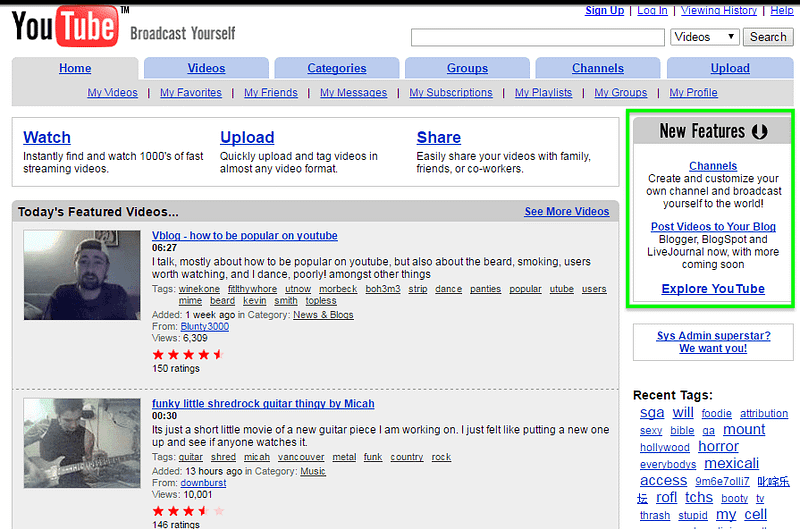
In addition to new features such as community groups, messaging, and blog integrations, YouTube began paying its creators through Google Adsense revenue sharing.
If you’re new to the concept, here’s a quick breakdown…
Prior to YouTube, it was far less common to make a living on the internet. To do so, you either had to host your own blog/website or offer external services through the big social media platforms (Twitter, Facebook, MySpace).
But, YouTube bridged the gap between consumers and creators through its Google Adsense program. In 2007, YouTube began running ads at the beginning of popular videos in which marketers could buy ad space — just like they would on a billboard or website.
Creators who met specific requirements could join the YouTube Partner Program, in which they shared in the revenue from the ads. This revolutionized the social media industry, as for the first time, the average consumer was able to post content and earn directly from it.
- 4,000 watch hours
- 1,000 subscribers
Depending on a variety of metrics (including how long viewers watch ads, click on them, etc.), YouTube calculates what is called a “CPM” — or clicks per 1,000 impressions.
Creators keep 55% of this CPM (known as “RPM”) and Google keeps the other 45%.
After the introduction of YouTube’s partner program, the amount of content on YouTube skyrocketed. In 2007, The Daily Telegraph wrote,
“YouTube consumed as much bandwidth as the entire Internet in 2000.”
And from there, the creator economy blossomed, with revenue sharing becoming a popular way for social media platforms to grow. More on that later.
That same year, with a newfound incentive for the world to begin uploading its best content to YouTube, the first batch of viral videos emerged:
- “Lazy Sunday” (a short SNL skit) was the first video to ever go viral, according to YouTube lore.
- “Evolution of Dance” (by Judson Laipply) was a close second, with 311 million views, to date.
And, on April 1st, 2007, one of the most famous memes in YouTube history was born — the infamous “Rick Roll” video:
As an April Fool’s prank, a link advertised as a trailer for the new“Grand Theft Auto” game brought users to the music video for the popular 1987 song, “Never Gonna Give You Up”. It has been used as a running internet prank, ever since.
As YouTube’s popularity grew, so did its creator economy. Eventually, YouTube moved on from silly cat videos and viral memes, to a place real creators chose to house their art.
And with that, as YouTube entered its awkward teenage years, the first batch of YouTube millionaires were born.
YouTube’s awkward teenage years.
In the mid-2010s, the internet landscape was unrecognizable from today:
- TikTok wasn’t a thing
- MrBeast was unsure if YouTube was going to work out for him
- Donald Trump was revered as a larger than life, reality television star
- Elon Musk’s net worth was a 1/4 of what it is today (as was his head of hair)
In 2010, 35 hours of content was being uploaded to YouTube every minute — by 2020, this number had shot up to 500 — that’s 8 hours of new content every second.
With this boom in content creation, YouTube trends changed rapidly. And as YouTube emerged from its adolescents into an awkward teenager, so did its content.
Comedy skits, pranks, and utterly cringe-worthy music videos dominated YouTube’s trending pages.
Contemporary classics, like the Gangnam Style music video, had set new standards for virality — being the first video to ever reach 1 billion views.
And seeing the success of these early viral videos, young motivated entrepreneurs began seeing YouTube as an avenue toward fame and fortune.
The term “YouTuber” went mainstream and these early influencers began hacking YouTube’s algorithm to create the most viral content possible. One key was the realization of YouTube’s very young (and very lucrative) audience.
YouTubers like Jake and Logan Paul capitalized on this, creating vlogs depicting their elevated lives — full of stunts, pranks, and lots of friends. Fulfilling the after-school fantasies of billions of young people around the world.
And, the most popular videos on the platform included internet beefs, fights, clickbait titles, and poorly scripted prank videos.
In 2018, as YouTube entered teenage-hood, the top-3 highest earning YouTubers were:
2. Jake Paul (earning $21.5 million)
3. Dude Perfect (earning $20 million)

From 2018–2021, YouTube paid out $30 billion to its creators — many of the highest earners being teenage millionaires who weren’t afraid to flaunt their newfound wealth. This spawned a culture of clout-chasing and internet beefs — usually settled through cringy music videos and poorly-acted apologies.
And although this was admittedly a dark spot on YouTube’s timeline, it created one positive byproduct — a desire for quality content.
A gap future creators would fill in, in spades, as YouTube moved into adulthood.
YouTube has now entered adulthood.
Even just 5 years ago, the idea of being a full-time YouTuber felt like a pipe dream.
But, as more creators have successfully made the leap from conventional career paths to pursuing their passions online, it feels far more attainable for young people.
In fact, a 2022 study showed that,
“1 in 4 Gen-Zers plan to become social media influencers.”
Although not everyone can influence, and the idea of chasing fame or fortune for the wrong reasons almost always ends in heartbreak, platforms like YouTube have provided a space for creative people to make a living doing what they love.
And, make a positive change in the world.
Creators like Jimmy Darts and MrBeast have popularized the trend of giving back, earning millions of views from their philanthropic videos. And others, like Rob Kenney, who has dedicated his channel to acting as the internet’s dad.
With so much content now on YouTube, you can find just about any video on any topic you’re looking for. And as YouTube continues to be a lucrative place to earn from creative expression, the quality of content has skyrocketed:
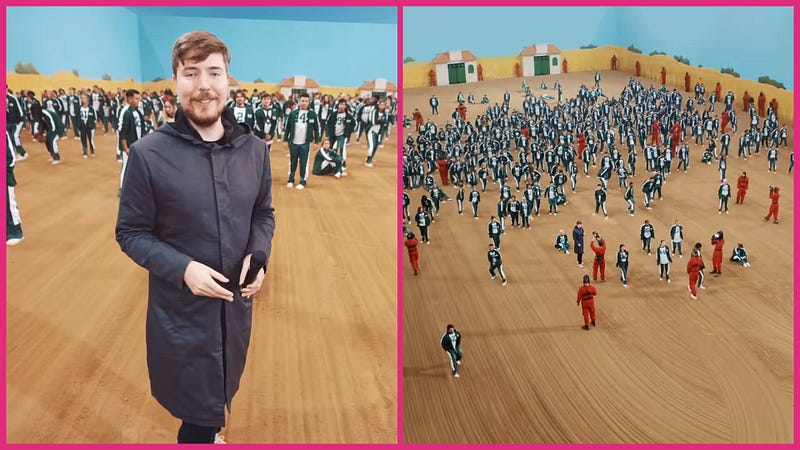
- MrBeast puts on Super Bowl-sized events with every new video — most notably with his “$456,000 Squid Game In Real Life!”. A video, which was been watched more times than the original series.
- Liza Koshy used YouTube as a launching pad into mainstream fame — now starring in Netflix movies and interviewing celebrities during fashion week.
- Sonny Side’s “Best Ever Food Review Show” rivals any food show on the Food Network.
YouTube has also become a place for performers to market their work, with some of the biggest names in comedy choosing to house their specials on YouTube as opposed to large streamers, like Amazon or Netflix.
In fact, Andrew Schulz recently bought his special back from a popular streamer for $1+ million just to post it on YouTube — seeing the benefit in exposure over a one-time payout.
Although YouTube still has a very young demographic, with its most-popular video being “Baby Shark” (with 12 billion views), it’s become a place for everyone of every age.
Like modern-day television.
So, what’s next for Youtube?
Like many 18-year-olds, YouTube has begun to form its own opinions on major world events. But, with a $300-billion valuation and more than $1 billion active users, it’s in a unique spot — with the power to influence how information is shared.
We saw this during the 2020 pandemic and when controversy struck following the 2021 presidential election. YouTube was no longer able to remain impartial. It had some tough decisions to make.
In the end, YouTube decided to play the role of censor, banning and demonetizing what it deemed political hate speech or misguided health information, with a new “misinformation policy”. This caused many creators to look for other alternatives. Most notably influencing Joe Rogan’s decision to move his wildly successful podcast, “The Joe Rogan Experience”, to Spotify.
It also made way for uncensored platforms, like Rumble, to gain its first 100 million users.
Like any public figure, great power comes with great responsibility, and YouTube has had many important decisions to make, in recent years.
As content has become the currency of the future, and large social media platforms have a direct impact on how information is spread, they are tasked with the nearly impossible job of drawing a moral line in the sand.
An issue that has become a hot topic of discussion in recent years — and will continue to be.
Final thoughts: it’s been a labour of love.
Since its inception on Valentine’s Day, 18 years ago, YouTube has been a labour of love for its creators, owners, and partners alike.
Personally, I’ve recently started a YouTube channel, and see the effort the creative team puts into helping its creators grow. With free analytics, training, and a community-based atmosphere, it’s clear YouTube wants one thing for its creators — to create the best content possible.
And, as the landscape of the internet is ever-evolving, we’ve seen numerous platforms follow suit:
- Instagram has begun paying creators for reels
- Twitter recently announced its new creator program
- TikTok’s creator program has revolutionized short-form content
Although as I get older, it’s becoming more challenging to keep up with the latest social media trends, I look forward to the future. To seeing how platforms like YouTube will continue to innovate, allowing humans to express themselves creatively.
Finally, when asked about the serendipitous nature of YouTube being founded on Valentine’s day, Jawed had this to say:
“That’s one of those things about being a computer science major: Valentine’s Day is just another day.”
Hi, I’m Hudson. I write about living healthier, happier, and more mindfully… and sometimes marketing. To have stories sent directly to you, subscribe to my newsletter.👇
💸 Join 500+ people who enjoy getting free stuff (online store). 🧘