
Why Humans Suck At Critical Thinking
And how you can improve your objective reasoning skills
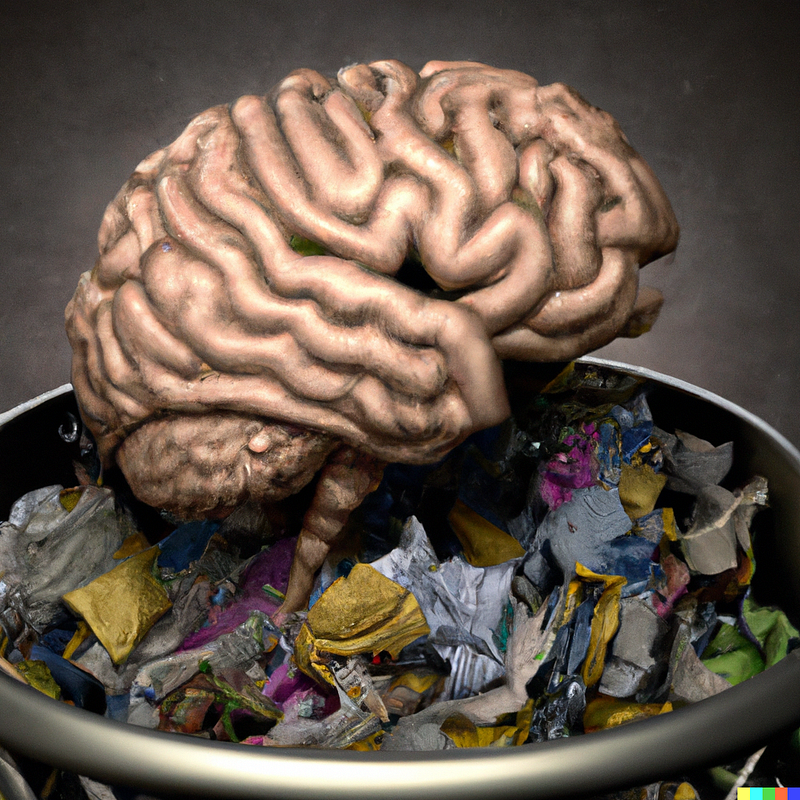
Critical thinking is commonly defined as the analysis of available facts, evidence, observations, and arguments in order to form a judgment by the application of rational, skeptical, and unbiased analyses and evaluation¹.
It’s a fundamental life skill when it comes to solving problems and making objective judgments or choices that may have a widespread impact on many lives, such as in politics, business, or social relationships.
In this article, we’ll first analyze why humans are generally bad at critical thinking and objective reasoning, and then discuss some techniques to avoid common biases.
How thinking works
To understand why it’s hard to make unbiased choices, let’s first take a look at a simplified high-level model of the human thinking process. The human thinker can be modeled as an information-processing machine that holds an internal state.
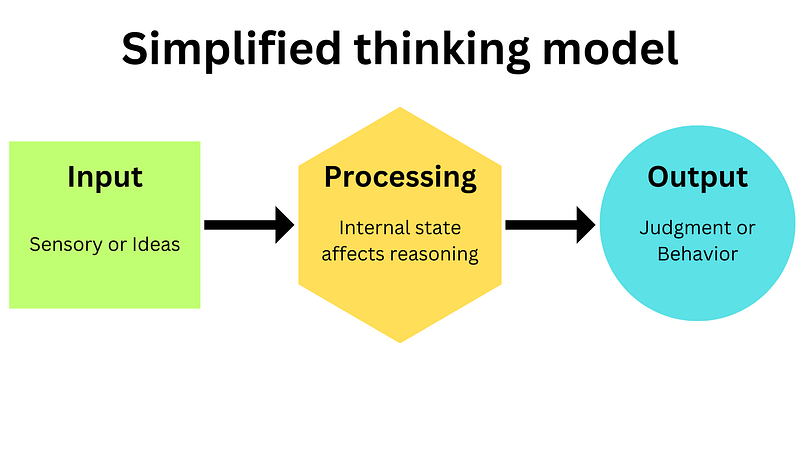
This high-level model is composed of three main steps: input, processing, and output. The input can be thought of as what triggers a thought. It may be an external or internal sensory stimulus or also an idea. A sensory input can be, for example, the sight of a dog. An input idea can be a political statement.
The processing stage is where the internal state affects our reasoning. The internal state can be thought of as a series of parameters internal to the individual, such as past experiences, knowledge, emotions, beliefs, and physiological variables such as hormone levels, blood pressure, hunger etc. The internal state can have various effects on how we handle the input. For example, information may be filtered through a person’s belief system and culture, complemented by knowledge, or handled differently based on their current physiological condition and emotional state. For example, after seeing a dog (sensory input), your brain says, “Oh, I love dogs. My friend Camilla has a friendly pet dog”.
The output is the measurable effect of thinking. The result of the information processing can be a specific behavior or a judgment based on the input data (senses or ideas) and its processing. For instance, after processing the, “I have seen a dog” input, you decide to get down to your knees and pet it (output behavior).
A person’s internal state may introduce biases in reasoning, making the process inherently subjective. In many cases, it’s absolutely ok to be influenced by one’s internal state. However, there are situations in which a biased viewpoint can lead to negative consequences for both you and other people, and more objective reasoning would help you make better choices.
The Dunning-Kruger effect, prejudice, and self-fulfilling prophecy
The Dunning–Kruger effect is a cognitive bias whereby people with low ability, expertise, or experience regarding a certain type of task or area of knowledge tend to overestimate their ability or knowledge². A consequence is that unknowledgeable people are likely to assume their point of view is not biased and that their thinking is flawless.
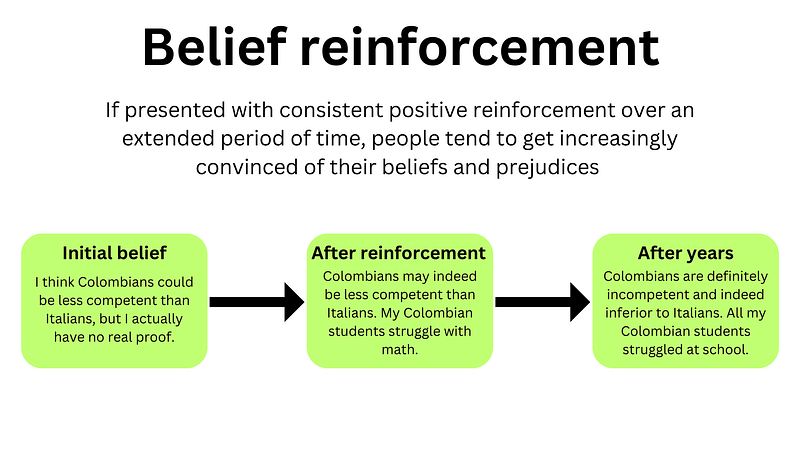
The unjustified assumption of holding the right viewpoint may be caused by limited knowledge and experience of the world. Specifically, the lack of exposure to different standpoints and the presence of prejudice, which is the affective, non-rational feeling towards a person or an idea³. Moreover, positive reinforcement — a consequence that increases a behavior or, in this case, a belief — of prejudice can lead to increased certainty of being right.
For instance, Marco is an Italian middle-aged high-school teacher who has never left his home country. This year, he’s assigned a class with two Colombian immigrant students among the other native Italians. These two guys have difficulty speaking Italian and find it hard to make themselves understood. Marco holds the belief that people from less-developed countries are less capable than, for instance, Europeans. Moreover, the two Colombians have a brownish skin tone, which Marco unconsciously associates with homeless people wandering around his city. The teacher observes that these students generally show confusion during lessons and consistently score low on math tests relative to their classmates. Since performance in math isn’t directly related to language, the poor performance of the two newcomers reinforces Marco’s belief that Colombian students are less competent than Italians, making him even more convinced of his initial assumption.
After continuous positive reinforcement, Marco will be so confident in his beliefs that he won’t even bother questioning whether there may be some underlying factors behind the Colombians’ poor school performance. This is what happens when people consistently experience only one point of view for an extensive period of time. Extended belief reinforcement is also one of the reasons elders and culturally-isolated people are less open-minded.
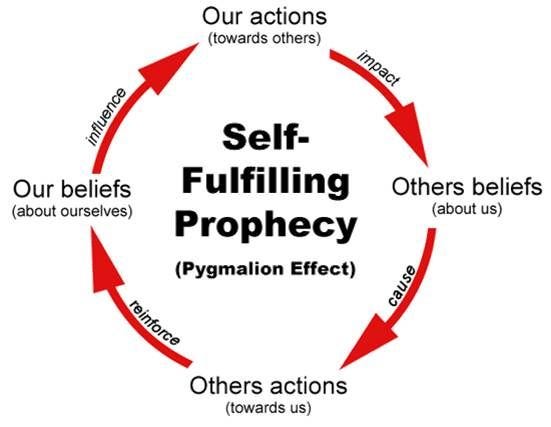
A self-fulfilling prophecy is an expectation held by a person that alters their behavior in a way that tends to make it true. When we hold stereotypes about a person, we tend to treat the person according to our expectations. This treatment can influence the person to act according to our stereotypical expectations, thus confirming our stereotypical beliefs.⁴
Consider this example of cause and effect in a self-fulfilling prophecy: If an employer expects an openly gay job applicant to be incompetent, the potential employer might treat the applicant negatively during the interview by engaging in less conversation, making little eye contact, and generally behaving coldly toward the applicant. In turn, the job applicant will perceive that the potential employer dislikes him, and he will respond by giving shorter responses to interview questions, making less eye contact, and generally disengaging from the interview. After the interview, the employer will reflect on the applicant’s behavior, which seemed cold and distant, and the employer will conclude, based on the applicant’s poor performance during the interview, that the applicant was, in fact, incompetent. Thus, the employer’s stereotype — gay people are incompetent and do not make good employees — is reinforced. Do you think this job applicant is likely to be hired?⁴
While it’s impossible to completely eliminate cognitive bias since it’s a fundamental part of human thinking, there are some techniques you can adopt to mitigate its negative effects.
Discuss with others
Sharing a topic or a problem with others may help you gain a wider view of the situation and become aware of additional standpoints you may have never thought of on your own. Also, explaining your thoughts can help you better frame your ideas.
For instance, have you ever tried to explain a concept or idea to a friend and only then realized, while you were talking, that your point of view was flawed or noticed a relationship that you never thought of? Or have you ever talked to someone only to realize through confrontation that you lacked some fundamental information that would disvalue your viewpoint?
For example, Anna, a psychology student, believes that electric current only takes the path of least resistance. She hangs out with Tom, an engineering student, and decides to talk about electrical safety. She bets that if she touched a stripped wire, she wouldn’t get shocked because her body offers much more resistance to electric current than the wire. Tom, however, dismantles her belief by explaining to her how the current that flows through a path is proportional to the path’s resistance and is not exclusive. Anna lacked the knowledge to make a correct assumption and would have made a bad choice touching the live wire. By discussing with Tom, she gained a wider view of electrical safety.
Try different viewpoints
You can force yourself to think about an idea or statement from the standpoint of another person. This could help you avoid prejudice and subsequent unjustified discrimination.
Bob, for example, is an average middle-class citizen who owns a house. Lucas is a homeless middle-aged man with three children. Lucas and his family struggle with hunger and are constantly near starvation. One day, Lucas decides to break into Bob’s property to steal some items in order to make enough money to live another day.
Bob may think that Lucas is a bad person because he committed burglary against him. However, how would the judgment change if you tried to analyze the situation as seen through Lucas’ eyes? Would Lucas still be considered a bad person, or should he be considered a good father who took the risk, through an illicit act, to feed his family?
As you can see, there can be multiple viewpoints on the same situation. When making judgments, it’s crucial to consider multiple standpoints in order not to fall victim to misinterpretations due to an over-polarized or over-generalized point of view.
Think of it later
Remember how thinking is affected by a person’s internal state. Also, the internal state changes over time. Hormone levels vary through the day and over a lifetime, beliefs aren’t set in stone, and experience constantly accumulates. For this reason, your thoughts are affected by your current internal state. Over time, your perspective might change, and so do your judgments.
Say you have been done wrong by a friend. At first, you might be angry and want to seek revenge. After a while, you feel that you don’t really want to hurt your friend for their offense. During this time, your internal state has changed in such a way that drove you towards a different choice.
When making a choice you aren’t sure about, take a break and wait some time to see if your thoughts have changed after a while.
Keep emotions under control
Emotions, especially strong ones, can and do influence rational thinking, making it less objective. While emotions are crucial to keeping us humans human, there are situations where a more critical approach is required.
Imagine you’re attending a conference about a controversial topic. Joe, one of the participants, has just explained his viewpoint. Sarah, another participant, has a different opinion and starts criticizing Joe’s speech. Suddently, Joe feels like he’s being attacked personally and immediately gets defensive. He raises his voice when responding, his logical steps become cluttered and unclear, and his speech chaotic and incoherent.
Assuming you don’t know Joe, does he show to be competent? Even if his arguments were valid, nobody could have agreed with his point if they didn't understand him because of his emotional outrage and overly defensive position. So, even if Joe was right, he couldn’t convince anyone in the room, and thus he failed to reach his goal.
Internal state analysis
One of the most powerful techniques to reduce your bias is analyzing yourself to see if you actually hold any prejudice or engage in discriminating behavior of some sort. It’s natural to assume that you’re not biased just because you are you, and you know you’re not biased. However, prejudice and discrimination are inherent to human nature since they’re traits acquired as means of survival through evolution.⁵
Analyzing your internal state to find cognitive biases is often done by asking yourself questions such as, “Am I biased on this topic because of my culture?”, “Does my past experience influence my objectivity?”, “Am I open-minded about this specific topic?”.
For instance, Marika is a mother who lost her son to a gunshot by a gang of black men. She now unconsciously holds prejudice against men of color. She also works as a hiring manager, and one day a young black man, Don, shows up for a job interview. He is highly competent in his field and a perfect fit for the position. As soon as he shows up, Marika leaps up and throws a death stare at Don. She was just reminded of how her son was murdered and felt uncomfortable talking to the recruit throughout the whole interview. In the end, despite Don’s competency, Marika may be reluctant to refer him to her higher-ups for hiring because of the negative feelings he experienced during the interview.
During a self-analysis of her internal state, Marika may ask herself in which way her judgment could have been swayed by her past experience or by her current emotions.
Rules of thumb
One effective method to avoid emotional bias is to follow some basic rational rules of thumb. You could tell yourself not to make important choices that may have a large-scale impact on you and on other people in situations when you know your internal state would significantly sway your judgment.
I, for instance, suffer from a major depressive disorder. As a rule of thumb, I force myself not to make critical long-term decisions when I know I’m not in a stable mood, as my reasoning may be strongly affected in a negative way by my emotions and depression-related decreased neural activity in the prefrontal cortex, a brain area associated with rational thinking.⁶
Conclusion
To wrap it up, a cognitive bias is an inherent characteristic of human nature. However, it can prove dangerous or counterproductive when you are to make important, rational, and objective judgments and choices, leading to harmful, discriminatory behavior or regretful decisions.
I hope you enjoyed this article. If you have anything to add, please share your thought in a comment. Thanks for reading!
[1]: Wikipedia. Critical Thinking
[2]: Wikipedia. Dunning-Kruger effect
[3]: Wikipedia. Prejudice
[4]: OpenStax. Psychology 2e. Self-fulfilling prophecy


