
Roles of the United States, China & Russia: Key Issues, Future Scenarios, Strategic Challenges & Opportunities
The Weekend Brief (TWB) newsletter is looking at international issues affecting publicly-traded companies operating in the global markets (including stock markets) at the nexus of tech, industrials and global commodities. It’s important to know the role of the United States, China and Russia within the broad scope of world events.

1. Key Issues
US-China Relationship Is Still In A Trade Conundrum
Of course when talking about the United States-China relationship we should be looking closely at the issues surrounding raw materials because the future supplies are coming from the world’s most vulnerable areas. For instance, I wrote about the BRICS 2023 Summit explaining how expansion comes at the expense of food security. Many of the BRICS members are vulnerable to the global food crisis, and thus their domestic politics will be more volatile in the future. Raw materials scenarios are no exception.
France-China Investment Scenarios Are Getting Problematic
France and China is a different problem. France cannot ignore that the country must be more dependent on China for its economy and trade. However, French leaders can take a stronger stance on their raw materials position vis-a-vis a more problematic scenario for critical raw materials. China also needs France as one of its key export markets, so this will be a big test for how the two countries use leverage against each other for investments.
Russia-Ukraine Maritime Conflict Has Highest Risk
To understand the full picture of maritime conflict between Russia and Ukraine, read an analysis about what’s happening in the Black Sea right now. According to the latest news report, hi-tech naval drones are taking the conflict to a new level of intensity. Drones will allow Ukraine to carry out more precise attacks, while also targeting certain ships or infrastructure of Russia’s Black Sea Fleet. Read more about the Russian Black Sea Fleet in the analysis about what’s happening in the Black Sea.
Russia’s Airspace Control Is A Warning To Maritime Neighbors
Russia’s next move is to take control of the airspace around its maritime borders. This is basically a new phase of the maritime conflict between Russia and Ukraine, as more and more surveillance is being carried out around Russia’s maritime borders. This is absolutely in response to the escalating situation in the Black Sea, as the attacks on infrastructure are still disrupting grain and food exports to emerging markets.
Cyprus Plays An Important Role In East Med Energy Projects
Cyprus’s Aphrodite natural gas field is crucial to the country’s energy security in the near-term. That’s why it must use all of its power and influence to negotiate the best deal for the country’s national interests. This offshore development project will undoubtedly cause international issues, since Israel and Egypt are two of the main beneficiaries of the gas export scenarios. Turkey also has its own interests in a nearby offshore gas field in the Eastern Mediterranean. Since sanctions on Russian energy exports are causing countries to rethink industrial policies, this will be another issue of leverage between Russia and Turkey in the future.
2. Future Scenarios
Food Security In Emerging Markets
Right now, the expansion of BRICS is at the top of the group’s agenda. Emerging markets from Saudi Arabia to Argentina have been allowed to join BRICS this year.
However, this BRICS expansion comes at the expense of food security. While everyone is talking about the BRICS success in capturing the emerging markets, the future surrounding these countries is very uncertain. They are some of the most vulnerable countries to energy and food security dilemmas.
I want to focus here on food security.
Even as the BRICS Summit 2023 is being held, India announced it would ban sugar exports to global markets. This is a lingering effect from Covid-19 policies. Many of the countries producing raw materials have decided to ban exports right out in order to control pricing and supply in domestic markets.
Meanwhile, Southeast Asia is struggling to comabt food security in the region. Rising costs of agricultural commodities during the Covid-19 pandemic disrupted food imports to Thailand, The Philippines and others.
Rice is the key food commodity in this region. During the BRICS Summit 2023, reports about food inflation are pointing to rising costs for rice producers, such as India and Vietnam, which will affect global markets.
By the way, India also became the fourth country to land on the moon this week. This is a nice display of power for BRICS, but banning exports of sugar is a major weakness. What’s the point of BRICS after all? Landing on the moon may impress other BRICS members but it does nothing for the emerging markets.
The volatility in global commodities markets will surely exacerbate the situation between Russia and Ukraine — witness the Black Sea Grain Initiative — as many countries are likely to deepen its dependence on the two countries for grain and fertilizers in the future.
The ongoing effects from the Black Sea Grain Initiative in international politics have raised the issues on global food security throughout the developing world. The issues of concern here have been thoroughly analyzed and covered due to the devestating impacts to food security brought on by Russia’s invasion of Ukraine.
Ukraine is an important agricultural producer and exporter of grain and wheat to countries throughout Africa and the Middle East regions. Russia, on the other hand, is a very important fertilzer producer and exporter for which it has been using as political leverage over the Black Sea Grain Deal. This has given birth to a new concept in international affairs called “fertilizer diplomacy”.
France’s Competitive Position in Emerging Markets
Elon Musk attended the Choose France Summit in Versailles on 15 May 2023, which shouldn’t be a surprise due to the event’s focus on Electric Vehicles (EVs). According to a Reuters report about the summit, Macron has been trying to woo Musk and others to invest in France.
This summit has been held consistenly since 2018. Yet this year’s summit was more significant than others since Macron’s controversial statements on foreign policy, and the domestic issues over the French retirement age, have somewhat overshadowed the international investment fervour.
EVs are very important to the French government.
French President Emmanuel Macron attended the 2022 Paris Auto Show, speaking with CEOs from Renault Group, Stellantis and others, about the developments in the EV market. One of the other standout moments of the 2022 Paris Auto Show was how Chinese EVs stole the show.
Significantly, during the time of the Paris Auto Show, there was a deal made by a French lithium miner, Imerys, to develop a new mine located in Beauvoir, France. This mining project aims to make France one of the European Union’s (EU) top lithium suppliers under the backdrop of increasingly higher demand for EU domestic production of EVs.
The significance of this announcement comes during a time of higher geopolitical tensions with China and Russia over global commodities, raw materials supply chains and the effects from sanctions on industrial policies during the conflict in Ukraine.
Another imporant event for France was the 54th Paris Air Show held from 16 to 22 June 2023.
During the event, French aerospace company Safran Group announced a $1.8 billion purchase of USA defense contractor Raytheon Aerospace Assets. The deal allows Safran Group to expand capacity to manufacture flight controls for aircraft and missiles.
Business reporting on the Safran-Raytheon deal indicates that because of a merger with United Technologies in 2020 that it gave the French aerospace company a step ahead of the competiton for aircraft, helicopters and missiles flight control systems. Indeed, the aerospace industry is booming with increased international travel demand and renewed military and defense cooperation among governments.
Tensions in the Black Sea
Tensions in the Black Sea are heating up. Both Russia and Ukraine have made aggressive statements aimed at provoking each other.
Ukrinform released a statement on behalf of the Naval Forces of the Armed Forces of Ukraine stating that Russian ships passing through a newly proposed corridor for merchant ships will not be observed.
Even while Russian ships have allegedly sought to intimidate other merchant ships in support of Ukrainian trade around the Black Sea, they are reportedly based in the northeastern part of the Black Sea near Russian territory. See the map below:
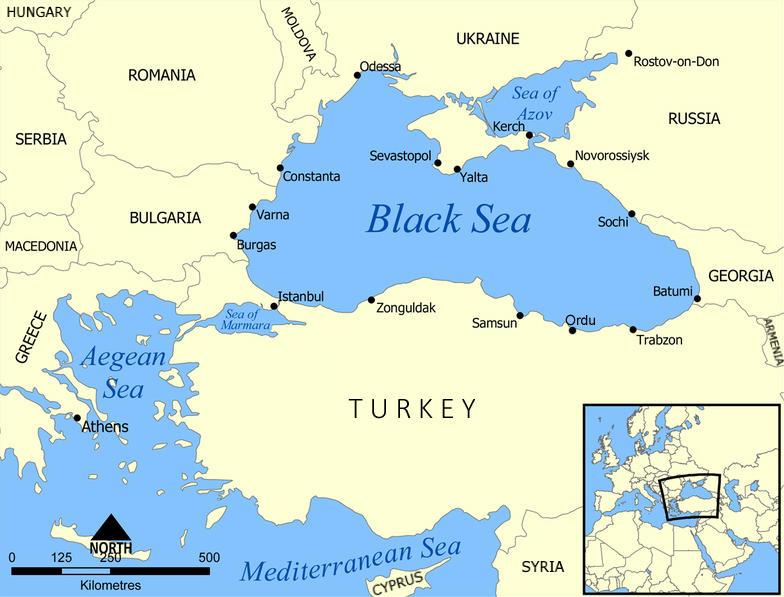
You can see from the map above that Russia’s Black Sea maritime areas include Novorossiyk and Sochi.
Meanwhile, a lot of the merchant ships are being spotted at coastal areas around Bulgaria and Romania. See Varna and Constanta on the map.
It was also reported on 13 August 2023 that Russia fired warning shots, using automatic weapons from a naval vessel, at merchant ships operating in the Black Sea. These warning shots were followed up by a staging and landing manoeuvre carried out by Russian military forces.
These are very serious incidents. Although there have not been any casualties reported, it is the first sign of things to come as more and more merchant ships appear to be resuming activities on the Black Sea. It’s important to remember that the Black Sea is a vital trade route for all of the countries in this maritime area: Ukraine, Russia, Turkey, Bulgaria and Romania.
Ukraine’s Militarization and Re-Building
This is also relevant to what’s happening in the Black Sea right now, since militarization and re-building is commencing in support of Ukraine by its Black Sea neighbours, particularly Romania and Bulgaria.
Romania and Bulgaria are advancing their capabilities as NATO partners. On the Black Sea, the two countries already serve as key links for defense and security cooperation with other NATO members. Now, it appears that the two countries are expanding on their capabilities in arms deals and defense cooperation as a response to Russia’s invasion of Ukraine.
In this scenario the next two countries to watch are Georgia and Belarus.
Georgia has already experienced a Russian invasion of its two seperatist territories, South Ossetia and Abkhazia, in 2008 when Georgia’s leader Mikheil Saakashvili tried to force them into Georgian control. They were previously considered to be autonomous regions of Georgia.
As for Belarus, the situation is a lot more complicated. Belarus is an important fertilizer producer and exporter of potash. Yet it also serves as a strategic location for Russia’s land-based military campaigns, with lots of exercises and training capacity for Russian military soldiers there.
Georgia and Belarus are important political questions for Russia’s future. This war between Russia and Ukraine, however, is increasingly focused on the Russian Black Sea Fleet. That’s why the maritime domain has become so important for what’s happening in the Black Sea right now.
Moreover, proposals to open up exploration opportunities for deep-sea mining are already trying to lift off in Norway.
This is a big development, as many of the world’s critical metals are to be found in the deep-sea maritime areas.
Please go back and read that last sentence carefully — “many of the world’s critical metals are to be found in the deep-sea maritime areas”.
This means one thing only: maritime borders and disputes are likely to reignite tensions between government, in addition to the evironmental, industries and wildlife impact that is the biggest focus from current reporting on this trend.
Critical metals include copper, nickel, cobalt, maganese, lithium, among others. Copper and nickel, along with potash fertilizers, form part of the future-facing commodities push from the global mining sector to increase output for global mega-trends.
Eastern Mediterranean Is The Next Flashpoint
A flashpoint case has recently come into the spotlight over a disputed claim where natural gas discoveries in the maritime EEZ of Cyprus are at the center of the territorial dispute between Greece and Turkey.
On 21 December 2022, it was announced that French oil and gas producer TotalEnergies and Italian oil and gas producer Eni had made new discoveries of natural gas deposits off the coast of Cyprus in the Mediterranean Sea. This part of the sea is referred to as the Eastern Mediterranean, or East Med.
It has been estimated that the offshore gas area of Cyprus can produce 2 trillion tcf, or 72 billion cubic meters (bcm), but territorial issues have come into play between the Turkish Cypriot government and the Greek Cypriot government. The former entity is only recognized by North Cyprus, which was occupied by Turkey in 1974.
The offshore gas exploration and production (E&P) in Cyprus has caused Turkey to accuse Cyprus of escalating tensions with Turkey. The Turkish foreign ministry said that the latest discovery intends to “violate the rights of the Turkish Cypriots, who are one of the co-owners of all natural resources of the island.” Reuters
Since Turkey is one of Russia’s biggest natural gas importers, how this offshore gas project plays out could determine factors in Gazprom’s market share.
These geopolitical trends haven’t caused the EU to stop cooperating with other countries for pipeline infrastructure and renewable energy projects.
A memoradum of understanding (MOU) was signed by Hungary, Romania, Azerbaijan and Georgia, to potentially develop a new source of energy for the EU. It’s a project that will send natural gas from Azerbaijan to Romania via an undersea electricity connector in the Black Sea.
EU President von der Leyen stated that this project was directly tied to Europe’s shift away from its dependency on Russia’s oil and gas supplies.
“Since the beginning of Russia’s war, we have decided to turn our back on Russian fossil fuels and to diversify towards reliable energy partners, like the partners here around the table. And it is working. The European Union has been able to compensate the cuts in Russian pipeline gas.”
In these cases, sanctions on Russia have caused divergent and convergent scenarios for global commodities during the Russia-Ukraine war.
Commodities are global in nature. The only attention being truly paid to regional development is about large investments in infrastructure — these investments do not seek to enhance regional connectivity, but give an advantage to a producing country so that it can more efficiently transport raw materials to markets far away from the original source.
This is the essence of the Arctic Strategy, Belt and Road Initiative (BRI) and Indo-Pacific Strategy: all of them revolve around the maritime areas.
3. Strategic Challenges and Opportunities
Russia’s Arctic Strategy
The talks about reconfiguring supply routes has come in tandem with one of the Russia’s strategic dilemmas: the Arctic Strategy.
Russia’s Northern Sea Route (part of the Arctic Strategy) seeks to increase exports via transshipments of products through North African ports that will reach Asian markets that have a high demand for the base metals of nickel, aluminum and copper, where Nornickel and Rusal could increase production from plants on the Kola Peninsula and in Monchegorsk of the Murmansk region on the Arctic Ocean.
Evidence is already showing that Russia is expanding its oil exports to China via this vital sea route within the Arctic Strategy.
However, since Russia’s industrial policies now favor deeper collaboration with China and the Asia-Pacific region, EU energy regulations have yet to determine how effective Russia’s strategy is to combat the sanctions from the U.S. and EU at present. Because the European region has one of the fastest growing industrial base economies in the world, which means more raw materials are needed to ramp up industrial production, Russia will seek to continue its energy exports to the EU despite the price cap.
The G20 Summit
The Group of 20 leaders, known as G20, met in India to discuss issues affecting the global economy and more. One of the highlights of this year’s meeting appears to be the G20 Energy Transitions Working Group Meeting.
Although the G20 ended without a consensus (big surprise, right?) it is clear that this meeting is setting the tone going forward about one global market aspect of the near- and long-term future: energy.
That’s why I previously wrote about the current affairs of both Algeria and Nigeria in Areas & Producers recently. Algeria is a North African country along with Morocco, Libya, Tunisia, Egypt and Sudan, while Nigeria is considered part of West Africa’s Sub-Saharan region.
They are both OPEC members with significant production and reserves of oil and gas. Though my purpose for Areas is to cover the political and economic considerations of countries, it’s impossible to ignore the dynamics of energy markets in the case of Algeria and Nigeria on the countries’ strategies. That’s why it is essential to know about the global commodities and why countries have a deep interest in emerging markets.
US-China Climate Negotiations
Kerry went to Beijing on 16 July 2023 as the special climate envoy during a heatwave in the People’s Republic of China (PRC). This trip has been seen as an indication of the United States’ efforts to restart talks with the Chinese Communist Party (CCP) on the future of climate change.
In report by CNN World, Greenpeace China senior global policy adviser Li Shuo told reporters: “If anything, this is the situation that should most bring China and the US back on the same page.”
This event reveals a very strange mix of intense climate change notions and geopolitical trends, which is why I’m not hopeful about the outcomes at present. But with a volatile world beset by countless effects from the global Covid-19 pandemic, I don’t think the two sides have anything to lose right now.
The problem is about the future.
Can the US special climate envoy agree to a future negotiation with CCP counterparts in Beijing?
I ask this question in response to BBC’s question — “Can US and China set aside rivalry for climate action?”
To answer that question, I think it’s plausible to talk about whether or not the United States and China are likely to accept having negotiations in the future at all.
The BBC article points this out too — “While their meeting is not widely expected to yield any concrete decisions, it will be seen as a conversation starter.”
But this BBC article points out another key fact about this meeting over climate talks: the United States and China are the world’s two largest carbon emitters and thus the world’s two largest investors in renewables energies.
I actually never understood it this way. I just knew this trend to be about the United States and China getting into the massive business opportunities being presented by emerging markets. Facts work in mysterious ways!
Sign up for TWB newsletter looking at international issues affecting publicly-traded companies operating in the global markets (including stock markets) at the nexus of tech, industrials and global commodities.