BRICS 2023 Summit: Expansion Comes at the Expense of Food Security
The BRICS 2023 Summit was held this week in Johannesburg, South Africa. The Center for Strategic and International Studies (CSIS) covered the event with in-depth interviews and insights on the countries most affected by BRICS.
BRICS stands for Brazil, Russia, India, China and South Africa. They are considered to be the leading group of countries in the emerging markets space.
Here are some key highlights from this year’s summit:
- BRICS want to expand on a common currency and strengthen ties in emerging global economies. France 24
- Chairman Xi advocates for political and security cooperation; President Putin denounces sanctions. Times of India
- Who did Chairman Xi meet with during African Tour? CGTN
- BRICS is becoming an important area for the United States-China relationship and the ensuing rivalry for emerging markets. CNN
- China’s Xi and Russia’s Putin do not attend BRICS Summit 2023; Brazil and India take center stage. Reuters
- BRICS to address “agricultural policies” in light of airlift challenges. Alarabiya English News
Right now, the expansion of BRICS is at the top of the group’s agenda. Emerging markets from Saudi Arabia to Argentina have been allowed to join BRICS this year.
However, this BRICS expansion comes at the expense of food security. While everyone is talking about the BRICS success in capturing the emerging markets, the future surrounding these countries is very uncertain. They are some of the most vulnerable countries to energy and food security dilemmas.
I want to focus here on food security.
Even as the BRICS Summit 2023 is being held, India announced it would ban sugar exports to global markets. This is a lingering effect from Covid-19 policies. Many of the countries producing raw materials have decided to ban exports right out in order to control pricing and supply in domestic markets.
Meanwhile, Southeast Asia is struggling to comabt food security in the region. Rising costs of agricultural commodities during the Covid-19 pandemic disrupted food imports to Thailand, The Philippines and others.
Rice is the key food commodity in this region. During the BRICS Summit 2023, reports about food inflation are pointing to rising costs for rice producers, such as India and Vietnam, which will affect global markets.
By the way, India also became the fourth country to land on the moon this week. This is a nice display of power for BRICS, but banning exports of sugar is a major weakness. What’s the point of BRICS after all? Landing on the moon may impress other BRICS members but it does nothing for the emerging markets.
I want to share an anaysis that is supplementary content for anyone following the BRICS Summit 2023 in Johannesburg. BRICS should be talking more about food security right now, since most of the countries hoping to join BRICS are vulnerable to a global food crisis.
Here are my questions about emerging markets going forward:
- Are African countries more likely to seek favorable relations with the United States or Russia in the future?
- What role will other state actors like China and Russia play in Brazil’s fertilizer diplomacy?
To answer those questions, I am proud to share my latest story published in The Diplomatic Pouch, the Online Magazine of the Institute for the Study of Diplomacy at Georgetown University in Washington D.C.
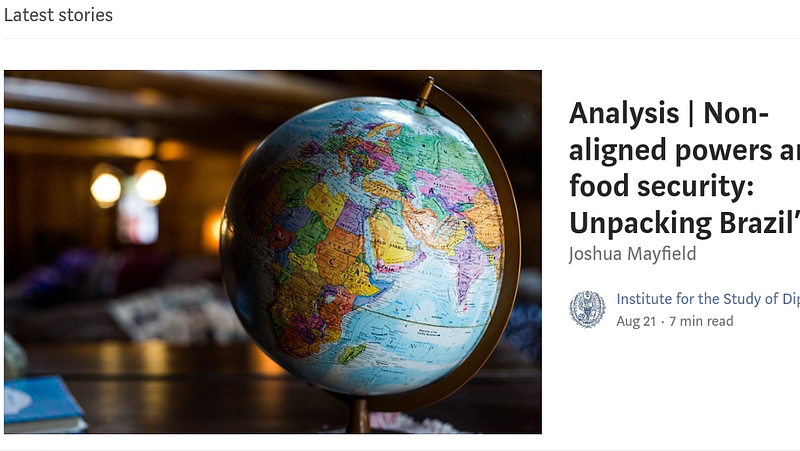
The story is entitled, “Non-aligned powers and food security: Unpacking Brazil’s fertilizer diplomacy under the backdrop of the Black Sea Grain Initiative”.
It was published as an analysis, featured along with other analyses by writers in the publication.
After a brief introduction, the story is broken up into four parts.
1.) How the war in Ukraine has affected Brazil’s fertilizer supplies
- Since Russia’s invasion of Ukraine in February 2022, global fertilizer supplies have been a critical aspect of Brazil’s economy and foreign policy agenda.
- Brazilian government officials went to the Middle East and North Africa (MENA) region for what they called “fertilizer diplomacy” in May 2022. Notably, they held talks with counterparts in Jordan, Egypt, and Morocco.
- These diplomatic visits reveal the priority that Brazil is giving to MENA to ensure diversified supplies of fertilizer imports despite concerns over fertilizer import dependency.
2.) Russia and Brazil are using fertilizer to reshape their diplomatic relationships
- Non-aligned countries like Brazil must treat this situation delicately.
- Global commodities are a critical part of the country’s economic growth and, thus, a vital “carrot-and-stick” toolkit for engaging in diplomacy with other non-aligned states.
3.) How Lula’s victory last year has affected Brazil’s foreign policy agenda
- Lula’s three-day visit to China in April 2023 arguably demonstrates that Brazil has returned to the international stage.
- Lula’s line to the world said it all: “Brazil is back.” What this means for BRICS, however, is that Brazil’s trade relationship with China remains a top priority.
4.) Conclusion
- Brazil is going to play a more important role on the international stage in the future.
- The country’s foreign policy should become more oriented toward the developing world’s economic interests.
Read the full story in Institute for the Study of Diplomacy with this link.
Joshua Mayfield works as a legal analyst and language consultant in Mandarin Chinese, French, and Russian. His international relations research background is in U.S.-Australia relations and the Indo-Pacific strategy. He holds a master’s degree in law from Shanghai’s East China Normal University, specializing in China studies. He manages a publication on Medium entitled, Areas & Producers, covering global markets, advanced technologies, and the latest news stories in international business, finance, law, and politics.


