
A Rock Snob Admits Ignorance
Punk Rock Before the Punk Scene
Take Dr. Feelgood’s prescription for raw-pop, brilliant R&B

I was gardening, transplanting a few azaleas that needed more sun for blooms. My Bluetooth headphones vibrated around my dirty blonde hair — loud enough for the Noise Cancelling feature to be useless for the neighbors.
My finely curated Spotify Clash mix ended. Then this incredible song followed. Who was this? What was this? Had I never heard of this jam?
Why am I still surprised that I am surprised by this?
I racked my brain. I wasn’t finished gardening, but I had to know. My hands were awash in wet soil and leaf compost.
Was there still a great band I didn’t know? How was that possible? Would my Inner Rock Snob admit to such a thing?
Yes. This is it — my humble admission.
After I Washed in my Rain Barrel Reservoirs, I Skipped Back Two Songs
The band? Dr. Feelgood! Isn’t that a really bad (or good) Mötley Crüe song?
No — it’s a band. Und was für ein Unterschied!
And what was that song? “She Does It Right.”
Then I started digging. Every song played while I recuperated from the trauma of Hubris Bruised. Incredible Blues — and Rhythm. And a dose of punk — and some funky boogie-woogie — country twang — harmonica — pre-Beatle pop and jazz?
What the heck was going on?
Later, I even asked my music-crazy coworker Brian. He didn’t know, either. So I didn’t feel too bad. And if you feel bad, drink Dr. Feelgood’s special cup — and you’ll feel all right.
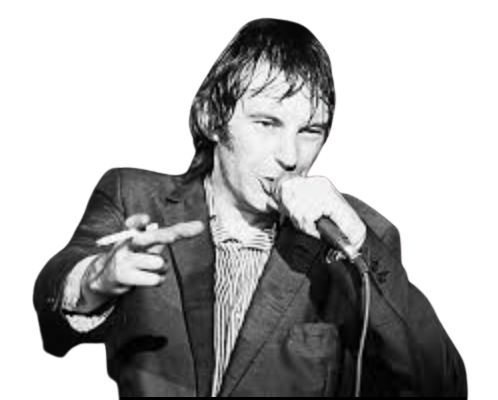
The Charismatic Singer, Lee Brilleaux, Died in 1994 of Lymphoma
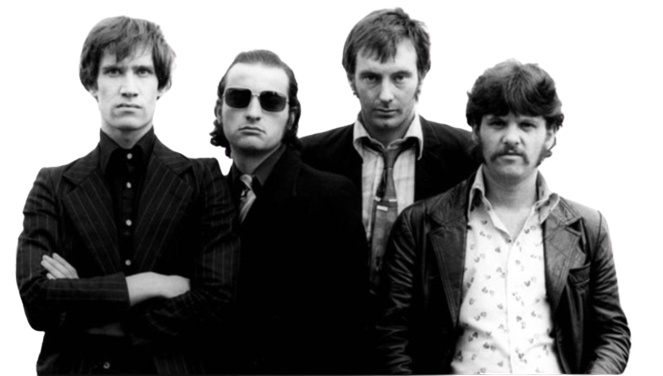
He blew a mighty harp, too. The band started on Canvey Island, Essex, England, in 1971. The name, of course, is street slang for heroin. Or a doctor like Lennon’s “Dr. Robert” from Revolver.
The guitarist Wilko Johnson on lead guitar and vocals is amazing to hear and watch. What an odd-cool-hip-chic presence. Take a look. He’s playing as if possessed. Almost robotic — like a Devo thing. Does he even blink?
Is that lead guitar and chords, too?
And that’s John B. Sparks on bass and someone who goes by The Big Figure on drums and vocals.
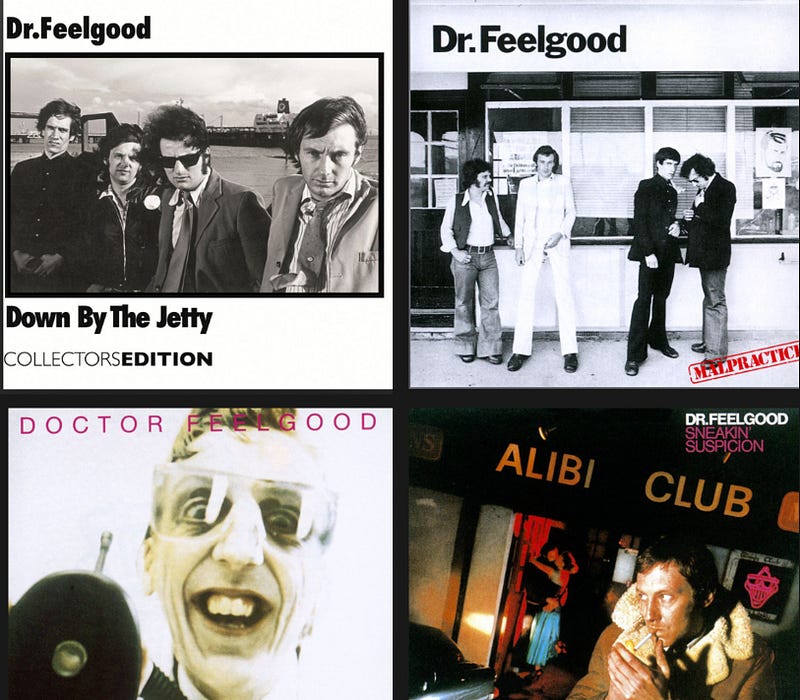
The Band Released Four Albums — from 1974 through 1977
Down by the Jetty, Malpractice, Stupidity, Sneakin’ Suspicions. They stopped recording after disappointing sales of their fourth release in 1977 but still toured almost nonstop. This caused rifts in the band — and not the good guitar riffs. I’ve listened to the first two albums.
Both are stellar.
The current band tours under the same name but with a totally different lineup. Right now, they’re somewhere in Scandinavia, I think. Say hi to ABBA!
“According to legend, their first LP, “Down by the Jetty” (1974) was recorded in mono and consisted almost entirely of first takes. While it was in fact recorded in stereo, the rumor added significantly to Dr. Feelgood’s purist image, and the album became a cult hit.” (link)
Dr. Feelgood is the antithesis of Acid Rock, Country Rock (The Eagles), Prog Rock, and Arena Rock. I see them as a precursor to the angrier, harder-edged Sex Pistols, The Clash, and The Ramones. I hear bands like Vampire Weekend and Franz Ferdinand in these dreamy lyrics and snappy riffs. Rock may have died, but not pop.
I’m so glad that rock critic Stephen Thomas Erlewine agrees with me. He writes:
“Pub rock is the frequently forgotten forefather of punk rock, although on the surface the two genres don’t appear to have much in common. Punk rock was about revolution and pub rock was about tradition, at least superficially. But place pub rock in its proper context, and it was nearly as revolutionary as punk. In the early ’70s, rock & roll was dominated by heavy metal, art rock, and blues-rock, all genres that required skill. The simple, laid-back three-chord shuffles of pub rock — ranging from straight-ahead rock & roll, to country and blues-rock — didn’t require much skill, but it was a working-class, do-it-yourself movement that took rock & roll back to its roots, which is essentially what punk rock did” (“Naughty Rhythms: The Best of Pub Rock”).
Rock critic Tim Sendra writes: “Pop music didn’t end when the Beatles quit.”
“In some ways, the British phenomenon of Pub Rock in the early ’70s wasn’t much more than roots rock, since it basically consisted of bar bands that played rock & roll, country-rock, and the blues” (link)
And since I love the company of great minds writing about music, David Hopper in 360 Sound, writes in 2020—
Not to be confused with the Mötley Crüe hit, Dr. Feelgood were one of the greatest and most popular acts from the UK’s pub rock scene in the ’70s. Pub rock was essentially back-to-basics roots music that stood in stark contrast to the popular glam and prog rock of the time. A forerunner to punk rock, pub rock was unpretentious and harked back to the fun and economical rock ‘n roll of the ’50s. “Threefer Thanksgiving: Dr. Feelgood.”
So Let Me Now Review Their Debut Album — Which I’ve Been Listening to for Almost Two Days
“She Does It Right” (3:28)
I’m sitting at the pub, talking with my mates. Laughing. Then the pub band pumps this song out, and I’m done with sitting, talking, drinking, and laughing. I’m dancing, man. I don’t care if anyone wants to join me. But that would surprise me. It’s that catchy and basic, with a bit of call and response between Lee Brilleaux and Wilko Johnson. It’s three-chord magic. The Holy Punk Trinity.
(Wait — I gotta hit repeat on the stereo and turn up the volume. I just have to remind myself to turn it down when my wife watches Netflicks tonight).
Nothing too complicated about the lyrics. It’s pop. It’s 1962, man.
“She works hard every night just to make me feel alright She told me not to worry and there ain’t a single trouble in sight.”
Here is a great live version in a pub — just hard-working mates having fun and getting it right: “She does it right.”
“Boom Boom” (2:42)
Ok — no one does this song better than John Lee Hooker himself. My Baptism in the Blues started, paradoxically, with Comedy.
Yeah, the Blues Brothers. And John Lee Hooker has a great spot in that film of my youth. Along with Cab Calloway. James Brown. Aretha Franklin. And Ray Charles.
But Wilko Johnson does a great job on vocals. The song is faster than the original. And Lee Brilleaux is awesome on the harmonica. The video is a great throwback to another era.
“The More I Give” (3:26)
So we go from Boogie Rock to Blues to this tune — is this country? It definitely has that classic country ironic twist. The “more I give,” the “less I get from you.”
It’s like the country satire song from Fountains of Wayne: “Since you hung up on me, I’ve been hung up on you.” Classic rhetorical AB-BA structure.
Imagine being at the pub, spilling back some Extra Special Bitter, bitter about your woman, and your mates are helping you — like this song. I guess many have been in such a situation. It’s a one-way street — both male and female.
“My friends told me that a woman’s love Is a most peculiar thing You treat ’em bad, steal their cash And they treat you like a dog gone king I never listened to their advice But now I must admit that it’s true.”
“Roxette” (2:53)
Drum beat. Add bass line. Then Wilko’s chords catch up — a guitarist who seems to play rhythm and lead guitar simultaneously.
Great hook at the opening — like the record skipping. Then it soon opens up wider to a House of Fun, as funky and odd as LED Soundsystem, but just much shorter. That’s what I like about Dr. Feelgood. The songs really knock off as quickly as a punk band.
These lyrics are the best yet on the album:
“Roxette I gotta go away And leave you for a couple of days Roxette, I don’t want no more of your tricks I’m gonna get some concrete mix And fill your back door up with bricks And you better be there waiting When I get my business fixed.”
Wow! That’s hardcore Edgar Allan Poe* there — using concrete to seal her up alive. Talk about revenge and resentment, and sexual jealousy! Hilarious — unless you’re Roxette.
*“The Cask of Amontillado”
“One Weekend” (2:20)
Okay — I hear the humor of Vampire Weekend and The Fountains of Wayne here.
All he needs is one weekend of her love? Well, okay. My wife has been busy with finishing graduate school and a new career — so when that one weekend came around, well. That was great. This song reminds me of some really hokey but catchy tunes from the early 1960s.
What a joy — pop music! No angst. No agenda. No politics. No Art. Just fun.
“Oh I could make you happy And you could do the same for me (Just one more weekend love) I’ll feel so fine Just delightin’ in your company (Just one more weekend love) You know I can’t speak Just a-tell me what you’re thinking of.”
“That Ain’t No Way to Behave” (3:55)
We go back to the Blues here — hard. Including mouth harp, blues guitar, and some bloke singing the blues about his baby treating him wrong. It’s so bad here. He’s waiting at the window — and he sees her at the corner holding another man’s hand.
It’s the Blues, man. We’ve all been there, right — on all slides of gender fluidity:
“You walked out and left me I didn’t see you for days And then you let me know you’re coming back here again When you write me a letter without a word to explain.”
Yeah — that’s no way to behave. The bridge is great. The harmonica takes over — and I could definitely see this in The Blues Brothers, but with genuine bluesman. Now Jake and Elwood are awesome, but they do like whole white chickens and white toast.
The song borders, sometimes, on the satire — at least lyrically. But Lee Brilleaux is amazing again on the mouth harp.
I love the piano adios at the end.
“I Don’t Mind” (2:57)
Can we do the hand jive, baby? You know — from Grease? That’s what I thought when I first heard this amazing song.
You can hear this from Wilko’s lyrics:
You’ve Been Sittin’ Home All Alone You’ve Been Talkin’ On The Telephone Oh Don’t Tell Me That It’s Only Your Friends Try And Make Me Think That You’re Mine Again And I Don’t Mind, I Don’t Mind I Don’t Mind, I Don’t Want The Worry I Ain’t Got The Time.
Is it my fav so far? Sure! It’s a great ride.
(I just hit repeat three times. I had to stop writing twice to dance. Could I get the old band back and play this?)
It’s the heaviest and fastest song on the album. This is where Dr. Feelgood veers from Blues to Working Class Easy Listening Punk. How many bands can get away with this? Well —the genre-bending Clash, eventually. And maybe even the Talking Heads — who also appeared on the Old Grey Whistle Test.
And then the song heads back to Blues, with the mouth organ. It definitely makes you want to get back to dancing. Yeah — I don’t have time, but three minutes is plenty of time to listen to this again and again.
This song will force you to play air harmonica.
“Twenty Yards Behind” (2:57)
This rocker reminds me of The Clash — the opening anyway. It rather reminds me of “Wrong ’Em Boyo” from London Calling. But as a Clash fiend, that’s common. But only for the first seven seconds.
Toxic Male Warning.
Why does he like being twenty yards behind? Well — she has a nice butt.
If you see my baby walking I’m a walking by her side Ain’t no need to look too far Because I won’t be hard to find
I’m walkin twenty yards behind her Cause I love the way she shakes behind.
This is funny because I sometimes walk ahead of my wife, Mary Jane, just so she can comment on my curvaceous ass. It’s amazing. Just rather too hairy, btw. Sorry. TMI.
But I can relate:
“It’s all much confusion in the town When she’s passing through All the cars are going backwards And the traffic lights change to blue
I’m walking twenty yards behind her Cause I’m frightened of the damage she’ll do.”
Current artists: Can we please have more harmonica? We do not need any more cowbell or AutoTune!
“Keep It Out of Sight” (2:58)
This is magic, indeed. Great hooks here — musically. We’re not talking about the lyrics of His Nobel Holiness Bobby Dylan or Paul Simon, but it’s rock and roll, man. Not the Modern Language Association.
“You movin’ up Man, the place is getting hot You just can’t lose With all that stuff that you got You know the people understand You got a reputation You don’t wanna argue fuss and fight Keep it out of sight Keep it out of sight.”
“All Through the City” (3:06)
Another one that starts at 60 miles an hour. Or 95.56 kilometers. Who said the metric system was easier, anyway?
Okay — I always thought this song was called “Down by the Jetty” — with that reference to the album title. When Wilko asks Lee to take us down to the jetty, it reminds me of when Robert Plant asks Page to take us to the bridge.
Damn! Is this a new fav from this album? I’ve only hit repeat here at a pub in the States with my Vienna Red lager four times!
Double Damn! There is not a bad song on this LP. Even the debut from The Cars had “I’m in Touch With Your World.” The only pimple on an immaculate face.
Then we have the great bridge of the song. Another great rocker. Upbeat. Raw. Pulsing. Working class. A pint of porter in Hammersmith. Can anything get better? Oh yeah — your mates and your love dancing with you, or helping you get home to your flat.
Listen. I attended University in Newcastle-upon-Tyne. I know what I mean, mates.
Lyrically, this may be the most symbolically sophisticated. What does the jetty mean?
“Stand and watch the towers burning at the break of day Steadily slowing down, been on my feet since yesterday I gotta get a move on tryin’ to find a man I know I got some money in my pocket and looking for a place to go.”
“Streets are full of signs, arrows pointing everywhere Parks are full of people trying to get a breath of air Listen to the weatherman praying for a drop of rain Look into the sky, the sky is full of aeroplanes.”
Do I think of Pink Floyd with those gray German bombers that turn to white crosses? Along the Watchtower? The pigeon house on the jetty in James Joyce? Sign, sign — everywhere a sign? “You don’t need a weatherman to know which way the wind blows.”
E: All of the Above.
Pretentious Literary Snob Alert:
This also reminds me of Yeats’ “Lake Isle of Innisfree.” He wants to escape to the solitude of Nature — away from “pavements gray” of London. The “jetty” represents that cabin — the place of escape.
And a touch of modern social commentary: “Hear the sirens wail; the cops are only killing time.”
“Cheque Book” (4:10)
This was composed by Mickey Jupp, a British Singer, songwriter, and musician, in 1970.
Okay — young folks may relate to this. The rents tell you: get out, man.
“Well my Mum and Papa told me they had some words to say They said get out, I said I’m leaving anyway I made some money playing this here guitar Filled in a form and went and bought myself a car.”
Isn’t this really the story that’s old as time? The baby bird must fly out of the nest for its own good.
“Well I’ve been here for so long sick of this whole town Ain’t getting younger and it’s time I got around Gotta’ go some places I ain’t never been before When I turn that corner mamma you won’t see me no more.”
Yeah — I was there, too. “You can live at home, as long as you’re in school.” So I moved out, went to grad school, got my own apartment, and met a fine lass named Mary Jane. Good advice, Mum!
“Oyeh!” (2:30)
A good, old-fashioned jam. No lyrics. Just raw, country-twangy guitar. Some cool riffs. Solid drum backbone — like a good malt in a brew. The bass keeps everyone in line.
“Bonie Moronie/Tequila” (4:40)
Okay — this is perhaps the greatest end of an album, like the closing song of a frat party. Everyone knows these songs. How many have covered this classic?
Also known, of course, as “Bony Moronie” from the original Larry Williams in 1958. You may also know the Ritchie Valens cover, too. I said this was pre-Beatle pop, right? Wait — John Lennon covers it, too.
(Post Beatles).
And then a seamless segue to “Tequila” and then back to Larry Williams. The original “Tequila” “is a 1958 Latin-flavored surf instrumental written by Chuck Rio and recorded by the Champs” (link).
Has the barkeep at The Royal Archer — my mate, Rob Snow, in Jesmond Dene, rang the bell already? Can we bring Dr. Feelgood to the After Hours clubs downtown in Newcastle?
Please? This music just makes me feel so good, dude.
As one YouTube commentator wrote about Dr. Feelgood: “Let’s hope we never completely lose the raw sound of creative people actually playing.”
Amen.
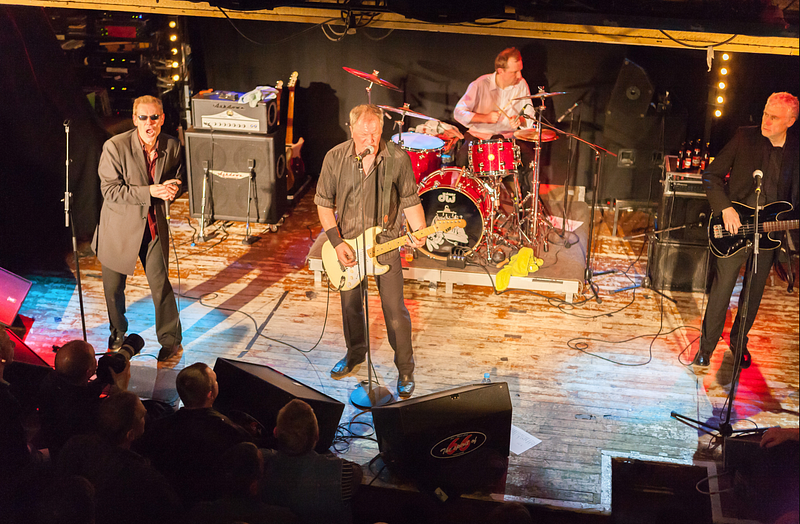

Current members:
- Phil H. Mitchell — bass, acoustic guitar, backing vocals (1983–1991, 1995–present)
- Kevin Morris — drums, percussion, backing vocals (1983–1994, 1995–present)
- Gordon Russell — lead and slide guitars, backing vocals (1983–1989, 2021–present)
- Robert Kane — lead vocals, harmonica (1999–present)