
The Legend of Stagger Lee
An 1895 Murder Triggered 400 Songs
For well over a century, this American folk story still inspires brilliant music
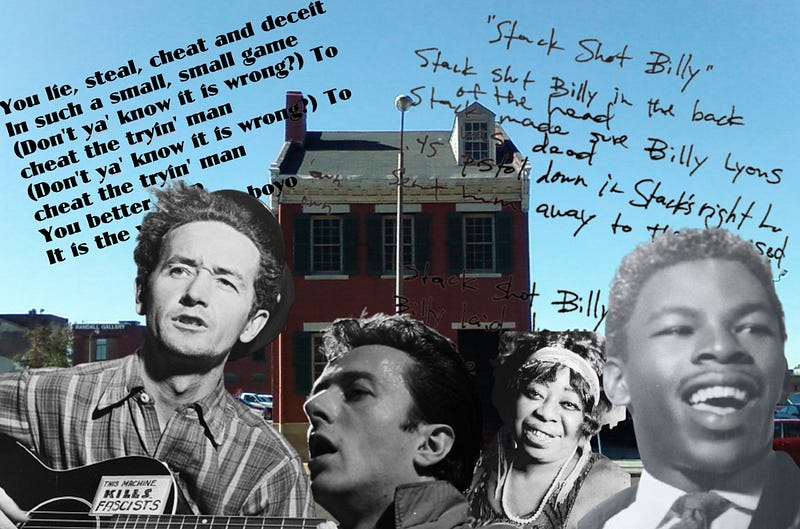


A song about a murder composed in 1911 led to an avalanche of great and diverse renditions and covers— as diverse as Duke Ellington in 1927 to The Clash in 1980 to Bob Dylan in 1993 to The Black Keys in 2004.
I’ll try to cover as much as I can about the murder — and how the murder has been immortalized by the music gods. I found out about Stagger Lee from research on The Clash, but more of The Only Band That Matters, later.
This is where my love of history, folk legends, and music intersect. Much like the true train legend Casey Jones — who didn’t watch his speed.
Stagger Lee, or Stagolee, murdered Billy Lyons in St. Louis, Missouri on Christmas in 1895. The feud and hatred between the two men were as vicious and as long-standing as the Hatfields and the McCoys, according to Matt Marshall, writing for The American Blues Scene.
Marshall writes that there are over 400 recordings of this feud-murder — all over a woman, gambling debts, a Stetson hat, and politics. It also seems that Stagger Lee was “just a mean man.”
Legend has it that Stagger Lee was so bad he even took hell away from Satan.
Marshall writes:
“The origins of this tale begin with a Christmas Eve bar fight in Saint Louis in 1895. The events of the murder were fairly commonplace; two friends, Billy Lyons and “Stagger” Lee Shelton, were drinking at Bill Curtis’s saloon and became enthralled in a conversation about politics. Billy grabbed Shelton’s hat in anger, and when he refused to return it, Shelton shot Billy in the gut, picked up his hat, and left. Lyons died from his wound shortly afterwards. That same night alone, five murders were committed in Saint Louis, but only one shot to world-wide infamy through a tangled web of politics, folklore, and raw persistence.”
Lee Shelton picked up the nickname “Stack” Lee, in his youth, probably after a steamboat. “The Stack Lee was then plying the Mississippi River” (Missouri Life link). He was only five-foot-seven, a small man with a crossed left eye. “According to the prison record, he had a face and torso that boasted several scars. He owned one of the tenderloin’s more notorious nightspots, the Modern Horseshoe Club.”
He used his job as driver to direct white visitors emerging from “Canal Street’s Southern Railroad Station to his nightclub, the local bordellos, or directly to girls whose activities he personally oversaw” (Missouri Life link).
So was Stagger Lee a pimp? Yeah. This group of pimps was known as “macks.”
He wore elaborate outfits with “gold rings on his fingers,” and he even carried “a gold-headed cane.”
Even though there were five murders in St. Louis that night — this murder became one of legend. According to legend, it came out through a game of chance.
“Stagger Lee says to Billy, I can’t let you go with that. You done won my money, You can’t have my Stetson hat!”
But the local newspapers say the feud was political. Billy was a Republican — Stagger Lee was not.
Of course, demon alcohol was fueling the rage of the feud.
“Lee dented Billy’s derby, whereupon Billy grabbed the Stetson from Lee’s head. Lee threatened to shoot Billy unless he returned the hat forthwith:
“I got a brand new razor, Got a big old .41. If you stay, I’m gonna cut you down, Gonna shoot you if you run” (Missouri Life link).
The next day, the St. Louis Globe-Democrat reported:
“William Lyons, 25, a levee hand, was shot in the abdomen yesterday evening at 10 o’clock in the saloon of Bill Curtis, at Eleventh and Morgan Streets, by Lee Sheldon, a carriage driver . . . When his victim fell to the floor, Sheldon took his hat from the hand of the wounded man and coolly walked away. He was subsequently arrested and locked up at the Chestnut Street Station. Lyons was taken to the Dispensary, where his wounds were pronounced serious . . .Billy Lyons later died from his wounds. Lee Sheldon’s first trial ended in a hung jury; at the second, he was convicted and served time; he died in 1912” (Richard Havers).
Okay — so let’s get to the music!
In the Kansas City Leavenworth Herald, a song called “Stack-a-Lee” was first mentioned in 1897 as being performed by “Prof. Charlie Lee, the piano thumper.”
Fred Waring’s band Pennsylvanians first wrote the song in 1911 and recorded it in 1923. It was actually a dance band founded at Penn State. The group consisted of college dudes — Fred and Tom Waring and their friends Freddy Buck and Poley McClintock (Syncopated Times).
The song was recorded in Camden, New Jersey, at the old Victor Recording Studio on 10–16–1923.
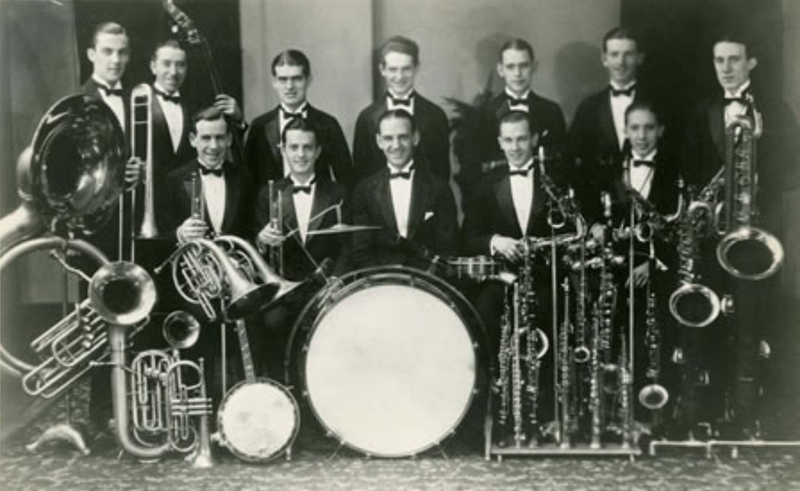
Here is a cover by Ma Rainy with Louis Armstrong on the horn in 1925. The full title of the band was Gertrude “Ma” Rainey & Her Georgia Band.
Here is a sample of the lyrics:
“Stack O’Lee was a bad man, everybody know And when they seed Stack O’Lee comin’, they’d give him the road He was my man, but he done me wrong
Stack O’Lee Stack O’Lee, was so desperate and bad He’d take everything his women would bring and everything they had He was my man, but he’s done me wrong” (link).
If you’re curious about other covers (pre-1945), check out:
Lloyd Price recorded a Billboard Hot 100 in 1959
Here is the beginning of the song. I love the imagery.
“The night was clear And the moon was yellow And the leaves came tumbling down
I was standing on the corner When I heard my bulldog bark He was barkin’ at the two men who were gamblin’ In the dark.”
His version was ranked number 456 on Rolling Stone’s 500 Greatest Songs of All Time list and also reached number 7 on the UK singles chart.
The catchy chorus with backing vocals goes:
“Stagger Lee (oh Stagger Lee) shot Billy (oh Stagger Lee) Oh, he shot (oh Stagger Lee) that poor boy so bad (oh Stagger Lee) ‘Till the bullet (oh Stagger Lee) came through Billy (oh Stagger Lee)and it broke the bar (oh Stagger Lee) (oh Stagger Lee) Tender’s glass (oh Stagger Lee) (oh Stagger Lee) (oh Stagger Lee) (oh Stagger Lee) (oh Stagger Lee) (oh Stagger Lee) (oh Stagger Lee) (oh Stagger Lee) (oh Stagger Lee) (oh Stagger Lee) (oh Stagger Lee)”
Can you tell we’re in the 1950s now?
Other artists and bands like Fats Domino, Ike and Tina Turner, Wilson Pickett, Tom Rush, the Grateful Dead, Neil Sedaka, Neil Diamond, Huey Lewis, and Bob Dylan, et. al, also covered the Stagger Lee saga. Who didn’t?
Led Zeppelin and ABBA.
Okay — Let’s Do the Time Warp to December 1979
RollingStone lauded London Calling from The Clash as the best album of the 1980s. Surprised? Well, you shouldn’t be, music aficionados. It’s that sweeping in its politics, social activism, musical fluidness, rawness, urgency, and fun.
“(The Clash) dabble in reggae, rockabilly, New Orleans R&B, even pop. It’s the mightiest band of their era hitting new heights, from the anti-fascist rage of “Clampdown” to the jolly brew-for-breakfast skank of “Rudie Can’t Fail” (link).
Leave it to a British punk band like The Clash to dig up vintage wild Americana and totally reinvent the approach for the current volatile period in Britain.
And the villain is not Stagger Lee, but the cheat — Billy. Stagger is the “new hero.”
I was researching “Wrong ’Em Boyo” — the first song on Side 3 (it’s a double album) for an earlier article on The Riff (Aug 7, 2021). The song has long been a favorite, and it was mostly for its reggae, ska, and funked-up groove. Did I just mumble the lyrics for three decades? I think so.
It was just about a pub fight in Bayswater, right, mates?
But a bar fight from 1895. Clive Alphonso originally performed the song with The Rulers.
Here are the lyrics to “Wrong ’Em Boyo” —
[Intro] “Stagger Lee met Billy and they got down to gambling Stagger Lee throwed seven, Billy said that he throwed eight, hey So Billy said, “Hey Stagger! I’m gonna make my big attack I’m gonna have to leave my knife in your back” (C’mon, let’s start all over again)”
[Verse 3] Billy Boy has been shot And Stagger Lee’s come out on top (Don’t ya’ know it is wrong?) To cheat the tryin’ man (Don’t ya’ know it is wrong?) To cheat Stagger man You’d better stop (you better stop) Hey! It is the wrong ’em boyo, hey
[Verse 5] But if you must lie and deceit And trample people under your feet (Don’t ya’ know it is wrong?) To cheat the tryin’ man (Don’t ya’ know it is wrong?) To cheat a tryin’ man You better stop It is the wrong ’em boyo (link)
Bassist Paul Simonon loved the song. “The Clash jammed on a cover version with Bill Price in the London Calling sessions, and it became a Ska-influenced rave with an infectious skanking beat” (SongFacts).
Here is a recording of the song from The Rulers in 1967. Notice its Jamaican rocksteady beat.
Let’s spin the date to 2003 and visit The Rubber Factory in Akron, Ohio
I have loved The Black Keys since I picked up Rubber Factory on CD in State College, PA, in 2003. In fact, I just took my daughter Nancy — a fellow devotee — and her boyfriend to see The Black Keys in the Philly area in July 2022.
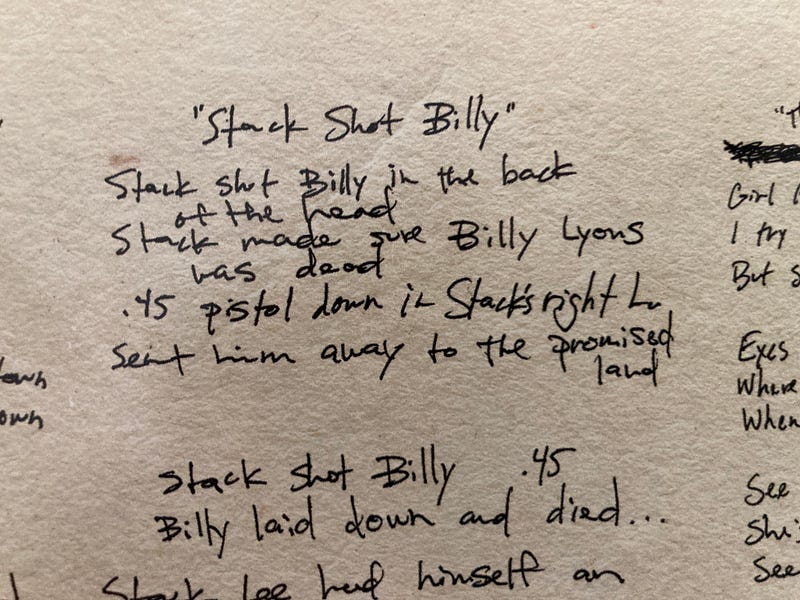
They did not play “Stack Shot Billy” — or anything from Rubber Factory — but the song was inspired again, like all the rest, from that 1895 murder.
It is track #9 on The Black Keys‘ third studio album Rubber Factory.
Here are the lyrics:
“Stack shot Billy in the back Of the head Stack made sure Billy Lyons Was dead .45 pistol down in Stack’s right hand Sent him away to the promised land
Stack shot Billy .45 Billy laid down and died
Stack Lee had himself an Evil brain Loved his gun and his Sweet cocaine But Stack got quiet when Shadows fell Cause he knew soon enough He’d burn in hell.”
Okay — Dan Auerbach. Did we know he liked cocaine? Or was it just easy to rhyme with “evil brain?” We do know that he was “just mean.” It’s not as lyrically effective as Woody Guthrie’s version or Lloyd Price’s hit, but like many songs, like “I Want You” from The Beatles, it doesn’t have to be about the words.
The song is so rich in the blues — the band that records at Muscle Shoals — and inspired by the likes of Elmore James and Lightnin’ Hopkins. It is also a fairly easy riff, but infectious, like most blues riffs.
Tune to open G. B string 1st fret. B string 3rd fret. Then D string. Open. 4th string D string. G string open. B 1st fret. 3rd. G string 3rd fret. That should be 10 notes. Da — da — da- dadadada- da — da — — Make sure thumb and index finger pluck to get that blues sound.
In his “Folk-Song and Folk-Poetry as Found in the Secular Songs of the Southern Negroes” Howard Odum discusses this folksong that was first referenced in a 1911 issue of The Journal of American Folklore (link).
Here’s a great RollingStone article about Dan Auerbach’s influences by Patrick Doyle.
The Black Keys (so young looking back then, but weren’t we all) on David Letterman:
The Black Keys are live here from 2010:
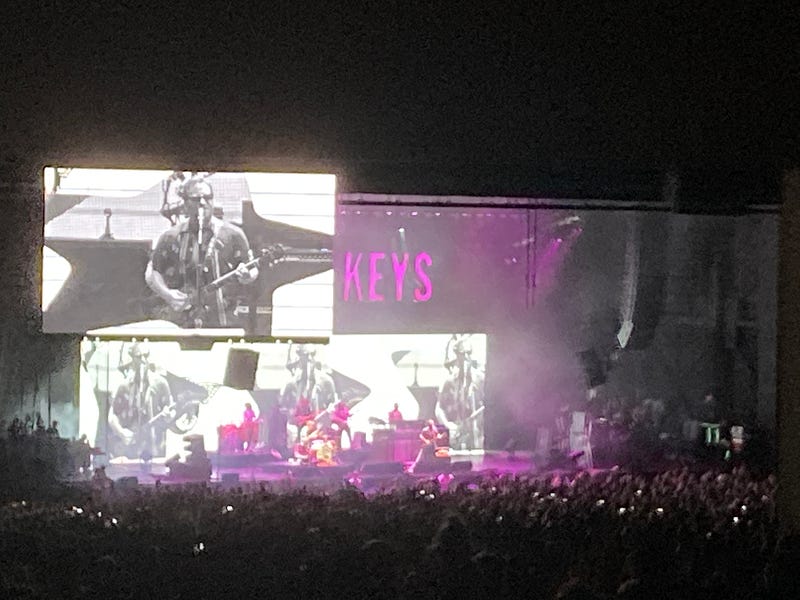
Here is the author at the July 30th concert in Camden, New Jersey. I wrote a review of their new album here on The Riff.

BTW, Nick Cave and the Bad Seeds also have a version of “Stagger Lee” from 1996 from the LP “Murder Ballads.”
If interested in more about the history and legend, go to Staggerlee.com