
Psychedelics: Forgotten Foundations of the Human Condition
Charting the profound influence of psychoactive plants on history, religion, elitism, and politics

If you were to ask me what the most important, underdiscussed subject might be, I’d probably say it’s psychedelics.
Even setting aside the wildest speculations about the meaning of the peak states of consciousness you undergo while you’re high on psychoactive drugs such as DMT, magic mushrooms, peyote, or even cannabis, the mundane interpretations of them are still revolutionary. That is, even if we assume — as we should — that you’re only hallucinating when you’re tripping or that you’re engaging with your unconscious mind rather than with God, angels, or extraterrestrial races, the implications still rewrite practically everything we take for granted about history, religion, elitist social divisions, and politics.
In what follows I discount the wild speculations about these drugs and treat them solely as having natural impacts on the brain. But I also show that even in those restrained terms, psychedelic drugs have shaped our species to such an extent that our willful blindness to that fact is almost enough to justify entertaining those farfetched conspiracy theories.
It’s reasonable to suspect that we outlaw these drugs and presume we can forget about their impact on us only because we’re secretly awestruck by what these drugs reveal about the conscious grasping of reality. The Christian myth of the “fall” of humankind is practically an admission that history is a collective descent from the peak states in question. Specifically, we descended from the shamanic consciousness that guided prehistoric people in the “Edenic” Stone Age, to the pedestrian consciousness which we think of as civilized or modern maturity.
This is to say that our forgetfulness is almost as dazzling as the peak states themselves. The yin of the majestic creativity that bursts from the high mind that’s liberated from social restrictions complements the yang of the dulled, domesticated mind that mistakes the valley for the mountain peak.
Indeed, we chase after those peaks even when we wouldn’t dream of getting high. The so-called progress of liberal, technologically advanced societies recasts the psychological dichotomy between felt godhood and the profane entrancement by shadows and illusions (as in Plato’s cave), as the temporal one between vulgar superstitions and medieval disempowerment, on the one hand, and the sci-fi utopia we long to build for ourselves, on the other.
Secular liberalism is quasi-shamanic: scientists, engineers, and industrial managers replace gurus, shamans, and sacred kings, and rigorous cognition replaces the drug’s cultivation of creativity and its therapy that spiritually disciplines the initiate. But the objective in both cases is transcendence or liberation from a state of slavery. There’s a telltale detail that proves as much, namely the nineteenth-century European secularist’s co-opting of the word “enlightenment” to mark the upshot of that period’s spectacular progress.
Many themes of my philosophical writing can be woven together to form a psychedelic tapestry. Indeed, perhaps any authentic philosophical grappling with big problems will amount to a series of footnotes not to Plato, as the adage has it, but to the psychedelic roots of all cultures in shamanism and animism.
The next sections, then, tie together a number of my articles by highlighting the profound importance of psychedelics for the human condition.

Psychedelics and history
In my writings I’ve posited two big-picture parallel themes in historical narratives: the directed transformation of nature, and the maturation of our species that resembles the individual’s growth from a child to an adult. Both themes are illuminated by showing the impact of psychedelics.
The overall speculation here is that there are potentially two points of transcendence, as it were, one at the beginning of our species and one at its end, just as there are for everyone: the nothingness prior to birth and the out-of-reach revelation of life’s absurdity at death.
Initially, we were swaddled in nature, as a baby is swaddled by its mother. We played nature’s evolutionary game of excelling in our niche as hunter-gatherers. We were bonded to nature by our animistic projections, fuelled as they were by shamanically directed, psychedelic experiences of unity with the wilderness. All of nature was alive with spiritual meaning, and there was no artificial retreat from that childlike state of unconditional trust and belonging.
But after hundreds of thousands of years, we evidently grew restless and more ambitious. We turned to agriculture, domesticating not just plants and livestock but so-called lower classes of humans, and we established sedentary societies to provide effective refuges from the wilderness. These cities and eventual civilizations were human-centered domains that celebrated our achievements and our presumed centrality to the universe.
All of which came to a head in modernity with the scientific and industrial revolutions, which enabled us to dominate nature, holding out the prospect of a universal conversion of the wilderness into an intelligently designed, artificial habitat. Whereas we discovered that the wilderness is an alien, indifferent realm that horrifies those who ponder its existential significance, we also acquired the means to rectify that problem by building a replacement that carries our intentions as an artificial vessel of our minds. That replacement is the cultured cityscape.
Turning to the other theme, again, as tough as Stone Age life must have been in some ways, and as noble as our prehistoric ancestors were in certain respects, we were nevertheless born collectively into a state of childlike naivety. That couldn’t be helped because knowledge of our real position in nature doesn’t fall from the sky. No God wrote the truth onto stone tablets. We had to accumulate that understanding, which took time.
In the beginning we were playing with our cognitive capacities, experimenting with our imagination, and inventing and reinventing ourselves in the process. We had that luxury because of our puny numbers in the Stone Age and because we evolved to outsmart our rivals in the animal kingdom.
And part of that initial playfulness was the shaman’s psychedelic investigation of the unconscious mind. There was no government at the time to ban drugs for being somehow harmful. Instead, there was childlike fearlessness or hubris on the part of nomadic clans. A child tries to play with whatever he or she is given, and we found not only psilocybin mushrooms and the like but the unconscious mind itself in dreams, artistic inspirations, and peak, mesmerizing visions.
The rise of civilization committed us to drudgery, just as the child grows up to be a “responsible” adult. We specialized in the tasks of sustaining and managing our societal endeavours, and priesthoods replaced shamans. The gods were identified less with natural forces than with supernatural backers of human dominators, comprising a shadow aristocracy (a pantheon of gods, as in pantheistic societies).
These tendencies are accelerated in modern secularization. If anything, we suffer from an over-abundance of knowledge. We have too much knowledge for us to digest, so we defer to experts, despite the partiality of their fragmented perspectives, or we opt for populist backlashes, lashing out as infantile consumers.
We can only hope there’s an uplifting resolution of these themes, a transhuman recognition of what we’ve been doing all this time, and a possible dedication to some sustainable, ennobling mission. The existential problem is essentially that of the adult’s needing a worthy substitute for childish play. If we’ve outgrown psychedelic immersion in nature, what’s the sustainable, honourable, “modern” or mature point of living?

Psychedelics and religion
Passing over the historic details, some of which are highlighted by the above chart, I’ll focus here on the main point that from a psychedelic perspective, organized religion is less a revelation of supernatural powers than an all-pervading conspiracy to suppress the subversive power of authentic religious experience.
Psychedelic drugs expand the mind, kill the ego, and cast doubt on the conventional delusions and frauds that sustain peace in society and that mask civilization’s horrendous impacts on the planet. Therefore, those drugs are antithetical to the “satanic” progress of sedentary, entrenched societies.
There is no experience of uncanniness or of supernatural mystery stronger than the peak states of consciousness that are generated reliably by nature’s psychoactive substances such as psilocybin mushrooms, DMT, peyote, and cannabis. The eerie suspicion that in so far as it’s perceived as submitting to human industry, nature is only an illusion encompassed by an unfathomable, inhuman reality is the source, substance, and sole existential merit of the theistic message. The politicization of that disconcerting, cosmicist message is the stuff, rather, of the creeds, rituals, and hierarchies of organized religion.
Granted, in its myths and traditions, religion may include traces of that existential confrontation in which the personal self delves into its unconscious depths to regain childlike wonder in the face of the apparent universality of magic. That’s the magic of experiencing nature aesthetically as raw, ultimately inexplicable art rather than of objectifying nature as a prelude to technoscientifically exploiting it.
Everything seems strange and profound when you’re high on these drugs, and that strangeness is indistinguishable from holiness and sacredness. As Aldous Huxley hypothesized in The Doors of Perception, this spiritual/existential sensibility is blocked by our mental filters, by the ambitions, fears, and vanities of the personal self. And as Terence McKenna stressed, we can return to childlike wonder and to a saint’s humility at any moment merely by ingesting one of these plants.
But because of that relative ease of access, the faint echoes of enlightenment in religion’s tribalized abstractions look more like ways of further obscuring what’s already hiding in plain sight. The best deceptions contain hints of the truth so that the lie seems plausible.
Whereas the drug offers you God on a plate, religion delays and distracts for the familiar, sordid reasons. The drug shows you your smallness and does so unmistakably so that no ego is arrogant enough to resist that truth, because the drug doesn’t merely argue with you but rewires your brain and gives you a godlike viewpoint. Yet theistic religion says you’ll know God mainly after you die, and in the meantime you must serve God’s human representatives. Religion is fishier than religious experience.
While religion exchanges human institutions for direct, profoundly transformative experiences, modernity replaces God/psychedelic experience with the secular promise of human empowerment and progress. This progress, in turn, threatens to re-enchant nature, landing us in an ironic pantheism: scientific objectifications present nature as zombie-like in its mindless, brute physical self-perpetuation.
Psychedelics and elitism
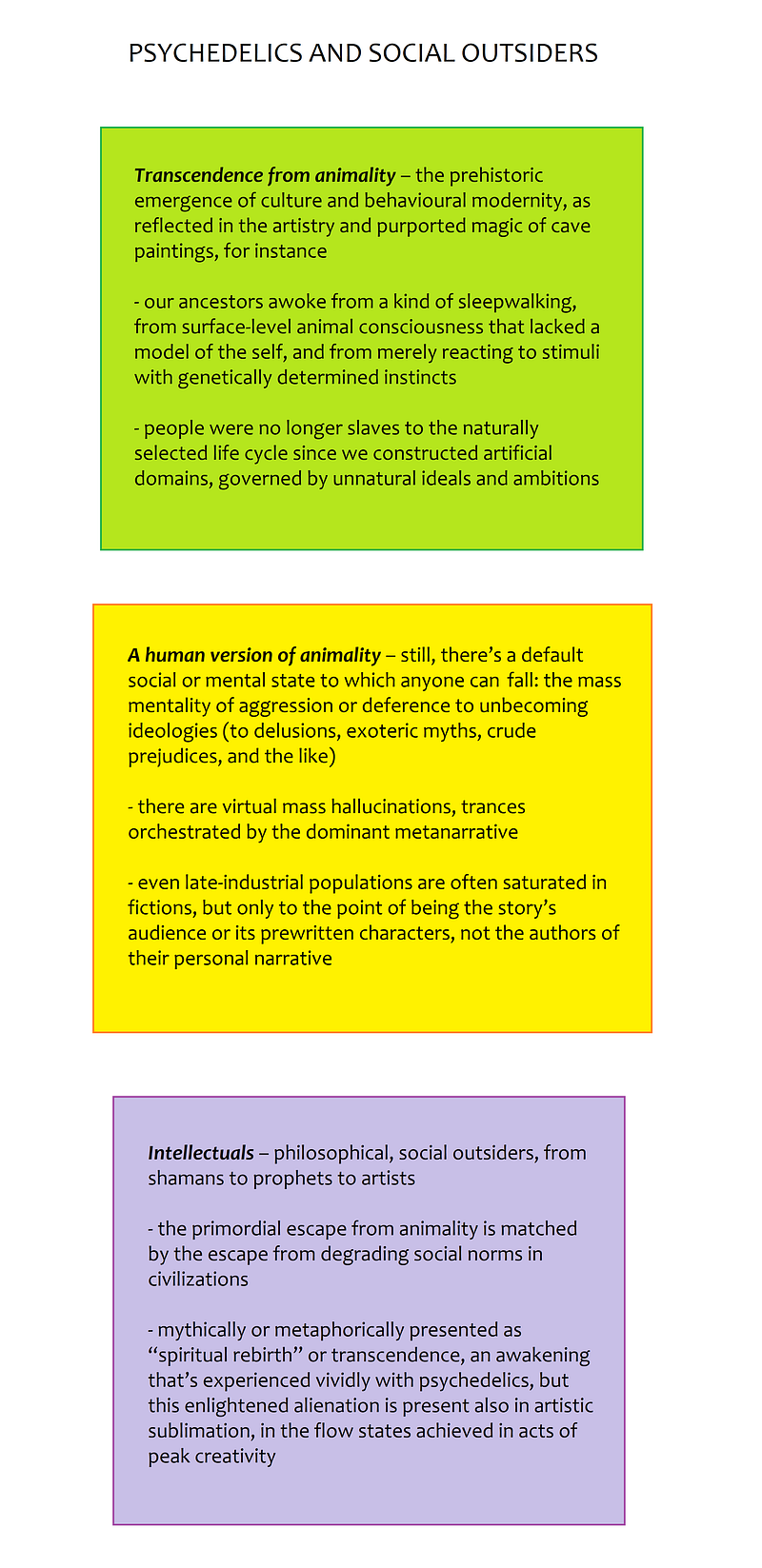
Psychedelic drugs are at the root, too, of one of the oldest class conflicts, besides that between men and women or between the young and the old, namely the divide between intellectuals and the less reflective members of society. It’s just a question of reading the same developments in religion, but now from a sociological perspective.
Shamanism and thus psychedelics helped extract our mindsets from animality, by steering us towards behavioural modernity, so that we came to exchange instinct for culture as the main driver of our behaviour. Possibly, the use of magic mushrooms preceded even shamanism, as in the stoned ape hypothesis.
In any case, there were leaders and followers in this daring, possibly self-destructive adventure in exploring the cultural territory. Sometimes in hindsight, the leaders in developing personhood as something distinct from animality were celebrated as divine paragons, as sages, saints, or prophets who showed how we could cope with our existential condition even if we lacked much power over our circumstances. Often, however, these leaders were feared, despised, and marginalized because they challenged the ignorance and delusions that domesticated the followers in this endeavour, who were in no sense mentally “high.”
Thus, history has been marked by a cold war between the vanguard that views our intelligence, autonomy, and creativity as inherently self-transcending, and those who prefer social stability and happiness to more “spiritual” or daring pursuits. Some social outsiders, of course, are just brutish criminals who stand apart from the masses by regressing to a state of crude animality. They exploit open societies not because they see a way of improving social conventions but because they don’t care about anyone else.
Other outsiders, however, are more existentially profound since their perspective hints at a transhuman future in which we’ve embraced personhood as the enemy of all conservative status quos, as a virtually divine, antinatural source of creativity that threatens the wilderness with artificial humanizations — including the inner wilderness of our animal nature.
Shamanism may be mostly surpassed, but psychedelic drugs have long fuelled artistic movements, and artists, too, seek meaning in culture, often clashing with lowbrow compromises and charades. Artists are often restless introverts who are radicalized by their vision of sacred ideals. To be captivated by ideals is to lift your mind out of the gutter of evolutionary habits and depraved or mind-numbing societal games.
Thus, just as people came to separate themselves from animals, intellectuals who are proto-transhuman are estranged from mass society.
Psychedelics and politics
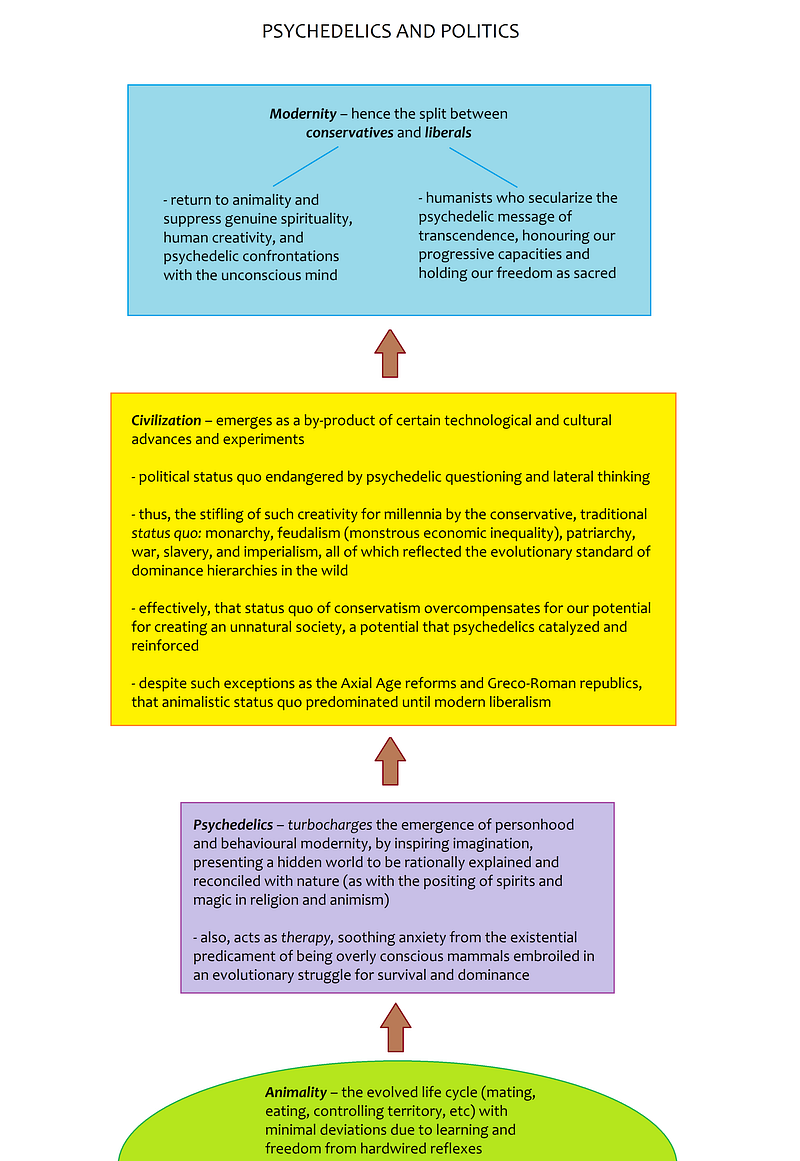
As Carl Schmitt pointed out, politics is about intense social conflicts, namely those between friends and enemies. Whereas the previous section dealt with the conflict between the domesticated defenders of the status quo and the social outsiders (the prophets, monks, intellectuals, artists, and so on), this concluding section shows the relevance of psychedelics to the modern distinction between conservatives and liberals.
Once again, there’s a parallel between what happened in primordial and in modern times. Initially, personhood emerged out of animality. Animals are wild in that their behaviour is governed mostly by evolutionary constraints and laws of nature. Some animals are more social and intelligent than others, but none are people, we assume, if they lack the degrees of self-awareness and self-control as well as the ambition (or perhaps audacity) and the ingenuity to build an entire domain that runs counter to the wilderness, as discussed in the first section above. People, therefore, are the animals at the biological level that nevertheless transcend animality at the psychological and social levels. We’re self-conflicted in that respect.
Much of personhood is due to natural selection, of course, as we evolved larger brains, the ability to walk upright, and opposable thumbs. But the mental side of personhood, and the behaviourally modern reliance on culture were at least shaped by religion and specifically by the psychedelic guidance of shamans.
Psychoactive drugs would have turbocharged the imagination and soothed anxiety, acting as a natural therapy, as prehistoric people would have used these drugs as medicines to realign their conscious self with their unconscious insights. For that reason, shamans were called “medicine men” or “witch doctors.” This role of psychedelics seems symbolized in James Cameron’s movie Avatar, as the alien characters have built-in pipelines, as it were, to their planet which enable them to feed on its energy and to adhere to natural wisdom. This is a Taoist sensibility that riffs on the psychedelic plant as the mechanism for grounding higher beings in deep truth.
In any case, there was a necessary retreat from that idyllic oneness with nature, as civilization preoccupied us with what became the imperial, patriarchal status quo. After the unimaginably long Stone Age, there were some nine thousand years of big-city life (beginning with Jericho and continuing to the present day), although smaller sedentary societies are as old as 25,000 BCE. With the earliest civilizations arising at around 4,000 BCE, bureaucrats replaced shamans and gurus, and abstract theological doctrines replaced psychedelic religious experience, as priests guarded their secret doctrines of how the gods bless civilization.
Feudal drudgery, slavery, and wars of conquest followed, and empires flourished and were conquered in turn. There were some foreshadows of what we call “modernity,” such as the Axial Age and Greco-Roman republics, but civilization is generally marked by the stability of this imperial machination.
And that stability, in turn, corresponds to the animalistic status quo of the dominance hierarchy or pecking order, which is evolution’s way of organizing social animal groups. The principle at work is the law of oligarchy, the centralization of power in the members who prove their merit either in hunting or in forming social alliances. Thus, alphas have first pick of mates and food, ruling over the pack with their beta lieutenants, and especially over the omegas who are the equivalent of the maladapted social outsiders. Often these dominance hierarchies are patriarchal, although some are matriarchal. But the point is that they’re evidently stable ways of keeping a relative peace, despite the amoral godlessness of the evolutionary enterprise.
Then came a break from that break from shamanism. Again, there was likely the childlike play of animistic shamanism for perhaps hundreds of thousands of years in the Stone Age, followed by just several thousand years of imperial civilizations. And then just a half a millennium ago came the modern revolutions of science, individualism, liberalism (capitalism and democracy), and mass production.
All of which is to say that this is the proper context for understanding the difference between conservatism and liberalism, and thus the essence of modern politics. Conservatives rose in the early modern period as reactionaries who dreaded what they saw as the impudence of modern progress and who longed for a return to medievalism and more generally to that second status quo of civilized imperialism.
As the modern revolutions proved to be progressive, however, conservatives found they had to hide their zeal for blood and throne, or risk being ostracized under the new standard of domestication. Thus, conservatives learned to use demagogic rhetoric to hide the fact that the effects of their policies tend to re-establish premodern barbarism.
For instance, if conservatives can no longer defend monarchic feudalism outright, they can at least cheer on the plutocratic tendencies of laissez-faire capitalism. Or if conservatives can no longer say explicitly that men ought to own women as property, they can conjure a discourse of patriarchal “family values” out of ancient scriptures or so-called divinely ordained “natural rights,” to rationalize their authoritarian personalities.
Conservatives are thus best thought of as closeted animalists who stand opposed to humanists, to those who recognize the profound stakes established by the emergence of personhood from animality. Better known as “liberals,” “progressives,” or “socialists,” humanists mean to preserve a creative form of society against the tyranny not just of the wilderness but of the conservative’s approximal wilderness, the latter being the second status quo of feudal imperialism.
And again, modernity sublimates the psychedelic ethos by secularizing it. Transcending the evolutionary mindset of being locked into genetically determined habits, the awakened, psychedelic mind recognizes sublime heights not just in nature but in life’s creative potential. Shamanic cultures fulfilled that potential by playing and experimenting with cultural norms, not burdening themselves with dogmas, but moving from idea to idea the way they moved from place to place as they followed the animal herds.
Although some people still take psychedelic drugs, we can hardly say that modernity is directly influenced by that raw religious experience. Instead, we assume our existential mission is to progress so that each generation lives better than the last, and by “better” we mean in material terms. We’re consumers in that respect. We transcend animality by exercising ever greater control over the outer wilderness with science and technology, even as we succumb to our baser childishness by narrowing our perspective and indulging in vain competitions for status and pleasure.
Whereas prehistoric groups excelled in the shamanic mindset and naturally lacked the power of technoscience, modern societies excel in the latter while lacking childlike innocence due to our hubris and jadedness. Thus, the concept of psychedelics enables us to understand not just the essential difference between conservatives and liberals, but the challenges faced by liberal society. In short, we’re only partially shamanic.


