
Why Real Art is Priceless and Most Artists are Poor
The clash between artistic and business standards
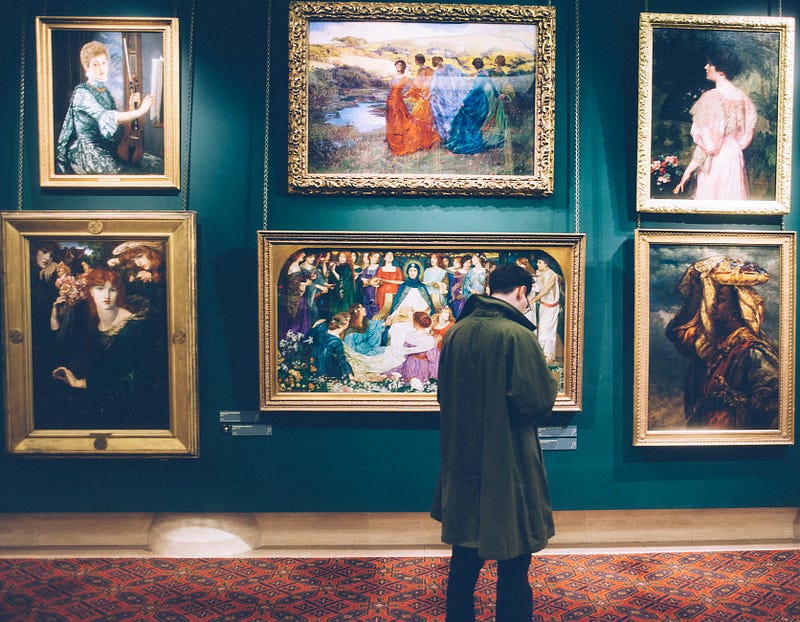
Technological advances in the computer age eliminate middlemen and enable more and more people to produce and to publish paintings, songs, movies, and writings. It might seem clear, though, that this greater ease of entry to the market of content-creation is made irrelevant by the encroachment of capitalist values which makes it harder to earn a living as an artist. Specifically, the aim of seeking profit from work seems antithetical to the artistic concern about maximizing the work’s quality.
The Progressive Promise of Modernity
But the truth is that it was never easy to make a living as an artist, and only a minority could ever manage to do so. For most of the Christian theocratic period in Europe, for example, artists sold out not to private corporations but to the Church and to wealthy patrons. In the Middle Ages, there was no question of democratizing the fine arts; instead, the fine arts were meant to be impractical, because for centuries they suited the tastes of the Church censors and of the aristocratic patrons. You had to go through years of rigorous training under a master artist to learn to produce the kind of art that appealed to those elites.
Modernity ushered in the expectation that not just knowledge and progressive living standards, but the arts were for everyone to enjoy. The newfound freedom of thought allowed artists to explore different subjects and media, producing the modern genres we consume. Capitalism, too, was supposed to be progressive since it enabled everyone to try their hand at a business, and to let the market of common buyers decide which efforts deserve the highest rewards. The arts and the production of wealth were democratized or “liberalized.”
Eventually, though, this progress produced a glut of art or pseudo-art so that the modern diffusion of the arts is arguably an illusion. Capitalism turns everything into a competition, which entails that there will be many losers for every winner. When anyone can produce “art,” even without much training, wading through the resulting market to find hidden artistic gems in a swamp of shoddy, half-baked, pandering kitsch or sentimental gibberish is onerous.
Thus, most art consumers don’t bother trying; instead, we lazily adhere to the recommendations of secular yet even more cynical, pretentious gatekeepers like the New York Times Bestseller List or whatever algorithm Google, Amazon, or Facebook has tweaked for that week. As oppressive as it used to be, the medieval Church at least assessed the inherent value of works or explicitly addressed the question of higher, spiritual merit, rather than favouring whatever has mass appeal.
Most of us don’t read at all for the same reason we suffer from a kind of vertigo when confronted with the endless choices on Netflix or at the supermarket. The overwhelming options discombobulate us, so we opt for the lowest-hanging fruit, the cute animal videos on YouTube rather than a novel that requires a greater time commitment and more concentration. This is one of many related reasons why most newly published books are read by hardly anyone, as the writer Elle Griffin shows.
(Incidentally, the progressive, egalitarian aspect of capitalistic wealth creation is likewise illusory, since although capitalism lifts people out of extreme poverty, wealth still ends up being concentrated in the fortunes of a relatively tiny number of billionaires who use their power to distort and to clog the democratic operations of government, as is especially clear in the US.)
The Trivialization of Digital Art
Still, there’s a difference between making a living and trying to do so in the context of capitalism. “Making a living” refers to the more general struggle to succeed, to earn money or to find a place in society.
Far from being antithetical to the arts, struggle or suffering is almost indispensable to the process of producing genuine, great art. If you look at the portfolios of top authors, filmmakers, painters, and musicians, you almost always find they did their best work when they were young, hungry, and struggling to reach an audience. It might sound old-fashioned and Romantic, but necessity is the mother of invention, and success can go to an artist’s head, making him or her self-indulgent or unfocussed.
Art that’s too easily produced is often of lesser quality and charmless. Thus, the huge, masterful paintings you see in museums are awe-inspiring because they took years to produce and were made with minimal tools. There are miniature gothic boxwood carvings from the sixteenth century that took decades to complete and that have almost miraculous details for their scale. They were highly prized and commissioned by nobles precisely because of the struggle required to produce them.
By contrast, mass-produced items that are manufactured by machines are shoddy or are designed not to edify or to enrich life but to betray and to ensnare the customer. Think of the hit music that exploits the ear’s fascination with simple “hooks” that addict the listener. Anyone now can produce these hit songs using software, although only a fraction can become hits on the charts because capitalism turns art into a competition.
For example, if you can’t sing, you can correct your voice with Auto-Tune. If you can’t play the drums, you can finger tap the pads of a groovebox and let the machine do most of the work. All of this must be contrasted with classical or with jazz music written and performed by experts who lacked machine crutches.
But the point is that pop music, self-published novels, and digital paintings as genres are progressive yet duplicitous. The means of production are more widely available than they were centuries ago, which is progressive, but the quality of work plummets and is uninspiring because of the amorality of the profit motive behind most of this work.
There are still talented, authentic artists using these new tools and trying to sell their art, but these disciplines have been both swamped by the mediocre output of amateurs and spammed by treacherous parasites who attempt to cash in by exploiting the audience’s psychological weaknesses.
The Consumer’s Realm of Illusions
Of course, the medieval Church did this too, using religious imagery to subdue the illiterate peasants by pandering to them, and the priest’s motive was like the capitalist’s: both use art infused with ideology to protect a power imbalance between society’s winners and losers.
What’s happened, though, is that so-called modern progress has backfired so that much of consumer culture has become a tasteless, bourgeois charade. We postindustrial consumers may not be peasants covered in dirt and with a life expectancy of three decades, but neither are we nobles enjoying the finer things.
Ours is a realm of illusions and simulacra where we think we’re more advanced than we are. Americans’ fixation on owning guns gives them the illusion of safety, although such a plethora of guns obviously makes them less safe. We think we’re cultured, compared to folks in developing nations, but we watch infantile superhero movies and get our daily news from Facebook algorithms or from propaganda outfits like Fox News or conservative Christian radio.
We’re obsessed with recycling our waste which is meant to lessen the damage our materialistic lifestyle does to the environment, and we’re smug in signaling our virtue, proudly displaying our recycling boxes every week on the street corner — and condemning those who fail to do so.
But recycling of plastic is a scam. We’re supposed to be enlightened, secular societies, yet we seldom bother to follow up on the government propaganda that hides the fact that China has stood at the end of the Western recycling process. And China neglected to recycle most of the plastic it received, and eventually stopped taking the world’s plastic. Much of the plastic we try to recycle has been tainted by food or is less reliable, so the big plastic-using companies won’t buy it back.
As a result, “Over the last seven decades, less than 10 per cent of plastic waste has been recycled.” Moreover — and gallingly — the “recycling logo was used as a green marketing tool…Fearing an outright ban on plastics, manufacturers looked for ways to get ahead of the problem. They looked at recycling as a way to improve the image of their product and started labeling plastics with the now ubiquitous chasing-arrows symbol with a number inside.”
Have I just lifted the veil with that truth-telling about the recycling of plastic? Will anything change for the better because of it? Obviously not, because this article will be lost in the deluge of infotainment. Everything that occurs in cyberspace is trivialized because of its digital format which makes it all-too easy to replicate or to replace.
Self-Exploration and The Essence of Art
The nemeses of fine arts, then, are at least twofold, one of which has to do with the new, digital medium, the other with the capitalistic motive. The digitization of content tends to facilitate the drive to maximize profits, because computers and the internet ease the production process.
Writers, for instance, now enjoy the benefits of dictionaries, thesauruses, word processors, and on-demand publishers. As a result, there are lots more writers than readers, so there’s a glut of information, which is why so much written content is pirated.
Is it really stealing when you’re taking something that’s evidently almost worthless, considering how few people earn a living as writers? The economy says eBooks are practically worthless, regardless of how much Amazon charges for them, because the supply vastly exceeds the demand. Thus, downloading a pirated eBook feels like picking up a penny that’s been lying on the sidewalk.
The more central culprit, though, is the value system of capitalism itself. To understand this, we need to ask about art’s purpose. Has there ever been such a thing as authentic art, something that might contrast with the cynical propaganda and rubbish excreted by dilettantes and mass-producers?
The Romantic period praised what it called the solitary, melancholy, often mentally disturbed genius who stands against dogma and illusion in a sacred quest to find truth. Modern European artists were united, then, with scientists in casting off the shackles of Christian theocracy. True artists used their work as a means of self-exploration, which the audience could share in by a kind of catharsis. These artists locked themselves in a studio, like the reclusive Jackson Pollack, take shelter with an elite club of fellow artists like The Inklings or Stratford-on-Odeon, or go mad with their ecstatic confrontation with sublime nature, like Vincent Van Vogh.
These artists thus tapped into the much older, shamanic practice that produced some of the very first great art, the prehistoric cave paintings. Shamans, too, explored the depths of their mind, using psychedelic drugs in their pursuit of ecstatic, peak states of consciousness that made the ordinary waking world seem tame and phony. Their authority as gurus and doctors was based on their daring forays into the so-called spirit world. Carl Jung would later call this the creative power of the unconscious.
This Romantic conception links art also with philosophy and with the esoteric traditions of the world’s religions, the shared features being self-exploration and the earnest, perhaps even foolhardy, self-destructive search for truth as opposed to settling for the dubious reassurances of mass prejudices, platitudes, and clichés. Artists were creative because they expressed their unique, individuated personality and perspective on the ultimate meaning of life. Their works are valuable as records of their brave inward journeys and of their defiance of popular small-mindedness.
The Profit Motive
Assuming this analysis captures something of art’s essence, we should be able to see why the profit motive is antithetical to the production of art. When you’re thinking about rewards, you’re not focussing on the task at hand of excelling in the artistic process. Nor are you showing that you’ve purified your character to be worthy of diving into your unconscious or of contemplating grand philosophical questions, unimpeded by the mass hallucinations or daydreams that sustain our superficial forms of happiness and peace.
If you’re attempting to maximize profit, you need to perpetrate some dishonesty, for roughly Marxian reasons. You’ll need a surplus, a gap between your costs and your sales price. Karl Marx thought that that gap comes at the expense of the labourers whom the owners exploit by not paying them all of what they deserve.
We see extreme examples of this exploitation when managers rake in huge bonuses and treat themselves to golden parachutes even while they lay off their workers and bankrupt their company. There are the predatory practices of vulture capitalism, but there are also the scams perpetrated by the likes of American Airways, which took billions of bailout dollars during the Covid-19 pandemic, laid off workers instead of using that money to keep them onboard, and complained about the labour shortage it created.
Technically, though, a capitalist firm wouldn’t be defrauding its workers if the owners reinvested much of the profit back into the company instead of pretending that they, the owners, deserve the lion’s share because they’re the only ones who do any real work. Even if the employees weren’t paid higher wages, they’d still benefit indirectly if the profit were invested elsewhere in the company to sustain the business.
Nevertheless, profit is maximized in the short-term by defrauding the consumer. Advertisers, for example, are inveterate liars. For legal reasons, the advertiser’s unpalatable truth is hidden in the small print. Even when companies aren’t lying outright in public, they’re shading the truth, using manipulative rhetoric to persuade the customers to buy what they don’t need or even want.
The consumer’s desires are manufactured along with the products. You create the demand in the market, so you’ll have a customer base, and you do this not so much by inventing a revolutionary device that improves the customer’s way of life, but by spreading misinformation or by starting a fad that maximizes narrowly defined gains while externalizing the long-term or broader losses.
Ultimately, the dishonesty inherent in maximizing profit lies in the fact that this kind of business shortchanges the future of our species for the benefit of the present’s chosen few. The so-called “progress” of all this freewheeling enterprise is itself an illusion, as is apparent from the environmental reckoning we’re preparing for ourselves and for our near descendants.
The Clash Between Business and Art
That disconnect between our reveling in present-day luxuries, and the longer-term environmental blowbacks against civilization — the global warming, water shortages, destruction of ecosystems and breakdown of food chains, and more frequent and severe diseases and natural disasters — isn’t an accident.
Profit, too, is theft in that someone else is usually left to pay the piper or to hold the hot potato. The rich few are stealing from the poor many, not just by paying them meager wages but by rigging the whole economy and government to maintain the social inequity. And producers and consumers alike steal the health and comforts from future generations, by ignoring the environmental downside of our progress. There’s no creation ex nihilo, contrary to the Christian miracle story which says that an almighty God created the universe from nothing by the sheer force of his will. In the real world, profits are created from the money spent on the costs of doing business, and profits are maximized by the predators and parasites that hide or that shift some of those costs.
Even if you’re not interested in maximizing your profits, you’re competing against those who are doing so, which means that just by setting up your business you’re entering a downward spiral. You’ll have to compromise your standards to stay afloat, because the products that cater to the lowest common denominator tend to sell the best. The lowest or broadest standard is also the least artistically honourable one.
Thus, capitalism isn’t a meritocracy. The most popular products make for the highest sales, but those products are almost never the highest in quality, according to artistic standards of evaluation. Of course, if you define “value” subjectively in terms of whatever people pay for, as neoclassical economists do define it, then Michael Bay or superhero movies are better than those that win Oscars or that film critics praise. Likewise, the vacuous self-help books that are Amazon bestsellers would be superior to philosophical classics.
Then again, to reduce value to those subjective preferences is precisely to eliminate value from the world and to confirm what Max Weber called the world’s total “disenchantment.” The fact that more people choose to watch formulaic movies to vegetate in front of, rather than original ones that challenge them, doesn’t mean that banalities are better than artistically and intellectually deep movie fare. Similarly, truth isn’t decided by popularity. The fact that a poll attests to a belief’s commonality doesn’t mean the belief is true or is even halfway rational.
Popularity is a quantitative fact, not a qualitative one. There’s nothing normative about noting that people prefer pop music to the classical kind, or romance novels to poetry. That’s a fact about people’s lack of education, the rarity of elite characters, or how predators can exploit the herd, and that fact as such is neither good nor bad. This is human behaviour at the sociological level, and if that’s all there is here, our distinction between right and wrong would be just another illusion.
Economists like to objectify values in this way so their discipline will seem more rigorous and scientific. But all of this ignores what we’ve already established, namely the independence of the artistic endeavour that stretches back to prehistoric shamanism, passes through philosophical and religious awakenings all over the world, and is secularized in the modern period, showing up as the Romantic backlash against capitalistic industry, and as the nostalgia for a sense of life’s meaning or of belonging to the world, goods which seem to be disappearing.
One of the reasons they’ve largely disappeared is that our preoccupation with making money to enjoy our free time is at odds with an interest in making real art. Art is about self-sacrifice, not self-indulgence. The standards of art negate those of business, but we’ve become neoliberals, philistines, and Friedrich Nietzsche’s Last Men.
As such, artists these days are outsiders. Most content-producers we celebrate are hacks and charlatans who’ve sold out their artistic sensibilities to turn a profit in an anti-artistic business environment. They may begin as artists, but they end their artistic career as soon as they start thinking like businesspeople.
Art is anathema in business for the same reason that disturbing, philosophical truths are less popular than the superficial, uplifting ones supplied by the self-help industry. Business is about using a fact to your advantage, such as the fact of what people are like or of how they could be molded by available techniques of persuasion. Art is about discovering hidden, possibly unpleasant facts — including the fact of our inner identity as anomalous, creative beings — to let our ideals shine on the artless world.


