
How Civilization Devours Nature like a Black Hole
The unnaturalness of our progress in the cosmic wilderness

These days scientists and philosophers are quick to dismiss Rene Descartes’ dichotomy between mind and matter.
Descartes said these are two metaphysical “substances” that are subject to different sets of laws, and never the twain shall meet. Within the realm of either, the other substance’s activities would be miraculous. Implicitly, then, a divine overseer is needed to ensure that the independent material and mental worlds cohere so that the pair’s interactions don’t degenerate into chaos.
Late modern, “naturalistic” thinkers are having none of that defeatist dualism. Their ambition is to explain everything in unified, ultimately materialistic terms, to naturalize all phenomena, including consciousness, reason, and freewill, leaving nothing inexplicable to science or more broadly to human reason.
Yet that very progress in our understanding presupposes a less abstract or technical kind of dualism that’s practically just as absolute, namely the duality between wild and civilized domains.
How naturalists humanize nature
So-called philosophical naturalists are supposed to say that everything is fundamentally, metaphysically “natural.” But these same philosophers concede that it’s not so easy to say what counts as natural in that unifying sense. Is quantum mechanics natural? How about black holes or the Big Bang? Is consciousness as natural as sticks and stones, and if so, does “natural” still have any substantive meaning? Or is “natural” supposed to mean just whatever scientists and philosophers can at least halfway assimilate to some useful theoretical framework?
Even if we take the widest sense of “natural,” we’re left with a dichotomy. The attempt to explain things naturalistically is a process which entails a stage that obtains before our understanding is maximized. There’s the world before we understand it and there’s the world afterwards. If we look closely at that implicit process, we see that “naturalism” is a misnomer.
The world that we understand well is also one we can potentially use, and we tend to actualize that potential. Once we understood what outer space and the Moon are, for example, we found we could potentially travel there, we eventually devised the technology to do so, and we planted a flag on the Moon and collected samples of lunar rocks.
Closer to home, the fruits of our “naturalistic” endeavours are even more apparent. Progress on Earth looks like a wavefront of artificiality, an expansion of civilization and cityscapes, and a domestication of the planet’s resources. At the positive end of this spectrum, then, between the pre- and the post-naturalized is what we might better think of as nature’s humanization or artificialization.
So-called naturalists are thus effectively anti-naturalists, the standard label of this modern perspective being a case of doubletalk. We want to understand how there are no supernatural miracles in the universe, in which case everything is natural. But that’s hardly the end of our cognitive endeavors. It’s not as though we tend to leave nature in its pristine wild condition once we’ve figured out how nature’s systems work. It’s not as though science were an Ivory Tower discipline like theology or women’s studies, divorced from capitalistic industry.
Naturalizing X, as in explaining it in natural, scientific, or at least rational terms is a necessary condition of physically humanizing X.
Prehistoric or insane people can imagine or fantasize that they understand what’s happening in nature so that they feel at home in a thunderstorm even if they think rain is caused by gods who live in the clouds. But imaginary humanization isn’t the same as technological exploitation. If we merely imagine we’re on the same page as the world, as it were, we could be setting ourselves up for a rude awakening. Imaginary humanization is illusory, in that we mistake our happy mental representations for that which they’re supposed to model. We can live entirely in our head only for so long until our luck runs out and the real world intrudes on our fantasy.
The progressive strategy, rather, is to intrude on nature to preclude nature’s intrusion on our home territory. Home for the most intelligent animals is a wholly artificial domain — not a natural habitat in the evolutionary sense, as in one to which animals are biologically adapted, but an intelligently designed and built refuge from nature. Collectively, our home is something like civilization, a host of tools, machines, buildings, infrastructures, and social conventions that physically replace nature.
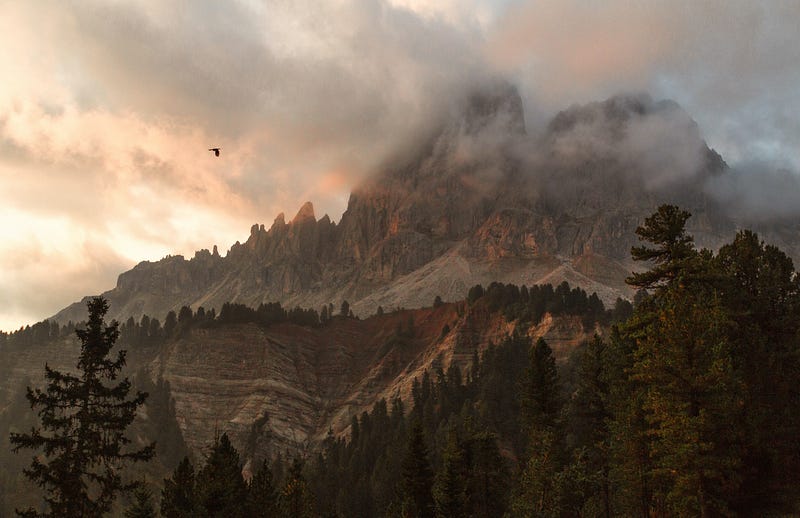
The wilderness as the prehumanized domain
At the start of this process of humanistic expansion is the predominance of the wilderness, the indifference of which compels us to fantasize that our existential condition isn’t horrific. There’s the pristine wilderness and there’s the fish out of water, the intelligent primate that mentally projects its prejudices onto nature to feel at home without physically being so.
What exactly is the wilderness, though? The word “wild” carries a negative meaning of uncultivated, untamed, uninhabited, uncivilized (barbaric). In other words, the wilderness is other than human or humanized. The wilderness is what there is before we’ve exercised our prerogative as a clever, ambitious species and transformed it to benefit our kind.
A wild place is “natural” as in not (yet) brought under our control with technological applications of scientific understanding and of a humanistic vision of progress. A wild creature (an animal or an uncivilized child or tribe) is one governed by natural rather than social laws. Thus, there’s humanization both of things and of minds.
Recall that the point of a naturalistic philosophy is that there are no miracles. Everything in the universe follows laws of nature, namely those posited by science. But here we see a reappearance precisely of a duality in the sets of laws, and this duality shows up not from any premodern, anti-scientific worldview but from an analysis of the scientific project itself.
Science is the engine of humanistic progress, which proceeds by the world’s humanization, by assimilating reality to the simplifications in our conceptions, models, theories, laws, and cultures, and by technologically enslaving or “domesticating” natural processes to our will. Science is thus part of an adventure in de-wilding the cosmos.
After all, the wilderness extends far past the jungles, tundra, and ice ages we’re familiar with from prehistory. The universe is the outer wilderness, the “final frontier” or the fullest range of that which hasn’t (yet) been humanized, that is, “naturalized” or rendered artificial and therefore unnatural.
The divide between scientific and social laws
The wilderness operates according to laws of nature, whereas our collective home, the artificial refuge of civilization follows social laws. We even codify the latter laws and appoint human judges to render their verdicts.
True, there’s overlap between those domains in that we can’t violate the laws of physics, chemistry, or geology. But that doesn’t mean we’re subject to scientific laws. In fact, technically nothing is subject to them in that nothing follows them. That conception of objective compliance is a vestige of an early-modern overextension of the concept of social laws to the natural domain. “Law of nature” presupposes a supernatural lawgiver so that natural phenomena would be forced to submit to those laws or risk being judged as malfunctional. Nature, in that case, would be entirely artificial.
The more developed scientific conception of “law of nature” is more pragmatic. These laws are just human generalizations which seem to work in models that necessarily simplify what’s really going on in nature. Obviously, natural processes are under no obligation to conform to our models; rather, we tailor our models to suit real patterns in nature because we’re intent on understanding those patterns. Nature’s not trying to please us the way the universe would be subject to a jealous Creator; on the contrary, we’re trying to subjugate everything that’s not human.
Moreover, laws of nature are narrowly defined even in physics. These laws apply only under certain conditions and are therefore ceteris paribus, which is to say that they all have exceptions. One part of nature can interfere with another, counteracting the former’s inherent behaviour so that a model just of that former part would fail to apply and thus seem superficially to be violated.
For example, a wormhole in spacetime would offer a shortcut around the universal limit of lightspeed. Would a wormhole therefore be miraculous? No, because Einsteinian physics is a model just of spacetime, whereas a wormhole could connect regions of space and time through a hyperspace. Just as lawyers can quibble about the precise meaning of words in a society’s laws, scientists are free to redefine their terms and to add parameters to their models.
In any case, there’s a natural order in which physical, chemical, or geological processes, for example, don’t change except perhaps on very long timescales. There are mathematical patterns in nature that seem absolute, but even they might change as the universe evolves. Let’s suppose, though, the natural order is permanent. The force of gravity, for example, applies the same to all masses. Again, this isn’t to say that massive objects submit to the law of gravity since humans write that law, not God.
Still, the question is whether people are strictly masses so that our movements express the gravitational force. Are we natural in that our behaviour inevitably conforms to the patterns posited by scientists? Suppose we learn enough about gravity that we’re able to invent an anti-gravity device. The device nullifies or bypasses the force of gravity, enabling us to accelerate in ways that defy Newton’s or Einstein’s laws. Would it still make sense to say we’re mere natural masses or slaves to that force? Not at all, since we’d have liberated ourselves with technology, and subordinated the natural order to the story we’d be writing with our anti-gravitational exploits.
We’d have to say, rather, that people are masses that have evolved brains, minds, and cultures that enable us to subvert the natural order. A person would be as natural as a black hole: we’d have emerged so far from strictly physical or evolutionary processes that we’d operate at the universe’s edge, at a pivot point that threatens to annihilate the wilderness.
To return, then, to the point about ceteris paribus models, one giant exception to laws of nature is that they’re subject to being circumvented by crafty organisms.

The “miracle” of anti-natural artificiality
A naturalist will insist that the story of our evolution is itself natural because chemists, biologists, psychologists, and sociologists understand every stage of it. And indeed, we do understand largely how we developed what anthropologists call “behavioural modernity,” including our personhood, language, culture, and progressive enterprises. But that doesn’t change the fact that the product of that evolution is unpredictable from the lower-level scientific vocabularies.
The explanatory unification here is therefore illusory and even perverse. Calling a black hole just another part of nature is grotesque when the gravitational singularity devours the natural order and transforms it into something we can never investigate firsthand without destroying ourselves in the process. Likewise, calling people as natural as animals or as rocks and twigs is sheer doubletalk when people devour the natural order with culture and technology.
What we’re seeing here is that nature carries the seeds of its destruction. Those destructive processes are obviously anti-natural in that they’re set upon terminating what we call the natural order — stars, planets, the very interstellar medium in the case of black holes, and the universe’s wild state in the case of our progressive humanizations.
Perhaps those seeds won’t fully germinate, as it were, and the universe’s wild creativity will triumph over black holes, entropy, and the selfish ambitions of intelligent animals. Nevertheless, while those seeds are in play, there are evidently antithetical laws applying to very different processes.
The asymmetry is one-sided since the wilderness is indifferent to whether it endures or is destroyed. But people and humanistic cultures are devoted to taming everything that’s wild. Thus, while the laws of nature are neutral towards the laws of society, the latter are opposed to the former.
Contrary to the more sentimental environmentalists, nature doesn’t cry out when we cut down forests and extend the range of civilization. Our planet will bounce back when our species is gone, and if we deplete the Earth’s resources, the universe has many more planets to spare. But if you act like a wild animal in human society, you’ll swiftly find yourself locked in a cage or executed. When tornadoes rampage through the streets, people are appalled, and we swear to avenge ourselves even against the unthinking weather conditions. If we had weather-controlling machines that could end tornadoes, earthquakes, and firestorms with a press of a button, we wouldn’t hesitate to deploy them.
The wilderness sees and understands nothing, whereas people see both the wilderness and the potential of human progress, and even the most politically correct sentimentalists systematically choose the latter over the former.
Does this analysis mean there are miracles after all? The question is wrongheaded because “miracle” is as obsolete as “law of nature.” Those two notions are complementary since a miracle can violate only a crypto-social law that’s divinely and personally commanded. Neither happens in godless nature. Nothing can break a law that isn’t literally followed by anything in the first place.
What there plainly is, though, instead of the supernatural is the anti-natural, that is, the artificial that’s opposed to nature in so far as nature is wild, as in not tamed by our kind. And this dichotomy isn’t as easily dismissed as Descartes’ implicitly theological dualism since scientific understanding presupposes humanistic progress.


