Progress Reports Are Meaningless
When educators don’t have the support or resources to properly assess their students
I told my son we do not care about his report cards
I really did.
I care about my son’s effort toward his learning goals. I care about his social-emotional development.
I care about my son feeling welcome in his school environment, being treated with fairness and kindness, and my son learning how to treat others with that same respect.
We’ve told our son we are not at all concerned with his grades. We care that he tries his best and that he is learning.
I truly do not care about my son’s report cards, especially when they so clearly do not reflect his abilities, his personal improvement throughout the school year, nor are they an accurate assessment of his academic progress.
That’s what happens when you give a teacher too many students, not enough support and inadequate resources.
When schools do not train their staff on how to implement individualized education plans, nor on how to assess students based on their individual learning goals, the children are the ones who experience the consequences.
At least put in the effort
That said, when I’ve already spoken with a child’s school about the inaccuracy of their report cards, or the fact their progress was not assessed based on their individualized goals, and they still don’t correct these errors… well, that’s when I get annoyed.
It’s one thing to lack the proper training, support, or knowledge. It’s another to be given the information required and to simply disregard it.
Dear teachers,
I know you have a near-impossible job with near-zero support, but I beg of you, but please, please do not do this.
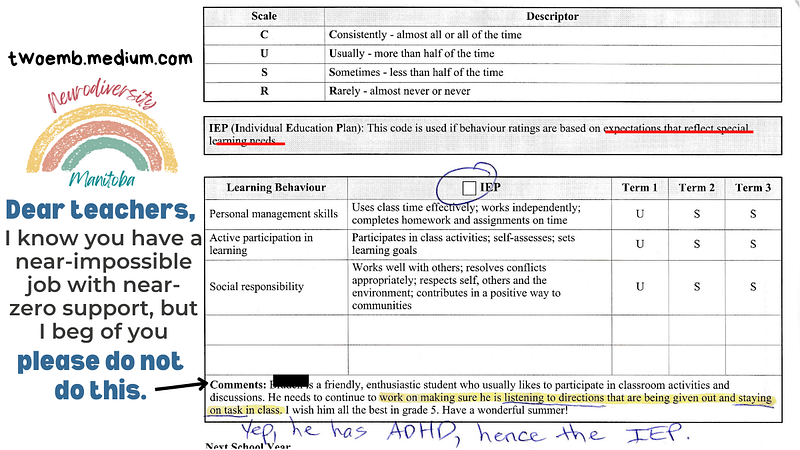
If a student has an individualized education plan (IEP), student-specific plan (SSP), or any other form of documentation for supports or accommodations, then all related assessments must be based on progress towards their IEP/SSP goals.
When I say their goals, I mean the student’s goals for themselves, not goals the adults have created and documented without consultation with the student.
If the student could be fairly and accurately assessed based on age or grade norms, they wouldn’t have a needed an IEP in the first place.
Education plans should serve three primary purposes:
- To inform staff and educators about the student’s strengths, struggles, and needed accommodations.
- To ensure the student is provided with those accommodations or supports needed for them to do their best.
- The student’s disabilities or support needs are outlined so their assessments are based on that student’s individual progress.
If the student could be fairly and accurately assessed based on age or grade norms, then… they wouldn’t have needed an IEP in the first place.
School staff need training, resources, and support
It’s unrealistic to expect teachers and school staff to be able to understand, follow, and engage with education plans if they receive little to no training or support in doing so.
This requires change at all levels:
- Teachers Colleges must include more required courses on supporting neurodivergent and disabled students, individual education plans, and accommodating disabilities in the classroom.
- Our provincial government must stop cutting education funding, and provide more money and resources to schools, so they can actually implement the recommendations made in IEPs and by clinicians.
- School divisions need to make Professional Development (P.D.) a priority, ensuring their staff receive P.D. and workshops relevant to their jobs and the needs of the students in their schools.
- Administrators need to seek out P.D. relevant to the needs of their school communities, and to provide support to their staff to attend these training opportunities.
- All school staff should take it upon themselves to find where their training or knowledge is lacking and make it a priority to grow professionally so they can better meet the needs of their students.
- Parents need to provide as much helpful information as possible to their children’s schools, and work collaboratively with their child’s teacher and support staff.
- School staff must be open and welcoming to parents, inviting their input and support, respecting that parents are the expert on their children, and their students are the experts on themselves.
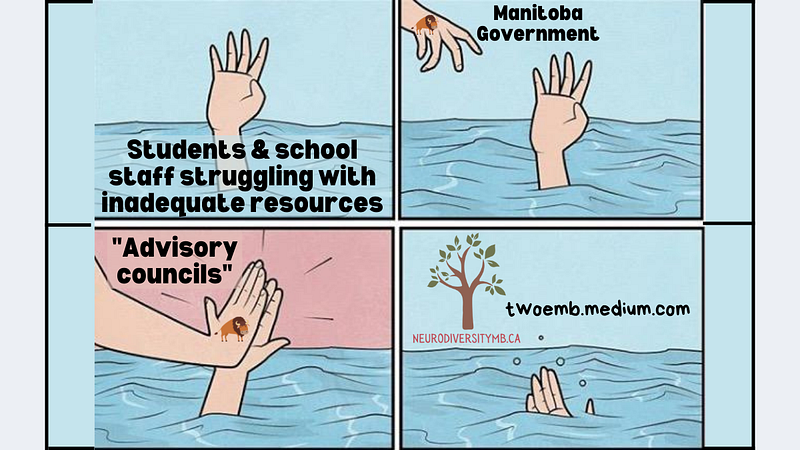
This is unsustainable
When school staff are not given the support or resources to properly assess — or even connect meaningfully with — their students, everyone suffers.
There needs to be significant change at all levels, and that has to start with our provincial government. They need to stop playing politics with our children’s education and start doing their jobs.
© Jillian Enright, Neurodiversity MB
Related Stories
When you join medium, as a member you’ll have access to unlimited reads for only $5 per month. If you use my referral link, I’ll earn a small commission, and you’ll earn my undying gratitude.