ESSAY | WRITING ON MEDIUM
Producing Superior Medium Content
Quality content and proper formatting are imperative
Preliminary Considerations
In writing for public distribution, one pursues perfection with unyielding determination. It’s hard-coded in one’s DNA. No other way is possible for one.
However, Dr Mehmet Yildiz suggests that the determined pursuit of perfection is counterproductive. It tends to diminish productivity. He suggests that one strive to approach excellence rather than doggedly pursue perfection. One needs to learn when to stop. See the comment to Perfection in Writing Is the Goal.
Every story, poem, or article one writes for publication on Medium must have several specific content features and must be formatted appropriately. Otherwise, one may find the piece unacceptable to a publication. Further, Medium may not curate it for broader distribution. By “content feature,” one means those parts of a Medium work that contain substantive content. These include the main text and the title, subtitle, kicker, and feature image.
Medium has its general distribution guidelines that apply Medium-wide. Further, each publication has its own submission guidelines. A link to its guidelines will generally be found in the publication’s menu bar. For an example, see the Be Open submission guidelines.
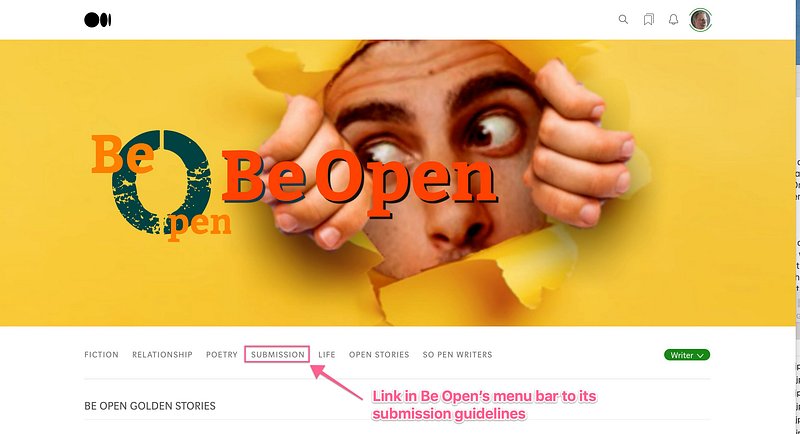
Together, the Medium and publication submission guidelines provide site-wide and publication-specific rules to follow to get one’s work published and curated.
This article will explore the various content features, discuss how to compose and structure them, and discuss their formatting requirements.
Content Features
The title
Two considerations go into making a quality title, phrasing and formatting. Other than perhaps the feature image, the title is the first thing your reader will see. Use it to capture his interest.
Phrasing the title.
A quality title will be short and pithy, that is concise and forcefully expressive. One might say short and sweet. Use the active, not passive, voice. Use a short phrase rather than a complete sentence. Instead of “How Superior Content Can Be Produced For Use On Medium,” use “Producing Superior Medium Content.”
Other than perhaps the feature image, the title is the first thing one’s reader will see. Use it to capture his interest. Crafting a compelling title requires planning and effort. One has from four to ten words in which to engage the reader’s attention and keep it.
To attract readers, your title must not only tell them what your post is about, it must also tell them why they should read it. Your title needs to tell readers what they are about to read and what they’ll get out of reading.
…
[Effective] titles clearly communicate what they offer and why readers should click. These two factors are great for building strong titles that grab readers’ attention and get them engaged. [How To Write A Medium Title That Rocks]
Formatting the title. Format it in Title Case, that is, with first letter caps for every word except prepositions. Do not include ending punctuation, irrespective of whether the title is a complete sentence.
The subtitle
Phrasing the subtitle.
The subtitle is the second thing the reader will see. It is one’s opportunity to expound on the title. It can but need not be a complete sentence.
For example, the title of this article is “Producing Superior Medium Content.” The subtitle is “Quality content plus proper formatting are imperative” It gives a further explanation and sets the context. It suggests why one should read the article — to learn how to write quality content and properly format it.
For a further example, consider article (3) below, Tips for Formatting Your Title and Headers. It has the subtitle “This is the first impression of your story — make it look great.” That explains why the title is essential and gives one an excellent reason to read the article — to learn how to make the title “look great.”
Formatting the subtitle.
Write it in Sentence Case with only the first word capitalized and no ending punctuation irrespective of whether it is or is not a complete sentence.
For some further tips on creating and formatting titles, see (1) How to Write A Medium Title That Rocks, (2) How Do I Create A Good Title for My Medium Article, (3) Tips for Formatting Your Title and Headers, (4) Medium Titles, Subtitles, and Kickers, (5) Want to Write the Best Title? Then Stack It up Against the Best of the Best from Amazon and Medium, and (6) Medium Title Formatting Tool.
Note: Ironically, that last article’s title violates several rules of good titling practice. It is long and wordy. It is not one but two full sentences. It’s not written in correct Title Case. It has ending punctuation. One might rewrite it as “How To Write The Best Title,” leaving the second sentence for the subtitle “Compare your title to the best from Amazon and Medium.”
The kicker
The kicker is a one-line paragraph placed above the title.
A kicker is one of the most underutilized title formatting options on Medium. Most medium writers do not realize that they can use this feature, assuming it is reserved for Medium’s own publications.
A kicker is a short phrase that precedes the title of the article. Kickers can be used as hooks or to further explain titles and they can be used to present a section or classification of content. [Medium Kicker]
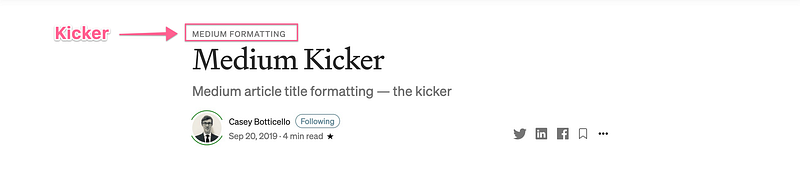
”In this example, the article’s title is “Medium Kicker,” and the kicker is “Medium Formatting.” One might more effectively have used the kicker “Medium 101 | The Kicker.” That suggests several articles in the Medium 101 category; this one is about the kicker.
The feature imfage
The feature image is the image that accompanies the title, appearing either directly after the title/subtitle or directly before the kicker. The feature image for this article sits before the kicker.
Articles with images get 94% more views than those without. On Medium specifically, images are also used to grab the attention of your potential reader when they’re scrolling through their feed. Images are super important, whether as a preview of an article or as inline content. [The Ultimate Medium Image Guide]
Choosing the correct feature image for one’s Medium piece can be critical to generating views. Choose an image that relates to the article’s content. The image should bolster whatever the title suggests. With the proper title/subtitle/kicker and feature image combination, one has the best opportunity to grip the reader’s attention as he scrolls through his Medium feed.
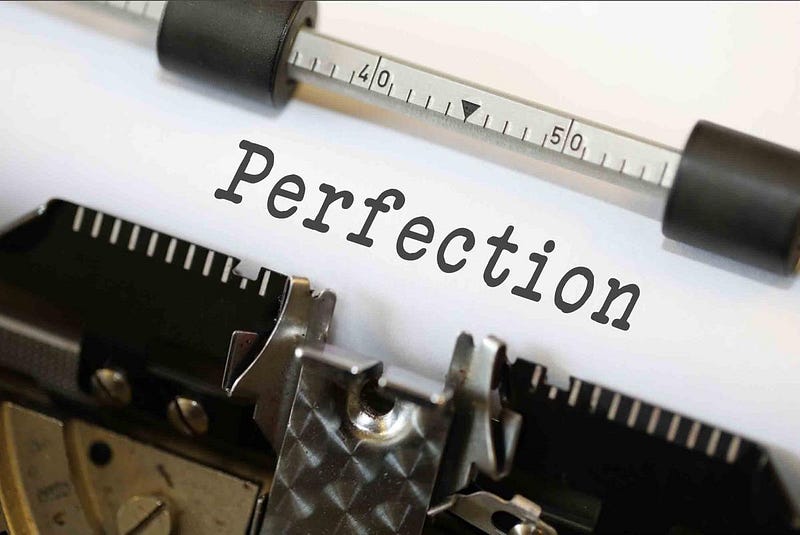
Be certain to correctly caption the image. Use the caption to give the image a name appropriate to the article, give credit to the image creator, and demonstrate either that the image is royalty-free or that one has license to use it. One scheme is that used for the feature image to this article. Its caption reads
Perfection | credit: Nick Youngson | Alpha Stock Images (licensed under CC BY-SA 3.0)
At the left section is “Perfection,” which is just the name one gave the image. It’s a hyperlink to the webpage at which one found the image. Should it ever be necessary to find the image source again, that link will do it. The middle section credits the photographer. His name is also a link to his website. The right section identifies the entity that owns the image (again, it’s a link) and explicitly states the license under which one has the right to use the image.
That scheme satisfies Medium’s image crediting policy and that of every publication one has come across.
For additional information on choosing feature images, see How to Choose the Perfect Featured Image for Your Medium Article, and The Ultimate Medium Image Guide. For an all-encompassing policy on handling images on Medium, see the guidelines for the Illumination series of publications, Handling Story Photos.
How to Write Quality Content
Writing a good quality story or article can be more of an art form requiring some degree of natural talent than a rule-based, formulaic enterprise. Of course, one must know the rules of both grammar and good English composition techniques, for example.
Some good English composition rules and best practices include:
- Active voice. Avoid writing in the passive voice. Write in the passive voice only if one has a specific reason to do so.
- Correct paragraphing. Do not write in long, dense, block paragraphs. Write in paragraphs of from one to six or eight sentences. Using multiple paragraphs gives the article greater white space and makes it easier to read.
- Correct paragraph structure. Paragraphs are generally structured with a paragraph. Following that are several sentences that do the developing. The closing sentence or two sums up the result and tie the thoughts back into the lead sentence(s).
- Grammar rules. The rules of English grammar are legion, complex, and abstruse. Few writers know them all. Fortunately, some applications can examine one’s text for incorrect grammatical constructs and suggest corrections.
- Grammarly, Scribens, and Hemingway App. These are three AI (Artificial Intelligence) editor apps. Each is browser-based. Each has both free and paid subscription versions. Feed your draft text through all three applications in the order listed before submitting it for publication. If you use beta readers or ask others to review your drafts, save them time and effort by first running the text through all these applications, making corrections as required.
- Grammarly. Grammarly can do more than spot punctuation and sentence-construction errors. It can suggest rephrasings of whole sentences and alternative vocabulary choices. Although, one should exercise care when using applications such as Grammarly. It can make mistakes. It follows general grammar, sentence construction, and vocabulary rules. A writer may have a specific reason to transgress one of these rules, in which case he will want to ignore Grammarly’s suggestion.
- Scribens. Scribens is similar to Grammarly in function but dissimilar in user interface. Its analysis reports different statistics and evaluations of one’s performance.
- Neither Grammarly nor Scribens works within Medium. To use them, one must open each in a browser window/tab by navigating to their home pages. One must then copy the full text of one’s story/article and paste it in the editor’s editing window/tab. As one proceeds down the list of suggested corrections, one must alternate between the Medium tab and the editor tab first making the change in Medium then in the editor. If one makes the changes in the editor tab then copies the whole of the changed text back too the Medium tab, one will overwrite the images and loose all title, subtitle, header, and subheader formatting. The process is laborious and tedious but is necessary if one wishes to produce quality work.
- Hemingway Editor. Hemingway Editor analyzes sentence structure for adherence to specific rules of construction. It generally prefers the writing style of Ernest Hemingway. It has a bias toward shorter sentences with exceptional “punch.” Its analysis of one’s composition provides excellent insight into proper English composition. If one uses it often enough, one begins to learn the rules for oneself. I would run the text first through Grammarly and Scribens then through Hemingway Editor. Hemingway Editor will still catch errors and make suggestions missed by the first two, they just won’t be so many and will be easier to correct.
- Vocabulary. The average adult native-English speaker has an active vocabulary of some 20,000 words. He has an additional passive vocabulary of some 40,000 words. How Many Words Does an Average Person Know? Using a solid vocabulary with multiple synonyms will make one’s story or article stand out. Grammarly and Scribens can suggest alternative words or phrases, and even rephrase whole sentences. These are powerful techniques for strengthening one’s work.
- Essential hecklist for writers: In this excellent article by Dr Mehmet Yildiz, you will find an easy-to-follow, comprehensive checklist to help you produce quality product on Medium. Run down the list in preparation for submitting your work to a publication.
Put in the work, reap the benefits
For those of you who feel somewhat grammar-challenged or who feel ill at ease with English composition, studying English grammar rules and composition techniques is not a viable course of action. Such studies can take months or years and be quite challenging. They will not help one in one’s immediate endeavors.
The best, immediate help one can get is to use both Grammarly, Scribens, and Hemingway Editor. Doing so is time-consuming, but one will both create markedly improved content and learn the rules and techniques for oneself. Learning by example and repeated exposure is remarkably effective.
One can’t produce the product without the work. Put in the time, do the editing work and generate writen copy in which one may take pride. Your reader will benefit. Through him, so also will you.
For some general articles on how to write well for Medium, see (1) Best Practices for Writing On Medium and (2) How to Write on Medium — A Guide With Tips and Best Practices, (3) How to write Medium stories people will actually read, and (4) 17 Secrets to Radically Improve Your Medium Stories.
More From