Writing | Quality | Perfection
Perfection in Writing Is the Goal
“Don’t Try to Be Perfect!?” Whatever Do You Mean?
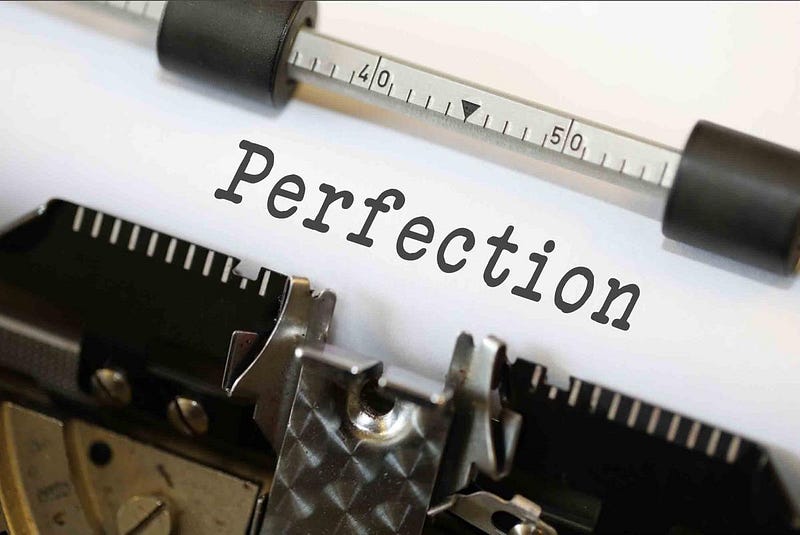
In his article 100 Day Challenge For New Writers, Dr Mehmet Yildiz challenges new writers to follow several goals and gives several tips to increase their success. He urges them to produce an article a day for 100 days. One suggestion he offers to help make that happen is:
Post regularly. Send at least one post per day for the next 100 days. This is a crucial point. Don’t try to be perfect.
Don’t try to be perfect!?
I’m afraid I must disagree.
I can’t help trying to be perfect. I don’t know how not to. It’s hardcoded in my DNA. It’s been a prominent part of me since I can remember, but never more so than when it comes to written product.
In Philadelphia in the early 1980s, I was with a small law firm of eighteen or so litigating attorneys. My mentor was the firm’s number-two man. He came to me after about six months and said,
Alexander, there’s such a thing as being too perfect. It’s more important to get it done and off your desk than to do it perfectly.
That didn’t sit well with me, but I nodded and stayed quiet. He left.
He was in the habit of dictating his briefs then editing the hard copy his secretary brought him. He edited only that once. He trusted to his secretary to correct typos and spelling errors. He trusted to himself that his logical flow, reasoning, argument, and persuasiveness were correct when they came to him extemporaneously as he dictated.
I can’t operate that way. I didn’t think he could either, at least not effectively.
I got six of his briefs that he had filed in the United States District Court for the Eastern District of Pennsylvania, the court that I was before at the time. I read three opening briefs on his motions and three briefs opposing the other party’s motion.
I was surprised. I would never have filed one of them over my signature. Never. Yes, they were acceptable. Yes, they were probably a cut above most of the briefs the court saw. But, with revisions and editing, they could have been excellent, and I knew how to improve them. So, I determined to stick with what I knew.
Some little time after that, I received from Dick, the firm’s owner and himself an anal perfectionist, a brief I had written and submitted to him for review. In his red fountain pen ink in the left margin on the first page was the notation
Three big words the judge won’t know. One spelling mistake, pg. 17. Fix it and file it.
I considered that due recognition of and a great reward for my pursuit of perfection in what I wrote. Dick seldom let something get past him without noting consequential revisions. He was known to strike whole paragraphs or move them about on the pages.
I’ve never regretted trying to do it perfectly, especially so when it comes to written product that I’m going to put before the world over my signature. I expect people to read it. I wish them to admire it. If I haven’t done my absolute best to make it perfection, how in good conscience can I put it before them with those expectations?
I understand Dr Mehmet Yildiz’s point. In his opinion, new writers need to produce product to get noticed, and that requires moving things off your desk quickly. In these circumstances, it’s Dr Mehmet Yildiz’s opinion that it is more desirable and beneficial to move the product. Unstated is the belief that one cannot both move product daily and pursue perfection.
I suppose that was the point my mentor at the firm was making to me. But I disagree. Whatever writing it is that one produces, however frequently, it is imperative that it be the best one is capable of producing.
Otherwise, what’s the point?
Otherwise, one does a disservice to one’s audience. One risks losing readers to other, better work by other, better writers who do put effort toward perfection.
This piece, some 1,300 words, took about five hours over three calendar days to get to the point that I am ready to submit it for publication. I edited it twice. (That doesn’t quite convey the editing effort, for I constantly edit as I write.) I put it through Grammarly, Hemingway, and Lingofy to polish it. Done correctly and carefully, that alone can take an hour.
Note: I don’t always do as they say. Grammarly can make mistakes. I may have a specific reason for not abiding by the general rule. Hemingway is skewed toward one particular writing style. Lingofy uses the AP Style Book intended for journalists. Nonetheless, I find their suggestions helpful and sometimes determinative.
Those three calendar days weren’t consecutive calendar days. I set it aside for two days before coming back to it this one final time to re-edit. I double checked that I have good tags. I triple checked the display title and subtitle. I ran through the SEO settings again, just to make sure. I revisited the citation to the feature image. Lest you think I’m unnecessarily punctilious, just note that I found one error in that citation after all that prior effort. I wound up rewriting it.
Note again: I make the citations in the image caption active links. Check the citation to the feature image above. One of the links was incorrect. It generated an
Error 404 page not found
notice. I had mistyped one character in the URL. How embarrassing would that have been — to have gone to all that effort for the reader then failed him because I was too lazy or too rushed to test out the link?
I believe it was Issac Bashevis Singer who once said that writing for him was sitting down at his desk of a morning and spending a couple of hours filling a page with words, then spending the rest of the day pushing them around on the paper with a pencil until they fell into the proper order.
That is what writing is like for me. I spend as much or more time searching for that other word that is perfect for that spot and pushing the words around as I do thinking of the original words in the first place. That’s editing. That’s revisiting one’s work after a few hours or a day away from it and checking that it says what one intended as perfectly as one can make it. That takes time, dedication, and devotion.
If one determines to produce one thing a day, one must also determine to put in the time, to do the work. Dedicate the time. Do the work. Devote oneself to the pursuit of perfection. Produce excellent material relevant to one’s intended audience. Get one’s work distributed. An audience will follow, will build, and will look forward to ones next piece.
More from