
Piece Works: Concepts of Chess
Considering the origins and Modern reinterpretations of the imagery of chess…
Chess pieces and game boards have long been symbols of sophistication, style, intellectual and, sometimes, material wealth. The sets of small tactile sculptures present artisans and artists with an almost irresistible opportunity to showcase their craft and, in turn, for owners to proclaim their good taste. I recall a time when so many authors and intellectuals posed for their promotional pictures with a chess set and an (optional) whisky tumbler or brandy bowl…
The ostentatious heritage of chess dates back millennia to its Asian origins when its main antecedent was known as chaturanga, a game played on the same board of 8 x 8 squares with 32 pieces. Early sets were divided into four different colour-coded groups of eight pieces, rather than two opposing line-ups of 16. The game as it is played today developed through the merging of chaturanga with several similar board and tablet based games played and distributed primarily by Viking traders across Europe. Most notable of these was hnefatafl or ‘king’s table’ — a version of which is still played today.
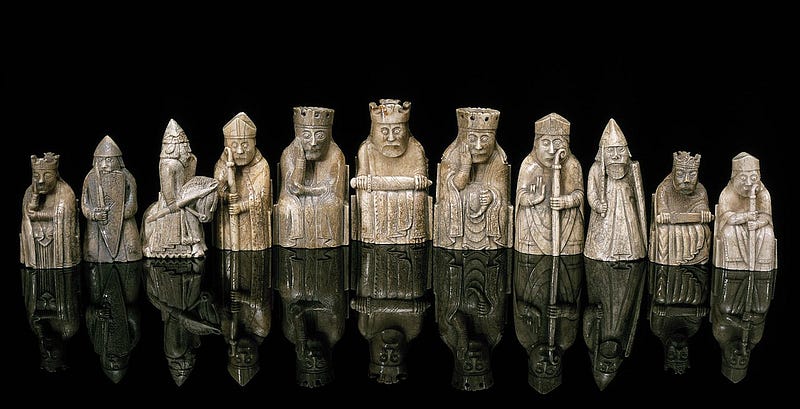
The Lewis Chessmen are probably the most famous of all and a rare example of surviving medieval chess pieces. Most of them were discovered among a Viking horde in the Uig area on the Scottish island of Lewis and seem to have originally come from eight separate sets carved from walrus tusks, and a few from whale teeth, between the late eighth- to twelfth-century. They feature motifs from Celtic-Christianity and Scandinavian styles with the pawns biting their shields believed to be inspired by the formidable Berserker Warriors of the Viking age.
The chess pieces most commonly used to this day and approved for tournament play are a standardised edition originally sold by Jaques of London in 1849 and approved by Howard Staunton, the English chess master of the day. They were designed by Nathanial Cooke who edited The Illustrated London News, the journal that published Staunton’s regular chess column. Since then there have been innumerable ‘variations on the theme’, some subtle tweaks, other more radical reworkings. Here we’ll consider just a few interpretations, and reinterpretations, of the chess set created by Modern and Post-Modern artists…
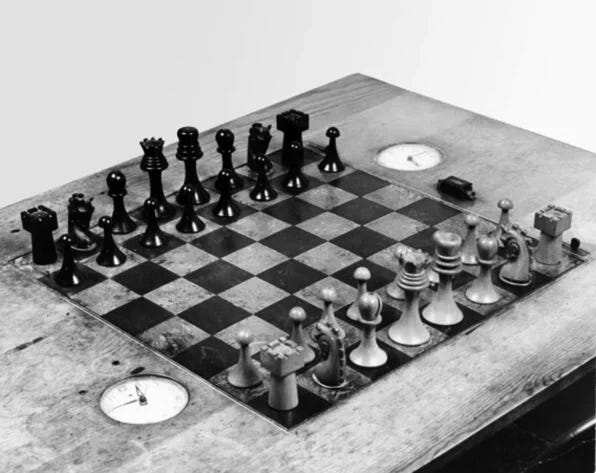
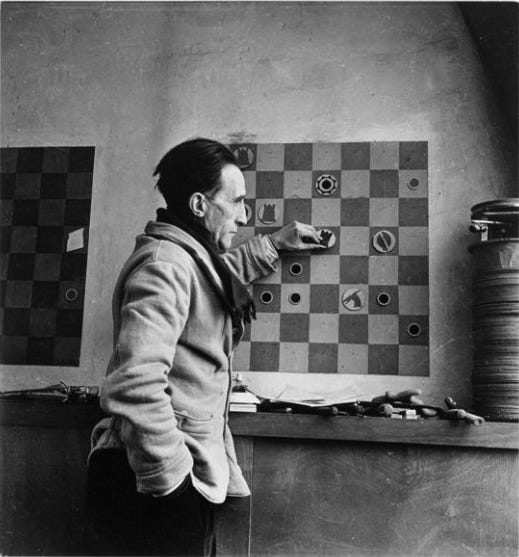
When approaching the concept of chess within the arena of art, one cannot avoid discussing Marcel Duchamp who, for a period in the 1920s ostensibly ‘gave up art’ to focus on his chess career. Reputedly he enjoyed the playing so much that he lacked the determination to enter a decisive end game. Though this tendency didn’t stop him from being ranked as a Chess Master by the French Chess Federation in 1925. He was then accepted as a player on their national team and competed in four Chess Olympiads, winning an international tournament in 1928. He became their official representative to the International Chess Federation in 1932, after Alexander Alekhine, the world chess champion at the time, stepped down.
Shortly after this, seeking a purer artform, Duchamp decided to separate the concept of chess from its physicality and favoured what he termed ‘non-retinal’ modes, such as playing via telephone, telegrams, and written correspondence. He also enjoyed playing mind-chess — keeping track of imagined games without the use of board or pieces. By the mid-1940s Duchamp had started organising blindfolded chess contests for his Surrealist friends.
Duchamp’s regular opponents were his serial collaborators Francis Picabia, and Man Ray, who applied for patents of several designs including wall-mounted magnetic chess sets he’d invented with Duchamp’s input. Together they laid-out a critical and conceptual grounding for chess to become a valid creative medium for visual artists to explore.
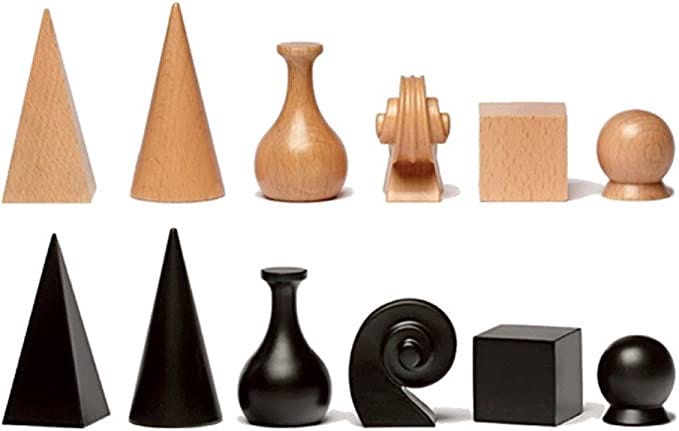
Between the wars, they were very aware of its strategic core, not unlike the battle field, yet applied in a way that brought people together with the added bonus of being an enjoyable, non-lethal pastime. They also realised that chess aligned with a core characteristic of the Modernist approach.
Traditionally, art had been a passive experience for the viewer — the artist looked at the world and re-represented what they saw. Modernism brought with it an understanding that the audience can take an active role as an interpreter. There’s an expectation that each viewer should observe carefully, considering the artist’s intentions and environment, before interrogating the works, considering their personal responses and forming their own judgments. Art was no longer fixed at the point of delivery, becoming a medium for dialogue between transmitter and receiver… indeed, rather like a game of chess that enables interaction within a framework and, just as in the game, the viewers were participants.
Chess combines several formal elements that could be considered to be ‘of art’. There’s the obvious sculptural aspect in the design of the pieces. They also have an iconography signifying additional meanings including their codes of play and rules of movement along with the extended connotations of their names denoting social hierarchy. There is a compositional element as moves are made and the arrangement of pieces changes. At any one time that ‘composition’ may appear abstract, though it has been arrived at by intellectual considerations, sometimes in conjunction with creative decisions.
Amazingly, there are more combinations of how the pieces can be arranged on the board than there are atoms in the observable universe. What!? I know… but that’s also including arrangements that cannot be arrived at through ‘legal’ game-play. Even when playing by the rules, the actual numbers involved are so mind-blowing that a better way to grasp it is to ponder that just five turns into a game of chess, there are in excess of 69 trillion possible combinations of moves and that number grows exponentially with each following turn. So, apart from famous games than can be replayed by following notations, every game is likely to be different.
Which makes Duchamp’s ‘non-retinal’ chess games all the more impressive, particularly the famous ‘blindfolded’, multi-player chess game he organised at New York’s Julien Levy Gallery in January 1945 involving chess master George Koltanowski taking on seven players all at once using Modern artist-designed sets which he couldn’t see. He had to keep track of each game from the moves called out by Marcel Duchamp who mediated the multiplied match. The opponents were the gallerist, Julien Levy; avant-garde architect, Fredrick Kiesler; the director of the Museum of Modern Art, Alfred Barr, photographer and theatre designer, Xanti Schawinsky; composer, Vittorio Rieti; Surrealist painter, Dorothea Tanning; and Max Ernst.
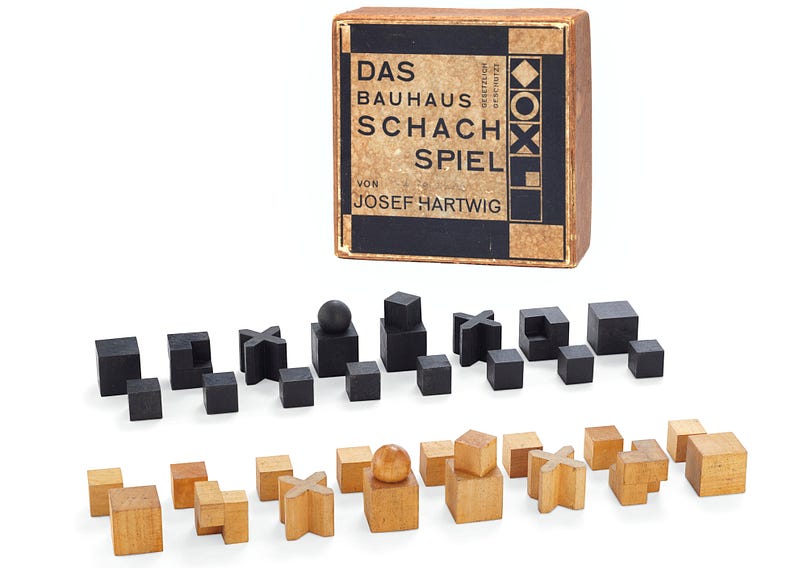
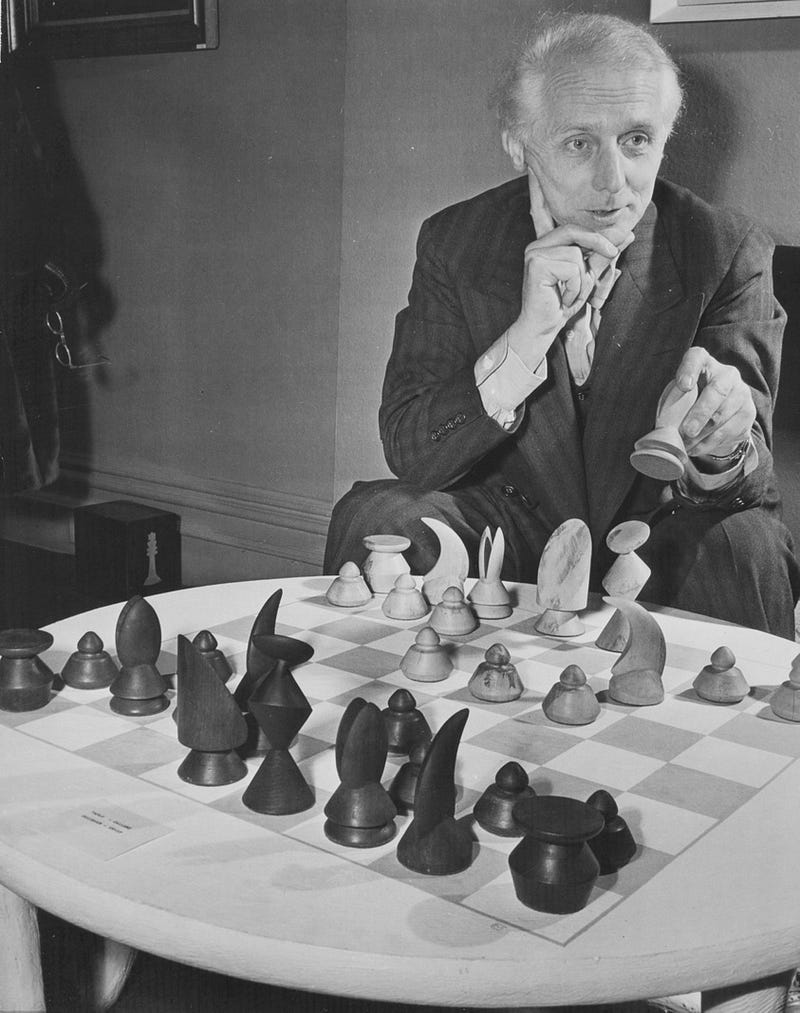
Notably, Schawinsky played using an authentic Bauhaus chess set, designed by Josef Hartwig in 1924, that had once belonged to his friend and founder of the influential German design school, Walter Gropius. Max Ernst supplied his own specially made sculptural set. Incidentally, it appears that Ernst and Tanning bonded over their love of art and chess and would later marry.
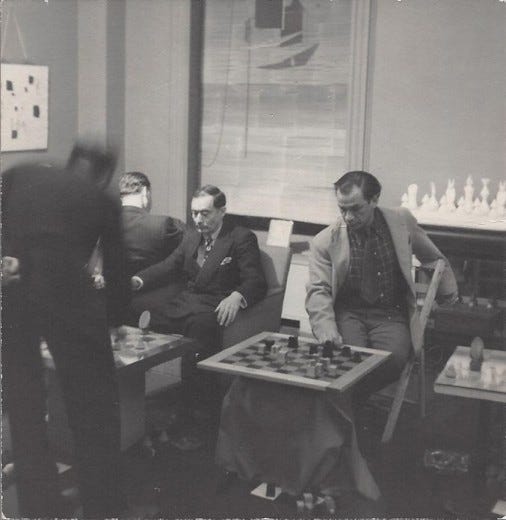
The seven-way match is considered one of the earliest ‘happenings’, a form of Performance Art that would characterise the New York art scene in the 1950s and '60s. Duchamp’s event was part of the groundbreaking Imagery of Chess exhibition at the Julien Levy Gallery which involved at least 30 artists contributing their creative responses to chess. A good proportion were established European artists, refugees fleeing Nazi persecution in the midst of the Second World War, others were emergent talents destined to become notable in the post-war period. There’s no surviving list of works but other exhibitors are known to have included John Cage, Alexander Calder, Ashile Gorky, David Hare, Carol Janeway, Steffi Kiesler, Matta, Robert Motherwell, Isamu Noguchi, Kay Sage, Muriel Streeter, Yves Tanguy…
It has since become fairly common practice for artists to create chess sets or produce chess-inspired works. The Imagery of Chess exhibition was reconstructed as accurately as possible in 2005 at Long Island’s Isamu Noguchi Museum. In 2012, London’s Saatchi Gallery commissioned sixteen artists, including Maurizio Cattelan, Paul Fryer, Damien Hirst, Barbara Kruger, Alastair Mackie, and Rachel Whiteread to create chess sets and related art in a post-modern reimagining. In 2020, the World Chess Hall of Fame in St Louis staged an extensive exhibition of works by Keith Haring, highlighting the many formal parallels and recurring chess-related motifs in the ‘graffiti’ artist’s colourful work. (Keep reading for a virtual tour of the exhibition.)
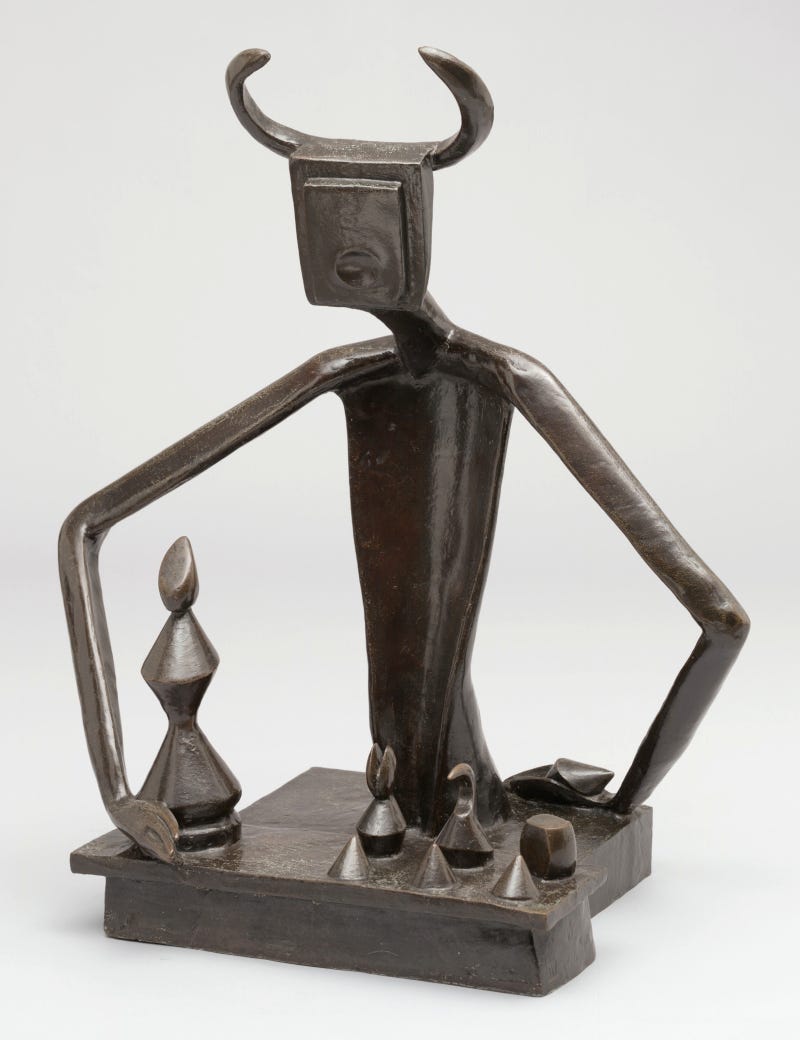
Toward the end of his career, Marcel Duchamp once again pretended to favour chess in place of the so-called art. He stated an intention to make his living into art so that “each second, each breath is a work which is inscribed nowhere… neither visual nor cerebral.” In chess, he believed that he’d found an expression of something he referred to as “socially pure art”. He reasoned that the aesthetics of chess lay mainly in the beautiful dynamics of the gameplay, which is transient and unsalable. The chess set was the medium — the paint and canvas, if you like — for the participatory, experiential, intangible dialogue of art. He’d already pioneered Conceptual Art in the early twentieth-century, perhaps because it troubled him that as soon as a piece of art was traded, it became (a) work and was immediately an aspect of commerce — a product.
Even this ‘endgame’ of his was a clever piece of Conceptual Art. Whilst he was spending his time playing chess — leaving only photographs and the memory of games in the minds of his chess partners as the record of the art — he was also working behind the scenes on his final opus. He completed the installation titled, Étant Donnés, Given: 1. The Waterfall, 2. The Illuminating Gas, left detailed instructions of how it was to be viewed, and stipulated that it not be shown until one year after his death. According to his instructions, it was posthumously revealed to the public in 1969, at the Philadelphia Museum of Art.
Duchamp had finally transcended materialism and ‘cleared the board’…
Marcel Duchamp’s Readymades are also discussed by Remy Dean in Signifier.
* All images are used with license, or presented here for educational purposes under fair usage policy.


