
Palmyra: A Greco-Roman City
UNESCO World Heritage Site
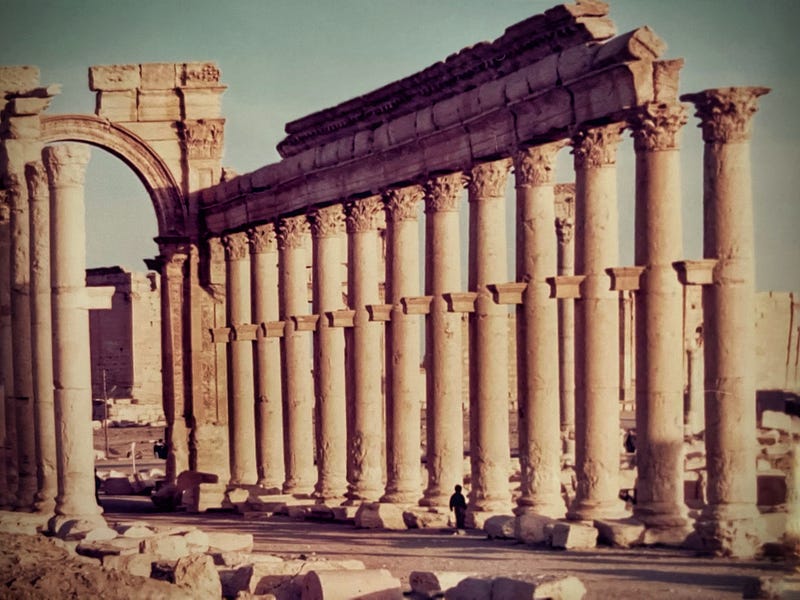
While living and teaching in Jordan, we often crossed the Jordan/Syrian border to drive to Palmyra, the Greco-Roman city ruins in northern Syria. As we drove, the sight of beautiful columns and arches in the distance indicated we were getting close to the ancient city again.
Palmyra started as a settlement on a fertile oasis in the third millennium B. C. The Mesopotamian settlement called Tadmore was controlled by the Arameans with the Arabs arriving and blending in during the first millennium. Its location helped it become one of the major trading posts on the Silk Road which brought influences from China and India through Messopotannia and on to Rome.
In 64 BC, the Romans conquered the area including Palmyra. At that time it was mainly a trading partner with Rome. It was fully conquered and put under Roman rule in A.D. 14. In the third century, Queen Zenobia rebelled against the Romans and lost. In retaliation, the Romans destroyed the city.
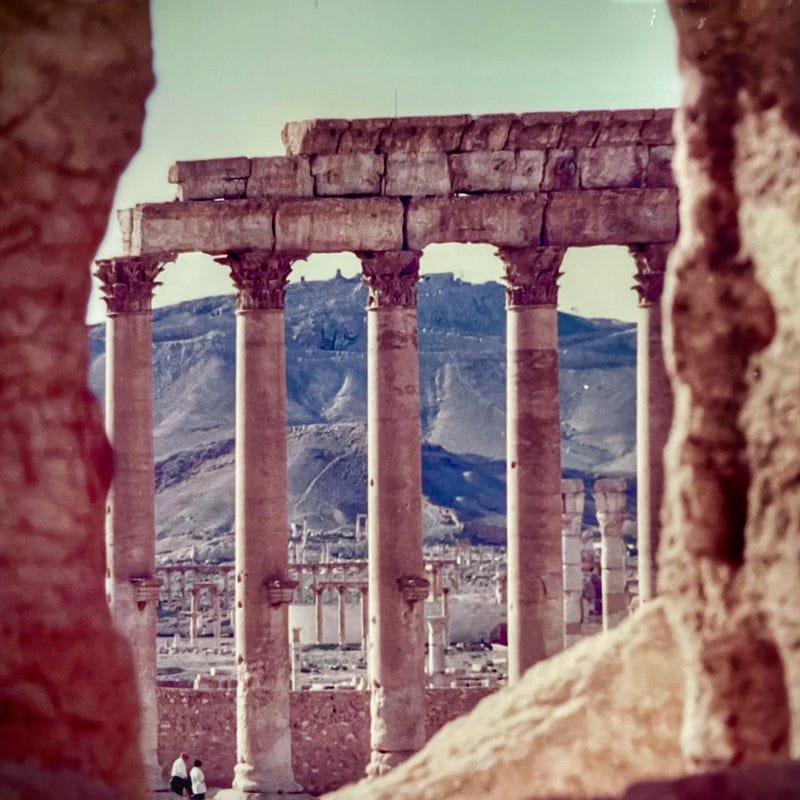
I never cease to be amazed to walk down ancient stone streets lined with columns. The streets were wide enough for camel caravans to walk through. The grand, colonnaded street, 1.3 km in length, formed the axis of the city. It was lined with 750 columns on each side. This road, together with secondary colonnaded cross streets, linked the major public monuments. Built into the street system was a network of pipes to control the flow of water. Although this is a semi-arid region, it was an oasis with water.
One of the large remaining buildings was a first-century temple dedicated in AD 32 to Ba’al (or Bel or Baalshamin). The sanctuary of Ba’al demonstrated hybridity of design — incorporating both Near Eastern and Graeco-Roman elements. Ba’al, one of the main divinities of pre-Islamic Palmyra, was a sky god. He was worshipped in a triad with the lunar god Aglibol and the sun god Yarhibol. They formed the center of religious life in Palmyra.
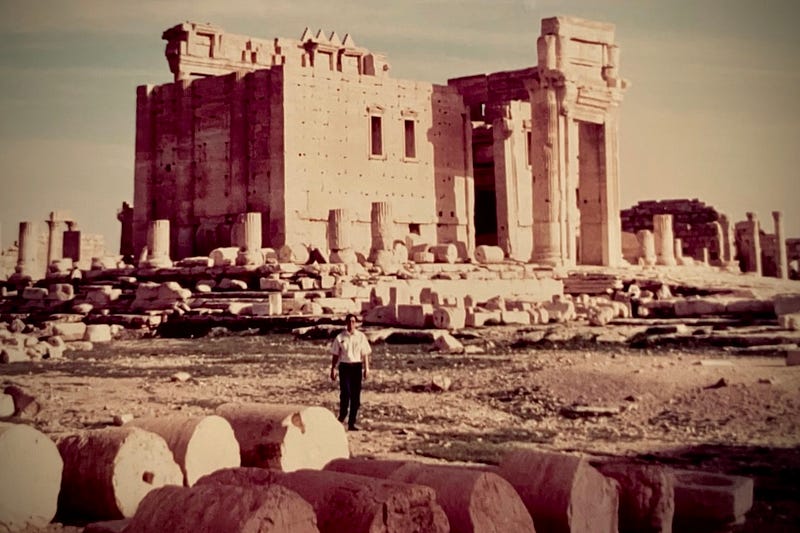
Although Ba’al has not been worshiped for centuries, and the temple was in ruins, the temple remains were bombed in 2013 during the Syrian civil war because it was considered to be pagan. It was recaptured in 2015. There are plans to rebuild it using the remaining materials.
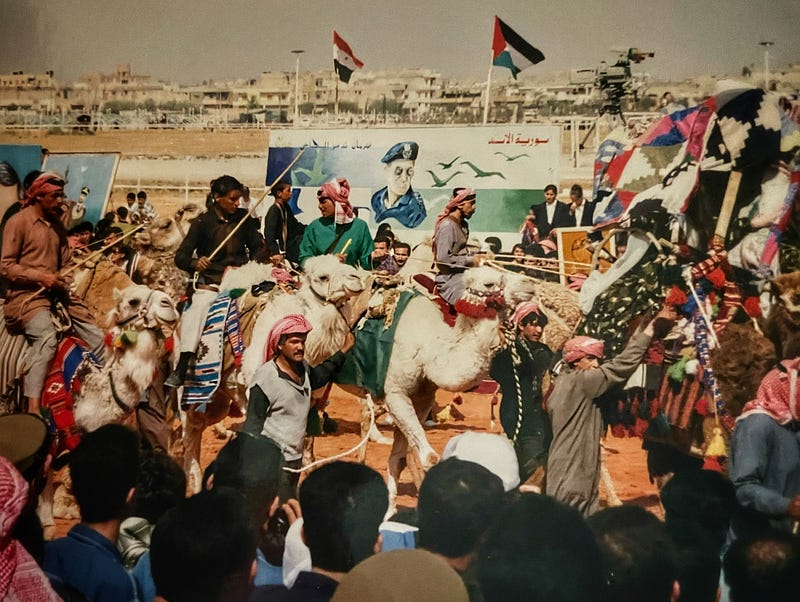
One of our trips to the Palmyra area of Syria was to watch camel races. It was quite an event. A crowd of people lined up along the side of the parade route. I was there with a group of teachers, but we got separated in the crowd. Just before the band came marching along, I was invited to join a group of Syrian women sitting on the back of a truck so I had a better view. Awesome. Then along came the band.
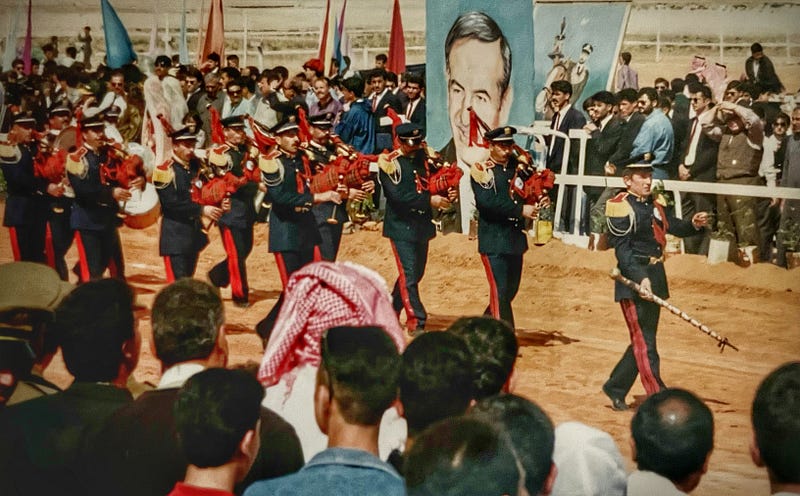
The camels and their riders followed the marching band. Finally, the camels and their riders were all lined up at the starting line. I don’t remember the details of the race because it was short and over so quickly. Suddenly it was done and everyone left the area.
I quickly found my group of friends again and we headed back to the nearby village where we were staying for the night. The next day we drove back south to Amman, Jordan again.
Each trip to Palmyra was an adventure. We were learning about the history, architecture, and culture of ancient civilizations but we were also learning about the culture of the people living in the area today.
The Syrian civil war is still ongoing. Hopefully, peace will come to the area again soon.
Other stories about ancient sites in Syria by me:
Crusader Castle: Crak Des Chevaliers
Information sources for this story
Additional Interesting Resources on Medium:
This Mesopotamian city was a hotbed of innovation — and a cautionary tale by Eric Jaffe
Humans Bred Hybrid Animals 4500 Years Ago in Ancient Mesopotamia by Prateek Dasgupta, M.S.
Exploring Bangkok’s UNESCO World Heritage Sites and Other Historical Marvels by UNESCO World Heritage Spotlight
Cambodia’s Gritty Past and Glorious Present: A Journey Through Time by UNESCO World Heritage Spotlight


