
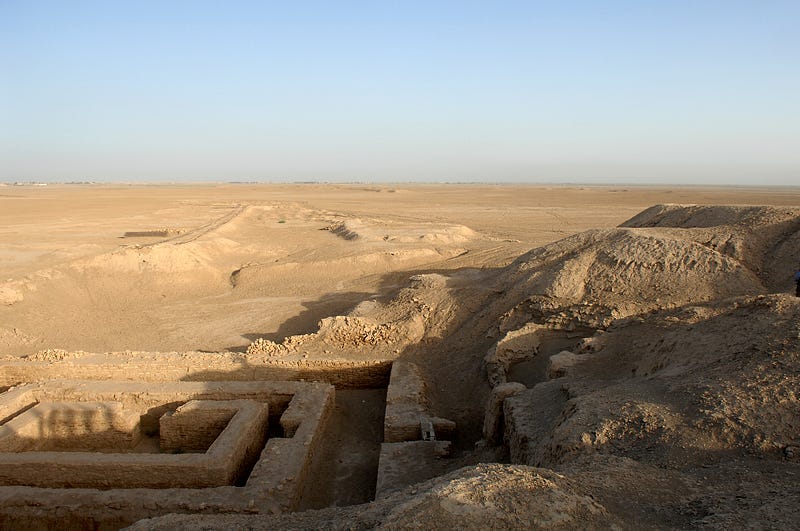

This Mesopotamian city was a hotbed of innovation — and a cautionary tale
At least three transformative ideas trace their origins back to the historic, once-thriving city of Uruk. But innovations must be wielded wisely.
From the very earliest settlements to the present day, people gathered in dense areas have used their collective ingenuity to manage the problems — and magnify the benefits — that uniquely arise from urban life. It’s a timeless truth: cities breed innovation.
Last year, I described the origins of urban innovation in the supersized village of Çatalhöyük, one of the earliest dense settlements to emerge in human history, dating back to 7400 BC. Çatalhöyük residents wanted to get the benefits of a large community (at that time, primarily food provision) without sacrificing all individuality. So they devised a social innovation we still use today: they created neighborhoods, complete with private homes and local leaders but also strong connections to a wider food network.
“Çatalhöyük therefore survived in large part because its residents found a way to live both separately and together,” writes anthropologist Justin Jennings in his book, Killing Civilization.
The journey continues a few thousand years later with what many historians consider the first true city: Uruk. Here our guide is author Ben Wilson, whose new book, Metropolis: A History of the City, Humankind’s Greatest Invention, is an impressive research feat spanning more or less the entirety of all urban development. In the tradition of Jane Jacobs, Wilson excels when describing the timeless link between cities and innovation — and the example of Uruk provides a hopeful yet cautionary tale.
Three Transformative Inventions
Located in Mesopotamia, Uruk had a main settlement period spanning roughly 4000 to 1900 BC. At its peak, the city was home to tens of thousands of residents in just 1.5 square miles. That population would put Uruk on par with some of the densest U.S. cities today, including New York City.
Uruk’s population consisted of highly skilled craft makers — specifically potters. Freed to focus on their speciality while the broader community handled food provision, these workers produced highly coveted luxury and everyday goods that Uruk’s traders exported across the region. The city’s urban form further fueled this thriving creative economy by encouraging interaction and knowledge-sharing. Here’s Wilson:
The density of the housing and the city’s layout, with its cool, shaded streets, encouraged sociability and mingling — and with it an exchange of ideas, experimentation, collaboration and intense competition.
These conditions led Uruk to become what Wilson describes as a “hotbed of technological innovation.” In fact, the following three ideas, all transformative in their own right, trace their origins back to Uruk.
Mass production. Wilson credits Uruk with creating the “first techniques of mass production.” As usual, this innovation began with a challenge. To serve regional merchants as well as its own large population, Uruk’s potters needed to make many more wares than early technology allowed. So they developed fast, foot-powered flywheels and axles that made it easier to throw clay, and they created beehive kilns that made it safer to fire the pots.
The result: many more higher-quality pots, made faster, consisting of both fine tableware for the luxury market and vast quantities of everyday jars and containers for bulk export.
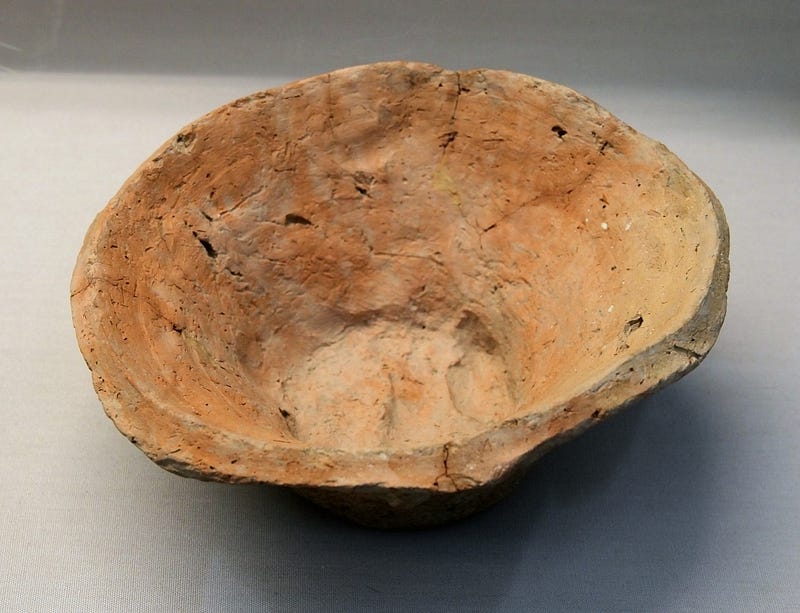

Finance. The breakthrough in production soon led to the core elements of finance. Uruk’s potters produced basic bevel-rimmed bowls so quickly, and at such high volumes, that the bowls became the basis for a new form of currency called a “sila.” One bowl’s worth of barley equaled one sila. But it was hard to cart around so many barley bowls. Uruk traders needed a more efficient form of exchange.
So some enterprising Uruk accountants created “bullae”: clay containers that stored little tokens shaped like a commodity. A little oil jar token, a little cloth token, and so on. The bullae served as contracts: you’ll give me this much cloth, I’ll give you this much barley at a later date. Uruk traders kept the contracts in storehouses — and thus banking emerged.
Writing. Over time, as Uruk’s economy grew, it got harder and harder to keep track of so much financial information. So Uruk society invented a little wedge-shaped marking that could encode some key information onto a clay tablet. Today we know these marks as cuneiform, or one of the earliest forms of writing. One of the oldest discovered tablets has all the elements of a basic contract: the transaction amount (“29,086 measures of barley”), the transaction length (“37 months”), and the name of the accountant on the file (“Kushim”).
In other words, to tackle its growth challenges, Uruk gave birth to perhaps the earliest form of city data. Here’s Wilson:
Uruk was not just a storehouse of humanity: it became a data-processing centre. No society in history so far had had to manage such immense quantities of information. The marks in the clay were invented by accountants in Uruk to compensate for the deficiencies of human memory, which could not begin to hold such quantities of data.
One Timeless Lesson
The ways that urban innovation can lead to economic growth and local prosperity are only part of the lesson of Uruk. Then, as now, innovation and technology were agnostic to their use. Whether new tools became instruments of advance or harm depended on the way people deployed them.
When Uruk deployed its innovations in a way that tackled local challenges and generated regional trade, the city became an “attractive” demonstration of “how humans might live and thrive together,” writes Wilson. Other cities soon adopted Uruk’s advances and adapted them for their own purposes. But those adaptations didn’t always go toward the same ends.
In time, the wheel and axle technologies that once sparked a thriving pottery trade in Uruk were deployed as battle chariots for war. The financial innovations that created new opportunities for Uruk’s makers and merchants were deployed as tools of worker oppression and social inequality. The cultural inventions that formed the basis of writing and information were deployed for propaganda and control. These new uses contributed to Uruk’s decline.
Climate change also accelerated the city’s end — as it had for Çatalhöyük thousands of years earlier. New rainfall patterns disrupted the Euphrates River, and with it the city’s irrigation and trade networks. Little by little, Uruk’s population declined, until by 300 AD there wasn’t much left of the city. By 700 AD it had been abandoned.
If these issues sound eerily relevant today, they should. Local challenges still give rise to urban innovations that serve as powerful engines of economic growth. Cities still copy each other’s social innovations and adopt each other’s technologies. But urban innovation must be wielded responsibly to help achieve outcomes that are good for everyone in the city, and climate change must be tackled urgently and aggressively at all turns.
“Uruk and the Mesopotamian cities speak powerfully to us,” writes Wilson. “They were an overture of all that was to follow.”
Follow Sidewalk Labs with our weekly newsletter or subscribe to our podcast, “City of the Future.”