
History of science
Humans Bred Hybrid Animals 4500 Years Ago in Ancient Mesopotamia
Kungas are the earliest known human-made animal hybrids.
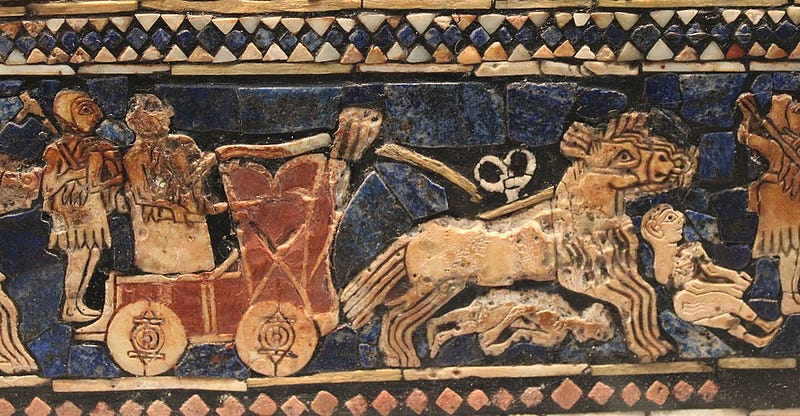
#/media/File:Etendard_d'Ur_-_char.jpg)
Eva-Marie Geigl, a geneticist at the Institut Jacques Monod, Paris, made an unusual discovery while studying the bones of animals from a burial ground in Northern Syria.
They looked like bones from equids. Equids are horse-like animals that include horses, mules, and donkeys. The burial ground bones, however, did not resemble any known equid.
Eva’s team’s first thought was that it belonged to an extinct species known as the Syrian Wild Ass. But the bones were larger than the Syrian Wild Ass’ bones.
The Syrian Wild Ass was much bigger in the past. Over the years it shrunk in size. So the researchers looked at the bones of Syrian Wild Asses from 10,000 years ago to see if they were similar.
They still didn’t match. The findings surprised the researchers.
The bones belonged to an equid species found in ancient Mesopotamia over 4500 years ago. They had just uncovered the first known example of human-made animal hybrids in history.
Sumerians called them Kungas.
What are kungas, and what was their use?
Kungas: The Bronze Age war animals.
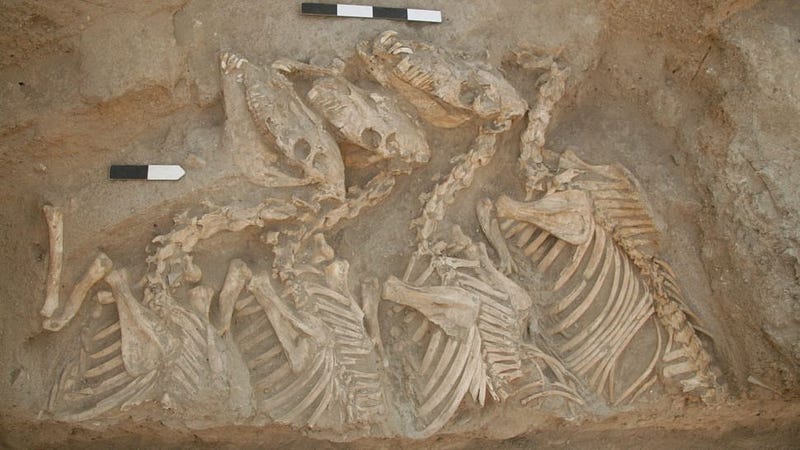
Scientists analyzed the bones of 25 animals from a royal burial complex at Umm el-Marra, near Aleppo, Syria. The animals were sacrificed and buried with their owners.
They found the animal bones near the ancient city of Tuba, one of the earliest settlements in the fertile crescent.
Decoding the DNA of the animals, we learn a remarkable story.
Y-chromosome of the animals was from the Syrian Wild Ass. The mitochondrial DNA was from a domesticated donkey. The animals from the grave inherited the Y-chromosome from the father and mitochondrial DNA from the mother.
“And all the analyses confirmed that the equid burials from Umm el-Marra were 50 percent Syrian wild ass and 50 percent domestic donkey.” Eva-Marie Geigl
This means that the animals whose bones they studied were mixed breeds.
They were not an accidental case of mating. The move was planned and well thought out, implying that the Mesopotamians were breeding these creatures around 4500 years ago.
Sumerian documents show they bred these creatures, although the details are unclear. Genetic research has helped us figure out which animals were used to breed the kunga.
The scientists dated the skeletons of the creatures between 2700 and 2600 B.C.
Prior to this discovery, the oldest known animal hybrid was a mule, which still lives today. But the kunga is over a thousand years older than the mule!
The kunga, like the mule, was infertile. They were fast and hardy creatures. The kunga had the speed of the Wild Ass and the strength of a donkey.
From the Standard of Ur, an artifact from the Mesopotamian city of Ur, we can see Sumerians used kungas to pull war chariots. If you observe the featured image, you will notice the kungas are tied to the chariot with a harness and have a ring in their noses.
This was long before the use of horses for chariots and as mounted cavalry in warfare.
But you might wonder why the people in the fertile crescent didn’t just use the donkey in a war? Why did they go through the trouble of breeding a new animal?
Donkeys, while magnificent beasts of burden, are not daring creatures. They are also stubborn and do not obey orders that easily. Military experts believe the donkey wouldn’t put themselves at risk in a war. Besides, the donkey isn’t particularly fast.
This made it essential to have an animal that could pull a lot of weight, like a donkey but was also fast and willing to take risks.
As a result, the kunga was born.
Sumerian records mention the kunga was a highly treasured and valuable animal. This might be because of the difficulty of breeding them. Because the Syrian wild ass was a swift species, taming them proved challenging.
The Sumerians employed the Kungas not only in war but also as a gift for those of high social standing. We have evidence of kungas being gifted from noblemen in Ur, in Southern Iraq, to the royalty in the Syrian city of Ebla.
The nobles in the fertile crescent respected these creatures, so why did they stop producing them?
Why we don’t see them anymore?
A new animal arrives.
The Kungas were the early Bronze Age’s Ferraris. However, its dominance was soon challenged by another animal, the horse.
Around 5500 years ago, humans tamed the horse in the Steppes. The horse was first used for milk and meat. Soon, humans found they could use it for transportation, hunting, and mounted warfare.
It wasn’t until 4000 years ago, or 2000 B.C., that horses showed up in the fertile crescent because of the migrations of Indo-European people. Indo-Europeans started trading with the people who lived in Mesopotamia and the rest of the Near East. They also taught the people there how to use horses.
Horse trading revolutionized transportation and warfare on a global scale.
The domestication of the horse is a watershed moment in human history. Herculean breeding efforts were not required for horses. The Mesopotamian societies began embracing the change.
Kungas wouldn’t go out of fashion with the introduction of the horse. They were faster than horses, hence continued to be used in war to draw carriages.
Reliefs from Nineveh, the capital of the Neo-Assyrian Empire ( 911 to 609 B.C.), show men trying to capture the kunga. This suggests that kungas were in use far into the Iron Age.
Horses had an enormous advantage over kungas when it came to breeding. Though slower than the kunga, they were swift creatures with a lesser upkeep cost. The horse was also strong and could travel vast distances.
With the rise in the popularity of horses, the Mesopotamians only gave kungas as gifts. Soon kungas lost their usefulness and people stopped breeding them.
Animal hybridization is now considered a regular practice, yet in a period before the widespread use of horses, humans genetically designing animals was quite an accomplishment.
It also shows that humans have been trying to make the best weapons of war and use animals to conquer land and defeat their enemies since the beginning of time. This wasn’t just about making animal hybrids or keeping animals as pets. People also used animals as weapons.
Continue reading to discover about the strange uses of animals as weapons of war.
Enjoy this? Please consider supporting my work by subscribing to Medium using my referral link.
References.
- Bennett, E. Andrew; Weber, Jill; Bendhafer, Wejden; Chaplot, Sophie; Peters, Joris; Schwartz, Glenn M.; Grange, Thierry; Geigl, Eva-Maria (2022). “The genetic identity of the earliest human-made hybrid animals, the kungas of Syro-Mesopotamia”. Science Advances.
- 1st bioengineered hybrid animals discovered — in ancient Mesopotamia, Livescience.
- Dolce, Rita (2014). “Equids as Luxury Gifts at the Centre of Interregional Economic Dynamics in the Archaic Urban Cultures of the Ancient Near East”. Syria: Archéologie, Arte et Histoire.
- Silver, Minna (2014). “Equid burials in archaeological contexts in the Amorite, Hurrian and Hyksos cultural intercourse.”