
NFT Tuxedo Cats!
On Programmatically Generating 10,000 Tuxedo Cat Portrait NFTs
Thoughts about NFT creation and marketing.
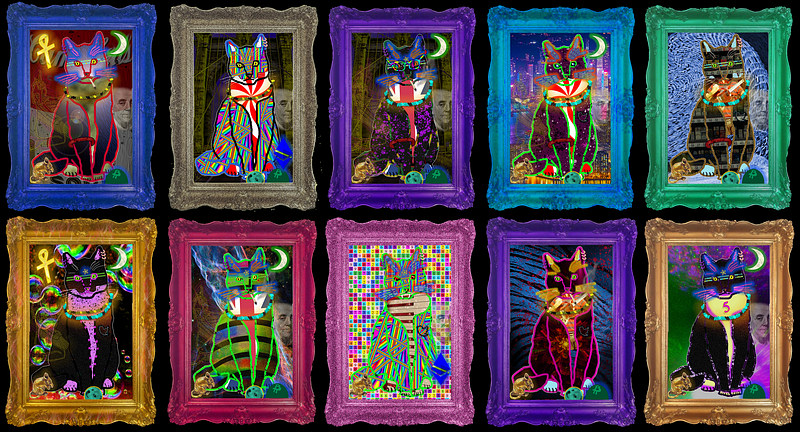
In this article, I’m sharing thoughts about a new digital art NFT project I’ve been working on lately. I call it NFTuxedoCats. I think this may be of use to those interested in creating and selling NFTs, though I’m not exactly an authority on them. But, as of yesterday, I can proudly say that I’ve actually sold one. I’ll talk more about that below, as the experience helped me learn a thing or two.
UPDATE: As of 8–20–21, I’ve sold 22 of these. But, the real update here is that this story is actually a lesson in what NOT to do with a generative set. I definitely have a solid handle on the generative coding aspect now. But, once you have the artwork, it’s a whole different universe than I knew when I wrote this article. Still, I’m leaving it up because there’s a good bit of valuable info in here just in general. After you read this page, here’s a link to a follow-up describing what I did right and what I did wrong with these cats! Nowadays, I can easily generate 10k unique images have them all uploaded via a smart contract and/or setup a mint-on-demand smart contract!
Also… if you want help in generating 10,000 unique characters for your own NFT drop, here’s information on how to get started:
Or, if you’re ready to rock on a generative NFT set, go here and contact me now.
If you’ve followed any of my previous articles on NFTs, you may have some indication about my obsession with them. I’ve written on how nonprofits might use them for fundraising, how musicians with hit tunes might cash in on the trend, and had even launched an initial foray into creating and marketing them myself.
As for that last item — the one where I started coming up with my own one-off NFTs — I liked the general concept, but a few things quickly became apparent: (1) manually creating one-offs is considerably time-consuming, and (2) I was running out of original artistic ideas to maintain the concept in a visual way that I thought was of acceptable quality. (I did not, notably, run out of written or tech ideas, though.)
As for #1 above: of course creating art takes time, and is supposed to! And, I think if you’re an established artist already (esp. a visual artist), the slow process of creating one-offs could be the way to go, as you’ll have a pre-built audience already. For me, though, I wanted something more interesting on all fronts — visual, technical, and even on the marketing side. So, I scrapped that project and went back to the drawing board.
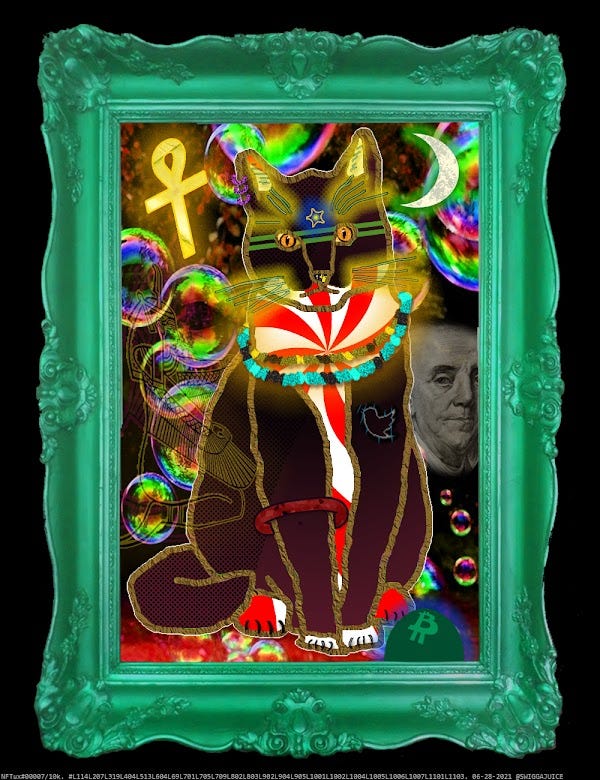
Looking at the success of various other NFT projects, I realized that (as this time, anyway) people seem to like collecting NFTs from larger sets. So many of the projects out there are 10,000 pieces in size. And, from a marketing angle, this makes a lot of sense. In many ways, it’s easier to market 10,000 things than it is 10 things.
So, I started looking at those types of projects — the ones with 10,000 items. Most are programmatically generated graphics with various “traits” (or variations). It’s the “digital Mr. Potato Head” approach — create something where you can interchange parts, and generate them as graphics.
For some reason, most of the popular ones tended to be more or less pixelated. I think this aesthetic is purposeful, as it harkens back to the early tech days of 8–bit graphics, popular among gamers and techies to this day. But, no matter if the project is low-res or high, the concept is the same: (1) Create some sort of character or scene, (2) Have various traits that show up either at random or a certain percentage of the time, (3) Make sure each one is unique, and (4) Generate X number of them as graphics.
If you’re a programmer, it’s actually fairly straightforward stuff, though I can tell you that the execution of it isn’t without some small challenges (e.g., programmatically ensuring uniqueness of each NFT). I suspect there are enough such challenges to make the “barrier to entry” for this sort of thing at least a little bit high still (though I imagine that there will soon be, or may already be, platforms out there to allow non-coders to do this sort of thing). But, being a programmer myself, I figured this barrier may offer me some sort of edge (even if only a little bit), and an opportunity to get a project out there earlier than the inevitable flood of these in the near future (that is, if you don’t already consider the NFT space flooded with uncountable groups of 10,000 NFTs).
(And if you think there are too many groups of 10,000 NFTs floating around already, all I can say is that your chances of successfully marketing NFTs seems higher to me than doing a one-off approach.)
Anyway, so I went to work on my cats. I won’t go into the code side of it for now. But you can look at a bunch of them and mentally imagine what I did. My cats have 11 distinct areas (many NFT peeps refer to this as “traits”) that can change out. Most of these areas have around 20 possibilities (some less). Mathematically, it works out to hundreds of billions of possible outcomes.
To ensure their uniqueness, when I generate them, I basically make a list of the new graphic’s proposed traits and compare it to all of the ones made previously. If it matches any (which is not super likely, as I’m only generating 10,000 out of 400 billion — but could happen), I start the generation over. So, that part’s actually fairly simple (again, if you’re a programmer!).
How’d They Turn Out?
Well, they’re interesting! (At least, to me!) When you’re designing traits / layers / aspect / qualities (call it what you will), you’re focusing on one thing, for the most part. You may have in mind, for example, that a dark necklace should look good on a lighter-background area. But, with billions of combinations, you can’t always reliable pre-imagine every scenario that will arise once you start generating graphics. So, the generation part is ever-fascinating to see what comes out of the system.
While they range wildly in presentation, as a whole I’ve been pleasantly surprised at the overall effect. From an artistic standpoint, I made a comment elsewhere that, bulk art-generation scripting presents interesting philosophical considerations — challenging existing notions we have about what art is and what the creative artistic experience means (e.g., esp. in terms of what decisions artists make when creating). What if you, as an artist, could see and/or even pursue ALL possibilities for a given work instead of having to follow just one direction? Or, to spin it into even more far-out terms: Such projects *compact* the multi-verse of timelines created by each decision-point and allow the viewer, and indeed the artist, to experience all wide-ranging directions simultaneously.
My First NFT Sale
I began posting them two days back, and decided that I’d post about 100/day for the next few months, which should get me through the 10,000 cats. But, more importantly, I feel that having at least 500 or so out there within the first week should be enough stock to really start marketing. Because, in the end, I think the whole NFT space is more about marketing at this point than it is about art. In many ways, that’s sad, of course. But, I think you just have to view it as a huge game and play within the parameters of said game.
One of the first comments I received in the wild had to do with traits. The person asked me for stats, which I hadn’t generated yet. In fact, I hadn’t even thought of stats at all — e.g., figuring out, mathematically, which cats were rarer than others.
For example, this guy …
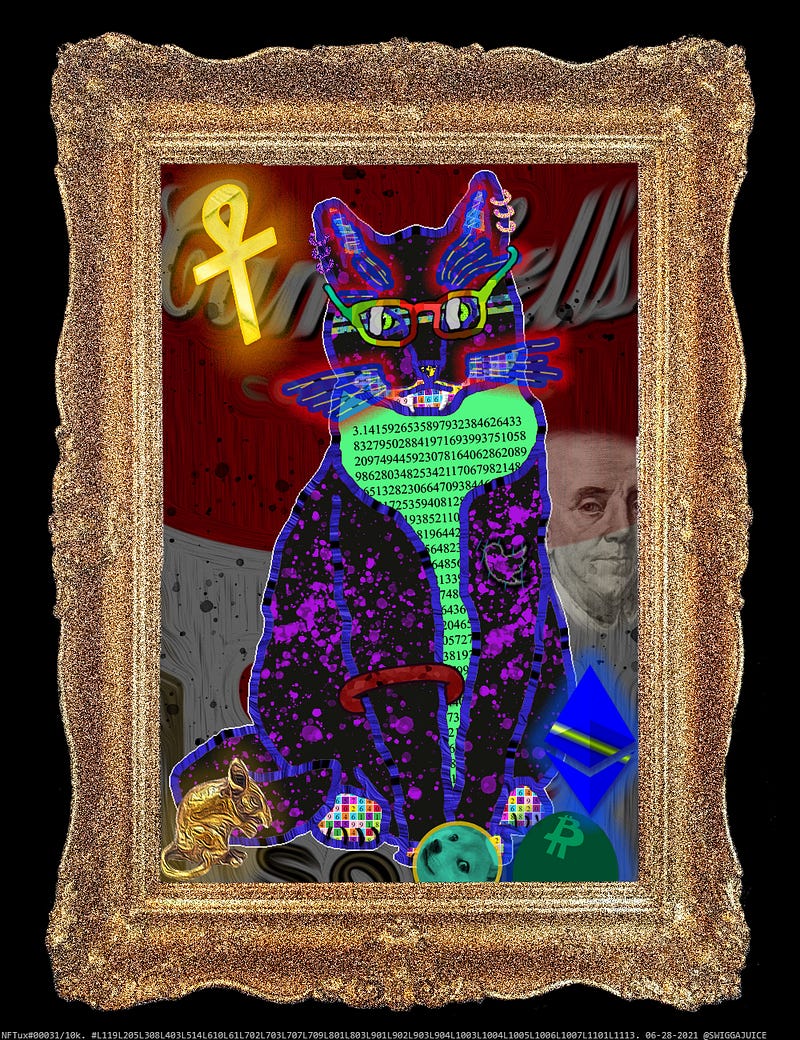
… has 24 traits active, which mathematically is impressive enough to make him among the rarest cats in the set posted so far. I believe there are some with 25 in the coming few hundred. But I believe that number could potentially reach 27 or so. We’ll see what happens once the whole 10,000 are available for analysis.
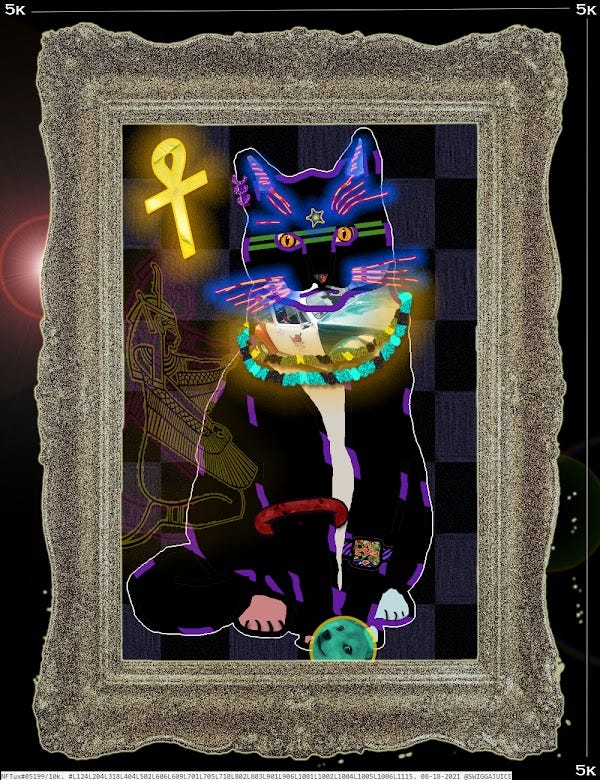
On the flip-side, rarity also works both ways. While seeing all of the on-canvas goodies in the above pic is one thing, this guy …
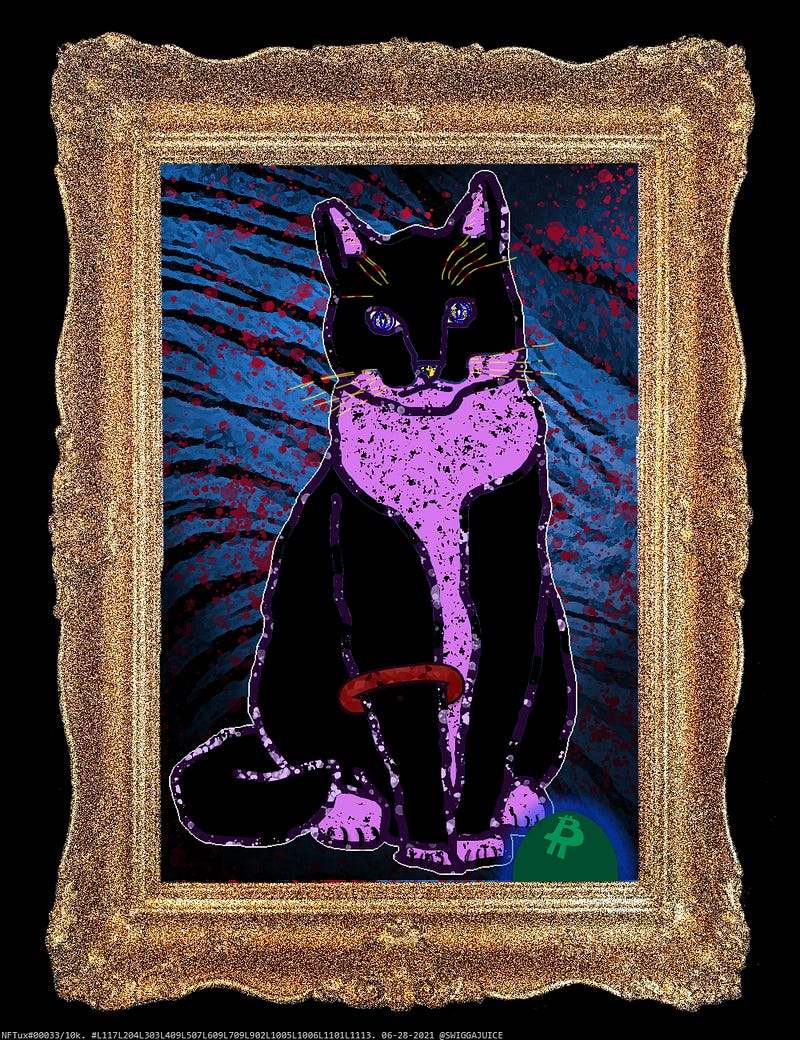
… is mathematically notable as well — only for the opposite reason. He’s got just a few on-screen extras, making his existence pretty darned rare. So far, he’s the most minimally rare one, though it’s possible for another to crop up with out that little BTC ball and without the bracelet. So, perhaps another will arrive that’s even more sparse.
Once I’m up into the thousands listed on OpenSea, I’ll publish a realtime stats page where users can filter cats according to all traits. I think some will like that. (UPDATE: I have some preliminary stats up here.) Even the OpenSea interface offers the ability to list such things. But, when posting 10,000 of something, I didn’t get the feeling that actually filling out data on 150 possible traits would be a good use of time. As it is now, I’ll spend about an hours/day minting and listing for sale 100 or so NFTs. If I listed traits on OpenSea, that would reduce my output to a few/day, and the project would never get off the ground.
The one that sold, though, was this guy…
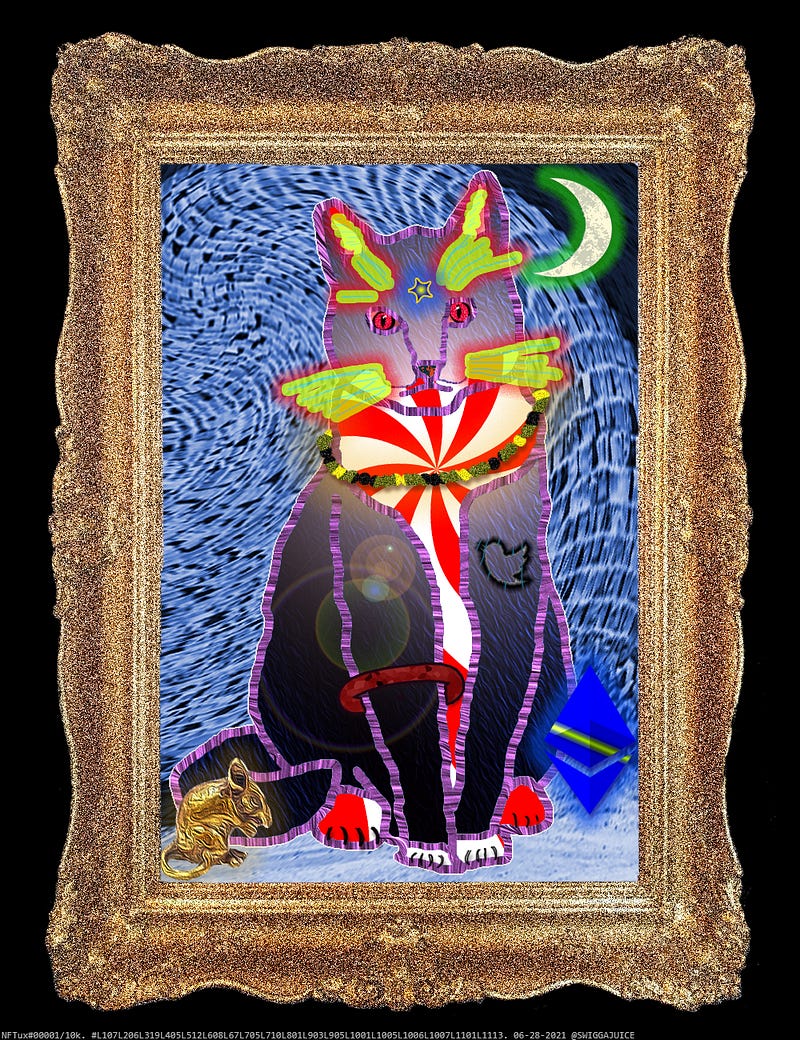
I’m not sure who bought him. I think it’s the same guy from Reddit who asked me about rare ones (which gave me the opportunity to think about stats a whole lot more!). But, in the end, I think I’d have bought #1 as well, just to say I have the very first one.
What’s to Come with NFTuxedoCats?
Stats!
Yes, stats, for one. That’s fur sure, and it’ll be super cool. Thankfully, all of my cat data lives in a database already (as I designed it that way from the ground up — needing to store my cat builds so that I could ensure uniqueness of each new cat). So, I’ll probably just build out a DataTables interface to it. (DataTables is a favorite jQuery plugin of mine that I use on tons of projects — just a super way to make table data readily interactive. UPDATE: See it in action here.)
New Rarities
I’ll likely introduce a new rarity with each 1,000 cats. I’ve been mulling this over as I go, and think this may be a good thing to do. I haven’t thought up any specifics about it, or whether I should up the price to maybe 0.015 ETH for any of those. We’ll see.
Giveaways
I definitely plan to do giveaways. They’re tough to plan, though, as they require more knowledge about gas fees and whatnot. But, giveaways are 100% going to happen. Ideally, I’d love to mint a commemorative one-of-many NFT for each platform (e.g., Reddit / Discord / Twitter / FB / etc.) and do giveaways in exchange for people sharing, etc. As long as I can cover the gas fees, that should be doable. But, we’ll see how that goes.
I can’t stress this point enough: The NFT space is absolutely flooded. Everyone’s doing them, either with one-off artworks or with huge collections. So, marketing is absolutely essential for a successful project. While I’m stoked to have sold ONE so far, I know that I’ll have to sell many to even get NFTuxedoCats off the ground in any significant way. So, this is a giant learning experience for me. How do you stand out? How do you garner attention? How do you create buzz? How do you sustain buzz?
Pricing
Pricing-wise, at least the first 500 will be 0.01 ETH, which is $22.10 USD as of today. That seems to be about right for these, looking at other projects. (In fact, these are hopefully reasonably priced.) I haven’t yet gained a full understanding of pricing in the crypto world. But, as I mentioned above, the marketing does take some $$$ to get done. So, I want to be able to cover that.
That’s all for now. Will update when I learn more. :-)
Other NFT Coding Articles:
