
Generative NFT Coding
Information Regarding Generative NFT Coding Services
What it is, and how my new company GenerativeNFTs.io approaches it.
Lately at Array Web Development (now known as GenerativeNFTs.io, I’ve been asked a few times about generative NFT coding assistance. [AUGUST 2021 Update: Make that many hundred times!] So, I wanted to talk about that and describe how I approach such opportunities. (Since first writing this, I’ve actually quit my job to focus solely on bringing generative NFT drops to life for clients around the world!)
To begin, you might ask me the following question:
What Is Generative Coding for NFTs?
Good question! What we’re talking about here is the programmatic generation of non-fungible tokens (NFTs), which usually would mean graphic files when we’re talking about generative coding. Even that may sound vague to some, so let’s use an example.
- Let’s say you have a basic outline of a face.
- You also have other “traits” you’d like to include, at least sometimes. Think of these as options or variations. For example, sometimes the face is smiling, sometimes it’s frowning. Sometimes it’s wearing eyeglasses. Sometimes it has blue eyes, sometimes green. It can have one numerous hair styles (long, short, straight, curly, none, etc.). You can also think of other changeable aspects as traits — things like the background color, which you may want to be able to change, and/or any extra items that might show on the graphic when it’s generated.
- You might have special rules as well — almost anything you can imagine. Things like, “if the character has pink hair, then they can only have red earrings” or, “if the character has eyeglasses, then there’s a 50% chance that a bird will show in the background.” Literally, any scenario imaginable can be coded into these systems.
As you can imagine, there would be many millions or billions of combinations, just based on the basic examples given above. It would be tedious and extremely work-intensive to generate a set of, say, 10,000 unique combinations (out of the millions or billions of possibilities) by hand. So, instead of going down that road, we ask a computer for help. And that’s generative coding, in a nutshell.
Generative Coding Example
To show an actual example of what such a project looks like, here’s an article about my experience generating 10,000 unique Tuxedo Cat portraits:
Or, if you’d like to see how that looks once they’re actually minted as NFTs and listed for sale, here’s a link to the NFTuxedoCats collection on the OpenSea NFT marketplace:
If you’d like to have a look at some statistics for the above, you can do so here.
Note: As of today (8–25–21), I’ve minted and listed 5,000+ NFTuxedoCats on OpenSea. As this was originally just a generative coding project, I opted to upload these manually instead of via a smart contract. (I’d never do that today, though! My company actually specializes in “mint on demand” style drops for clients.) Minting/listing will continue through 2021, as I have 10,000 unique cats to get through! :-)
My Approach for Generative Coding for Clients
[UPDATE after working with many clients!]: Here’s how the process works:
- The client sends me a bunch of artwork (usually a base character, traits/amenities/rarities/backgrounds/etc.) and any additional logical rules relating to the trait rarities. Generally, they send this as a Photoshop file, formatted per my preferences, outlined here.
- Then I would work my various graphical and programmatic magic on the set (setup, custom code, testing / sending samples to client, and finally a formal generation of the entire set). I have some handy best practices in this area, already, as I’ve climbed the learning curve & learned a few key lessons here working on client NFT projects!
- Then, along with the set of graphics, I prepare a dataset (JSON usually) that summarizes each NFT in some way that the developer can use when minting/listing, etc. (This communicates the ID and traits so that the properties and traits will show up on the marketplace.) My system logs everything in a database as it generates so that I can ensure that each one is unique.
- I also convey a set of analysis showing the actual distribution % of traits as they generated. (In theory, these should match pretty closely with what was requested (e.g., a rule like “4% should have a necklace”). But, at least in my own system, we are working with randomness often (meaning, I’d likely setup a rule that says something like “when we come to this trait (using 4% as an example), pull a # between 1 and 100 and, if it’s <5, then we generate the necklace trait”. So, the distribution of traits *should* statistically be ~4% (especially over larger sets), but it might turn out at, say, 3–5%, just depending on how the numbers run. (Well, that’s using a 4% example, of course. You might want 90% of characters to have X trait. It’s completely dynamic, though — you can set a % for any trait, and/or have traits dependent on the existence of other traits. I don’t know a lot about how other generative systems work, to be frank, but for my own, I want 100% control in terms of the ability to set desired %s of traits and also to custom-code any desired “if this then that” rules.
While the above sounds straightforward and implies a transaction of “client sends me art + rules and I return a set of graphics / data,” there could be potential for additional work after the initial set generation and delivery of the data. For example, in a generative set, it’s difficult for the artist/creator to envision 100% of the possibilities (as there are usually billions), and thus in your “final” set, you might notice something truly weird — e.g., maybe one comes out that follows all of the rules, but it’s just aesthetically hideous and you’d rather not have it included.
So, what do you do? Well, you can’t just make up a new one yourself, or you risk creating one that already exists, and thus you’d blow your claim of uniqueness. So, in such a case, you’d have to go back to the code and have it spit out a new one and verify it as unique. (Not a giant deal, of course, but just using that as an example. And hey, some people would LOVE an unexpected glitchy-looking disaster as part of a set. Some might even deem it especially collectible!)
How I Verify Uniqueness
In case you’re wondering how I verify uniqueness, my approach is basically to make a list of the specific traits that a generation has. (Example: There are 50 possible traits, and a proposed new one has traits #2,4,7,9,22,35, and 44.) I then have a log of all existing combinations. So, let’s say we are on generation #9000. I generate a list of possible traits for the new one, and then compare it to the other 8999 existing ones. If it does not match, then I’ve got a unique one on my hands and I go ahead with it. (If it does match, I scrap that one and try again.)
Technically speaking, one might add rules to this area, too (in addition to any rules that kick in during generation). For example, you might say that “only ONE of my characters can ever have trait X.” So, instead of that being a “0.01%” kind of rule, it’s a “only 1 ever” kind of rule (which might be distinct from other similar rules like “up to only 1 ever.” I think those last two are a little tougher to implement, as there are some logical challenges to deciding when that “only 1 ever” or “up to only 1 ever” should or might happen. (It’s interesting stuff, really. If you have a rule like that, it might well bestow an otherwise absolutely common NFT with the rarest of rare traits.)
Timeline and Cost for Generative Coding
Given the above and the various uncertainties involved, there’s the question: How long would it take you to generate a set of X NFTs, based on Y traits and Z rules … and what would it cost?
SCHEDULE
Broadly speaking, allow between 1–2 weeks from start to delivery of the graphics and rarity table/analysis. Much depends on the size and/or logical particulars of your project, of course. But, whatever we do, we need time to communicate and nail down the specs of the project, do testing, and do tweaking needed to get everything just right — as well as time for the generation, analysis, and delivery. For that last item, what happens is that I supply the graphics and meta data to my smart contract developer, which results in a mint-on-demand system on the client sites.
COST
UPDATE #547: Sorry to have to update this section so much! As of late August, 2021, I’m creeping up on having spoken with 150 NFT teams worldwide(!), and I’ve realized that all projects are unique in terms of scope, timing, and other factors. In fact, I’ve hired a project manager to field requests for help with generative art NFT projects. So, here’s what you can do: Drop me a line at jim [at] generativenfts.io and let me know about it as soon as possible. All emails will get a reply! :-)
Either way, we can arrange a call or Zoom or Google Meeting and once I have your particulars about scope, timing, and smart contract needs, I can get you a quote.
That said, I do want to talk about the setup:
1: NFT Set
This is column (1) below, where you start. Find your quantity and read to the right on your row, depending on how many NFTs you want generated. I’m including lower-count sets, but the standard is basically 10k.
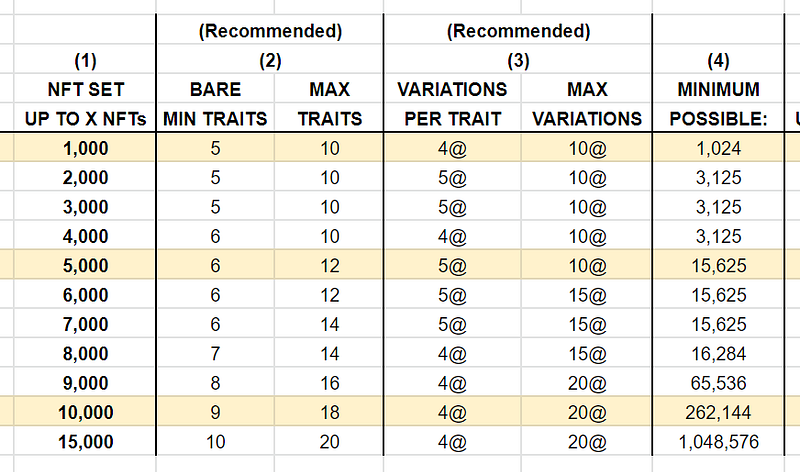
REFINEMENT: After doing 30+ projects, most of them 10k sets, most have around 6–12 different traits (properties), with usually 20–30 (sometimes up to 50–60!) variations per trait. For example, you may have a cat and one trait or property is the fur color. I’m seeing typically 20–50 fur colors. But not all traits will have that many. Backgrounds tend to get a ton of variations, as do fur colors. But things like hats or jewelry typically sees less.
2: Traits Column(s)
After talking with so many people, I think this is one thing that is giving teams some trouble — especially those without a developer currently involved. Think of a generative NFT as a character. Let’s say it’s a girl punk. What traits are you going to give her? Column 2 suggests a bare minimum number. (It’s true that your estimation of a bare minimum may differ from mine. This is only a suggestion here, which I came up with out of a combination of technical as well as aesthetic opinions.) So, for example, if you’re going to have 1,000 girl punks (see column 1), I’m suggesting (in column 2) that you give her at least 5 traits (more is better but at least 5). That could be eyes, hair, jewelry, clothing, and background. These are the five things that, in this example, will change.
3: Variations Column(s)
Variations are what I’m calling variations of each trait. So, in our example of a 1,000 run of punk girls, we said the minimum is 5 traits. What I’m saying with variations is that you’ll want at least 4 variations of each one. So, for example, for the EYES, you’d have something like closed, open, wide, and squinting. (Colored eyes would be a good example of more variations of the eye trait.) (Note that beyond all of these traits and variations, there may be other rarities that happen in your NFTs. I don’t want to limit anyone’s imagination here; rather, I just want to give an example to convey the most basic concepts.)
4: Minimum Possible Column
This is just a handy guide that says, “Okay, if your girl punk has 5 traits and 4 variations of each one, here’s how many different unique combinations there are for your NFTs. I put this in there because, in my talks with several teams, the math wasn’t there yet (meaning, they hadn’t planned enough various stuff going on to have their set of NFTs be all unique). In most cases, more traits and more variations are better than less, as you’re going to get better aesthetic diversity within your final set.
Minting NFTs
One other update here, as the above only addresses the generation of graphics to be used as NFTs.
Once you have your graphics, you of course need to get them onto a marketplace for sale. Creating an official NFT is called “minting.” There are some technical nuances to that term, but for now let’s just say that, once it’s created and put onto a marketplace (possibly owned by you, possibly owned by someone else), it’s “minted.” So … how do you get your 1,000 or 5,000 or 10,000 (or whatever) graphics minted and listed for sale on a marketplace?
Well, basically there are three models for this:
1. One at a Time
In this model, you have your 10k items, and you go to a marketplace like OpenSea or Rarible or Foundation or where ever, you setup an account (if needed), and you basically upload them one at a time, filling out the meta data, if you like, and listing it for sale. This is the easiest method by far, though it is also time-consuming (can take a minute or two per item once you get the process down).
If you can do it in one minute, then you’re looking at this:
- 1,000 NFTs == 16 hours work to mint/list
- 5,000 NFTs == 83 hours work
- 1,0000 NFTs == 166 hours work
That’s a lot of time, but still doable if you’ve got the time (and/or the staff to help). And, as I’ve written, this method can be automated, at least a little bit, to help improve those times somewhat.
2. Batch Minting
This is where your whole collection goes to OpenSea and is for sale, likely at different prices based on rarity. This is possible via a custom smart contract, but I’m just not seeing this model in the marketplace for various reasons: First, you’d have to pay gas on those mints, and most sellers don’t want to do that. Second, it means your more rare items would be findable and people might just buy only those ones, leaving the collection in a weird state. And finally, it just defeats the whole gamified purpose of minting sight-unseen and trying to get a rare one.
3. Mint-on-Demand Minting
→This is what everyone wants. In this scenario, the UX is different than going to a set on OpenSea, browsing or hunting for a favorite, and then purchasing it. In this model, the user goes to a web site and pays to mint X NFTs out of a generational set. The purchases are made sight-unseen (though certainly they’ve by then seen representative examples on Twitter, Discord, Instagram, etc.) It’s a bit like taking a chance on a slot machine, as the user is generally hoping to get some rare combination of traits (although, in all cases, the user gets NFTs, of course).
There’s more to this whole “rarity” and “reveal” game, as described in my many articles here on Medium. But, the good news for NFT teams worldwide is that my company can shepherd your team through the entire process — from artwork through mint-on-demand. Somehow, we’ve become a highly sought-after little team in this space, and we could not be more enthusiastic about it. (During August 2021, my team and I have worked approximately 16–18 hours/day getting all of this setup. I can proudly claim that we’ve got a particularly good handle on the entire process. What a journey it’s been!)
How to Move Forward
Feel free to reach out anytime of course. I’m Jim [at] generativeNFTs.io.
Beyond that, I wanted to mention that, as a full-time web coder for 10+ years, I’m deeply experienced when it comes to working with entrepreneurs. This is basically what today’s NFT pioneers are, as they’re pursuing business ideas (artistic as they usually are, of course). In the web development world, I can tell you that transparency and success are closely related. The more of your idea / vision you share, the better I’m able to bring it to life for you.
From a business perspective, this can be counter-intuitive because, when you’ve got a great idea, you want to get it done, but also aren’t always keen to tell strangers about it. The answer to this sometimes-dilemma is to use a Non-Disclosure-Agreement (NDA). Basically, this is a legal document that allows you to tell your developer every imaginable proprietary detail and having it legally bound to be kept secret. I just wanted to mention this, as I’m happy to setup an NDA document for anyone who’d like to discuss an idea in full and have that be protected. I’ve been doing programming for 10+ years now, and this is the best practice. :-)
My team and I are fully transparent about who we are. We’re on web sites all over the place, LinkedIn, Facebook. We’re actual, identifiable people with solid reps in the dev world. (And trust me… when you work in crypto, you run into some shady types!)
You can also get started now on your own. Here’s how to do your art:
How to Prep Your Artwork:
How to Setup Your Rarity Table:
Other NFT Coding Articles:


