avatarJillian Enright

Free AI web copilot to create summaries, insights and extended knowledge, download it at here

4959

Abstract

ium.com/most-social-norms-are-arbitrary-283db0b477af">arbitrary</a>, to be enforced depending on the adults’ moods or whims that day, or depending on which child is breaking that rule?</p><p id="27c5">What it <i>really</i> does is increases children’s <a href="https://readmedium.com/misbehaviour-is-stress-behaviour-f077cee16f43">stress levels</a>, harm their trust in adults, and create a prevailing culture of “<i>life is unfair, suck it up</i>”, rather than conveying “<i>your feelings and experiences matter</i>”.</p><figure id="8702"><img src="https://cdn-images-1.readmedium.com/v2/resize:fit:800/1*o_zbqNUnjMVVxaGnE9jttw.png"><figcaption>Created by author</figcaption></figure><h2 id="86b2">Like I said</h2><p id="9b89">As I said in my <a href="https://readmedium.com/how-dog-training-is-like-parenting-a8e29c783de4">previous piece</a>, I do understand that we won’t always be able to get our way in life, and learning how to deal with disappointment is an important life skill.</p><p id="2af5">Some readers asked about this in the comments as well — “<i>How should a child be taught that sometimes life requires them to do something they don’t want to do?</i>” They gave the examples of being to work on time and filling out boring forms, which they dislike doing, but do anyway because it’s required.</p><p id="3dbe">The thing is, <a href="https://readmedium.com/children-are-not-mini-adults-65fde13afb92">children are not mini-adults</a>. Their brains are not completely developed, and they may not be <a href="http://www.developingchild.harvard.edu">neurologically capable</a> of seeing the long-term benefit of something, like eating their vegetables or brushing their teeth.</p><p id="864b">They also don’t <i>choose</i> to go to school, receiving an education in itself is <a href="https://www.edu.gov.mb.ca/k12/schools/gts.html#:~:text=Children%20are%20required%20to%20attend,attain%20the%20age%20of%2018.">legally mandated</a> in most countries for their <a href="https://www.edu.gov.mb.ca/k12/schools/gts.html#:~:text=Children%20are%20required%20to%20attend,attain%20the%20age%20of%2018.">entire childhood</a> (usually from age 6 or 7 until age 18, depending on the region).</p><p id="b2a7">We may not <i>want</i> to go to work, we may not like our jobs, but we get <i>paid</i> to go there, and we had at least some degree of freedom in choosing our place of employment. We understand that showing up on time and filling out forms are part of the agreement we entered into when we accepted the offer of employment.</p><p id="7725">There’s still <i>something</i> in it for us, and we understand the reasons for what’s being asked of us, regardless of whether we agree with those reasons.</p><h2 id="580a">The pitfalls of compliance</h2><p id="f63d">In addition to <a href="https://readmedium.com/compliance-makes-us-vulnerable-d6682a102115">increasing children’s vulnerability</a> to mistreatment and abuse, being conditioned into compulsive obedience can lead to lifelong struggles.</p><p id="559c">Some people become chronic people-pleasers, unable to “rock the boat” or set healthy boundaries for themselves. This leads to mental and physical health issues, stress, and building resentment of never having one’s own needs considered.</p><p id="25e3">This doesn’t happen with everyone, of course, but it is a possible outcome of being taught that “good” kids follow the rules and do what they’re told, and only “bad” kids <a href="https://readmedium.com/why-im-okay-with-my-son-calling-me-out-597728ca1e72">question authority</a>.</p><h2 id="0b04">Keep ’em coming</h2><p id="332a">I do genuinely enjoy being challenged and questioned — it makes me think more deeply about things, challenge my own assumptions, and usually motivates me to learn more.</p><p id="3de9">In fact, I received so many great comments and questions after publishing this article, they inspired me to write another <a href="https://readmedium.com/cant-versus-won-t-dae8c35d1cb5">follow-up piece</a>.</p><p id="846d">Thank you all for your support and interest in my writing, I truly appreciate it.</p><p id="de24">© Jillian Enright, Neurodiversity MB</p><h1 id="7f91">Related Articles</h1><div id="9bce" class="link-block"> <a href="https://readmedium.com/cant-versus-won-t-dae8c35d1cb5"> <div> <div> <h2>Can’t Versus Won’t</h2> <div><h3>Knowing when to push and when to back off is a difficult balance</h3></div> <div><p>medium.com</p></div> </div> <div> <div style="background-image: url(https://miro.readmedium.com/v2/resize:fit:320/1*os9_DQ54U5dk1HVkipjliQ.png)"></div> </div> </div> </a> </div><div id="76a0" class="link-block"> <a href="https://readmedium.com/how-dog-training-is-like-parenting-a8e29c783de4"> <div> <div> <h2>How Parentin

Options

g Is Like Dog Training</h2> <div><h3>(also teaching, or working with children in any capacity)</h3></div> <div><p>medium.com</p></div> </div> <div> <div style="background-image: url(https://miro.readmedium.com/v2/resize:fit:320/1*rxLONq5GLelXbzGJD9YR8g.png)"></div> </div> </div> </a> </div><div id="88d7" class="link-block"> <a href="https://readmedium.com/deny-recess-at-your-peril-9703764ed26c"> <div> <div> <h2>Let Kids Play And Be Heard</h2> <div><h3>Denying recess, planned ignoring, and behaviour contracts are counter-productive</h3></div> <div><p>medium.com</p></div> </div> <div> <div style="background-image: url(https://miro.readmedium.com/v2/resize:fit:320/1*9eGrl5L0IjWolZCJjb2xVw.png)"></div> </div> </div> </a> </div><div id="b727" class="link-block"> <a href="https://readmedium.com/the-power-of-validation-483bb53f9b93"> <div> <div> <h2>The Power of Validation</h2> <div><h3>A profound way to strengthen any relationship</h3></div> <div><p>medium.com</p></div> </div> <div> <div style="background-image: url(https://miro.readmedium.com/v2/resize:fit:320/1*xBmjJaLLpHtM-qJZ_1djfA.jpeg)"></div> </div> </div> </a> </div><div id="f7d4" class="link-block"> <a href="https://readmedium.com/demanding-blind-obedience-is-dangerous-fed8a44770b2"> <div> <div> <h2>Demanding Unquestioning Obedience Is Dangerous</h2> <div><h3>Those who subvert authority change the world for the better</h3></div> <div><p>medium.com</p></div> </div> <div> <div style="background-image: url(https://miro.readmedium.com/v2/resize:fit:320/1*8aMGNVguxTB1uXle7bbQ7g.png)"></div> </div> </div> </a> </div><div id="1216" class="link-block"> <a href="https://readmedium.com/compliance-makes-us-vulnerable-d6682a102115"> <div> <div> <h2>Compliance Makes Us Vulnerable</h2> <div><h3>Neurodivergent people are often expected to show unquestioning obedience</h3></div> <div><p>medium.com</p></div> </div> <div> <div style="background-image: url(https://miro.readmedium.com/v2/resize:fit:320/1*rb63_n4bUnhP2DEM_EtKUQ.png)"></div> </div> </div> </a> </div><div id="144c" class="link-block"> <a href="https://readmedium.com/children-are-not-mini-adults-65fde13afb92"> <div> <div> <h2>Children Are Not Mini Adults</h2> <div><h3>Stop comparing apples to oranges</h3></div> <div><p>medium.com</p></div> </div> <div> <div style="background-image: url(https://miro.readmedium.com/v2/resize:fit:320/1*GEOcfckS4rOAJ3C2pbWIsQ.jpeg)"></div> </div> </div> </a> </div><div id="4305" class="link-block"> <a href="https://readmedium.com/why-im-okay-with-my-son-calling-me-out-597728ca1e72"> <div> <div> <h2>Why I’m More Than Okay With My Son Calling Me Out</h2> <div><h3>No, he does not get into trouble for calling me on my hypocrisy.</h3></div> <div><p>medium.com</p></div> </div> <div> <div style="background-image: url(https://miro.readmedium.com/v2/resize:fit:320/1*YUPwl3xJf-P10ouR4yg0pg.png)"></div> </div> </div> </a> </div><p id="cad9"><i>When you join medium, as a member you’ll have access to unlimited reads for only $5 per month. If you use <a href="https://twoemb.medium.com/membership">my referral link</a>, I’ll earn a small commission, and you’ll earn my undying gratitude.</i></p><p id="b274"><i>If you’d prefer give a one-time tip, you can <a href="https://ko-fi.com/neurodiversitymb">support my writing on Ko-Fi</a> — also, it’s free to <a href="https://facebook.com/NeurodiversityMB">follow me on Facebook</a>!</i></p><figure id="f599"><img src="https://cdn-images-1.readmedium.com/v2/resize:fit:800/1*Mh7F1-FwC0E5R1Die2_YHA.png"><figcaption></figcaption></figure><h2 id="584a">References</h2><p id="0ea7">Center on the Developing Child (2007). <i>The Science of Early Childhood Development</i> (InBrief). Retrieved from <a href="https://developingchild.harvard.edu/">www.developingchild.harvard.edu</a></p></article></body>

Do Kids Really Benefit From Learning To Tolerate Things They Don’t Like?

Is the old saying, “no pain no gain” fact or fiction?

Created by author on Canva

Thank you for your responses

I want to start out by thanking everyone for their enthusiastic responses to my recent article, How Parenting Is Like Dog Training. I appreciate all your thoughtful comments and questions, and enjoy the intellectual discussions that spawn from them.

I got a few questions that really sparked some thoughts and ideas for me. As I began to respond, I realized I was writing a novel in the comment section, so I decided to turn it into a follow-up article instead.

I want to be clear that this is not intended as a “clap back” at anyone’s comments, this is genuine interest and enjoyment I feel when people’s writing, comments, or questions get me thinking more deeply about something.

I appreciate your thought-provoking questions and welcome respectful debate and disagreement.

I’m going to summarize some of the comments I received, so they’re not direct quotes from any particular reader, they’re representations of the themes present across many of the questions asked.

“You would do well to learn to follow the rules”

Would we, though?

That depends.

Some readers asked questions like this about my recent article, How Parenting Is Like Dog Training, in which I gave an example of my son not wanting to do something at school. I wondered out loud whether it was worth it to enforce that particular expectation when it didn’t seem at all important to me, nor beneficial to my son.

Some rules are for everyone’s safety, and those boundaries I hold firmly. When the rules are simply there to make the adult’s jobs easier, and are actually detrimental to children (i.e. sitting still for 5 hours per day), then I will question them and allow my son to do so respectfully.

“We don’t always have to give a reason”

But why? Why not?

If a child is being asked to do something against their will, shouldn’t there be a damn good reason to force them to do something they don’t want to do? Why shouldn’t adults have to explain their reasoning for setting a boundary or expectation?

I wasn’t even saying my son needed a reason, I was really saying he needed to be heard. Often when I explain something, he is more cooperative and willing to do it, even if he doesn’t want to, because he understands the rationale behind it. Why are we expecting unquestioning obedience?

“Outside of abuse”

Many will draw the line at abuse, but expecting compliance is exactly how we make our children more vulnerable to abuse, because they’re taught to respect and obey authority, without question.

School is conditioning kids to tolerate things they don’t like

Yes, that’s what scares me.

I addressed this in the original article (i.e. vaccines), but think about this: Why should anyone have to learn to tolerate things they don’t like, if they don’t have significant meaning or benefit?

My son hates shots, but we get them because they are protective. Running from one line to another benefits no one and enforcing compliance in many cases is primarily for the sake of the adult’s ego.

The other thing is that my son (both of us being Autistic) is actually a fantastic rule-follower once he understands the meaning and purpose of a rule. The problem is that we adults are horrendously inconsistent when it comes to enforcing rules, which confuses children, especially kids like my son (of whom there are many).

So how are children supposed to know which rules are enforced all the time, and which ones are arbitrary, to be enforced depending on the adults’ moods or whims that day, or depending on which child is breaking that rule?

What it really does is increases children’s stress levels, harm their trust in adults, and create a prevailing culture of “life is unfair, suck it up”, rather than conveying “your feelings and experiences matter”.
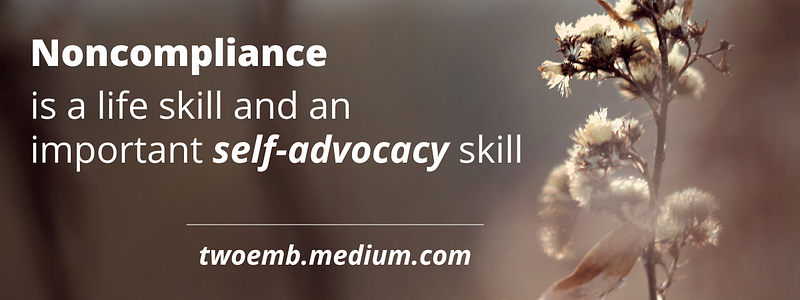
Created by author

Like I said

As I said in my previous piece, I do understand that we won’t always be able to get our way in life, and learning how to deal with disappointment is an important life skill.

Some readers asked about this in the comments as well — “How should a child be taught that sometimes life requires them to do something they don’t want to do?” They gave the examples of being to work on time and filling out boring forms, which they dislike doing, but do anyway because it’s required.

The thing is, children are not mini-adults. Their brains are not completely developed, and they may not be neurologically capable of seeing the long-term benefit of something, like eating their vegetables or brushing their teeth.

They also don’t choose to go to school, receiving an education in itself is legally mandated in most countries for their entire childhood (usually from age 6 or 7 until age 18, depending on the region).

We may not want to go to work, we may not like our jobs, but we get paid to go there, and we had at least some degree of freedom in choosing our place of employment. We understand that showing up on time and filling out forms are part of the agreement we entered into when we accepted the offer of employment.

There’s still something in it for us, and we understand the reasons for what’s being asked of us, regardless of whether we agree with those reasons.

The pitfalls of compliance

In addition to increasing children’s vulnerability to mistreatment and abuse, being conditioned into compulsive obedience can lead to lifelong struggles.

Some people become chronic people-pleasers, unable to “rock the boat” or set healthy boundaries for themselves. This leads to mental and physical health issues, stress, and building resentment of never having one’s own needs considered.

This doesn’t happen with everyone, of course, but it is a possible outcome of being taught that “good” kids follow the rules and do what they’re told, and only “bad” kids question authority.

Keep ’em coming

I do genuinely enjoy being challenged and questioned — it makes me think more deeply about things, challenge my own assumptions, and usually motivates me to learn more.

In fact, I received so many great comments and questions after publishing this article, they inspired me to write another follow-up piece.

Thank you all for your support and interest in my writing, I truly appreciate it.

© Jillian Enright, Neurodiversity MB

Related Articles

When you join medium, as a member you’ll have access to unlimited reads for only $5 per month. If you use my referral link, I’ll earn a small commission, and you’ll earn my undying gratitude.

If you’d prefer give a one-time tip, you can support my writing on Ko-Fi — also, it’s free to follow me on Facebook!

References

Center on the Developing Child (2007). The Science of Early Childhood Development (InBrief). Retrieved from www.developingchild.harvard.edu

Parenting
Education
Mental Health
Psychology
Schools
Recommended from ReadMedium