
My First Curation: The Path to Curation is Paved With Mistakes
Great writing tips for writing better stories

I published my first story, Failing Retirement 101 and Loving It, in this venue on September 4, 2019. Seventeen stories later, Stupid Mistakes Lead to a Slow Painful Death for Two (1.2K Views, 511 reads, 55 fans) was curated on October 21st.
This story tells the tale of how I started writing in early September and how I arrived at curation in October.
First Objective
My first objective in writing in this venue was to determine my goal. I’d been a member since July 2018. I was a reader. Beginning in September, I decided to jump into writing and publish stories.
Some folks write with the intent of producing excellent literature, formal literary content, or a straightforward narrative. Others crank out content designed to generate a constant presence.
For all of two days, I dedicated myself to publishing daily. I found producing high-quality work to be time-consuming. Although the time may come that I can devote 4 to 6 hours a day toward writing and publishing, I’m not there yet.
I found my goal
I settled on the strategy of writing to express myself in the best manner possible. My initial goal was to produce a submission every 3 or 4 days. Now my goal is to publish a curated piece once a week.
Here are some of the lessons I’ve learned and Great Writing Tips to share
Drop caps can be distracting.
Just because you can use drop caps for every paragraph doesn’t mean you should. I read an article on using the unique features of the text editor. I thought drop caps looked classy. I became an overachiever. I think it was highly likely Secret Sex Rendevoux Does Not Remain Secret For Long (349 views, 195 reads, 45 fans) failed to be curated due to excessive use of drop caps.
Titles are important; make them relevant and engaging.
Writing a witty title is fun, but being too smart can hurt the opportunities for curation. On Sept. 13th, I published How is a Writer Like a Child: This sounds like the straight line of a bad joke. (140 views, 80 reads, 42 fans) I still think the title and subtitle are witty, but they don’t tell a reader the story is about how a writer should look at the world with the eyes of a child to get writing ideas. I believe the title and subtitle cost this story curation. The story also had loads of drop caps.
I wrote titles that sounded good to me, but, in all honesty, were weak. Titles require strong, compelling words that emotionally call to a reader and tell the reader about the story. I’ve gotten better at delivering compelling titles. I’ve been using the Emotional Marketing Value Headline Analyzer by the Advanced Marketing Institute (2019). There are other free headline analyzers on the internet, too. @bloghands (Feb 2018) published a list of online title analyzers.

A picture is worth 1237.5 words.
I’ve found a better way to search for and get good quality photos for my stories is to create a free account at unsplash.com. Customizing searches directly on their site is simple, and I have specific search capability.
Use spelling and grammar checkers.
Subscribe to a spell check and grammar check service. I subscribe to the premium version of Grammarly, but there are plenty of free subscription sites on the internet from which to choose.
Flexibility is important.
Do your drafts in Google docs, MS Word, or something similar outside of the publication text editor. I make a habit of writing, editing, and proofing my selections in Google docs. G docs allow me to edit on my phone or anywhere I can access the internet with my computer. I can make all kinds of changes. Since I am writing outside of the publication text editor, nothing becomes permanent until I want.
Choose your titles carefully.
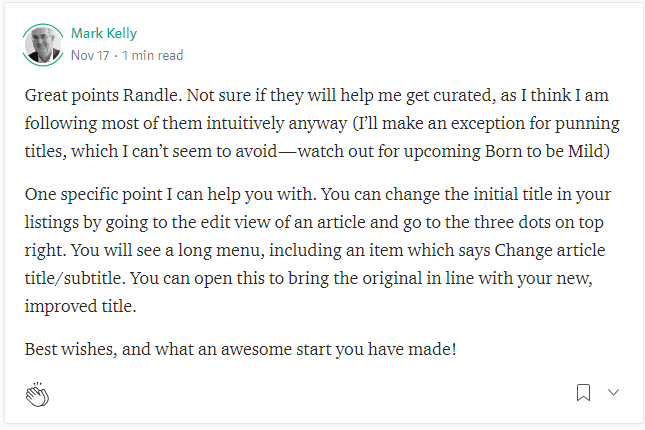
Your first save in the venue text editor will determine your permanent story title. You may be asking yourself why is that. You may have noticed the file name at the top of your screen is the same as the title of my story. This venue uses a system to save a writer’s story to its servers. This process is initiated when you identify your title and subtitle. The computer system pointers use the original story title. If you change the title of your story, links throughout the venue will still show the original story title even though the story will show the modified title when opened. Here are a couple of examples:
- My story, currently titled Costly Mistakes Lead to Slow Painful Death for Two, has a pointer of Stupid Mistakes Lead to Slow Painful Death for Two.
- The subtitle for How is a writer like a child? is “This question sounds like the straight line of a bad joke,” but when you open the story, it now reads, “Why writers should view the world with the eyes of a child.”
Post-Pubication Edit (Nov. 27, 2019) — Grateful appreciation is given to Mark Kelly for telling me how to reset system links, Change article title/subtitle, to reflect revised titles and subtitles.
Controversy may be a good thing.
After publishing the story “Stupid Mistakes Lead to Slow Painful Death for Two,” I changed Stupid to Costly. I did this in deference to a grieving mother’s concern “Grieving Mother is Irate Due to Stupid Word.” There was a great discussion in the responses over the use of the word stupid. Some readers strongly objected, and some felt the word was appropriate and descriptive. Given the new monetization, this controversy has benefitted me.
“As writers use facts, ideas, and quotations from the writing of others, they must integrate these into and within their own ideas.” — Coates Library, Trinity University, 2019
Let other writers help you make your points.
Even if your name is I.M. Expert, Ph.D., O.M.G., draw on the words of other authors to help you make your points. Getting their help not only strengthens your argument or knowledge, but it also shows the reader you have researched your topic. It also provides you with additional insight and may be of further help to your readers.
Read aloud for flow, and let the story ferment overnight.
I am not a fast writer. I plod along, reading, writing, and editing my stories. I spell-check and Grammarly through the text multiple times carefully considering each suggestion. After a while, I see what I think is there, and cease to see what is there. Read your stories aloud. Let them sit overnight. Then reread them with fresh eyes in the morning. If possible, after final polishing, have someone who has never seen the story read over it before publishing.
Pay attention to publishing guidelines.
Reread the guidelines before publishing every story. Use a checklist to look for these elements in your submission. “Curators are looking for stories that are insightful, considered, and well-written. Among the kinds of stories they select are pieces with a strong narrative, pieces that convey useful and/or well-researched information, and articles with a nuanced point of view. The writing should be polished and free of errors.” (Medium, May 2019)
Post your story to a popular publication, if possible.
Publishing groups are excellent; this venue’s house publications are better. Apply to be a writer. If you’ve not been invited to be a writer, start a magazine yourself. Shannon Ashley (July 2019) has an excellent article on running a publication.
Be persistent and authentic.
Your writing is an expression of you. You only have one chance to make an excellent first impression.
Do these tips work?
I have just published my second curated story, an educational reflection on the unintended consequences of retesting students.
Citations:
Ashley, Shannon, (July 2019), Things To Know If You Want To Run Your Own Publication On Medium, Retrieved from https://readmedium.com/things-to-know-if-you-want-to-run-your-own-publication-on-medium-e1b13013047d
Blog Hands,(Feb 2018), Best Free Headline Analyzer Tools for Quickly Writing Better Titles, Retrieved from https://readmedium.com/best-free-headline-analyzer-tools-for-quickly-writing-better-titles-d9b9049a4989
Advanced Marketing Insitute, (2019), Emotional Marketing Value Headline Analyzer, Retrieved from https://www.aminstitute.com/headline/index.htm#
Coates Library — Trinity University, (2019), INTEGRATING SOURCES IN THE TEXT OF YOUR PAPER, Retrieved from https://lib.trinity.edu/integrating-sources-in-the-text-of-your-paper/
Medium’s Curation Guidelines: everything writers need to know, (May 2019), Medium.com, Retrieved from https://help.medium.com/hc/en-us/articles/360006362473-Medium-s-Curation-Guidelines-Everything-Writers-Need-to-Know
© (2019) Randle B. Moore All Rights Reserved
Please click this [LINK] if you have enjoyed reading this story and would like to have my stories delivered to your email inbox when I publish.
Medium is a beautiful site for innovative and exciting stories. Paying $5 for a monthly subscription or $50 for an annual subscription entitles you to read all articles. Use this [LINK] to join. Your membership fee supports writers of Medium.
If you have enjoyed this article, you may also enjoy these other articles.