avatarJillian Enright

Free AI web copilot to create summaries, insights and extended knowledge, download it at here

3417

Abstract

bilities to manipulate their surroundings and learn about the environment. In doing so, they come to understand a cause-and-effect relationship</p><p id="c2b8">Between 6 months and two years, infants and toddlers improve their awareness of object permanence, understanding that objects and people continue to exist even when they are not visible.</p><figure id="fe26"><img src="https://cdn-images-1.readmedium.com/v2/resize:fit:800/1*2LWHih8YVS9Ng6PcfaYkjw.png"><figcaption>Created by author</figcaption></figure><h2 id="b61a">Working Memory</h2><p id="3f37">When you forget something because you don’t see it, that’s more of an “out of sight, out of mind” phenomenon. This is not an issue of object permanence, rather, it’s an issue with working memory.</p><p id="b407"><a href="https://readmedium.com/how-executive-functions-matter-in-daily-living-bfdccc04162a">Working memory</a> is holding information in mind and mentally working with it. According to <a href="https://doi.org/10.1037/0894-4105.8.4.485">Baddeley and Hitch</a> (1994), working memory is broken into three sub-categories:</p><ol><li><b>Phonological loop</b>: keeps auditory information active in consciousness for the purpose of immediate problem-solving (such as repeating a number in your head to remember it until you can write it down).</li><li><b>Central executive</b>: allocates cognitive resources, focuses attention that is needed to solve problems, and controls cognitive interference. That’s a fancy way of saying your brain tells you to pay attention to some things and filter out others.</li><li><b>Visual-spatial</b>: allows people to keep visual images and spatial information active in the mind for problem-solving (like remembering where you left your keys, phone, or significant other).</li></ol><p id="d72a"><i>That’s the one!</i></p><p id="21dc">The fact that I put my cup of coffee in the microwave to heat it up, forget about it, and find it ice-cold two hours later is a visual-spatial memory issue.</p><p id="fade">When I put my keys down in my office chair because my hands are full, then spend panicked minutes or hours the next morning desperately searching for them, it is not because my brain thinks my keys cease to exist.</p><p id="4003">I know my cup of coffee and keys exist, I just can’t for the life of me remember where I bloody put them!</p><p id="be81">© Jillian Enright, Neurodiversity MB</p><figure id="7669"><img src="https://cdn-images-1.readmedium.com/v2/resize:fit:800/1*prbgD-A6BFL_l46H9UQ6JQ.png"><figcaption></figcaption></figure><p id="3587"><i>When you join medium, as a member you’ll have access to unlimited reads for only $5 per month. If you use <a href="https://twoemb.medium.com/membership">my referral link</a>, I’ll earn a small commission, and you’ll earn my undying gratitude.</i></p><h1 id="ca38">Related Stories</h1><p id="bbf4">For another take on ADHD and Object Permanence, I recommend a piece by <a href="undefined">John Kruse</a>: <a href="https://readmedium.com/making-object-permanence-disappear-from-the-adhd-discussion-78c630741aab">Making Object Permanence Disappear</a> (<i>see what he did there</i>?)</p><div id="d8bc" class="link-block"> <a href="https://readmedium.com/making-object-permanence-disappear-from-the-adhd-discussion-78c630741aab"> <div> <div> <h2>Making Object Permanence Disappear from the ADHD Discussion</

Options

h2> <div><h3>Out of sight out of mind is not a failure of object permanence.</h3></div> <div><p>medium.com</p></div> </div> <div> <div style="background-image: url(https://miro.readmedium.com/v2/resize:fit:320/1*MBKcCTd_w1me5yXvVPkIIQ.jpeg)"></div> </div> </div> </a> </div><div id="446f" class="link-block"> <a href="https://readmedium.com/adhd-the-good-the-bad-and-the-ugly-8428b84d6b56"> <div> <div> <h2>ADHD: The Good, The Bad, and the Ugly</h2> <div><h3>Ok, not really “the ugly”, but the bad and the good. In that order. Jillian talks about the Strengths and Struggles…</h3></div> <div><p>medium.com</p></div> </div> <div> <div style="background-image: url(https://miro.readmedium.com/v2/resize:fit:320/1*IO2zkJXnKQ0EhNpyuHJ2qg.jpeg)"></div> </div> </div> </a> </div><div id="5236" class="link-block"> <a href="https://readmedium.com/adhd-actually-faf3a7ea2a8f"> <div> <div> <h2>ADHD, Actually: Research Reveals How Life-Altering ADHD Really Is</h2> <div><h3>ADHD is about so much more than difficulty focusing and sitting still.</h3></div> <div><p>medium.com</p></div> </div> <div> <div style="background-image: url(https://miro.readmedium.com/v2/resize:fit:320/1*aIwujD2Guw1FJ6BSsW0cYw.jpeg)"></div> </div> </div> </a> </div><div id="67e9" class="link-block"> <a href="https://readmedium.com/how-executive-functions-matter-in-daily-living-bfdccc04162a"> <div> <div> <h2>How Executive Functions Matter in Daily Living</h2> <div><h3>How they relate to ADHD, Autism, and other divergent brains.</h3></div> <div><p>medium.com</p></div> </div> <div> <div style="background-image: url(https://miro.readmedium.com/v2/resize:fit:320/1*W7eqkPsBXyIbkYBG-F6pig.jpeg)"></div> </div> </div> </a> </div><h2 id="7297">References</h2><p id="b581">Baddeley, A. D., & Hitch, G. J. (1994). Developments in the concept of working memory. <i>Neuropsychology, 8</i>(4), 485–493. <a href="https://doi.org/10.1037/0894-4105.8.4.485">https://doi.org/10.1037/0894-4105.8.4.485</a></p><p id="7e24">Berger, I., Slobodin, O., Aboud, M., Melamed, J., Cassuto, H. (2013). Maturational delay in ADHD: evidence from CPT. <i>Frontiers in Human Neuroscience, 7</i>, 691. <a href="https://doi.org/10.3389/fnhum.2013.00691">https://doi.org/10.3389/fnhum.2013.00691</a></p><p id="dd32">Diamond, A. (2013). Executive functions. <i>Annual Review of Psychology, 64</i>(1), 135–168. <a href="https://www.annualreviews.org/doi/pdf/10.1146/annurev-psych-113011-143750">doi:10.1146/annurev-psych-113011–143750</a></p><p id="89ce">Malik, F., & Marwaha, R. (2021, July 31). <i>Cognitive Development</i>. In: StatPearls [Internet]. Treasure Island: StatPearls Publishing. Available from: <a href="https://www.ncbi.nlm.nih.gov/books/NBK537095/">https://www.ncbi.nlm.nih.gov/books/NBK537095</a></p></article></body>

If You Can Read This, You Do Not Have Problems With Object Permanence

That term does not mean what you think it means

Photo of author & son when he was an adorable little toddler (© Lizette of Peekaboo Studio Photography)

Fellow neurodivergents, lend me your…

eyes.

I have an announcement.

We have ADHD. We are not infants.

I have seen, heard, and read a lot of ADHD-related content perpetuating the misconception that we struggle with object permanence. Let me assure you: if you can read this blog post, you do not.

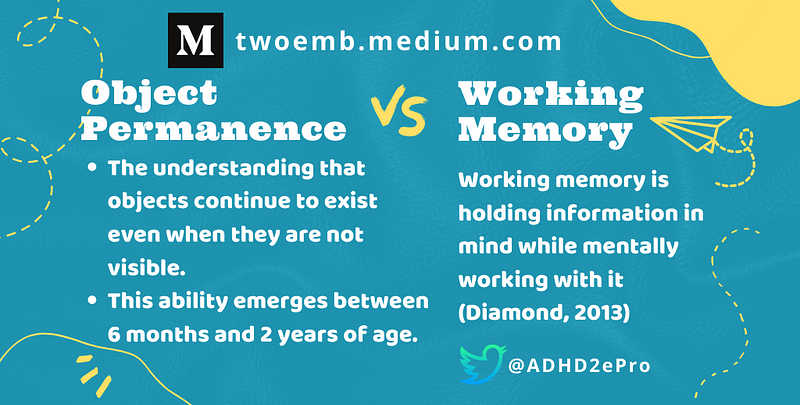
Object permanence is the concept that objects continue to exist even when they are not visible, and in typically developing babies, this ability emerges between six months and two years of age.

I’m neurodivergent, so I’m not typically developing… but even when you apply the estimate that some parts of ADHD brains develop approximately 30% later than typical brains, then we’d still have the concept of object permanence down pat between the ripe old ages of 8 months to 2 1/2 years.

This lack of object permanence is why babies get so excited when their caregiver uncovers their eyes and magically re-appears while playing a game of peek-a-boo, or when they become distressed because their parent has left the room, even when they’re just around the corner.

If you were to cover your eyes and could no longer see me, I hope you would understand you were not, in fact, invisible, nor did I disappear.
Created by author

Piaget must be rolling in his grave

…or at least rolling his eyes

Object permanence was a concept first developed by a Swiss psychologist named Jean Piaget, way back in the early 1900s, a concept included in his Theory of Cognitive Development. I won’t go into great detail about this, as this theory has been covered in great length in many child development textbooks and articles.

Piaget’s theory of cognitive development suggests that children move through four different stages of mental development as they grow. These four stages are as follows:

  1. The sensorimotor stage: from birth to 2 years
  2. The pre-operational stage: ages 2 to 7
  3. The concrete operational stage: ages 7 to 11
  4. The formal operational stage: ages 12 and up

The sensorimotor stage is the time when children master two phenomena: causality and object permanence. Infants use their senses and motor abilities to manipulate their surroundings and learn about the environment. In doing so, they come to understand a cause-and-effect relationship

Between 6 months and two years, infants and toddlers improve their awareness of object permanence, understanding that objects and people continue to exist even when they are not visible.
Created by author

Working Memory

When you forget something because you don’t see it, that’s more of an “out of sight, out of mind” phenomenon. This is not an issue of object permanence, rather, it’s an issue with working memory.

Working memory is holding information in mind and mentally working with it. According to Baddeley and Hitch (1994), working memory is broken into three sub-categories:

  1. Phonological loop: keeps auditory information active in consciousness for the purpose of immediate problem-solving (such as repeating a number in your head to remember it until you can write it down).
  2. Central executive: allocates cognitive resources, focuses attention that is needed to solve problems, and controls cognitive interference. That’s a fancy way of saying your brain tells you to pay attention to some things and filter out others.
  3. Visual-spatial: allows people to keep visual images and spatial information active in the mind for problem-solving (like remembering where you left your keys, phone, or significant other).

That’s the one!

The fact that I put my cup of coffee in the microwave to heat it up, forget about it, and find it ice-cold two hours later is a visual-spatial memory issue.

When I put my keys down in my office chair because my hands are full, then spend panicked minutes or hours the next morning desperately searching for them, it is not because my brain thinks my keys cease to exist.

I know my cup of coffee and keys exist, I just can’t for the life of me remember where I bloody put them!

© Jillian Enright, Neurodiversity MB

When you join medium, as a member you’ll have access to unlimited reads for only $5 per month. If you use my referral link, I’ll earn a small commission, and you’ll earn my undying gratitude.

Related Stories

For another take on ADHD and Object Permanence, I recommend a piece by John Kruse: Making Object Permanence Disappear (see what he did there?)

References

Baddeley, A. D., & Hitch, G. J. (1994). Developments in the concept of working memory. Neuropsychology, 8(4), 485–493. https://doi.org/10.1037/0894-4105.8.4.485

Berger, I., Slobodin, O., Aboud, M., Melamed, J., Cassuto, H. (2013). Maturational delay in ADHD: evidence from CPT. Frontiers in Human Neuroscience, 7, 691. https://doi.org/10.3389/fnhum.2013.00691

Diamond, A. (2013). Executive functions. Annual Review of Psychology, 64(1), 135–168. doi:10.1146/annurev-psych-113011–143750

Malik, F., & Marwaha, R. (2021, July 31). Cognitive Development. In: StatPearls [Internet]. Treasure Island: StatPearls Publishing. Available from: https://www.ncbi.nlm.nih.gov/books/NBK537095

Adhd
Psychology
Neuroscience
Neurodiversity
Autism
Recommended from ReadMedium