ADHD Awareness
ADHD, Actually
Research Reveals How Life-Altering ADHD Really Is

ADHD is about so much more than difficulty sitting still or paying attention.
So. Much. More.
In light of this being Neurodiversity Celebration Week, we wanted to share some important facts about ADHD. Unfortunately, despite decades of information being available to anyone and everyone (including doctors, teachers, and the general public), there is still a lot of misinformation out there. It’s ironic (okay, a bit sad and frustrating too) that one of the most common childhood disorders is one of the least well understood.
The CDC (U.S.) indicates that 9.4% of children aged 2–17 years are diagnosed with ADHD. Statistics Canada states that 5% of school-aged children (presumably aged 5–17) are diagnosed with ADHD. The Centre for ADHD Awareness, Canada (CADDAC) states that ADHD is the most prevalent childhood psychiatric disorder in Canada and remains under-recognized and under-diagnosed, despite being the most treatable psychiatric disorder in Canada.
So, what is ADHD, if not a case of “the wiggles”? If it’s not simply a matter of needing to focus more or get more organized, then what exactly is it?
ADHD is Life-Altering
We will only touch upon a couple of the most life-impacting symptoms of ADHD in this blog, but of course, each person’s experience with ADHD will be different and there are many other symptoms that affect people’s everyday lives.
Executive Functioning Issues
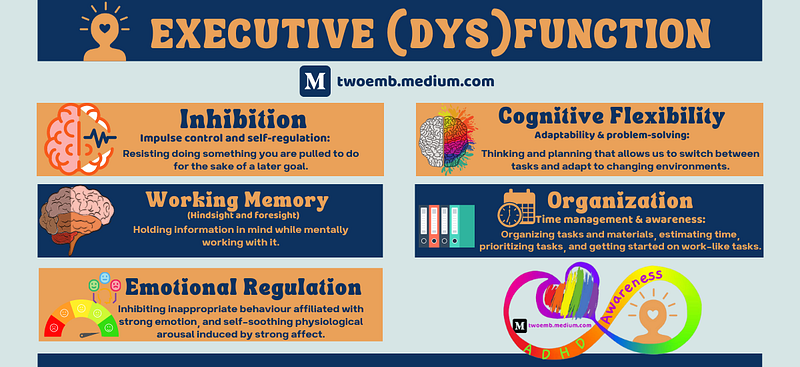
Two major factors impacting the life of children (and adults) with ADHD both stem from Executive Functioning difficulties:
Impulse Control
As defined in our previous blog post, 7 Ways ADHD is Misunderstood, Impulse Control is the ability to pause between the action and reaction. “Response inhibition refers to the ability to withhold a cognitive or behavioural impulse that may be inaccurate or maladaptive.” (Barkley, 2015).
When people seem to act without thinking, it is not because they’re careless or thoughtless. Certain parts of the ADHD brain develop approximately 30% slower (on average) than a typical brain. This includes the Prefrontal Cortex (PFC), an area of the brain responsible for impulse control and complex decision-making.
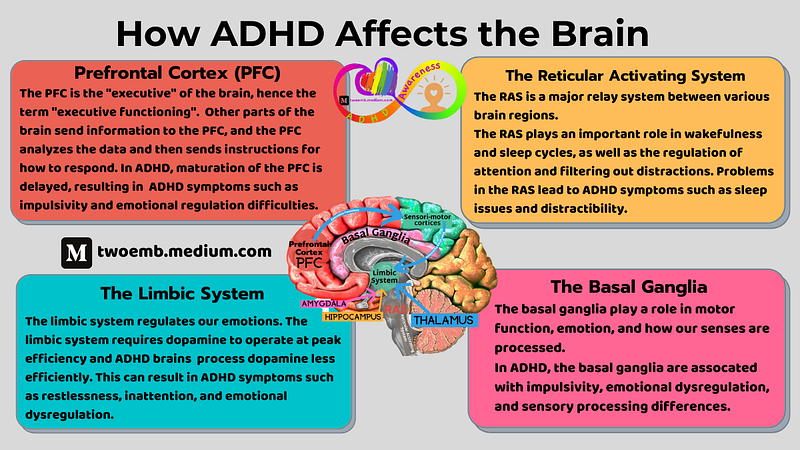
Click for more information on ADHD & Brain Structure
Difficulties with Emotional Regulation
Emotional regulation can be very difficult for some people with ADHD, and can have a significant impact on their lives, including their friendships and other relationships. A child who becomes angry easily and lashes out aggressively is a “ bad” kid, they’re not even an aggressive kid, they’re a child experiencing emotional dysregulation whose behaviour is being expressed in an aggressive manner in that moment.
The distinction is important: children are not their behaviour, and when that behaviour stems from a disability or neurodifference, they are not necessarily in control of said behaviour. A person with ADHD cannot help if they have an underdeveloped amygdala, the part of the brain largely responsible for emotional regulation.
Add Them All Together…
Impulsivity and emotional regulation are very much interconnected: Combine the experience of intense emotions (due to an underdeveloped amygdala), plus difficulty pausing to evaluate prior to acting (due to an underdeveloped PFC), plus difficulty using memories of previous events to consider the possible consequences of said actions (also due to that underdeveloped PFC causing difficulty with hindsight and working memory)… those are a lot of brain-based challenges to work against in order to exert “self-control”!
Some additional points that we will touch on in future articles, but that people must understand about ADHD:
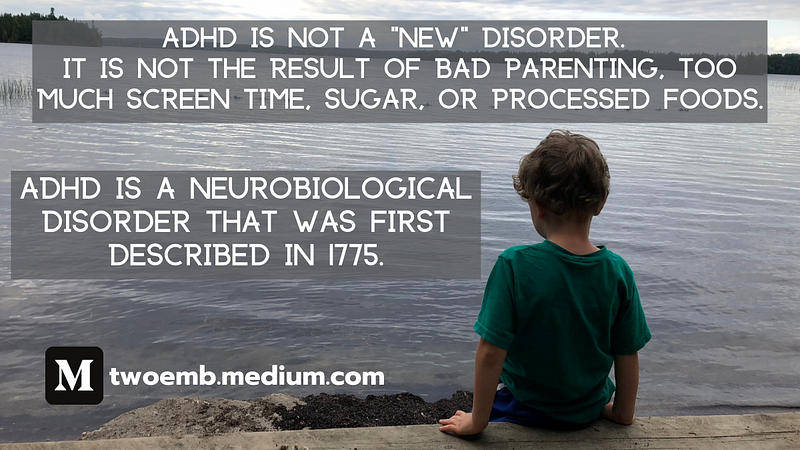
- ADHD is not a new disorder! ADHD is not the result of bad parenting, too much screen time, too much sugar or processed foods (or any other diet), “chemicals”, or whatever else people try to blame.
- ADHD is a neurobiological disorder that was first described in medical literature all the way back in 1775 (Barkley & Peters, 2012).
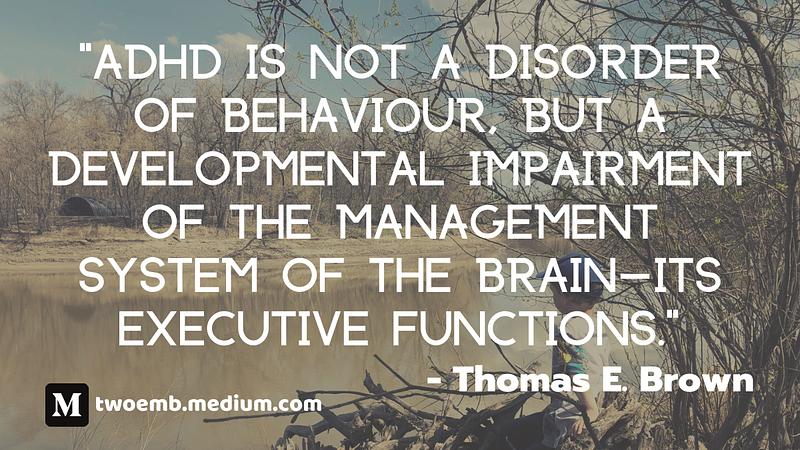
- ADHD is not a mood disorder, a learning disability, a mental illness, nor a behavioural disorder. ADHD is a neurodevelopmental disorder, a condition that is due to differences in in the development and function of the brain.
© Jillian Enright, Neurodiversity MB
When you join medium, as a member you’ll have access to unlimited reads for only $5 per month. If you use my referral link, I’ll earn a small commission.

The Struggle is Real
Now that you know more about the real-life struggles of people with ADHD, click here to learn what you can do about it.
More ways to support my work
You can leave a “tip” on Ko-Fi at https://Ko-Fi.com/NeurodiversityMB
Become a paid subscriber to my SubStack publication.
Check out my online store at https://NeurodiversityMB.ca/shop
Read and share my articles from twoemb.medium.com

References
Barkley, Russell A. (2015). Attention-Deficit Hyperactivity Disorder: A Handbook for Diagnosis & Treatment. The Guilford Press.
Barkley RA, Peters H. (2012). The earliest reference to ADHD in the medical literature. Journal of Attention Disorders
Brown, Thomas, E. (2013). A New Understanding of ADHD in Children and Adults: Executive Function Impairments. Routledge.
Kofler, M. J., Rapport, M.D., Bolden, J., Server, D.E., Raiker, J.S., & Alderson, R.M. (2011). Working memory deficits and social problems in children with ADHD. Journal of Abnormal Child Psychology, 39, 805–817. https://doi.org/10.1007/s10802-011-9492-8
Further Resources:
The Centre for Addiction and Metal Health (CAMH): Attention Deficit Hyperactivity Disorder (ADHD)
American Academy of Child & Adolescent Psychiatry
Attention Deficit Hyperactivity Disorder (ADHD)
About the Author
Jillian is an ADHD 2e Coach and Child Advocate in Manitoba, Canada.
Jillian has a diploma in Child & Youth Work and a Degree in Psychology, as well as being the parent of an amazing 2e/ADHD child.