
Why lockdowns are necessary, and wrong
And why leaders need to get out of a lockdown mentality, fast — to save lives and economies.

Wait, dither….Lockdown!
Only option left. Six months?
Track, trace, back to work.
— — —
The terms used differ, but many countries are now in lockdown, with all but essential services closed, and citizens self-quarantining — attempting to slow the spread of COVID-19.
Lockdowns are not an ideal solution for containing SARS-CoV-2, the virus causing the disease, but for those now in lockdown, relying on it as the primary control method may necessitate many months with businesses, and economies, shut down.
As Dr Anthony Fauci observed, public health advisers are not economists. They recommended lockdowns as a necessary measure to get the virus under control. As a political scientist specializing in policy effectiveness and outcomes, this ‘book’ suggests a pathway that meets public health and economic objectives, without compromising either.
The “collective hysteria” whipped up by coronavirus, according to former UK Supreme Court Justice Lord Sumption, risks conflating draconian measures restricting lawful movement as the only solution.
The pressure on politicians has come from the public, they want action. They don’t pause to ask whether the action will work, they don’t ask themselves whether the cost will be worth paying — they want action anyway.
This chapter suggests a complementary set of measures offering the prospect of leaving lockdown earlier, and reducing the need for future lockdowns.
Nor is this approach radical. It has been tested, successfully — at least in part, enabling countries to avoid, or leave, lockdown. It is consistent with, and complements, the recommendations of Dr Fauci and other medical experts.
However, my observation of recent media coverage suggests a public perception of lockdowns as ‘the’ solution. They are not. This chapter explains why. It is not an academic research paper, but a brief opinion piece offering a different perspective.
Blunt instrument
Lockdown is a blunt, and costly, instrument.
As Scott Morrison, Australia’s prime minister, said, it effectively requires businesses to go into ‘hibernation’, perhaps as long as six months, he reckons (for reasons explained here).
Massive government bailouts will be needed to keep businesses viable, and soften the impact of an almost certain recession and, possibly, depression.
However, some countries — like Singapore, South Korea, Taiwan, and Viet Nam — demonstrated that a quick and effective response can avoid an economic wasteland. Widespread testing, comprehensive near-real-time contact tracing and targeted quarantine can control the virus without the need to lock down entire populations.
As the only country with no warning, China was slower to react. With rapidly escalating cases, Wuhan, the epicentre of the outbreak, was locked down to slow the virus’ transmission. As the United Nations observed, China demonstrated that Covid-19 can be ‘stopped in its tracks’.
These examples are now well known. However, there are many misconceptions about what they mean. Some of their most important lessons remain less well understood, at least judging by worldwide media coverage.
For example, China’s lockdown of Hubei province was widely reported. Likewise, its easing of restrictions, and people returning to a ‘new normal’.
Understandably, such images affect public perception, particularly in countries currently experiencing lockdowns: Lockdowns work.
Lockdowns do indeed work well in suppressing the transmission of viruses. But it’s not the whole truth.
China’s lockdown worked. But lockdown wasn’t China’s solution, nor that of other countries.
Enabling it to release the lockdown, reduce the need for future lockdowns, and allow its economy to get back into production, China repurposed existing systems into a high-tech track-and-trace virus control mechanism (explained here). This is the real solution. Not so much the way China did it (many of its surveillance tools would be unlawful elsewhere) as the core non-lockdown concept — albeit necessarily also involving lockdowns in Hubei, because the virus had gotten beyond control in that province. It’s also the solution adopted (in different ways) by countries that avoided widespread lockdowns.
When someone tests positive, everyone who was in contact with them is told to self-isolate, or is treated. For everyone else, life, and business, continues — in a ‘new normal’ until (and if) a vaccine becomes available.
However, learning lessons from others’ experiences is not always easy.
Barriers to better solutions
Leaders need to select the ‘right’ lessons, and stay on top of developments across many disciplines, including constructive criticism. That is difficult for politicians who need to seen to be ‘in charge’. However, in a fast-moving environment, ‘in-group’ unity risks ‘on-message’ groupthink — with solutions later found not to work.
Likewise, as Lord Sumption noted, the pressure on politicians to be seen to act, and to be seen to act decisively, is immense. If the public perceives a solution to be the right one, it takes a special type of politician to lead an effective solution over a populist one.
Facing any new situation, experts, too, need to overcome the ‘already thinking’ of expertise. The dominant narrative in virus control has already been found not to match what’s known about this virus. Most protocols and specialist knowledge about influenza pandemics and other coronaviruses remain useful, and vital. But some is not, and it can be difficult to ‘unlearn’ ‘accepted truths’ on a timescale requiring immediate response.
Learning the right lessons
One of the first lessons from countries that got ahead of Covid-19, albeit deceptively like standard virus mitigation strategies, is simple: don’t react to the number of known cases, respond instead to the likely true cases.
This involves explicitly recognizing that known cases undercounts the true number of cases. That’s because official case numbers are wrong, sometimes by an order of magnitude. That’s one reason why projection models are vital. (Fatality rates also differ substantially in magnitude, for similar reasons). However, only in places with testing at the scale of populations (such as South Korea) is there a high degree of confidence that known cases reflect the number of infected people.
Without better knowledge about this virus, assumptions continue to drive projection models. It’s like a warrior cutting off one arm and a leg, and putting on a blindfold, before going into battle.
Limited testing in many countries means that many people with the virus remain unknown to authorities, because new information about the virus’ capacity for silent transmission suggest that many more people than first thought are asymptomatic for longer. And some never have symptoms.
Up to 60 percent of people with COVID-19 are now believed to show mild or no symptoms — and a third of those may exhibit none, silently passing it on to others without knowing they had it.
In other words, the number of reported cases may be accurate, for what it measures, but is systematically misleading, in terms of the true number of cases. For control purposes, the number of reported cases is almost completely bogus — mostly useful as general indicators offering a rough idea of what the true numbers might be.
The capacity to understand the true scale of the problem also requires factoring in time, to account for incubation periods, and exponential transmission. Computer models do this well, for known diseases. The fact that so many countries were forced into lockdown suggests that the assumptions fed into them were wrong, exacerbated by low testing rates.
In other words, today’s policy response should respond to the estimated true number of cases in several weeks’ time. They’re already locked in, because people have the disease; it’s just that authorities — and perhaps most of those infected — don’t know it yet.
Here is an excellent, practical explanation (with charts) explaining serious problems caused by not testing asymptomatic carriers from a medical perspective, with illustrative charts, from Dr Rick Dobson (ret):
Officials in countries like Italy, Spain, the Netherlands, the UK and others, almost certainly tried to base their responses on what they thought the real number of cases were, rather than simplistically reacting to the number of known cases. But medical science was playing catch-up. This virus differs, in important ways, from most modeling scenarios. They needed to be updated, in real-time, in the face of an onslaught of new information.
Typically, new information prompts modifications to simulation models. Keeping up with that is hard enough, but, with Covid-19, some assumptions underpinning the modelling generated dangerously false projections, requiring wholesale changes to give leaders more reliable information.
For example, a late February report by a World Health Organization-China mission may have lulled officials into a false sense of security. It suggested that people with no symptoms were “relatively rare and does not appear to be a major driver of transmission”.
Within a matter of weeks, it emerged that the opposite may be true. As noted above, it is now believed that most people with Covid-19 have only mild or no symptoms; likely to represent “a major driver of transmission.”
That makes the limited testing in many countries more disturbing, in terms of understanding the scale of the disease’s spread, and the capacity to control it.
Instead, the virus itself exposed the truth. Mounting deaths quickly revealed the hidden reality of the scale of the task that authorities in Italy, Spain, and other countries, now face.
At first, the number of known cases was deceptively low. With simple linear progression, that wouldn’t matter so much. Nor would it matter as much with influenza, the pandemic most countries were prepared for. My doctorate is in policy effectiveness and outcomes, not medicine, but, as I understand it, influenza has a shorter incubation period, considerably lower lethality, and is characterized by the availability of vaccines.
Covid-19 is characterized by none of those things.
Failing to account for those differences fast enough, in the context of exponential growth (which flips from the lullaby of slow growth to a screaming freight train of unbelievable rates, seemingly overnight), profoundly restricted leaders’ policy choices.
Overcoming other barriers, enabling effective decision making
As well as facing key issues related to the disease itself, it’s also important to address ‘human’ issues. For example, overcoming cognitive biases like the availability heuristic, and anchoring bias — to help officials overcome a natural inclination to use official figures, and to think about the unofficial true number of cases, uninfluenced by ‘known’ and ‘reported’ cases.
Similarly, it’s important to overcome the natural inclination to help make leaders look good, for example by presenting ‘known’ cases with reassuringly precise (and, to begin with, low) numbers to the public, rather than explain the underlying uncertainty about what’s really happening.
Politicians in many countries initially projected a calm image of controlled leadership. Although it’s important to assuage fear (panic doesn’t help either), too much comfort is a risky strategy with viruses.
A citizenry lulled into a false sense of safety is when viruses operate at peak capacity. For example, when people join throngs of shoppers stockpiling provisions before a lockdown, confident that there are ‘only’ a few cases, the reality of many more cases than reported means that the virus will also be circulating amongst shoppers in many of those stores.
If these issues are not addressed quickly, the consequences become inevitable, quickly. As they did.
With massively escalating cases, and deaths, only one policy response remained. Throughout Europe, parts of America, and elsewhere, a series of populations, including whole countries, were locked down. India, and others, are following close behind.
Learning some of the lessons from other countries, some, like New Zealand and Australia, began their lockdowns earlier in the cycle. It seems likely the ‘right’ decision (albeit sometimes only because better solutions may have been missed, as in Wuhan) — subject to any impact from factors like Australia’s slow, phased-in, lockdown and curious exemptions, the common problem of hidden cases systemically under-reported, and the extent of compliance with physical distancing requirements.
Those countries also missed opportunities for a better policy response, but, going into lockdown earlier should help improve their chances of avoiding the worst experiences of Italy and Spain.
It is too early to tell if the United States, India and Brazil will avoid the tragedy in Italy and Spain. The prospect looks poor.
But, while severe lockdowns may be needed, leaders can also prepare for a different strategy to get them out of lockdown earlier, and just as safely.
Among the many issues that future social historians might explore is whether leaders following other countries’ lockdowns were influenced by a bandwagon effect. Did officials believe that other countries’ actions represented an optimal response, rather than the only one left, forced into it because they didn’t consider or execute better responses earlier? If so, they will likely explore the extent to which leaders’ became stuck in a ‘lockdown mentality’, underappreciating the value of alternative and complementary strategies.
In any event, countries now in lockdown can choose to continue with that policy, or learn lessons from countries that responded quickly and, arguably, appropriately, rather than those that didn’t.
Economic ‘unlock’
If the sledgehammer tool of a lockdown is the only one that politicians see in their policy toolkit, then — as Australian and UK officials say — lockdowns may well need to last six months. From a unitary disciplinary perspective, that’s how lockdowns work, as explained above (again, here).
Although seldom mentioned publicly, if lockdown is regarded the primary response, it may also require an ongoing series of “pulse” lockdowns. As transmission rates start to rise after each lockdown eases, further shutdowns may be needed to get rates down again.
Lockdowns work, from a public health perspective. But, on the scale of entire countries, they cause severe economic disruption.
Drawing from policy effectiveness and outcomes principles to complement medical expertise offers a broader perspective to assess the lessons from countries with successful strategies, rather than those forced into lockdowns as a last resort.
This suggests the prospect of unlocking better outcomes, including an earlier return to work, and less financial chaos.
That’s because lockdowns are not the optimal solution.
Or, more precisely, lockdown may not be the best solution if better health and economic outcomes is the objective. (Lockdown remains an effective health solution, albeit economically debilitating).
The clue, again, is China. They didn’t contain the virus by locking down Hubei province. Instead, China used the lockdown to knock transmission rates down, and quickly implemented other measures to contain the virus on an ongoing basis, enabling the lockdown to be lifted. Like several other Asian countries did earlier, notably Viet Nam, avoiding the need for whole country lockdowns.
Amongst countries that failed to learn those lessons fast enough, Germany offers a good test case for pathways to better outcomes, as noted below. New Zealand, or Australia, both currently in lockdown, could be better test cases’ with unique characteristics offering invaluable lessons for other nations — and huge financial benefits for the country that does so.
New Zealand: Perfect test case
Just a few days into lockdown, New Zealand has fewer ‘known’ cases than many others (albeit systemically under-recorded, with very limited testing), and, currently, only one death. Far fewer than many European countries, including Germany.
While other countries focus (rightly) on trying to stop mounting deaths, rather than simplistically extending New Zealand’s lockdown, a multi-disciplinary approach could focus on what works, offering a model for other countries when they start to get death rates down and turn their attention to ongoing virus control.
Importantly, New Zealand is an island nation with a relatively small population, combined with excellent health care facilities, a world-class scientific community, and a penchant for ‘getting things done’.
Significantly, if New Zealand tested at the same rate as Germany, it needn’t just target the most vulnerable areas. Nor bother with representative sampling. New Zealand could test its entire population in just three weeks or so. In reality it would take a little longer, because tests are not perfect. Targeted testing, multiple testing, and testing cycles would be needed. But, from a scientific perspective — and for the country’s own benefit, and other nations — the significance of such an opportunity almost defies overstatement.
An example of full population testing was a cruise ship with 3,711 passengers. Results from a country population would be invaluable for other nations. Especially, the controlled population of an island nation.
A different approach than it is currently following also offers New Zealand a unique opportunity to stop the virus dead in its tracks and allow the country to re-open for business, potentially including international travel, much earlier than ‘lockdown as the only strategy’ thinking. (Air New Zealand has announced mass redundancies, and predicts that the effects of a prolonged shutdown might make the airline, in effect, mostly a domestic carrier).
Broadly speaking, there are two main limbs to a strategy emulating successful countries rather than those forced into lockdown.
Mass testing
The first involves a critical change to New Zealand’s testing regime founded on so-called ‘risk based’ standards, testing only people meeting strict guidelines. Protocols eased slightly over the past few weeks, but, at about 1,700 per day, testing remains insignificant. Long one of the worst performers (chart below), New Zealand’s testing rate undercounts cases, and is ineffective for control purposes. Absent fundamental change in this area, New Zealand is probably stuck with lockdowns for the foreseeable future.
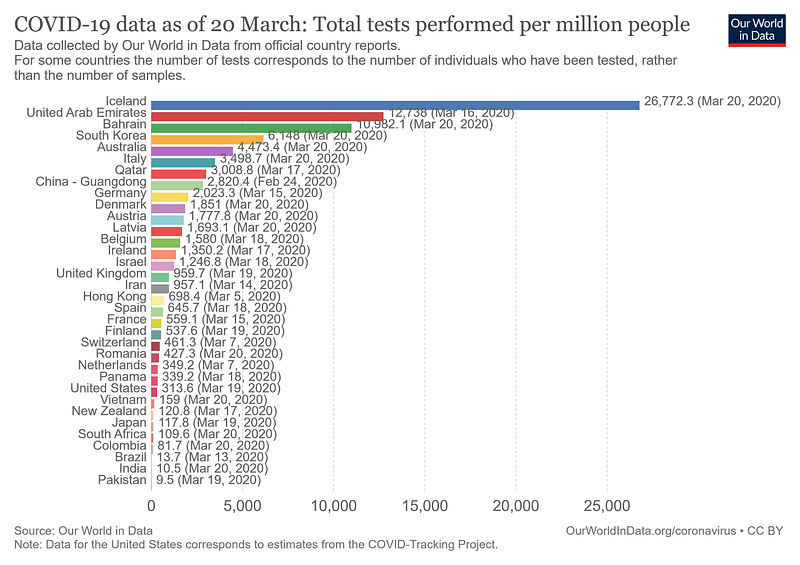
Alternatively, authorities could implement a different strategy. As soon as it is ready to implement such a plan, if it chooses a full population testing option, New Zealand could start releasing people from lockdown within days, and avoid the need for further shutdowns.
Widescale population testing (screening to check who has the virus, plus antibody tests to see who’s had it and recovered), combined with real-time, effective, track-and-trace capabilities, would allow people not infected to be released from lockdown. (It also offers a research pool of all subjects who contracted the virus and recovered from the disease; not, as now, limited to the few cases with serious symptoms. This data alone would be immensely valuable to global efforts to combat Covid-19).
For those infected, immediate triage: self-isolation, quarantine or hospitalization, as required.
To quote Dr Dobson (ret):
The bottom line is simple: Test a lot of people, meaning every one. Test frequently. Quarantine if there is any possibility of exposure to SARS-CoV-2. [Continue] until there is an effective vaccine and or treatment.
If Wuhan can do it, already out of lockdown, and South Korea and Germany, other countries can.
Any suggestion that it can’t be done is plain wrong. It has been done. Therefore, it can. South Korea and Viet Nam manufactured massive testing capability in short order, and implemented mass testing, fast.
Other countries followed suit, like Germany, reportedly testing up to 200,000 people a day. Germany will soon also roll out mass testing to find out who has already had the disease. They will have antibodies that may help prevent re-infection, and give authorities a more accurate picture of the problem. Such data also offer some the most effective tools to contain the virus, without the need for debilitating lockdowns.
But, Viet Nam, South Korea and Germany have big populations. Getting to population scale may not be feasible. For smaller nations, it might be feasible, and desirable.
Clearly, mass testing is possible. All that is needed is vision, strategy, implementation, resources, and political will.
Nonetheless, timing remains an issue. New Zealand’s planning might be centered mostly on lockdowns as ‘the’ solution, rather than a temporary means to deploy other tools to achieve multiple policy objectives. If so, adapting a Chinese adage, the best time to manufacture or order test kits and technology was two months ago. The second best time is today.
Testing alone, however, is not enough.
Track-and-trace
Ongoing real-time monitoring helps keep transmission rates in check, allowing people to return to their normal lives, and work — or at least, a ‘new normal’ until a vaccine is delivered.
There are, of course, many other issues impossible to canvas here. For example, unlike China, democracies may not have existing surveillance capabilities easily repurposed for virus control, as outlined above (again, here). Democracies also face privacy issues, and the risk that authorities might mirror China, in reverse, by later repurposing virus response mechanisms for mass surveillance. These issues are surmountable.
Nor should resources be a problem, judging by the trillions of dollars already spent to prop up ailing economies. A tiny fraction of that amount could help economies back on their feet, much sooner — with a return on investment measured in days, or perhaps even hours, compared with lockdowns causing ongoing economic carnage.
Likewise, technology solutions needn’t be as extensive as China’s. Simpler solutions can be selected and tailored in ways suitable for each country. Many are already available, or, with the right resources, and ingenuity, can be developed in days rather than months.
The trick, however, is to ensure that effectiveness and outcomes principles weed out touted ‘solutions’ that generate activity and ‘outputs’, in favour of those that offer direct line of sight to meaningful health and economic outcomes.
In that regard, effective contact tracing requires much more than interviewing patients, the current mainstay in many countries. Relying on people’s memories, where they might have been, precisely when, and who they recall coming into contact with, is inefficient, and ineffective. Authorities will find some of the most obvious for self-isolation, but countless more people that the person actually contacted will continue transmitting the virus throughout the community.
Again, any country that can’t be bothered to implement an effective contact tracing system is probably stuck with lockdowns for the foreseeable future.
Nor is it difficult to find examples of better systems.
Together with mass testing, South Korea used phone-based GPS data, card transaction records, and other information to quickly trace people in close contact with newly diagnosed cases, enabling targeted isolation. Other measures to minimize and prevent further transmission of the disease included systematic updates through SMS and app messaging to inform people which areas to avoid.
In Singapore, a voluntary contact tracing app (freely available for other developers) uses mobile phones to quickly identify people that came into contact with infected people in the past 21 days. In the UK, a symptom monitoring app developed in four days instead of four months has been used by more than two million people. Israel has a notification app (also open source) that tells people if they have crossed paths with someone known to be infected with COVID-19. It uses the location histories of confirmed cases in the 14 days before their diagnosis.
New Zealand would be an ideal test case, but others could be instead. The prime determinant is not location or circumstance, it’s leadership.
Australia, and other nations
Many other nations could adopt the strategies outlined in this paper, and elsewhere.
Australia, for example, also an island nation, has many of the same advantages to help itself, and the world, as New Zealand. Although it has a much larger population, testing at a population scale at the same rate as Germany could be done in about 4 months in Australia. That is less than its possible lockdown period, according to the country’s Prime Minister. Moreover, South Korea has shown that testing can be effective long before an entire population is covered, so Australia could begin to enjoy the benefits earlier. (However, the benefits of a full population dataset for other countries would take longer).
Nations like the United States, however, face more immediate challenges. Rapidly escalating cases, and deaths, suggest — as authorities are clearly aware, and rapidly ramping up capabilities — the immediate priority is to cut transmission rates, fast. During its trying times ahead, the United States would benefit enormously from the experiences of other countries getting the virus under control beyond the simplistic tool and massive collateral damage of country-level lockdowns.
Countries like Germany and China appear to be leading the way. Smaller countries like New Zealand and Australia offer the tantalizing prospect of invaluable full population datasets for deep understanding of COVID-19.
However, absent political will to implement effective, near real-time measures to track-and-trace contacts, complementing testing at the scale of populations (or, for larger countries, representative sampling), leaders may as well just leave their countries in lockdown, and leave other nations to their own fates, unaided.
Conclusion: Leadership crossroads
The measures briefly outlined above are not, of course, the only possible responses. Lockdown remains a valid choice. It favors health over the economy. Sweden’s relaxed approach, which some fear does the opposite, might ultimately prove successful. (Japan’s comparatively low number of cases, whether because or despite low testing, or some other reason, rates is uncertain may, in time, offer more insights).
The suggestion outlined here offers an initial rough guide from a policy effectiveness and outcomes perspective, seeking to meet health and economic objectives, compromising neither.
But, no-one knows for sure. It is easy for me, and others, to make such suggestions, but, for leaders, such decisions are not easy.
But that, arguably, is the point of leadership. And what helps distinguish it from followership.
The main message here is not that a system of mass testing with near-real-time track-and-trace capabilities is the only policy choice, but that policy choices should be evidence-base and outcome-oriented, resolutely focused on what is most likely to work.
Of course, that is what every politician claims. Trouble is, a corollary of a fast moving virus is that it quickly exposes rhetoric to reality. Many such claims have already been proven false, at least in terms of initial responses — with many countries forced into sub-optimal outcomes, with debilitating lockdowns, rapidly mounting deaths, and political leaders quickly changing the narrative.
It will take several years for social historians to unpick the timelines — with the clarity of hindsight — and separate truth from appearance.
In the meantime, in some countries, political rhetoric and bullshit might give citizens the impression that their leaders are doing the right thing, and that it’s the virus causing economic damage rather than leaders’ responses to it. In other countries, leaders are responding as well as might be expected in trying times, and some currently (or could) offer beacons of inspiration, resolutely ensuring better outcomes for their citizens, and, perhaps, for the world.
To conclude, apart from a postscript haiku with one possible future for political leadership, the main part of this chapter can end simply, repeating the conclusion of its opening chapter:
Whether or not leaders explicitly or implicitly embrace policy effectiveness and outcomes principles, or extend simplistic and economically debilitating lockdowns, the COVID-19 crisis is a once-in-a-lifetime test of leadership.
In the future mountain of books that will inevitably dissect every aspect of COVID-19 crisis management, some leaders will be found wanting, some inspirational, and, some, initially lethargic, will be praised for stepping up to lead for better social and economic outcomes for their people.
This book, told in chapters of 17 syllables, and a little explanatory prose, cannot arrive at any firm conclusions while the crisis, and its response, unfolds. However, one thing is certain. Leadership — for better, or worse — will profoundly affect many lives, livelihoods, and legacies.
— — —
[updated 2/4/20 (JAP, RepSam, Err)]


