
Community Transmission
Haiku

We are good, boast we.
Cases low. Test by ‘standards’ -
travelers only.
— — —
Limited testing flawed, and dangerous
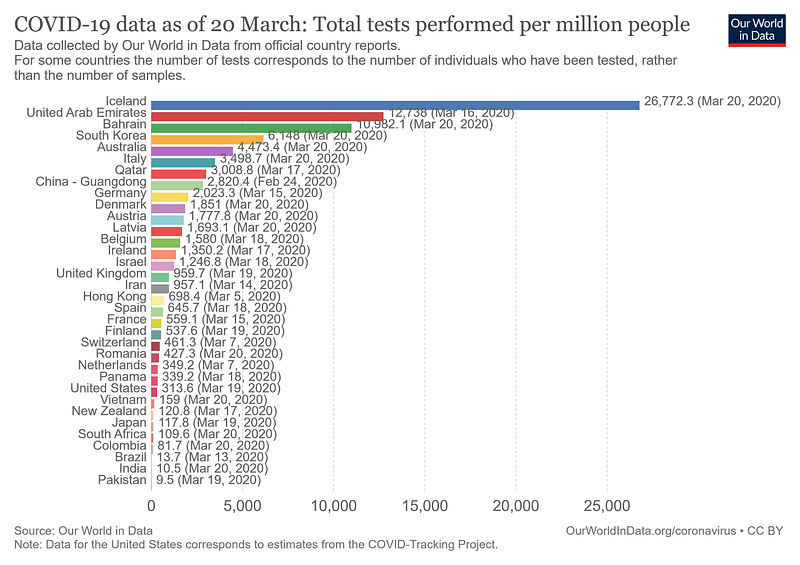
Many countries restrict Covid-19 testing, limited by so-called ‘risk-based’ standards, such as only testing people with symptoms and recently in a country deemed high-risk or in contact with such a traveler or known case. Perceptions about “no community transmission” until such cases become known, are false. Dangerously so.
When such cases start appearing, the lack of community testing, the sheer luck in finding them when not looking for them, the time-lag between transmission and symptoms appearing (up to about 12 days in 98% of most cases), that many (perhaps most) infected people may show few or no symptoms, combined with the virus’ exponential spread, means that the true number of cases may exceed the number of ‘known’ cases by an order of magnitude. (Despite India’s first case on 30 January, authorities steadfastly insisted that cases were one-offs and no local transmission was taking place, eventually forcing a nationwide lockdown; a lesson how not to handle a pandemic).
Moreover, citizens’ behavior (for example, flouting physical distancing rules, say by frenzied stockpiling in crowded stores before lockdowns) may be affected by the false sense of safety afforded by simplistic reporting of ‘known’ cases; ironically creating more community transmission in the mistaken belief there is little or none already. Countries with limited testing regimes exacerbate these issues, because the number of known cases inevitably undercounts the number of people infected.
The result is as tragic as it is almost inevitable; an exponential spike in the number of known cases, and, likely, deaths, as seen in Italy, and elsewhere.
Restricted testing is contrary to World Health Organization (WHO) recommendations. Widespread testing was instrumental in some countries getting the virus under control, eg South Korea.
Sources and charts: These actions will determine severity of COVID-19
Updates — 26-29 March 2020
Recent studies reveal the scale of risk associated with persistent misperceptions about virus transmission. One found a median 5.1 days for symptoms to appear, and up to 97.5% of cases in 11.5 days. That’s a long time with exponential spread. (Links in These actions will determine severity of COVID-19).
Another found the virus arrived in Italy around 1 January. That means by the time Italy’s first case appeared (20 February), “the virus had already spread to most towns and cities” in the entire region. Like many countries still, Italy’s actions were based on reported cases. That is fundamentally flawed, and exacerbated further in countries with low testing rates.
A report on a third study (on the cruise ship Diamond Princess, with a rare opportunity to test an entire population) noted that as many as 18% of infected people showed no symptoms. With a relatively high average age of passengers, researchers suggested that the proportion of people infected with the virus and showing no symptoms may be even higher in the general population (What the cruise-ship outbreaks reveal about COVID-19). The research paper itself, however, noted that “by 20th February, there were 634 confirmed cases onboard (17%), with 328 of these asymptomatic” — ie 52%.
A late February report by a joint World Health Organization-China mission might have lulled officials into a false sense of security. It suggested that people with no symptoms were “relatively rare and does not appear to be a major driver of transmission”.
Alarmingly, in terms of community transmission (especially in countries with minimal testing regimes), a slew of studies indicate that as many as 60 percent of people with COVID-19 show mild or no symptoms (and, as noted above, as many as a third of those may exhibit no symptoms at all).
This means that:
Transmission occurs long before cases become ‘known’, especially when testing is so limited, as in the US, New Zealand, and many other countries.
Most people will be oblivious that they’re spreading the virus for a week or two before symptoms appear.
A significant number of infected people with no symptoms will be transmitting the virus to others.
Put simply, anyone who says “I don’t have it” or “we can do X because he/she doesn’t have it” or feels confident breaking the rules of self-isolation (“what’s the harm, I feel fine”), is dangerously mistaken, or worse.
— — —


