
Lifesystem: Design for A Meaningful Journey
A knowledge canvas for Life Discovery
The purpose behind the Lifesystem framework is to develop a framework for discussing work-related design innovation and career development from the perspective of the ecological practice approach which is inspired by ecological psychology.
There are at least three ways to understand the concept of “Life”.
- Life as Organism: this is the perspective of biological theories.
- Life as Practice: this is the perspective of social theories.
- Life as Ideal Type: this is the perspective of humanities.
The Lifesystem framework is not for all things of life, but only the life of working. However, the framework understands “working” in the broad sense. It considers paid work and non-paid work as a whole as a career. It is also considered playing as a special type of “working”.
It also echoes the concept of “Activity” from Activity Theory. According to Victor Kaptelinin and Bonnie A. Nardi, the founder of Activity Theory has considered Life as the name of his theory.
Moreover, I also adopted Alfred Schutz’s concept “The World of Working” to define work-related life activities. Since “The World of Working” is the opposite of the world of fantasy and dreams, it is perfect for defining the concept of “Career” to consider paid work and non-paid work as a whole.
I have discussed the Lifesystem framework in the following articles:
- Lifesystem: Modeling Ice Skating and Other Social Practices (9/30/2021)
- Lifesystem: Theory-based Reflection (3/6/2022)
- Lifesystem: Operation-based Reflection (3/7/2022)
Today I am going to introduce a new canvas called Lifesytem Development and use it for Life Discovery Activity.
Lifesystem for Life Discovery
On Feb 7, 2022, I published the Life Discovery Toolkit (v1) with the following nine questions which leads to nine modules.
- What kind of hero are you?
- What is the status of your primary life project?
- What have you created so far?
- Where did your ideas come from?
- What’s your primary life project?
- How do you manage your networks of enterprises?
- How do you interact with significant others?
- How well do you adapt to environments?
- How do you echo the development of culture?
The last three questions belong to the third group of modules: Multiple Perspectives. Though the Life Discovery Toolkit (v1) is based on the Project-centered approach, I believe it is important to adopt Multiple Perspectives for building the flexibility of mind. I deliberately select three other theoretical perspectives and put them together for the third group.
The Lifesystem framework is one of three other theoretical perspectives. It aims to answer the 8th question: How well do you adapt to environments?
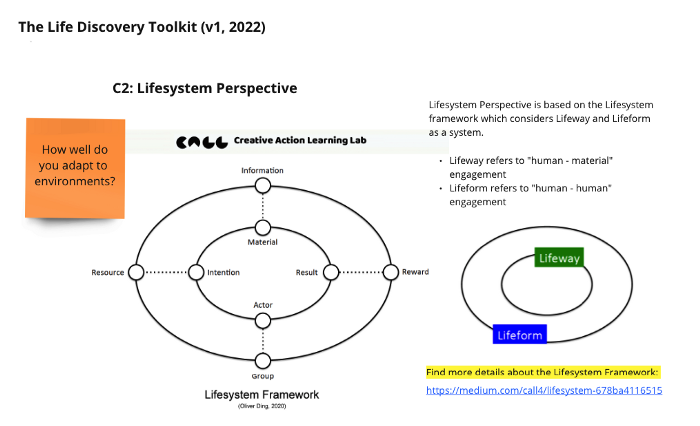
From the perspective of personal career development, the Lifesystem framework needs some concepts for discussing competence. Following the distinction between percept and concept, the distinction between Affordance and Supportance, and the distinction between Lifeway and Lifeform, I developed the pair of concepts of Material Adaptability and Social Adaptability.
Material Adaptability refers to a person’s competence in the actualization of affordance and material engagement while Social Adaptability refers to a person’s competence in the actualization of supportances and human engagement.
The Lifesystem Development Canvas
On Feb 26, 2022, I designed the following Life Discovery Canvas from the perspective of the Project-centered approach.
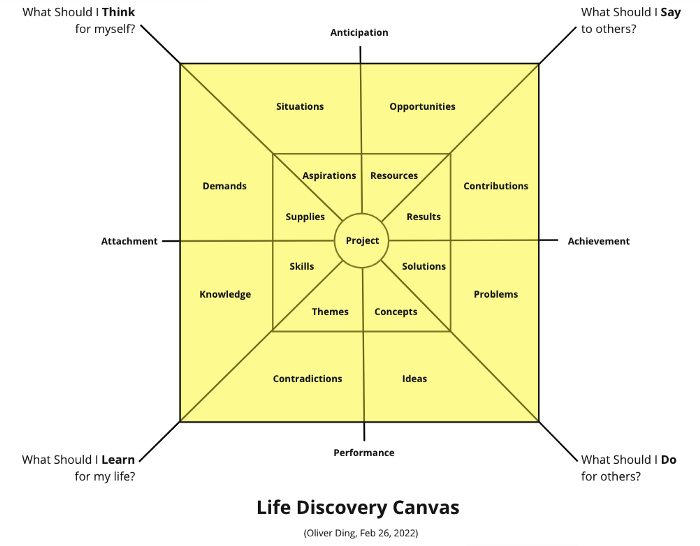
The following articles offer details about the canvas:
- Part 1: Theoretical Background
- Part 2: Spatial Structure
- Part 3A: Concepts (THINK and LEARN)
- Part 3B: Concepts (SAY and DO)
- Part 4: Inspirations
On March 3, 2022, I designed the Optimal Context Canvas which is based on the Infoniche model.
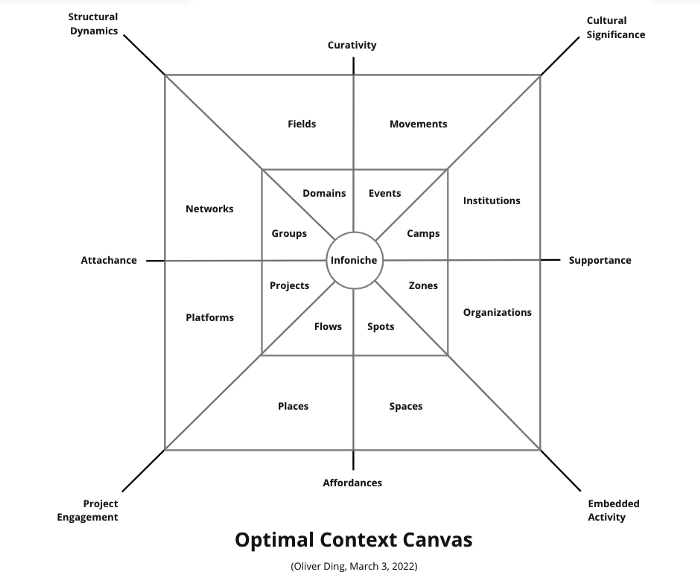
The Optimal Context Canvas uses Inner Space for Proximal Contexts and Outer space for Pervasive Contexts. From the perspective of individuals, the Optimal Context Canvas offers a landscape view of an ecosystem for discovering opportunities. For Ecosystem builders, the Optimal Context Canvas offers a landscape view of an ecosystem with a brand new typology of social contexts.
Today I want to introduce a new canvas called Lifesystem Development. This one is based on the Lifesystem framework.
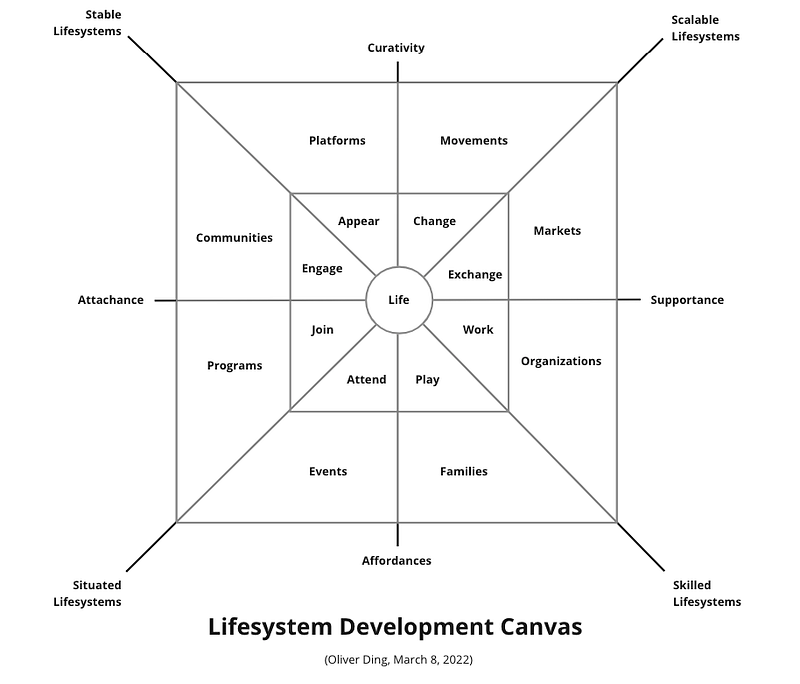
The new canvas’s Inner Space refers to the Tendency of Actors while Outer Space refers to the Context of Groups.
The Tendency of Actors
As mentioned before, the pair of concepts of “Actor — Group” comes from the concept of “Subject”. The concept of Actor is located at the loop of Lifeway while the concept of Group is located at the loop of Lifeform. The Actor refers to the primary subjects while the Group refers to secondary subjects.
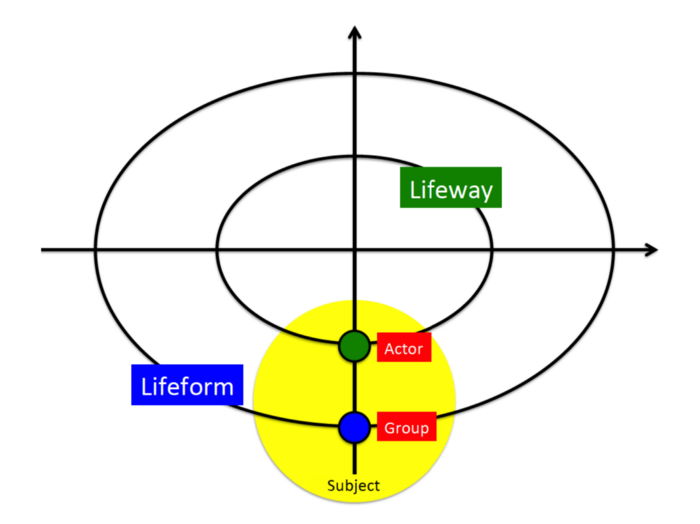
I use the Lifesystem Development Canvas’ Inner Space to highlight eight types of tendencies of actors.
- Attend
- Join
- Play
- Work
- Appear
- Engage
- Exchange
- Change
The above eight types belong to four types of Lifesytems:
- Situated Lifesystems: Attend + Join
- Skilled Lifesystems: Play + Work
- Stable Lifesystems: Appear + Engage
- Scalable Lifesystems: Exchange + Change
Is it a typology of Lifeway which refers to “human—material” engagement? There are many ways to develop a typology. We can consider it as a rough typology from the dimension of Tendency of Actors.
What I want to talk about are Material Adaptability and Social Adaptability. A great typology of Lifeway should be useful for reviewing Material Adaptability.
This canvas is more about Social Adaptability because the above eight types of tendencies roughly correspond to the following eight types of Contexts of Groups.
The Context of Groups
The Lifesystem Development Canvas adopted some terms from the Optimal Context Canvas. Since these two canvases are based on two different theoretical frameworks, we should use them with their master frameworks.
The Lifesystem Development Canvas’ Outer Space highlights eight types of contexts of Groups.
- Events
- Programs
- Families
- Organizations
- Communities
- Platforms
- Markets
- Movements
Now we can see a rough connection between Inner Space and Outer Space:
- Events (Attend)
- Programs (Join)
- Families (Play)
- Organizations (Work)
- Communities (Engage)
- Platforms (Appear)
- Markets (Exchange)
- Movements (Change)
To be honest, this is a pretty rough connection. As a version 1.0, I just want to highlight the value of the following ideas:
- The notion of “Tendencies of Actors”
- The notion of “Contexts of Groups”
- The connection between the above two notions
In this way, we can expand the Lifesystem framework with a new canvas.
The Landscape of Social Life
The Lifesystem Development Canvas uses four types of Lifesystems to define four significant areas.
- Situated Lifesytem
- Skilled Lifesytem
- Stable Lifesystem
- Scalable Lifesystem
The diagram below represents the dynamics of the development of Lifesystems. We can see several contexts of Group on the diagram.
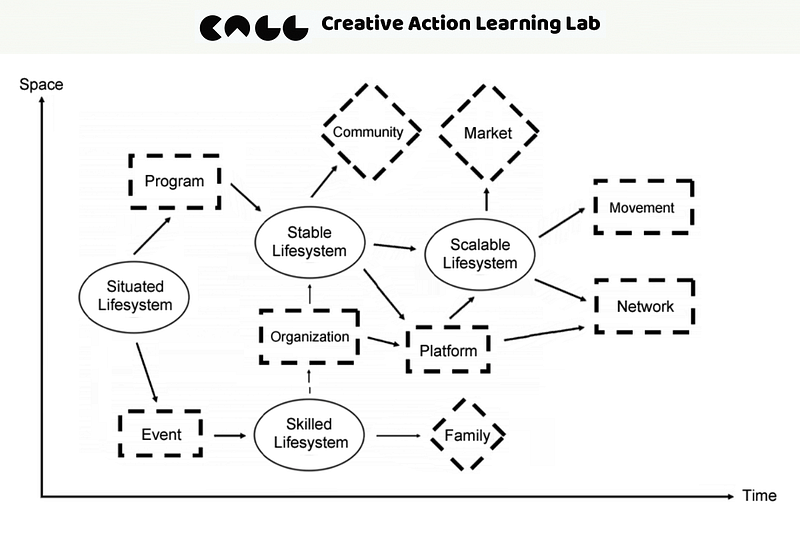
The above diagram is called the Landscape of Social Life. Lifesystem is a new theoretical term that belongs to the Ecological Practice approach. Other terms are normal words that refer to different types of social phenomena. I put normal words for describing social structures and four types of Lifesystems together. In this way, we can use the Lifesystem framework to discuss the dynamics of social life.
The Lifesystem Development Canvas uses a different way to visualize this relationship.
Lifesystem Development and Life Discovery
The Lifesystem Development Canvas also adopts four theoretical concepts from the Ecological Practice approach. Each concept has its heuristic orientation for thinking.
- Affordance: Material Adaptability
- Supportance: Social Adaptability
- Attachance: Sense of Boundaryless
- Curativity: Sense of Wholeness
These heuristic orientations refer to the benefits of learning these concepts and mastering related skills.
Material Adaptability refers to a person’s competence in the actualization of affordance and material engagement while Social Adaptability refers to a person’s competence in the actualization of supportances and human engagement. There is a gap between potential possibilities, a person has to develop his skills and capabilities to take Affordances and Supportances.
Attachance leads to a Sense of Boundaryless because actions of Attaching and Detaching reduce the boundary’s impact on a person. Curativity leads to a Sense of Wholeness because actions of turning pieces into a meaningful whole increase the skill of making sense of wholeness.
Mapping Multiple Lifesytems
For Life Discovery Activity, the Lifesystem Development Canvas also has a unique function:
It can be used for mapping multiple Lifesystems.
My previous articles focus on one lifesystem. The new canvas can be used to put several lifesystems together. In this manner, we can use it for the Life Discovery Activity.
As mentioned above, the Lifesystem framework considers the concept of “Life” as the “World of Working”. The view echoes the notion of “Life as Project” which is the core of Life Discovery Canvas.
We can also consider the Life Discovery Activity as a continuous journey of Developing Tacit Knowledge about “Self”, “Mind”, and “Life”.
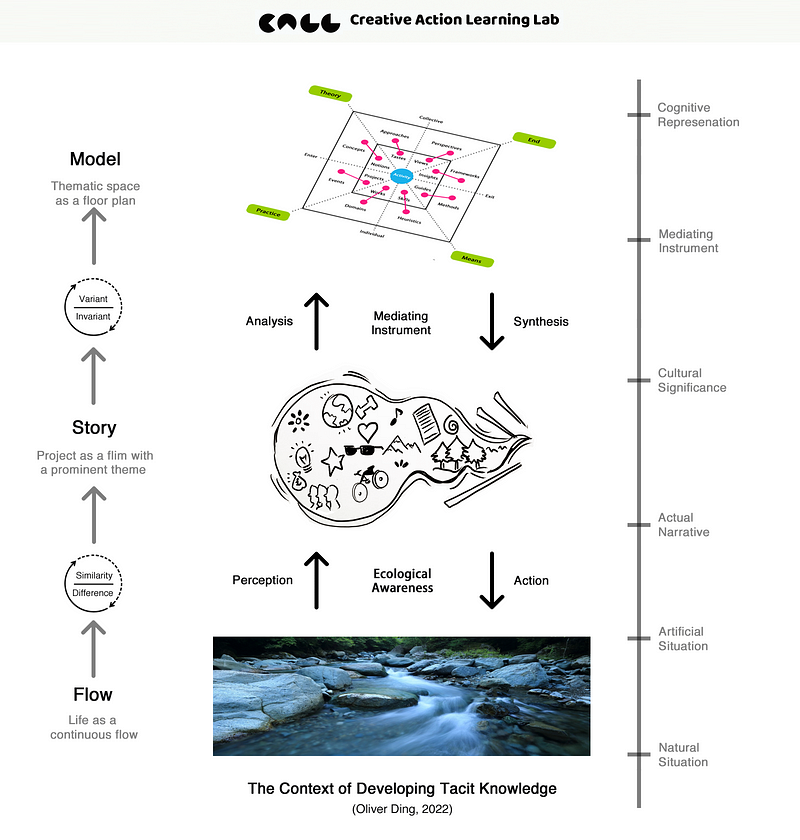
The above diagram uses the “Flow — Story — Model” metaphor to understand the context of Developing Tacit Knowledge.
- Flow: Life as a continuous flow
- Story: Project as a film with a prominent theme
- Model: all knowledge frameworks and models as floor plans
The Lifesystem framework and its canvas are Models for understanding our life projects and life stories. The picture below visualizes the landscape of my life from the perspective of Lifesystems.
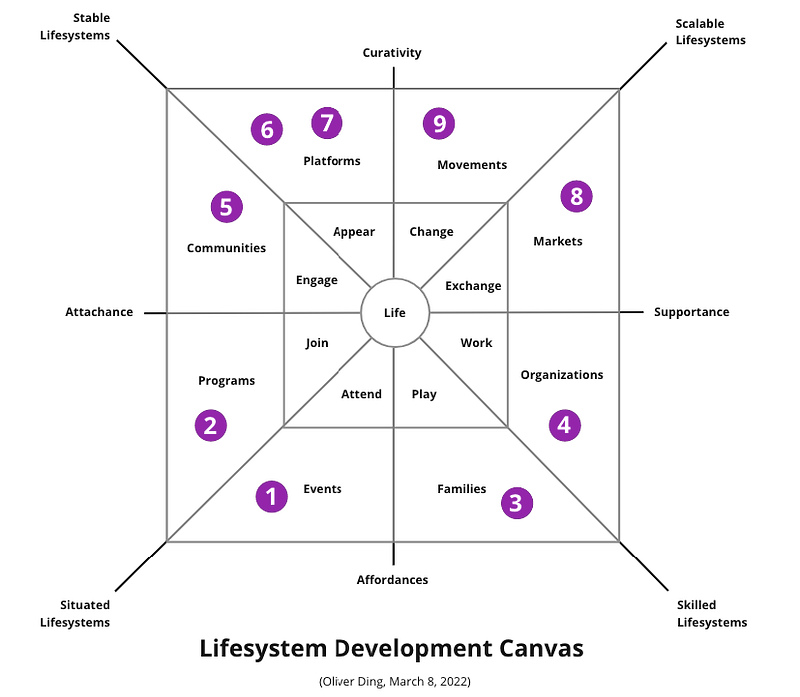
The above canvas shows some pink dots which refer to some Lifesystems. For example:
- Events — #1: Virtual Attendance
Last Friday I virtually attended the 2022 Born Global Summit. The Lifesystem behind the event is Virtual Attendance and its Lifeway is using a computer to watch a live event while its Lifeform is a loose relationship between me, other attendants, and the host.
- Programs — #2: Digital Life Discovery
I recently joined an adult life development program which is hosted by SSL (Shaper & Supporter Lab) as a guest. My goal is to apply the Anticipatory Activity System Framework to study the program. The Lifesystem behind the event is Digital Life Discovery and its Lifeway is a digital spreadsheet-based life discovery meeting while its Lifeform is a structured peer-review group.
- Families — #3: Fully Automatic Chinese Cooking
Last month we bought an intelligent automatic cooking pot. The Lifesystem behind it is Fully Automatic Chinese Cooking. We use Gemside LWOK-DA10 to cook meals for our lunches, this is the Lifeway. Also, the Lifeform refers to a work-from-home couple since I and my wife are working from home.
- Organizations — #4: Adjustable Height Desks and Large Spreadsheets
My wife works for an accounting firm and I work for a knowledge curation studio. The Lifesystem behind my wife’s work is a work-from-home tax service. Its Lifeway refers to adjustable height desks and large spreadsheets while its Lifeform is about remote team collaboration.
- Communities — #5: Strategic Doing
I recently communicated with the Strategic Doing community closely. The Lifesystem behind the community is Strategic Doing workshops. Its Lifeway is about dealing with four strategic questions while its Lifeform is about local open network collaboration.
- Platforms — #6: Social Media Sharing
I use Linkedin and Twitter for sharing my writings. The Lifesystem is Social Media Sharing and its Lifeway is using social media platforms such as Linkedin and Twitter while its Lifeform refers to digital social networking.
- Platforms — #7: Digital Whiteboarding
I use Miro, a digital whiteboard, to draw diagrams and develop knowledge toolkits. The Lifesystem is Digital Whiteboarding and its Lifeway is using a digital whiteboard tool while its Lifeform is about remote team collaboration.
- Markets — #8: Buying Used Books
I often buy used books from Amazon. The lifesystem is Buying Used Books and its Lifeway is reading used books. I found this Lifeway quite fun because I can read both books and notes. Its Lifeform is about the remote exchange of goods and minds.
- Movements — #9: 4E Cognition
4E Cognition refers to 4E features of the Mind. 4E stands for embodied, embedded, enacted, and extended cognition. You can find more details in The Oxford Handbook of 4E Cognition (2018). My primary theoretical work, the Ecological Practice approach is inspired by Ecological Psychology and its core idea Affordance Theory which is an important concept for 4E Cognition. Though I don’t directly work in the 4E field, the Ecological Practice approach echoes the movement of 4E Cognition in cognitive science. The Lifeway of 4E Cognition is dealing with 4E-related theoretical approaches and empirical research while its Lifeform is about academic research and independent study.

The Lifesystem framework doesn’t adopt the subjective perspective to see a person’s life experience. However, we can consider Lifesystem as a special type of container which could shape our life experience. By mapping multiple Lifesystems, we can better understand Self, Mind, and Life.
You are most welcome to connect via the following social platforms:
Linkedin: https://www.linkedin.com/in/oliverding Twitter: https://twitter.com/oliverding Polywork: https://www.polywork.com/oliverding Boardle: https://www.boardle.io/users/oliver-ding


