
Let Them Eat Cake
Exposing the American Racial Wealth Gap

Children and adults agree: Cake is a fabulous, decadent treat.
So, why was the phrase, “Qu’ils mangent de la brioche,” offensive?
The phrase in English is Let them eat cake. However, historians highlight that brioche is not cake. Brioche is buttery, indulgent French bread. Generally, a cake is a much sweeter pastry. Historians also emphasize that no proof exists that Queen Marie Antoinette ever uttered the famed phrase.
“Because cake is more expensive than bread, the anecdote has been cited as an example of Marie-Antoinette’s obliviousness to the conditions and daily lives of ordinary people. But did she ever actually utter those words? Probably not” (Cunningham, 2020).
Nonetheless, people have been using the phrase since 1789 to talk about economic injustice. It reflected the ideology of the elite who were out of touch with everyday people and the difficulties of poverty. Wealthy people, leaning into their privilege, often blame impoverished, marginalized communities for their socioeconomic stagnation. This ideology harms all poor people but disproportionately impacts Black people and people of color.
Wealthy people claim the American Dream relies on luck, charisma, and an abundance of opportunity. This argument fails to meet the issue face to face. While it sounds pleasant enough, this world view blatantly ignores the role of history in determining socioeconomic status. The assertion that wealth and opportunity are proponents of a chance act counter the cries of injustice by underprivileged groups.
Wealth passes down from generation to generation. New money refers to the bizarre occurrence of someone rising out of poverty into the upper echelon. Too often, race becomes an afterthought in discussions about economic stability and growth.
“At $171,000, the net worth of a typical white family is nearly ten times greater than that of a Black family ($17,150) in 2016. Gaps in wealth between Black and white households reveal the effects of accumulated inequality and discrimination, as well as differences in power and opportunity that can be traced back to this nation’s inception. The Black-white wealth gap reflects a society that has not and does not afford equality of opportunity to all its citizens” (McIntosh, Moss, Nunn, & Shambaugh, 2020).
Anti-poverty programs that subsidize essential health and welfare are effective. However, these social programs often lack support from wealthy, white, fiscally conservative citizens. The current, color-blind system fails to address factors contributing to wealth inequality. Scholars judge civilizations on how they treat marginalized communities. Seemingly oblivious of this, America seems reluctant to change the degrading living conditions among its citizens.
Let Them Eat Cake.
Black Students Left Behind
While the United Staes offers free public education for K-12 students, public school districts are not equally funded. Funding for public schools reflects the property value of homes in the school district. As a result, poor neighborhoods lack proper funding. The system maintains poverty.
Besides, inaccessibility to higher learning opportunities maintains inequalities. Private colleges cost families a lot. While public colleges offer better prices, a college education remains out of reach for many individuals and families.
Private and public colleges base admissions, in part, on standardized test scores. These tests discriminate against Black and Hispanic students, who statistically score worse than white students. Standardized tests, developed by mostly white academics, fail to rid the tests of culturally biased questions. When combined with the lack of funding in poor school districts, BIPOC students struggle to enter college proportionately to their white peers.
“One highly significant factor that contributes to the racial stratification of higher education in general, and the decline in black students at very selective colleges in particular, is the growing weight of race in determining SAT/ACT scores. For too long and by too many, these test scores have been taken as a proxy for individual intellectual merit, when they have always correlated more highly with demographics than with academic performance. Over the last decade, race has become a higher predictor of SAT/ACT test scores than parent education or family income” (Soares, 2020).
Deprived of the American dream
Owning a home is considered the American dream. Sadly, homeownership remains out of reach for many families. Predatory lending and racist redlining practices maintained and exasperated segregation long after the Civil Rights Act passed. Through the use of redlining, the private sector contributed to the creation of impoverished districts. Lenders used federal loans to discriminate against Black people, further perpetuating systematic racism.
Unfortunately, the government turned a blind eye to racist redlining policies.
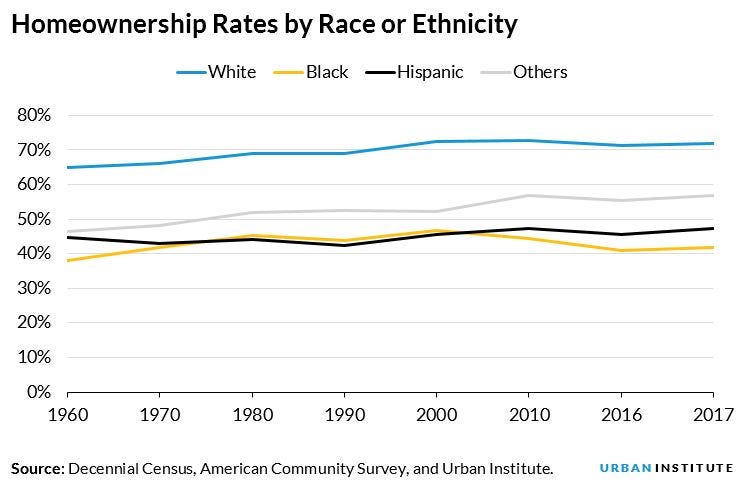
Homeownership improves communities by increasing their economic value. That increased value ensures that local cities receive funding for community programs. Under the current system, a community’s property values will provide better funding for schools. Anti-poverty advocates fight to change what programs municipalities support.
To increase homeownership amongst Black people and people of color, the government must commit to curtailing the obstacles to homeownership. Increasing first-time homeowners grants, providing free financial literacy information, and ensuring fair lending practices can rectify the inequalities in housing.
Help more renters become homebuyers:
“Any efforts to reduce renters’ barriers to homeownership should also increase black homeownership, such as analyzing how income is calculated in mortgage underwriting, stabilizing and broadening the reach of down payment assistance and low–down payment lending programs, and exploring how using rental payment history could support mortgage eligibility for millions of black households who are currently renting” (McCargo, 2019).
Unequal Investment Opportunities
Warren Buffet, George Soros, and Carl Icahn amassed vast amounts of capital through investment. Forbes named them as the top three investors on the planet. All of the top seven are white men. No surprise. White men retain more access to capital. As a result, the stock market is a wealthy, white man’s game.
Financial literacy and disposable income are vital components fundamental for investment. Public schools neglect to equip students with the tools to become savvy investors. Instead, they reinforce traditional skills for the country’s blue-collar underbelly.
White investors use the stock market to maintain inequality and exclusivity, widening the wealth gap. For Black people and people of color, lack of financial literacy and disposable income exasperates and solidifies the system of poverty.
Inaccessibility to Healthcare
The for-profit health care system fails to provide adequate healthcare to all Americans. Three types of people have insurance: insured through an employer, Medicaid/Medicare, and private market.
The private health care system relies on the strength of work-based programs. When people quit, get fired, or laid off, their insurance vanishes. Buying insurance through the Health Marketplace or the private market without a job is too expensive for many Americans. Medicaid and Medicare are not equally available for all Americans. Funding, determined at the state level, fails to provide healthcare to everyone who needs it. Young working Americans cannot quickly obtain Medicaid or Medicare, reserved for the elderly, children, and extremely impoverished. Hard-working Americans continue to fall through the cracks.
Even when healthcare is available, systematic racism negatively impacts BIPOC. Doctors and healthcare professionals do not treat everyone equally.
“they operate in an inherently racist system.” In addition, we know that our own subconscious prejudices, also called implicit bias, can affect the way we treat patients. Basically, there are so many layers and levels to this issue, it’s hard to wrap our heads around it. But, we’ll try.
We now recognize that racism and discrimination are deeply ingrained in the social, political, and economic structures of our society. For minorities, these differences result in unequal access to quality education, healthy food, livable wages, and affordable housing. In the wake of multiple highly publicized events, the Black Lives Matter movement has gained momentum, and with it have come more strident calls to address this ingrained, or structural, racism, as well as implicit bias” (Monique, 2020).
Inadequate Political Representation
American politicians praise the all mighty dollar bill. Financial strength facilitates a campaign’s ability to advertise and advocate for change. Possessing less economic power disenfranchises efforts to challenge the predatory capitalistic system.
“We tried to deal with our original sin of slavery by fighting a Civil War, by passing landmark civil rights legislation, elected an African American president,” McConnell said. “I don’t think we should be trying to figure out how to compensate for it” (Aulbach, 2019).
Mitch McConnell’s statements should offend all anti-racist Americans. In his way, he said, Let them eat cake. Instead of addressing systematic racism, he insisted that the people already possess the justice they seek. Electing one Black president out of 45 presidents does not and cannot provide restorative justice for the descendants of slaves. Freeing Black people from physical bondage and providing them with civil rights is the least that America could do.
Colonial-based systems of government created and maintained a wealth gap between white people and BIPOC. Without consistent advocacy for representation in government, representatives who share McConnell’s perspectives remain in power. Ideology carries weight when held by a powerful, privileged elite.
When we cry out about the injustice we see, the elite tells us to eat cake — the elite gaslight the poor by insinuating that the problem is laziness or inherent inferiority. On the contrary, possession of wealth does not correlate with moral, physical, or psychological superiority.
If low-income families could raise themselves by the bootstraps, they would.
“…when white Americans tell the Negro to lift himself by his own bootstraps, they don’t look over the legacy of slavery and segregation. Now I believe we ought to do all we can and seek to lift ourselves by our own bootstraps, but it’s a cruel jest to say to a bootless man that he ought to lift himself by his own bootstraps [Dr. Martin Luther King, interviewed by Sander Vanocur, NBC News, May 8, 1967” (Heidelberger, 2019).
Dr. Martin Luther King spoke eloquently about the cruel jest of asking the bootless man to pick himself up by his own bootstraps. White descendants of colonial powers mock the poor when they refuse to address systematic racism and poverty. Let them eat cake.
In the modern sense, the cake represents decadence and enjoying something extra; bakers served brioche, the national bread, for French people. While people eat cake on special occasions, brioche became daily bread for French people. The translation misses a bit of nuance since it would be absurd to tell Americans to eat only cake while less ridiculous to say to the French to eat brioche.
Nevertheless, the quote addresses the magnitude of decadence discussed in the original and translation. Both cake and brioche are savory, creamy, buttery, and vibrant. If people cannot afford to eat ordinary bread, it would be hard-pressed to find them eating more decadent pastries. Not to mention that cake cannot provide substantial nutritional value.
When deprived of proper education, housing, financial literacy, health care, and political representation, Black people and people of color continue to suffer from a widening wealth gap.
The people should not take the jest, Let them Eat Cake, lightly. Black people and people of color should be outraged at the constant pandering by politicians and community leaders who fail to represent the interests of the people. The elite, using more subtle versions of this phrase, attempt to maintain the social order. Even within communities of color, everyone is not on board with increasing social programs. To successfully combat poverty, people cannot merely eat cake as the wealthy would suggest. Instead, they must support anti-poverty programs, standing in opposition to oppressive policies. Until poor people of color are uplifted out of socioeconomic despair, justice remains out of reach.
There are numerous ways to address the racial wealth gap. Social programs, like the Social Security Program and SNAP, are essential in addressing poverty. However, these policies alone are inadequate answers to poverty.
Andrew Yang, who ran for the Democratic presidential nomination, advocated for Universal Basic Income. He argued that this program strengthens the economy by countering job displacement and the impact of automation on the job market. This policy could pull millions of families out of poverty and provide capital to pay off debt and buy homes. Universal Basic Income provides financial stability for low-income families. In response to the economic downturn of COVID-19, Spain started the process of implementing UBI. In small studies, the policy showed positive results for decreasing poverty.
While Universal Basic Income could stabilize incomes for BIPOC families going forward, it would not address the systematic racism implicit in the wealth gap. To address the racial wealth gap, Americans should support HR-40, the bill in pursuance of reparations. This commission would be granted the task of evaluating the institution of slavery and restorative justice measures. This bill, introduced by Texas HR Sheila Jackson in 2019, currently has 141 co-sponsors and has gained steam since the loss of George Floyd.
Aggressive anti-poverty policies are essential for addressing systematic racism in America. These policies could close the wealth-gap once and for all, providing better educational opportunities, health care, investment opportunities, access to capital, and increase homeownership. Real structural change is possible and necessary. Cake filled platitudes simply won’t do.
More Stories about Justice, Race, Equality, and History:
References:
Aulbach, L. (2019, June 19). Mitch McConnell: We paid for ‘sin of slavery’ by electing Obama. Retrieved July 30, 2020, from https://www.usatoday.com/story/news/politics/2019/06/19/mitch-mcconnell-reparations-slavery-compensation-not-needed-after-obama-presidency/1501650001/
Cunningham, J. (2020). Did Marie-Antoinette Really Say “Let Them Eat Cake”? Retrieved July 29, 2020, from https://www.britannica.com/story/did-marie-antoinette-really-say-let-them-eat-cake
Heidelberger, C. A. (2019, January 22). King: “Cruel Jest” to Tell Bootless Man to Lift Self by Bootstraps. Retrieved July 30, 2020, from https://dakotafreepress.com/2019/01/21/king-cruel-jest-to-tell-bootless-man-to-lift-self-by-bootstraps/
McCargo, A. (2019, February 14). A five-point strategy for reducing the black homeownership gap. Retrieved July 30, 2020, from https://www.urban.org/urban-wire/five-point-strategy-reducing-black-homeownership-gap
Monique Tello, M. (2020, July 09). Racism and discrimination in health care: Providers and patients. Retrieved July 30, 2020, from https://www.health.harvard.edu/blog/racism-discrimination-health-care-providers-patients-2017011611015
McIntosh, K., Moss, E., Nunn, R., & Shambaugh, J. (2020, February 27). Examining the Black-white wealth gap. Retrieved July 29, 2020, from https://www.brookings.edu/blog/up-front/2020/02/27/examining-the-black-white-wealth-gap/
Soares, J. A. (2020, June 25). Dismantling White Supremacy Includes Ending Racist Tests like the SAT and ACT. Retrieved July 30, 2020, from https://www.tcpress.com/blog/dismantling-white-supremacy-includes-racist-tests-sat-act/