
The Caribbean Black Power Movement
Peter Tosh- The Legendary Recording Artist Activist
The blissful imagery of cerulean blue waves, sandy beaches, and coconut-rum based cocktails inspires and entices people from around the world. Positioned between the North Atlantic Ocean and the Caribbean Sea, more than 700 islands and thirteen independent countries dot the horizon. These islands consist of a diverse population of European, African, and Indigenous people. Although the scene appears serene, the Caribbean contains a turbulent past. Europeans used many islands as ports for their colonial endeavors, casting aside African dreams of freedom and prosperity. The Black Power movement set out to address harms caused by Colonialist ideology.
“Black Power and Africanness is the driving force behind the Caribbean’s search for its identity” (Lux, 1972).
The descendants of Colonial explorers maintained power in the Caribbean using white supremacist ideology. Ruling as the minority, they tightly controlled the socioeconomic power structure. Their economy developed at the expense of enslaved Black lives, similar to the colonies in the Americas.
During the 1960s and 1970s, the Black power movement circulated throughout the Caribbean, inspiring art, music, and popular culture. Revolutionary activists challenged the white power structure to improve the lives of Africans living in the diaspora.
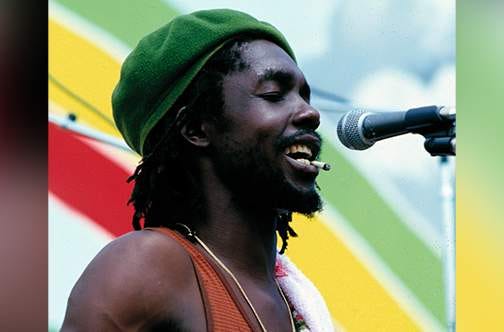
Winston Hubert McIntosh, better known as Peter Tosh, used his artistic platform to fight for Black liberation. Born in 1944, he lived with his mom, who raised him in the Christian Church.
“Even as a young boy, he had felt alienated by the hypocrisy of the doctrines that were taught in school and in church, and so he left home in his early teens and headed for the slums of Kingston, Jamaica, known as Trench Town” (History, 2020).
Living in Trench Town, Tosh witnessed the product of white supremacist ideology, which ignored the plight of the people. In the 1960s, he began making music, working with a local artist, Joe Higgs.
The Caribbean Black power movement gained its ideology from Marcus Garvey, Haile Selassie, and Dr. Walter Rodney. These Black men promoted the teachings of Pan Africanism. Uniting African people living in the diaspora was the purpose of the movement. The movement promoted unity amongst African people inside and outside of the continent.
“The objectives of Black Power dictate a break from the traditional economic dependence on the institutions of white society because the interests of the two groups are not compatible” (Lux, 1972).
Using a Pan-African ideology, Peter Tosh created music that educated and uplifted Black people. Tosh sang, played the guitar, the drums, the keyboard, and the violin. While he gained notoriety from being an original member of The Wailers with Bob Marley, Tosh had a substantial solo career.
Peter Tosh Solo Albums:
Legalize It (1976)
Equal Rights (1977)
Bush Doctor (1978)
Mystic Man (1979)
Wanted Dread and Alive (1981)
No Nuclear War (1987)
Unfiltered, urban melodies characterized Tosh’s music. Uplifting Jamaican people, the themes of revolution, spirituality, and anti-colonialism flowed through his songs.
“Tosh’s music is a powerful instrument of education. I recall a student from the eastern Caribbean in New York informed me that he learned about apartheid and the anti-apartheid struggles from Tosh’s music”(Moyston, 2020).
In his debut solo album, Peter Tosh captivated his audience. His songs, Legalize It and Whatcha Gonna Do, spoke about the injustice of persecuting Black Rastafarians for possessing marijuana.
Even though marijuana was considered a sacrament with spiritual and medicinal purposes, the government rejected it. As a result, Peter Tosh was arrested and beaten for possession of marijuana on multiple occasions. Although many years past, the circumstances of a colonial based rule in the Caribbean remains intact.
Unfortunately, his youngest son also experienced abuse because of possession of marijuana. He had no prior charges. Mr. Jawara Gmal McIntosh endured a brutal beating while in jail, resulting in a coma. On July 17, 2020, he succumbed to his injuries and died.
“In a video posted yesterday, the family wrote: “40 years ago, our father began the fight to legalize cannabis and despite its medicinal value and many states completely legalizing it, some states are still clinging to antiquated laws and a broken criminal justice system to deal with it. This is criminal. We can’t be bystanders any longer” (Tsioulcas, 2017).
Jawara’s father, Peter Tosh, spent his life fighting against systematic racism and brutality at the hands of colonial powers. He rejected the criminalization of marijuana and the over-policing of Black communities.
In 1977, Peter Tosh released his album, Equal Rights. In his song, Equal Rights and Justice, Peter Tosh condemned peace as pacifism.
“I don’t want no peace.
I want equal rights and justice”
(Equal Rights and Justice — Peter Tosh)
The descendants of European colonialists wanted peace because they did not want to address the harm experienced by Black people. Applying restorative justice would be costly. Furthermore, the elites lacked the will to pursue it. They wanted silence, submission, and absolution. Tosh expressed the anguish felt by black people. Peace is an insufficient platitude for the oppressed.
When faced with violence and systematic oppression, a call for peace meant submission was more important than justice. Believing in the righteousness of the Black Power movement, Peter Tosh used his voice to advocate for equal treatment under the law.
In, Steppin’ Razor, he demonstrated his strength and conviction. His bold lyrics depicted a threat to the oppressor. He would hurt anyone who set out to hurt him. Like Malcolm X, Tosh advocated self-defense when facing brutality.
“I’m like a stepping razor
Don’t you watch my size
I’m dangerous, dangerous”
(Steppin Razor — Peter Tosh)
His songs, Apartheid and Downpresser Man, condemned the system of segregation in South Africa and colonized countries. The theme of spirituality appeared throughout. The song, Jah Guide, expressed his humility and love. In the song, African, he spread the message of Pan-Africanism. He urged all black people, no matter where they were born, to embrace their African heritage.
“Don’t care where you come from
As long as you’re a black man, you’re an African
No mind your nationality
You have got the identity of an African” (African — Peter Tosh)
The Caribbean found its identity through the lens of Africa. So, the descendants of Africans found their identity in kind.
His message pushed beyond musical expression. On many occasions, he used his platforms to speak directly to the people.
“At the 1978 Peace Concert he spoke about laws in the Jamaican society that were created by the elites to keep the underprivileged in a state of ignorance and extreme poverty. Tosh asserted his school of critical legal thinking and argued that the laws are associated with oppressive injustice set as policy objectives by the colonial elite” (Moyston, 2020).
The criminal justice system degenerated since his death in 1987, with more Black people institutionalized. His son, a victim of the system, provides a modern example of the oppressive tactics Tosh dedicated his life to fighting.
The success of the Black power movement always relies on the active participation of social activists. Consistent throughout his career, Tosh dedicated his artistic craft to challenging white supremacist ideology. His message became synonymous with Reggae music and circulated to all four corners of the Earth. The music of the 1960s made people consider efficacy the colonial socio-economic system. Still relevant, Peter Tosh’s songs live in the hearts of many Black activists.
My Articles Curated in Justice, Equality, Race, Art, & Beauty:
References:
History. (2020). Retrieved July 28, 2020, from http://petertosh.com/history/
Lux, W. (1972). Black Power in the Caribbean. Journal of Black Studies, 3(2), 207–225. Retrieved July 27, 2020, from www.jstor.org/stable/2783844
Moyston, L. (2020, March). Peter Tosh: The man, the time, and the music. Retrieved July 27, 2020, from http://www.jamaicaobserver.com/the-agenda/peter-tosh-the-man-the-time-and-the-music_158361?profile=1096
Tsioulcas, A. (2017, June 23). Peter Tosh’s Son Beaten Into Coma In New Jersey Jail. Retrieved July 28, 2020, from https://www.npr.org/sections/therecord/2017/06/23/533947525/peter-toshs-son-beaten-into-coma-in-new-jersey-jail