
Leadership
Leadership Theory Versus Leadership Reality
Which came first, or does it matter?

There is no mystery about it. Good leadership is synonymous with business success. Organizations that cultivate and maintain complex and functional interpersonal relationships perform better than those that do not.
The road to complex interpersonal relationship development and maintenance is fostered by leadership. So, the million-dollar (maybe billion dollar these days) question has been and remains what is it that constitutes good leadership?
Much like justice Potter Stewart’s summarization of obscenity in the famous Jacobellis v. Ohio decision in 1964, leadership is akin to obscenity in that perhaps we can’t functionally describe it in whole, but we know it when we see it.
Everyone inherently knows when they have a good boss or a bad boss, even if they cannot iterate why that is.
So too, people know when they have a healthy functional employee — leader relationship as opposed to an unhealthy one.
A lot of leadership theory revolves around defining those incredibly complex relationships between the leader and the follower. As such, many descriptive models have been developed in an attempt to flush out and quantify individual aspects of those relationships in order to better duplicate the positive and avoid the negative.
One of the prominent leader — follower relationship theories is called the Leader-Member Exchange Theory or LMX for short. My colleague Paul Myers MBA wrote a fantastic technical analysis of this theory recently, which has prompted me to evaluate the usefulness of LMX as a relational evaluation tool in this article.
To get a better feel for the methodological concepts of LMX theory read Paul’s article here:
He does a great job of describing and breaking down LMX and its effectiveness for relationship evaluation.
I like to make things super simple (so that I can understand them) and so at the most basic level LMX postulates that there are 3 phases of the leader — member exchange cycle. There is essentially a:
- Getting to know each other phase
- A phase where the leader subconsciously places the member in either an ingroup or outgroup based on the leader’s formal and informal assessment of the member
- And a functional phase where the leader and subordinate both know which group they are in; and the working relationship is cemented into high-functioning members and lower-functioning members, based on which informal grouping they are placed within
Ingroup outgroup theory also exists outside the workplace and can be defined by specific criteria such as skin color or just as commonly as an arbitrary assignment like bicyclists and automobile drivers. Any particular person might be one of the other on any given occasion.

One of the most famous demonstrations of ingroup outgroup theory is Jane Elliott’s 1968 segregation experiment in a third-grade classroom. Ms. Elliott’s exercise based on student eye color demonstrated not only how quickly in and out groups begin to perform based on expectations, but by switching control groups, she also demonstrated the arbitrariness that can define classes.
It is very obvious how easily members can be assigned to in or out groups, and how quickly the members begin to perform based on the informal group expectations. This happens almost organically in the workplace, and this is what LMX theory seeks to define and measure.

In addition to having three phases, LMX also has three domains, or variables to consider. The leader, the member and the relationship. They can be thought of in a Venn diagram formation like this:
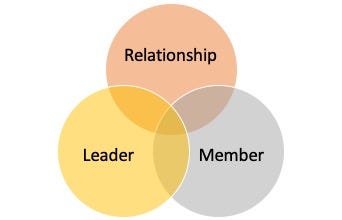
LMX theory in itself really only serves to define the interconnectedness of the three domains, but it doesn’t suggest whether a leader-driven, member-driven or relationship-driven approach might produce the best outcomes.
Historically I believe that the responsibility was assumed to fall to the leader to define the relationship and make it productive. Seemingly a good leader would exhibit traits and actions that allowed for all followers to be placed into the ingroup.
However, history doesn’t seem to favor outcomes that rely strictly on a leader-driven relationship. Rather it demonstrates the subconscious placing of members into in and out groups. So clearly the member needs to participate in defining the relationship.
And, it is obviously undesirable for any organization to have employees relegated to outgroups.
More recent studies suggested that a relationship-driven approach, where leaders and member establish a partnership interaction might be the best tactic to avoid this subconscious segregation. By shifting the power dynamic to place the member and leader on cooperative footing rather than a “just do what I say” relationship leads to better outcomes (Graen & Uhl-Bien, 1995).
Nowhere has this been more objectively demonstrated than at Google, where the company sought to use data to define what makes a good leader in their Project Oxygen research over ten years beginning in 2008 (Bariso, 2018).

Google found that it isn’t managerial traits, but rather relationship-based behaviors that are markers for effective management. In other words, relationship-driven arrangements between leaders and members tend to work best, particularly when the member is allowed to evaluate the quality of the relationship.
Conclusion
So, what can LMX theory do for us in terms of analyzing effective leadership and how well complex interpersonal relationships are formed?
While LMX doesn’t offer obvious solutions on its own, it does an excellent job of defining what happens in “traditional” leader — member relationships. LMX gives us a great understanding of how important it is for both leader and follower to create a relationship driven dynamic.
It is no longer solely up to the leader to create a cohesive and complex interpersonal partner relationship, but rather everyone’s responsibility. Leader and member play a role as does organizational culture that supports relationship-driven models.
Even in cases where the leader may not be actively seeking a relationship driven model, the member can take some effective steps to push the dynamic in that direction. This article outlines some approaches to impact the leader — member relationship:
Similarly, with the idea of a partner-like relationship being superior to fixed roles of boss and subordinate, the concept of leading from behind can come into play and has application for both leader and member. You can read more about that here:
There is one thing that LMX does a great job of explaining. That is what happens when leader and member don’t take a cooperative and integrative approach to forming a complex and beneficial relationship in the workplace.
Those are my thoughts on LMX theory. It describes reality but doesn’t change it unless we extrapolate the lessons and change our approach to the normative LMX dynamic.
I saw that Paul Myers MBA called out a few other thought leaders like Kathryn A. LeRoy, Ph.D., Joe Luca, Arthur G. Hernandez, Aurora Eliam, CMP, Bill Abbate and Julia E Hubbel. I am also interested in hearing your take!
Graen, G. & Uhl-Bien, M. (1995). https://digitalcommons.unl.edu/cgi/viewcontent.cgi?article=1059&context=managementfacpub
Bariso, J. (2018). Inc. Magazine. https://www.inc.com/justin-bariso/google-spent-a-decade-researching-what-makes-a-great-boss-they-came-up-with-these-10-things.html
You may also like these stories:
Timothy Key spent over 26 years in the fire service as a firefighter/paramedic and various fire chief management roles. He firmly believes that bad managers destroy more than companies, and good managers create a passion that is contagious. Compassion, grace and gratitude drive the world; or at least they should. Follow me on Instagram, Facebook, and Twitter, and join the mail list.


