avatarPaul Myers MBA

Free AI web copilot to create summaries, insights and extended knowledge, download it at here

4596

Abstract

oth leader and subordinate are factors.</p><p id="27d5">For instance, <a href="https://www.businessinsider.com/big-five-personality-traits-predict-leadership-2016-12?r=US&amp;IR=T">extraversion and agreeableness</a> in the early stages of a new team tend to predict a more favourable exchange relationship.</p><p id="59d9">A favourable relationship is more likely to perceive a <a href="https://readmedium.com/what-do-followers-want-from-a-leader-1d08802796e1">subordinate as competent</a>, once shared values and attitudes, with that of the leader, are present (Yukl, 2013).</p><p id="8ad0">Favourable leadership behaviours are more supportive in the following three areas:</p><ol><li><i>Consultation</i></li><li><i>Delegation</i></li><li><i>Mentoring</i></li></ol><p id="858e">The research proposes that subordinates in a high-LMX environment are “proactive in developing favourable relationships, as opposed to passively accepting” what a leader decides (Yukl, 2013).</p><p id="f3ea">This seems like a statement of fact.</p><p id="01e4">Research also indicates that favourable downward exchange relationships correlate with role clarity:</p><ul><li><i>A higher level of commitment</i></li><li><i>A higher level of satisfaction</i></li><li><i>Shared values</i></li><li><i>Mirrored behaviours, and</i></li><li><i>Improved subordinate performance</i></li></ul><p id="618f">This again seems like a statement of fact.</p><figure id="de18"><img src="https://cdn-images-1.readmedium.com/v2/resize:fit:800/1*kRoNJACoQ8VNB1XQYBbvlQ.jpeg"><figcaption>Image by <a href="https://pixabay.com/users/jerrykimbrell10-612624/?utm_source=link-attribution&amp;utm_medium=referral&amp;utm_campaign=image&amp;utm_content=1280966">Jerry Kimbrell</a> from <a href="https://pixabay.com/?utm_source=link-attribution&amp;utm_medium=referral&amp;utm_campaign=image&amp;utm_content=1280966">Pixabay</a></figcaption></figure><p id="1007">One field experiment discovered that “leaders who developed favourable exchange relationships with subordinates” experienced “gains in subordinate performance and satisfaction” (Dirks & Ferrin, 2002).</p><p id="cf85" type="7">“A reciprocal exchange mirrors trust.” (Dirks & Ferrin, 2002)</p><p id="0746">As such, leaders should “endeavour to develop a high-exchange relationship with all subordinates”, not just a few favourites, in order to be “effective leaders” (Garen & Uhl-bien, 1995).</p><p id="d3e6">Again, a statement of fact.</p><p id="1c78">The research found that a leader’s <a href="https://readmedium.com/the-balance-of-the-leader-follower-relationship-9973f6eb491f">upward relationship impacts downward relationships</a>.</p><p id="9001">A leader with a favourable exchange-relationship with their boss is more likely to establish <a href="https://readmedium.com/the-leadership-attributes-associated-with-successful-leaders-2e7fdcefe532">favourable relationships with his/her subordinates</a>.</p><h1 id="37c1">Evaluation</h1><p id="d7e9">Dyadic theory (LMX) definitely needs more longitudinal research to better understand how exchange relationships evolve over time.</p><p id="7bd5">Stating facts about humanity or human relationships, while valid, do not seem to be credible research findings.</p><p id="0b35">On that note, below are four observations on LMX research to date:</p><ol><li><i>We know little about how the role-making process occurs.</i></li><li><i>Some studies imply that all exchange relationships evolve in a continuous fashion, starting from an initial impression, forming quickly thereafter and remaining stable over time.</i></li><li><i>Other evidence suggests that dyadic (LMX) relationships navigate a series of ups and downs (Fairhurst, 1993).</i></li><li><i>Research lacks sufficient situational conditions and how this impacts the development of exchange relationships (Green, Anderson, & Shivers, 1996).</i></li></ol><p id="758d">For example, stability, size, function, type of business, underlying processes, and the implications of leadership are not comprehensive.</p><h2 id="d594">Flaws</h2><p id="9801">Theories lack a clear description of <a href="https://readmedium.com/can-we-just-stop-calling-imposters-leaders-dfe4a95ec4a6">how a leader develops different dyadic relationships with others</a>, why, and how they affect each other and indeed the wider group performance.</p><p id="d0a4">Leaders don’t treat all subordinates the same, we know that, but each person should feel that he or she is a respected member of the team rather than a ‘second-class citizen’ found in a low-exchange relationship.</p><div id="91dc

Options

" class="link-block"> <a href="https://readmedium.com/can-we-just-stop-calling-imposters-leaders-dfe4a95ec4a6"> <div> <div> <h2>Can We Just Stop Calling Imposters Leaders</h2> <div><h3>Let’s stop calling people leaders until they earn it</h3></div> <div><p>medium.com</p></div> </div> <div> <div style="background-image: url(https://miro.readmedium.com/v2/resize:fit:320/0*Tne-CC1UVFr3RWwQ)"></div> </div> </div> </a> </div><p id="2667">Resentment among low-exchange members, who believe a leaders’ ‘favourites’ have more benefits than they deserve (Mcclane, 1991). This indicates a bias defect in leadership.</p><p id="789b" type="7">One thing is clear, not all relationships are equal.</p><p id="78c0">Now over to you, what do you think?</p><p id="c9be"><b>I’m talking to you</b><b>Yes, you</b> … thought leaders like <a href="undefined">George</a>, <a href="undefined">Bill</a>, <a href="undefined">Chris</a>, <a href="undefined">Aurora</a>, <a href="undefined">Rosennab</a>, <a href="undefined">Michael</a>, <a href="undefined">Dr Mehmet</a>, <a href="undefined">Arthur</a> and other leading writers who <a href="https://readmedium.com/do-we-know-how-to-lead-5ad62197164e">shared a wonderful selection of articles lately</a>:</p><p id="3632"><a href="undefined">Kathryn A. LeRoy, Ph.D.</a></p><div id="6eed" class="link-block"> <a href="https://readmedium.com/daring-leadership-for-the-future-begins-with-you-781551d69cd4"> <div> <div> <h2>Daring Leadership for the Future Begins with You</h2> <div><h3>How do you model leadership every day?</h3></div> <div><p>medium.com</p></div> </div> <div> <div style="background-image: url(https://miro.readmedium.com/v2/resize:fit:320/0*51lhZKwaSSAHxk02.jpg)"></div> </div> </div> </a> </div><p id="3d1b"><a href="undefined">Joe Luca</a></p><div id="cad8" class="link-block"> <a href="https://readmedium.com/leadership-lessons-f3a4fc40ea01"> <div> <div> <h2>Leadership Lessons</h2> <div><h3>The Future is wide open, if we have the Courage to learn from our Mistakes</h3></div> <div><p>medium.com</p></div> </div> <div> <div style="background-image: url(https://miro.readmedium.com/v2/resize:fit:320/1*L32g32FlEJ3qyYm9JEMirg.jpeg)"></div> </div> </div> </a> </div><p id="661c"><a href="undefined">Julia E Hubbel</a></p><div id="45d5" class="link-block"> <a href="https://readmedium.com/on-leadership-in-a-time-of-challenge-2908c818879e"> <div> <div> <h2>On Leadership In a Time of Challenge</h2> <div><h3>Do you need to be a man to be a leader? Nope. In fact, that might be what gets in the way.</h3></div> <div><p>medium.com</p></div> </div> <div> <div style="background-image: url(https://miro.readmedium.com/v2/resize:fit:320/0*PS99lmbcNZA_oH2F)"></div> </div> </div> </a> </div><p id="36ea"><a href="undefined">Timothy Key</a></p><div id="b9f2" class="link-block"> <a href="https://readmedium.com/passing-leadership-lessons-to-future-generations-448ccf8980e6"> <div> <div> <h2>Passing Leadership Lessons to Future Generations</h2> <div><h3>Some of us don’t even realize how well we are failing</h3></div> <div><p>medium.com</p></div> </div> <div> <div style="background-image: url(https://miro.readmedium.com/v2/resize:fit:320/1*02KwWPN5qamwebU6PS78sw.jpeg)"></div> </div> </div> </a> </div><figure id="345e"><img src="https://cdn-images-1.readmedium.com/v2/resize:fit:800/1*EsIO9CvqGkOFnwy9fHxADw.jpeg"><figcaption>Image by <a href="https://pixabay.com/users/ernestoeslava-6289958/?utm_source=link-attribution&amp;utm_medium=referral&amp;utm_campaign=image&amp;utm_content=2773007">Ernesto Eslava</a> from <a href="https://pixabay.com/?utm_source=link-attribution&amp;utm_medium=referral&amp;utm_campaign=image&amp;utm_content=2773007">Pixabay</a></figcaption></figure></article></body>

LEADERSHIP | BUSINESS

What Is the Significance of the Leader-Member Exchange?

The relationship between followers and leaders is complex but vital

Image by Gerd Altmann from Pixabay

Most research literature focusses on leadership. In recent times, however, followership has been in the spotlight, and rightly so.

This article explores the ‘Leader-Member’ (LMX) theory, to better understand this unique relationship exchange, as follows:

  1. What is LMX?
  2. Research
  3. Effectiveness
  4. Evaluation

Without followers there are no leaders.

So let’s take a look at this “relational approach to leadership.

What is LMX?

LMX theory describes the role-making processes between the leader and each individual subordinate and the exchange relationship that develops over time (Dansereau, Graen & Haga, 1975; Graen, Cashman, 1975).

The basic premise is that leaders establish an exchange relationship with each subordinate as both parties define the subordinate’s role.

High exchange relationship

  • Established on the basis of compatibility
  • Influenced by a subordinates’ competence and dependability
  • Solidified over time (or not)
  • Exchange cycle repeats
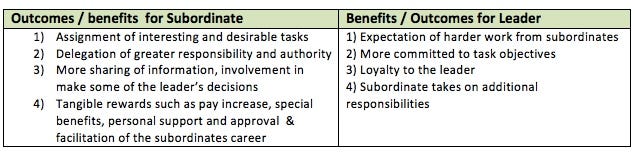
LMX Outcomes and Benefits by Yukl, 2013

High-exchange is likely to evolve to the point where there’s a high degree of mutual dependency, engagement, loyalty and support.

This is good for business.

Low-exchange is the polar opposite of high-exchange.

LMX Research

LMX definitions vary, however, LMX characteristics exhibit “mutual trust, respect, affection, support, and loyalty” (Ferris et al, 2009; Schriesheim, Castro & Cogliser, 1999).

That said, more research is needed to appreciate the implications, to measure the ‘unknowns’ about exchange relationships at work.

Some conflict is obvious from the current research:

  • Agreement about the “importance of the leader-subordinate relationship is commonplace, but the level of agreement is low” (Yukl, 2013).
  • There are no clear reasons for the lack of agreement. Possibly due to the differences in evaluating each relationship.
  • Leader ratings are influenced by judgements (and bias) about a subordinate’s loyalty, competence and dependability.
  • Subordinate ratings are influenced by how supportive and fair their leader is.

Consistency and congruence is a problem with research so far in order to effectively measure LMX.

LMX Effectiveness

What makes LMX effective?

Personality traits found in both leader and subordinate are factors.

For instance, extraversion and agreeableness in the early stages of a new team tend to predict a more favourable exchange relationship.

A favourable relationship is more likely to perceive a subordinate as competent, once shared values and attitudes, with that of the leader, are present (Yukl, 2013).

Favourable leadership behaviours are more supportive in the following three areas:

  1. Consultation
  2. Delegation
  3. Mentoring

The research proposes that subordinates in a high-LMX environment are “proactive in developing favourable relationships, as opposed to passively accepting” what a leader decides (Yukl, 2013).

This seems like a statement of fact.

Research also indicates that favourable downward exchange relationships correlate with role clarity:

  • A higher level of commitment
  • A higher level of satisfaction
  • Shared values
  • Mirrored behaviours, and
  • Improved subordinate performance

This again seems like a statement of fact.

Image by Jerry Kimbrell from Pixabay

One field experiment discovered that “leaders who developed favourable exchange relationships with subordinates” experienced “gains in subordinate performance and satisfaction” (Dirks & Ferrin, 2002).

“A reciprocal exchange mirrors trust.” (Dirks & Ferrin, 2002)

As such, leaders should “endeavour to develop a high-exchange relationship with all subordinates”, not just a few favourites, in order to be “effective leaders” (Garen & Uhl-bien, 1995).

Again, a statement of fact.

The research found that a leader’s upward relationship impacts downward relationships.

A leader with a favourable exchange-relationship with their boss is more likely to establish favourable relationships with his/her subordinates.

Evaluation

Dyadic theory (LMX) definitely needs more longitudinal research to better understand how exchange relationships evolve over time.

Stating facts about humanity or human relationships, while valid, do not seem to be credible research findings.

On that note, below are four observations on LMX research to date:

  1. We know little about how the role-making process occurs.
  2. Some studies imply that all exchange relationships evolve in a continuous fashion, starting from an initial impression, forming quickly thereafter and remaining stable over time.
  3. Other evidence suggests that dyadic (LMX) relationships navigate a series of ups and downs (Fairhurst, 1993).
  4. Research lacks sufficient situational conditions and how this impacts the development of exchange relationships (Green, Anderson, & Shivers, 1996).

For example, stability, size, function, type of business, underlying processes, and the implications of leadership are not comprehensive.

Flaws

Theories lack a clear description of how a leader develops different dyadic relationships with others, why, and how they affect each other and indeed the wider group performance.

Leaders don’t treat all subordinates the same, we know that, but each person should feel that he or she is a respected member of the team rather than a ‘second-class citizen’ found in a low-exchange relationship.

Resentment among low-exchange members, who believe a leaders’ ‘favourites’ have more benefits than they deserve (Mcclane, 1991). This indicates a bias defect in leadership.

One thing is clear, not all relationships are equal.

Now over to you, what do you think?

I’m talking to youYes, you … thought leaders like George, Bill, Chris, Aurora, Rosennab, Michael, Dr Mehmet, Arthur and other leading writers who shared a wonderful selection of articles lately:
Kathryn A. LeRoy, Ph.D.

Joe Luca

Julia E Hubbel

Timothy Key

Image by Ernesto Eslava from Pixabay
Leadership
Business
Ideas
Advice
Entrepreneurship
Recommended from ReadMedium