
Kung fu stunts and red state politics with Chris Mitchum
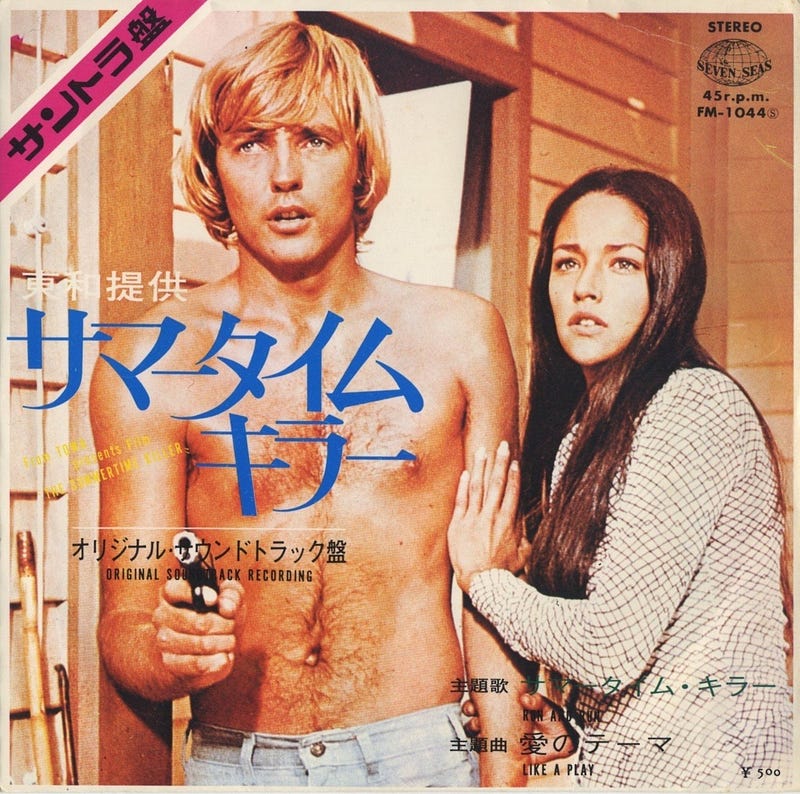
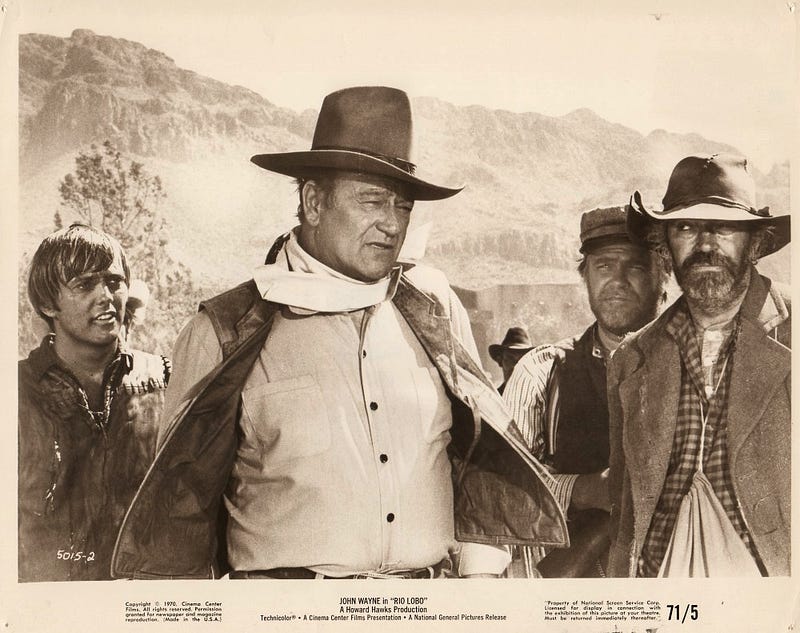
Blonde-haired heartthrob Christopher “Chris” Mitchum dreamed of being a writer. Obtaining a Bachelor of Arts in Literature degree from the University of Pennsylvania, the second son of disturbing Cape Fear antagonist Robert Mitchum transferred to the University of Arizona and picked up gigs as a day extra in TV westerns filmed at the Old Tucson Studios. Then the acting bug bit. Three back to back John Wayne westerns — Chisum [1970], Rio Lobo, and Big Jake — should have been a blessing. Insisting that he was “blackballed by Hollywood liberals,” action hero parts in schlocky foreign flicks kept Mitchum’s name on marquees through the ‘80s.
In the fourth chapter of an eyebrow-raising exclusive interview — “‘John Wayne Built My Career:’ Durango Prop Guys and Pistoleros” was the preceding installment — the two-time U.S. House of Representatives candidate unashamedly details the Duke’s conservative red state politics and critical disdain for The Green Berets in spite of racial injustice protesters urging that John Wayne Airport in Orange County be renamed. Further anecdotes abound about unprofessional, dangerous film sets in China and the Philippines, martial arts, and whether The Wild Bunch and Butch Cassidy and the Sundance Kid singlehandedly destroyed the Western genre.
The Chris Mitchum Interview, Part Four
Once your name rose above the title, you had to learn how to take charge.
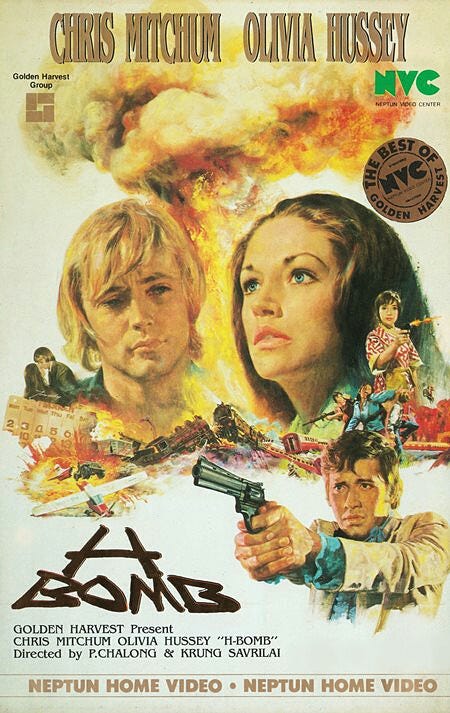
It’s part of the burden of being the lead. You take a leadership role, and people look up to you. When I was doing my Chinese films, Larry Elkins was a Kenpo Karate third dan black belt who I brought over with me to keep me in shape for Dtàt lìam pét [aka H-Bomb, 1971, costarring Olivia Hussey].
I was working with phenomenal guys who were Kung Fu masters, and they were constantly deferring to me. I pulled Larry aside and said, “Why do they defer to me and back off?” “Chris, first of all, you’re a star. Second of all, you’re a 6’2” black belt in Kenpo Karate” [laughs]. It never occurred to me that they might be physically intimidated. Most of these guys were like 5’6” or 5’7”. I’d never seen myself as a physical threat to people.
Were you ever on film locations that weren’t very professional?
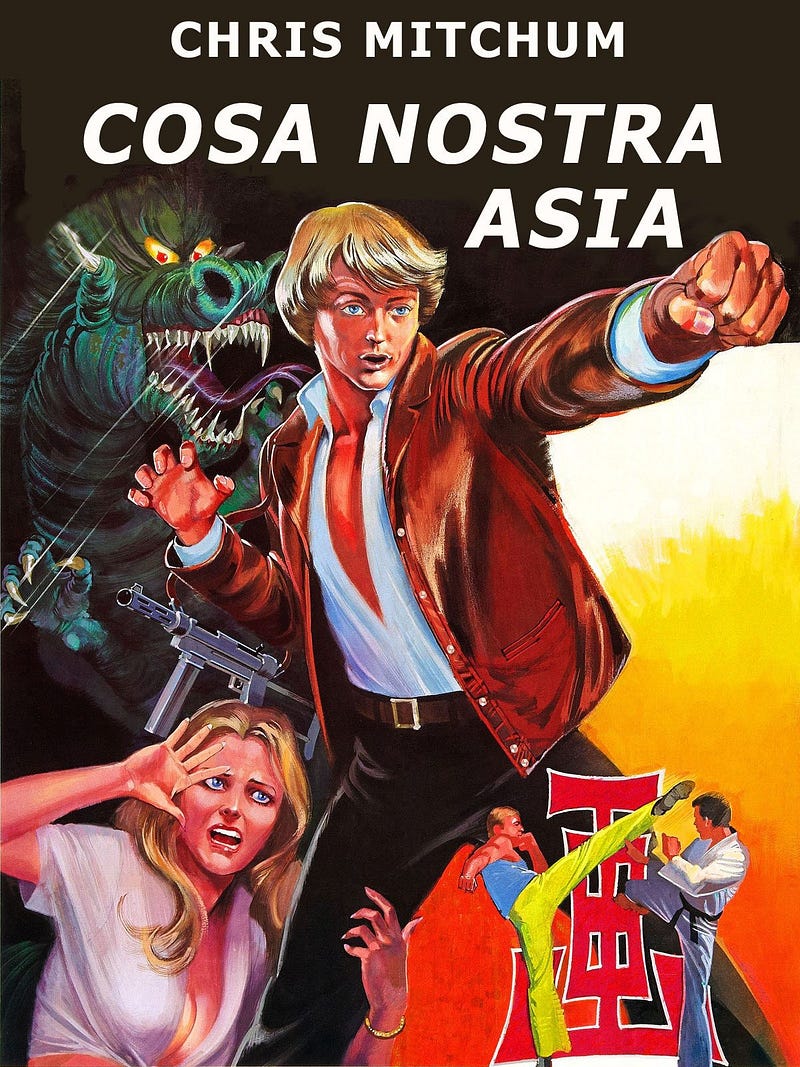
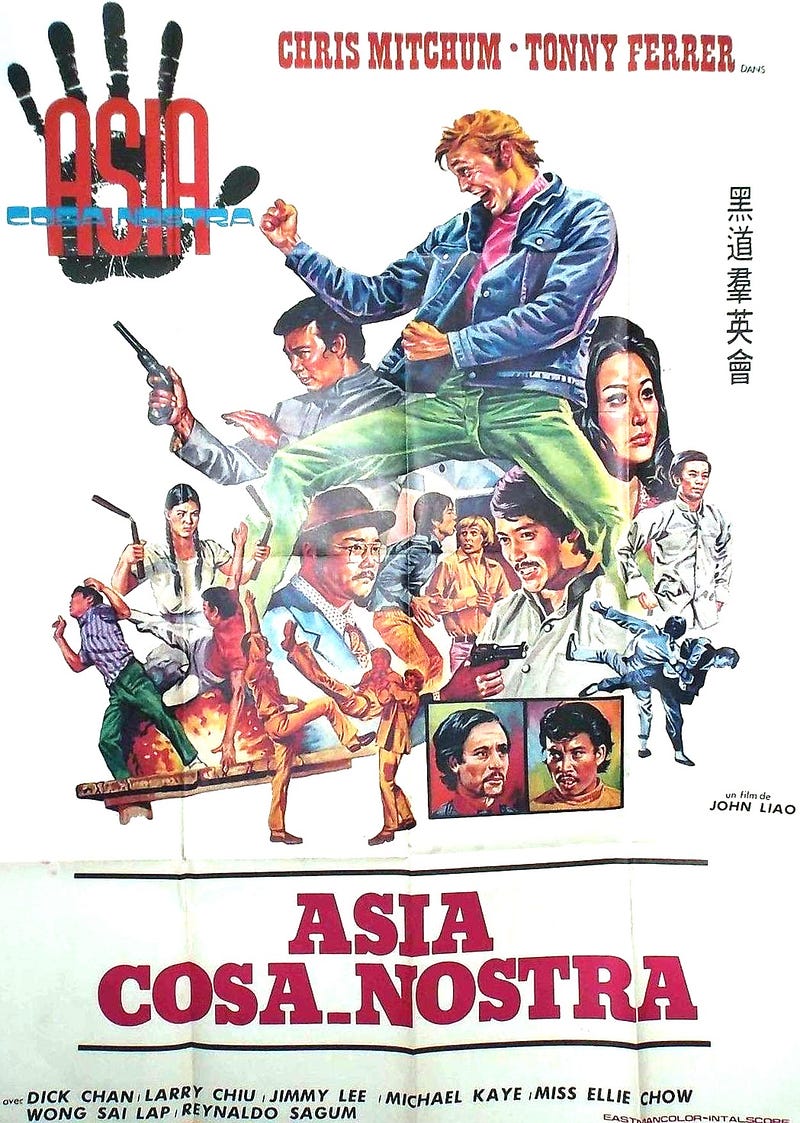
Someday I’m gonna do a book about this. Jackie Chan still does all of his own stunts. In the early days of working in Asia, that’s what they expected you to do. I remember my first day working in China on Cosa Nostra Asia [1974].
My very first scene found me fighting 14 different people in a karate studio. I walk in, and the Sensei of the class makes me fight through all of the students to get to him and subsequently battle two women and the Kung Fu champion of Hong Kong. Kung Fu star Dick Chan [sometimes referred to as Dick Chen] and I choreographed everything.
After the first take, director John Liao, who studied in San Francisco and Berkley, says, “Print.” There’s silence. He paused and said, “Chris, it doesn’t look like you’re hitting them.” I said, “You mean like really hitting them?” “Yes.” “Well, I’m not. They’ve gotta snap their head back and show that they’re taking the punch so it looks real.” “No, no, I want you to hit and kick them. That’s what they’re paid for.” They didn’t know movie fighting or throwing a miss if the guy takes the punch. They actually fought.
I came back from work that first day, and both my forearms and shins were black and blue from taking and blocking punches. When the cameras were rolling Dick would change the choreography to try to tag and hit me. I was doing soft blocks so nobody got hurt, and I was beat up by the end of the day.
The next day we’re doing another fight scene. I did hard blocks, hitting Dick with my wrist bone, elbow, and heel palm to the top of his foot and just nailing him. He very quickly learned how to do a movie fight where you don’t make contact because he didn’t wanna get hurt anymore [laughs].
To get back to the 14 guys, on the next take I made contact. I don’t care how good you are, when you’re fighting that many people at one time, if you’re off about a half-inch on the side kick, you’re gonna crack somebody’s ribs. They finished the take, and there were a couple of guys lying around with bloody mouths and hurt ribs.
The director says, “Cut! Print!” They all gave me a round of applause. I realized that they didn’t give a damn whether or not you could act. They only cared whether you could fight! [laughs]. That’s a tough way to make a living, I’m sorry.
Have you received acknowledgement for your stunt work?
No. When I was working in the Philippines, Bobby Suarez, a cult director in future years, said, “Okay Chris, in this shot you’re gonna be driving the car between 35–40 miles an hour. When you start to get to the top of the driveway, open the door and roll out” [laughs]. I replied, “And roll out?” “Yes.” “Tell you what Bobby, why don’t you show me how to do it?” “Oh, okay, we’ll change it” [laughs].
When I was working in Thailand, Krung Srivilai was a big Thai star. He would come in from shooting on one set, do a couple shots with us, hop in his car, and go off to another set. I asked Krung, “How many films are you shooting right now?” “I’m signed to do 32 films.” Back then they didn’t have scripts. They shot off a 20-page synopsis.
I said, “Thirty-two films? How long does it take you to do a film?” “Most films, if they get finished, take about two years.” “How many are you gonna finish?” “Oh, maybe 10–12 films will get finished.” “What happens?” “A star gets killed, the director dies, or the producer runs out of money. Different things can happen. That’s why I get paid $2,000 a film up front.”
When Thai actors or crew members watched an American film where a guy jumps out of a third story window, falls through the awning of the café below, hits a table, it collapses, and gets up and runs away, they did not realize a stunt man was involved. There was a fall pad underneath the awning, and it was done in three shots.
In Thailand they would throw a guy out of a three-story window. He’d fall through, hit a table, and die. We’re talking about the star of the film. [Mitchum assumes a Thai dialect] “Oh, actor die. Uh, movie over.” They just didn’t get it.
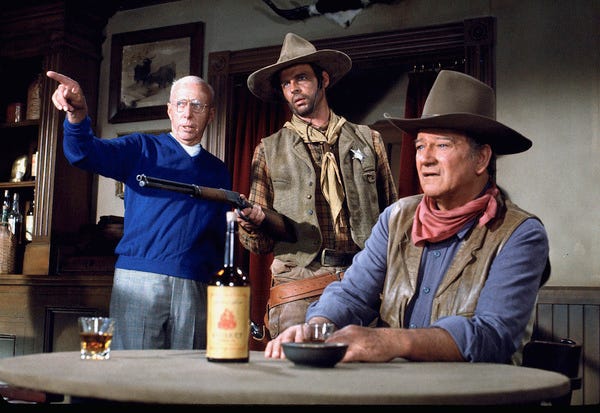
Was Howard Hawks the best director you worked with?
Different types of films, different directors. I had been working production when I started getting hired out of the office to act. I acted because I made more money and had a wife and two kids to support. Howard was the one who taught me to love acting, so I am forever in his debt.
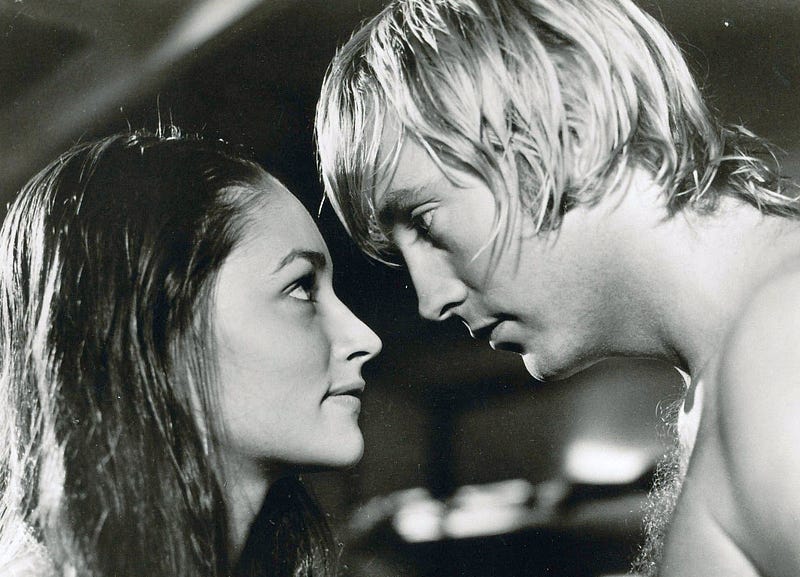
Antonio Isasi, who did Un verano para matar [aka Summertime Killer] in Spain with me, Karl Malden, and Olivia Hussey, was a great director. We got along very well. He didn’t speak much English, and I didn’t speak much Spanish. Antonio said [Mitchum adopts a Spanish accent], “Chris, in this scene if you would just give me an expression.” I knew exactly what he meant. It’s like we had a telepathy communication.
I’ve had the good fortune of working with a couple of really superb directors who knew how to work with actors, although I worked with a lot of dogs in my Chinese Kung Fu movies, too [laughs].
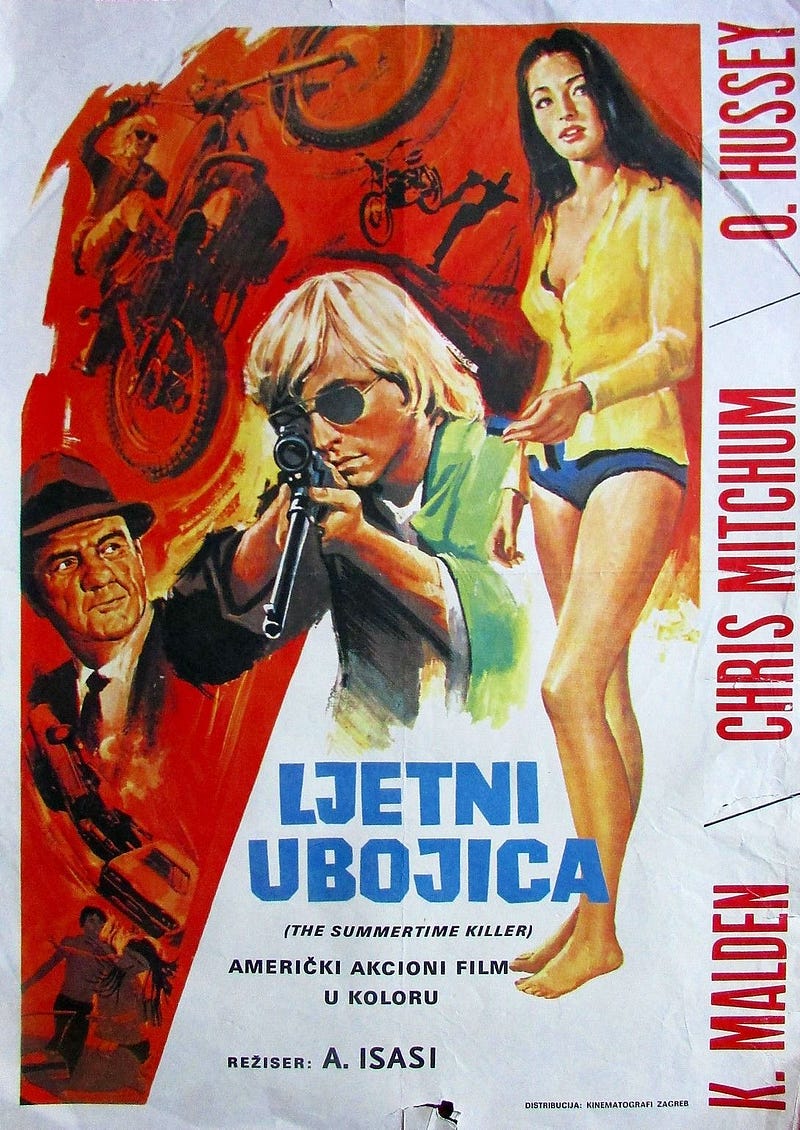
How did you land the scarcely seen Summertime Killer [1972]?
I had just finished Big Jake and was on a P.A. [personal appearance] tour with Patrick Wayne. We had some delay over in Houston. On Saturday my agent called me and said, “Chris, these people from Spain want to fly you up to New York on Sunday. They’ll fly in from Spain, and they want to have lunch with you to discuss a film.” I thought, ‘Wow, that’s Jet City. That sounds cool!’
I flew up to New York on Sunday morning, had lunch with Antonio Isasi and José de Vecuña, was given a wonderful script written by Bill Buckley’s brother Reid, and flew back to Houston Sunday night so I could resume the P.A. tour. Antonio was a well-known Spanish director, and José owned distribution rights for both Paramount and Coca-Cola in Spain.
José wanted to produce his own film for his theaters. He had bought Big Jake for Spain. My character in Summertime Killer [named Ray Castor] rides a motorcycle, and I rode a motorcycle in Big Jake. They thought I’d be perfect for Summertime Killer, so Big Jake actually got me the picture.
They hired a wonderful international cast — Karl Malden [e.g. On the Waterfront and The Streets of San Francisco], top Italian actor Raf Vallone [Two Women, Nevada Smith, and The Godfather: Part III], and Claudine Auger [Thunderball]. Olivia Hussey had just done Zeffirelli’s Romeo and Juliet and played my love interest.
I went over to Spain, did Summertime Killer, came back to the USA, and couldn’t find work. In fact I didn’t get a job interview for another 11 months. I finally got one for a film called Steelyard Blues [1973, costarring Jane Fonda, Donald Sutherland, and Peter Boyle].
The casting director — I’ve searched for her name but seems it has been purged from all credits — said, “Oh, I’m sorry. I can’t interview you. I didn’t realize you were that Chris Mitchum.” “What do you mean?” “You starred with John Wayne.”
Despite being on the cover of Seventeen Magazine twice, Photoplay, doing The Tonight Show Starring Johnny Carson three times, The Dick Cavett Show, and The Merv Griffin Show, I couldn’t get a job interview. I was blackballed in Hollywood.
We were seven years into the Vietnam War, and Duke was very outspoken against flag burners — the guys who threw urine on our troops when they came back from Vietnam. Hollywood thought Duke was pro-war, but basically he was pro-our troops. They didn’t want another hot new star coming up, taking a conservative voice, and joining John Wayne in criticizing the flag burners.
Take Duke’s True Grit. The industry was buzzing about an Academy Award nomination for Kim Darby. Name her next movie. Blackballed [Darby costarred in four forgotten films in the two years post-True Grit, including reuniting with Glen Campbell in the comedy-drama Norwood, and settled into steady television guest roles throughout the ‘80s]. Duke helped me in some ways for a career. Because of him I got Summertime Killer which gave me an international career. But because of him I was blackballed in the United States.
Could you get blackballed for doing a film with a conservative star in the 21st century?
It wouldn’t surprise me at all. I ran for office several times, and [unpredictable comedy icon] Jonathan Winters was a local guy living in Santa Barbara. I said, “Jonathan, I’d like you to come do a fundraiser for me.” “Oh I can’t, Chris. I can’t.” “Why?” “If word gets out that I’m supporting a conservative, I’ll never work in Hollywood again.” Evidently that fear still exists.
That’s totally antithetical to what America’s supposed to represent.
That’s right. Duke was very active in the McCarthy era banning Communists from making films because he felt that they were subverting the public with Communist themes. It has been proven that McCarthy was right. There were Communists making Communist-themed films. The Socialists hated Duke for that and never forgave him. It was quote “wrong” for Communists to be blackballed, but they don’t think it’s wrong for conservatives to be blackballed. There’s a little hypocrisy there.
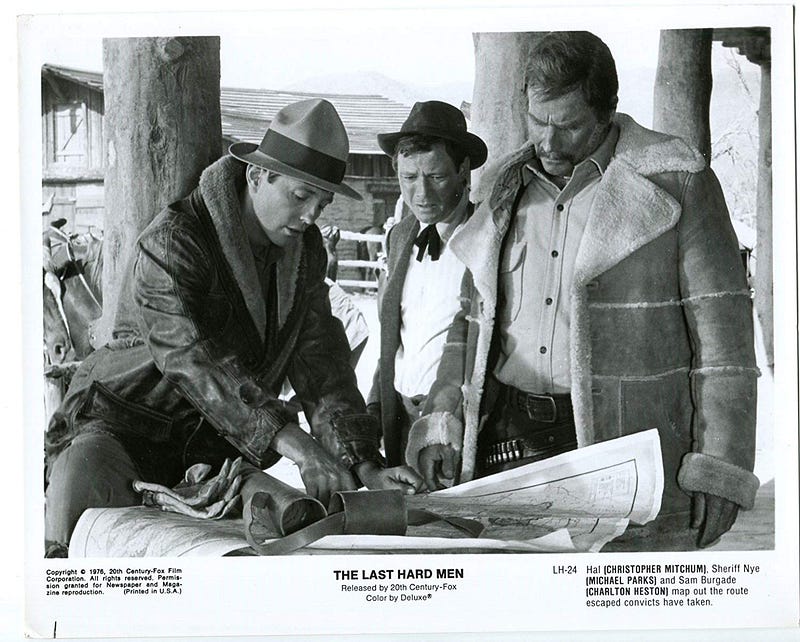
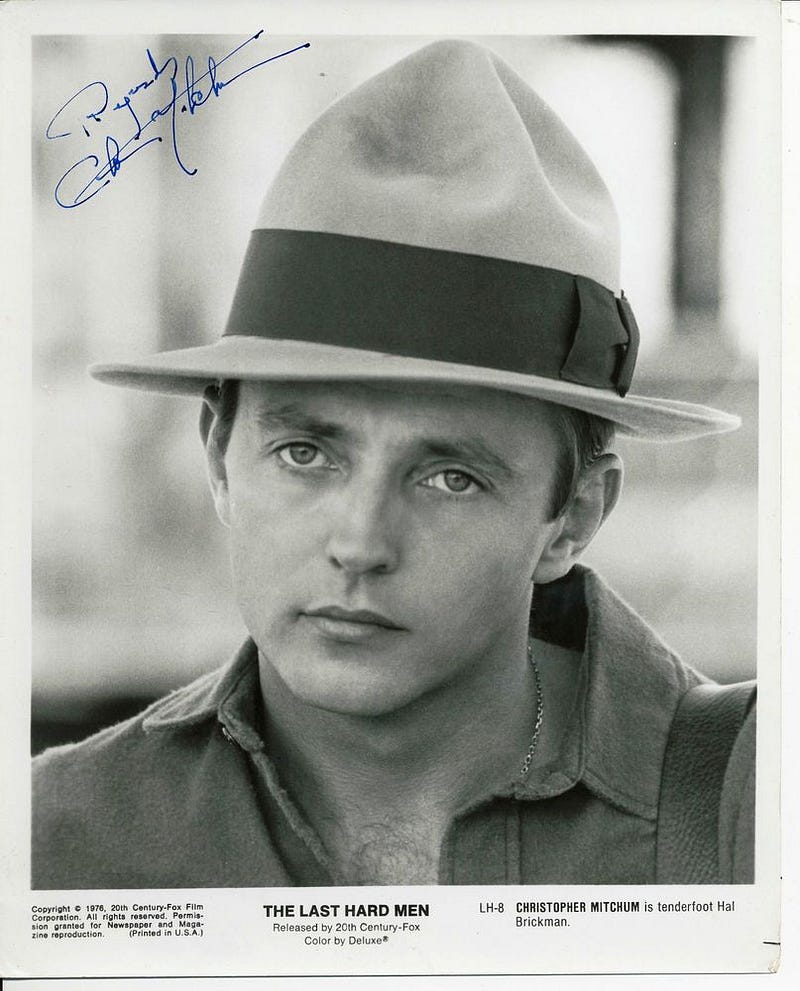
In the five years post-Big Jake you did not appear in an American film until The Last Hard Men with Charlton Heston and James Coburn. How did that Andrew V. McLaglen-directed western come together?
What a surprise — the first one to hire me again when I came back to the states was a conservative actor. The liberals wouldn’t hire me — it took Chuck [Charlton] Heston to do it. Chuck was a good man. When I ran for State Assembly in 1998, Chuck did a fundraiser for me up in Sacramento.
Chuck also organized Actors Working for an Actors Guild [AWAG] in 1982 because Ed Asner had become president of the Screen Actors Guild [SAG] the previous year. Against SAG rules, Ed was using the bully pulpit of the SAG presidency. He spoke from the front steps of SAG to advocate the Sandinistas — communists in Central America.
Ed’s a Communist, and he’ll tell you straight out that he is a Communist. Chuck, who was several times president of SAG, felt that was a violation of the rules and should stop. What Chuck did was form AWAG.
I was actually living back East at the time getting ready to move back to California. I got this little mailer asking for a donation. I sent Chuck $10. There was a little box asking if you would be willing to volunteer. I checked yes. The next thing I know Chuck calls me up and says, “We’d like you to run for office at SAG.”
I ended up being on the board of directors for two terms [1983–1989] and one term as National First Vice President of SAG [1987–1989]. We got Ed to not only shut up but to not run for office again and retire. Patty Duke replaced him in 1985.
Have your political views evolved since you were a young man?
No. I think I was born a Reagan conservative.
Did you meet President Ronald Reagan?
No. I wish I had. My parents knew him. They had dinner with President Reagan a couple of times.
Are you finished running for public office?
The last time I ran was for Congress in the 24th district in Santa Barbara, San Luis Obispo County, California. In 2012 the guy who ran for that office was Abel Maldonado. He spoke at the 2004 National Republican Convention and hoped to be the Latino hope for the Republican Party. His political career consisted of city council, mayor, State Assembly, State Senate, and Lieutenant Governor of California.
The registration difference between Democrats and Republicans was 3.8 percent. Abel ran and was a bad candidate. I knew that he was not gonna be able to beat the 18-year incumbent, a woman named Lois Capps. I actually ran against him in the primary just to get some name recognition.
When he ran the NRCC gave him $2 million to help his campaign. He lost by almost 11 points, way above the 3.8 difference in registration. The following year I won the primary. When I ran, the NRCC gave me zero dollars. They said it was an unwinnable seat which killed my fundraising with my big donors. The NRCC said I couldn’t win, so why should they donate.
Nancy Pelosi [Democratic Minority Leader of the United States House of Representatives since 2011] came to Los Angeles and did a fundraiser for Lois Capps, raising $2 million. She ran a $3 million campaign against me. I raised $460,000 on $10 donations.
I lost by 3.8 percent, exactly the difference in registration. I was two points ahead of her a week out, and they came out with a slanderous campaign. She did a television advertisement and the DNC did a radio guide — collusion that is against campaign laws. They took something I had said and totally re-edited it to have me say something else.
I went from two points ahead to losing by three points. However, I did retire Lois Capps. She said she had never been so scared in a race. She wanted to retire a winner, and she did.
The following race in 2016 was an open seat. A young kid named Justin Fareed ran against a Democrat named Salud Carbajal. The NRCC gave Justin $2 million. He lost by 7.8 percent to Salud for an open seat. I ran against an incumbent with no money at 3.8 percent loss — I did pretty good.
I’m too conservative for the Republican Party. That’s why they didn’t give me any money. They realized that I would have been there with the Freedom Party in Congress. I’d have been giving the Republicans hell for being too liberal and not backing our president.
I am an assistant poll manager at my local voting precinct. What would you say to young people who aren’t interested or feel it’s useless to exercise their sovereign rights?
I’d tell them they better be interested because it’s their future and their country. We’re on the verge of losing this country to socialism and to the people who want a one-world government. It’s time to wake up.
It’s tough to fully comprehend why people refuse to vote. What about the service men and women who died so we can live in a free democracy?
That too — and for the right to vote.
“The Wild Bunch and Butch Cassidy and the Sundance Kid singlehandedly destroyed the Western genre.” Please expound upon that quote you gave in Herb Fagen’s essential tome Duke: We’re Glad We Knew You [1996].
I met Andrew Breitbart, who was a staunch conservative with a blog. He started out with the Huffington Post — he wasn’t a liberal — and later went out on his own. Andrew died unexpectedly at the age of 43 in 2012 of a heart attack. Some people think he was poisoned, but that’s another story.
Anyway, he was up in Santa Barbara speaking. He said, “Chris, I’m doing a book on Hollywood [Hollywood, Interrupted: Insanity Chic in Babylon — The Case Against Celebrity, co-written with Mark Ebner, 2004]. This is not just a theory — this is what happened.
“What it comes down to — Hollywood did not like Duke. In 1968 he came out with The Green Berets, which he basically funded himself. He did it to honor the Green Berets, and Hollywood hated him for doing that.” Somebody once said a 90-minute movie of John Wayne sleeping would make 15 million dollars [laughs]. That’s the kind of following he had.
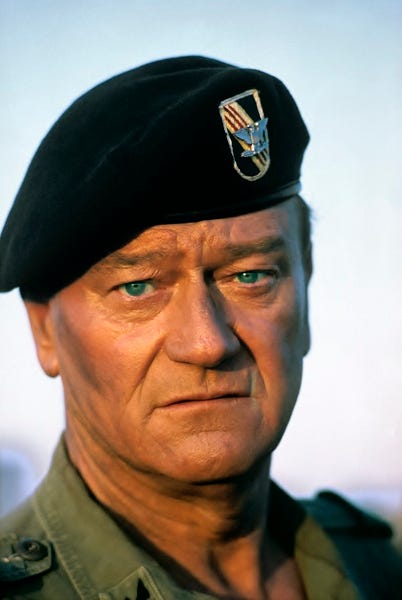
The Green Berets was a huge hit at the box office even though critics reviled it.
Absolutely. Critics were liberal. Hollywood decided that they wanted to take away Duke’s bread and butter — the western. Shane [1953, directed by George Stevens and costarring Alan Ladd, Van Heflin, and Jean Arthur] is probably one of the epitome westerns.
The general theme of a western — going back to the old days of Hoppy — the good guy wears a white hat, and the bad guy wears a black hat. The hero kisses the horse and tips his hat to the woman. Very high morals.
In Shane the villain [Emile Meyer as “Ryker”] owns the town and buys up farmers’ water rights. The cattle rancher is pitted against the little sheep herder. It’s always the big conglomerate versus the individual. Here comes this lone cowboy [Ladd] who stands up for the individual and defeats the big conglomerate in a blazing saloon gunfight.
If you have a conglomerate as government and the individual as the citizen, in the Western model the citizen is able to defeat the wrongdoings of the government. Liberals did not want that model, so they had to kill the classic western.
Butch Cassidy and the Sundance Kid and The Wild Bunch are wonderful movies. But they’re not Westerns, because for the first time the bad guy is the hero. You want your kid to grow up to be a bank robber? Come on [laughs].
When I was doing Pro-Celebrity Rodeos with Ben Johnson in Oklahoma and Texas [Johnson suffered a massive heart attack in 1996], people would come up all the time and say, “Chris, when are they are gonna make a western where I can take my kids and they can look up to the hero and say, ‘Dad, I wanna be just like him?’”
I really hope you write that memoir. You have some stories to tell.
People think I’m making most of them up.
© Jeremy Roberts, 2020. All rights reserved. The Chris Mitchum interview was condensed and edited for clarity. To touch base, email [email protected] and mention which story led you my way. I appreciate it sincerely.