
‘John Wayne built my career:’ Durango prop guys and pistoleros with Chris Mitchum
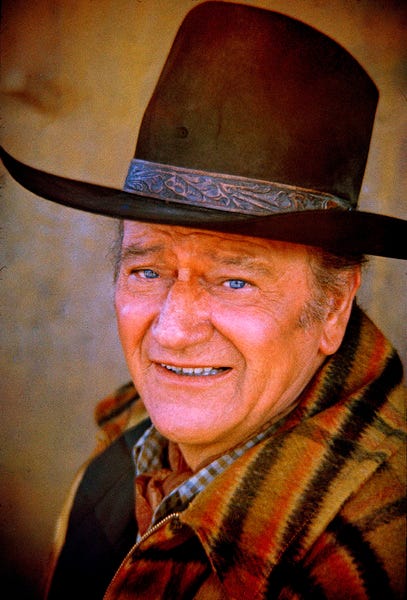
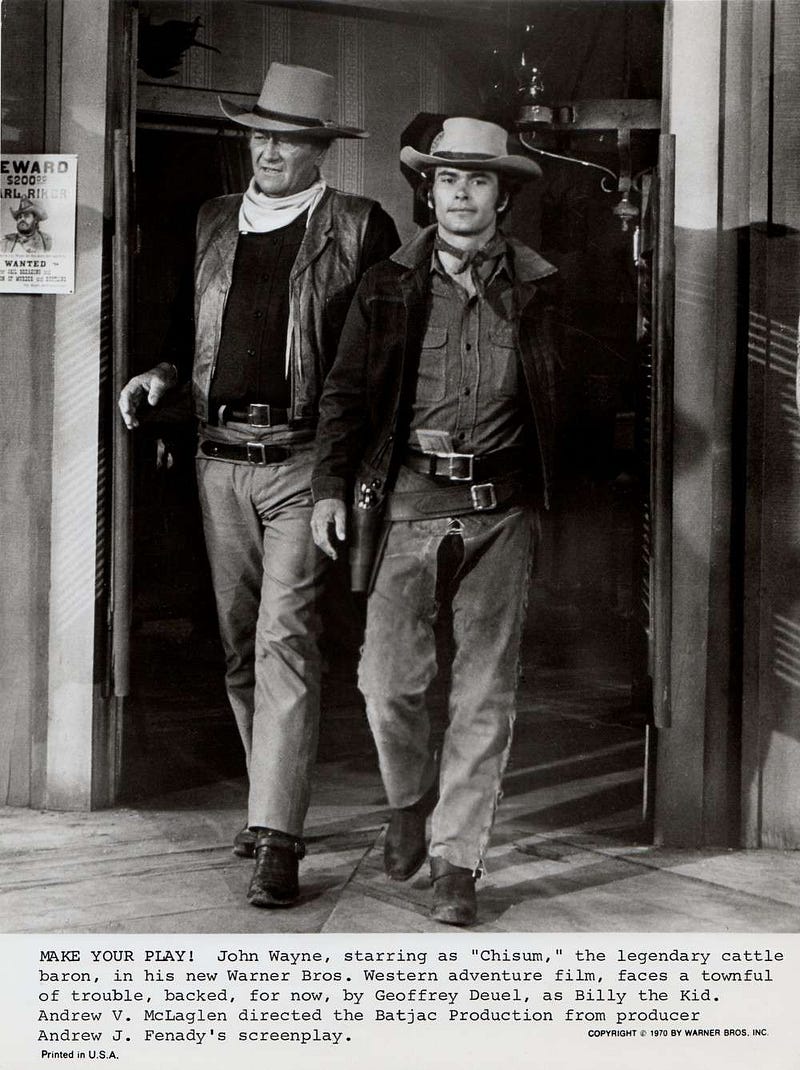
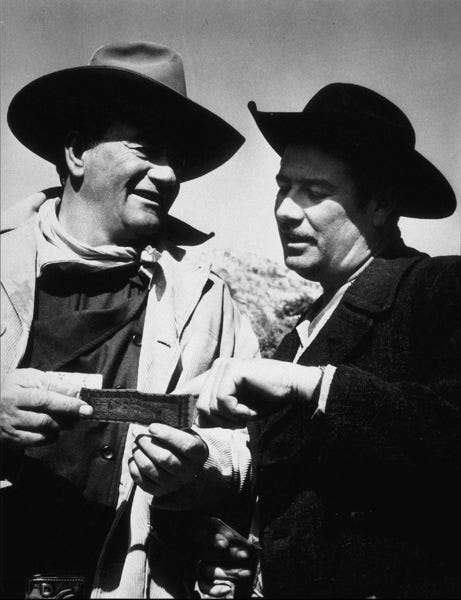
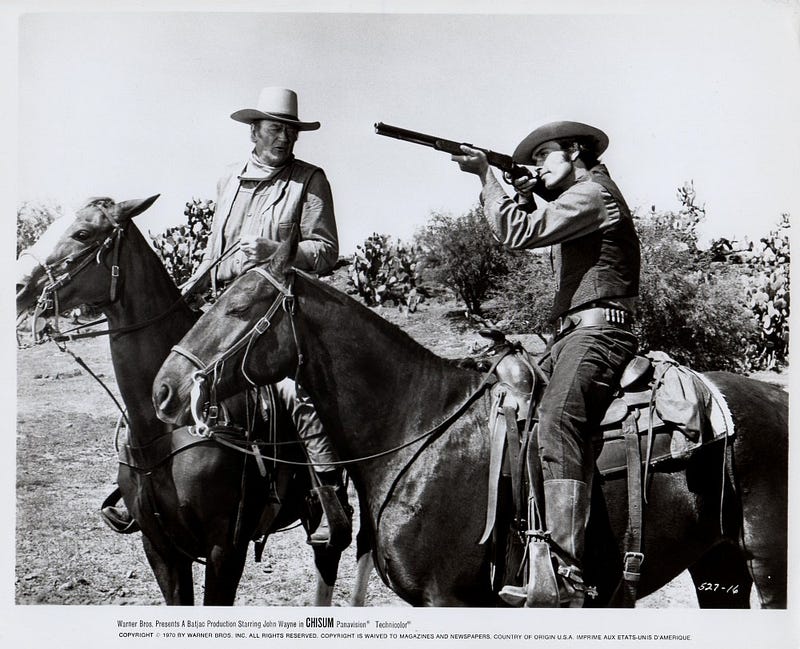
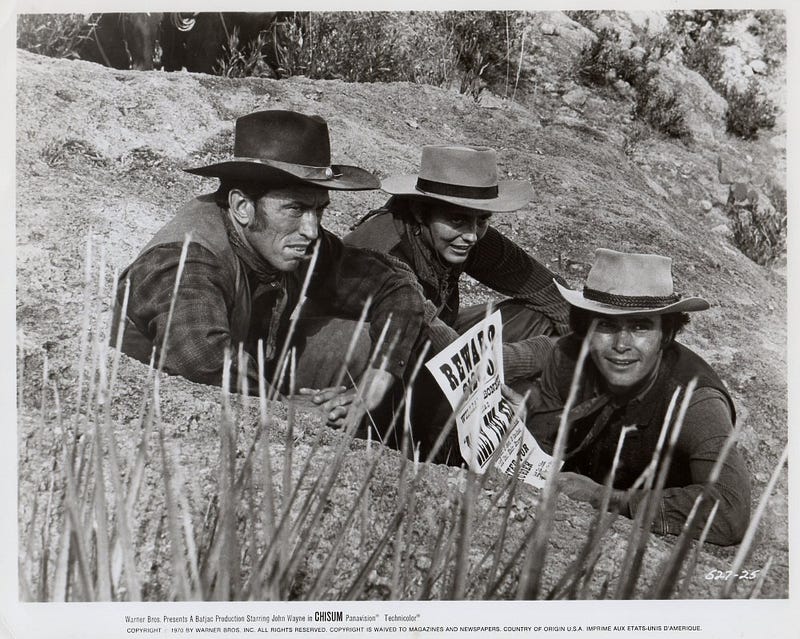
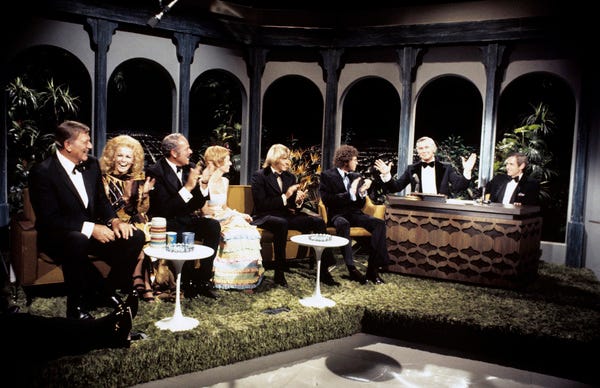
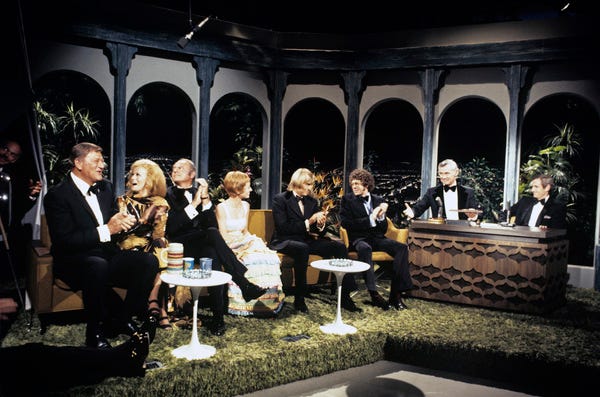
“John Wayne was more of a mentor and a father to me in the business than my own father was…Duke did nothing but give me support. He took me from a two or three-line role to costarring with him. He basically made my career…” Chris Mitchum, the second child of the masterful Winds of War naval commander emblazoned by the late Robert Mitchum, wound up good-naturedly sparring with Wayne in three westerns filmed consecutively in Mexico — Chisum, Rio Lobo, and the legend-embellishing Big Jake — before their relationship suddenly crumbled during a joint 1972 summit on The Tonight Show Starring Johnny Carson.
So pull off your spurs for the third installment of an ongoing, exclusive conversation where Mitchum examines his mentor over 50 years since Chisum began production under the tutelage of gentle giant Andrew V. McLaglen. Previous segments in this “Next Stop, John Wayne Station” column uncovered the naturally reserved, intelligent actor’s startling encounters with Steve McQueen and Elvis Presley.
The Chris Mitchum Interview, Part Three
Did you know John Wayne before you worked with him in Chisum?
I didn’t meet him until I filmed Chisum in 1969 with director Andy [Andrew] McLaglen. Of course my dad had known Duke for decades and worked alongside him in Howard Hawks’ excellent El Dorado [they were also among the all-star cast in the 1962 World War II epic The Longest Day but had no scenes together].
I actually went in for the part of Billy the Kid in Chisum. One day when we were down in Durango, Mexico, I was probably the fourth guy in the back doing the scene. Duke’s sitting down with a chaw of tobacco in his mouth watching.
He walks over towards me. I’m on a horse’s back. Duke slaps his hand on my side and says [Mitchum adopts a dead-on Wayne impression], “You should have played Billy the Kid.” “Gosh Duke, that was my thought when I went in for the interview” [laughs].
Duke added, “Howard Hawks is coming down to talk to me about my next film [Rio Lobo]. I want to introduce you to him.” Duke did just that, and Howard gave me his card. Howard told me, “When you get to Hollywood, give me a call. I want to see you.” “Okay.”
Howard and I had about an hour meeting in Hollywood. We started off talking, and then Howard had me do a reading for the part. We chatted some more, and Howard asked me to do a reading again. This time he gave me totally different direction on how to play the part which I closely followed. I guess Howard wanted to see if I could take direction on set. That was on a Tuesday.
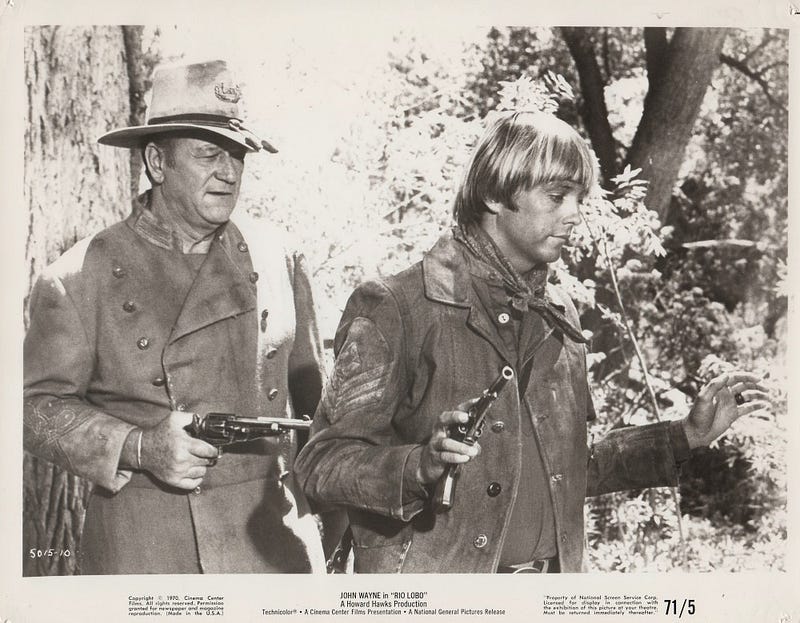
Howard wondered, “Would you mind coming in to screen test on Thursday?” “Sure.” I screen tested with Sherry Lansing, who later became the head of Paramount Studios, for the part that Jorge Rivero eventually played [Rebel Capt. Pierre Cordona].
It’s the scene where the captain is being chased by the bad guys. He ducks into the store, and there’s a topless woman bathing herself in a wash basin. They have a little conversation, and she ends up becoming a quasi-love interest to the captain.
If you look at Rio Bravo [1959], El Dorado [1967], and Rio Lobo — that scene is in all three films. Basically Howard made the same western three times. He said, “Chris, you just need five good scenes that people will talk about. You won’t need to advertise to film. It will be a success.” Those five scenes are in all three.
Howard decided that Jorge looked more mature and was better as a captain and that I was more suited to be a sergeant. So I ended up playing Tuscarora Phillips.
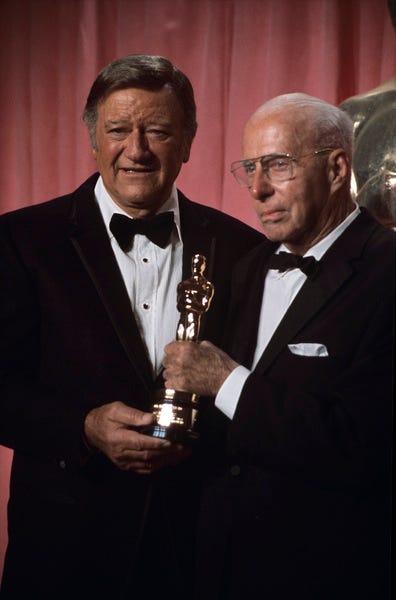
While we were doing Rio Lobo Duke came back from getting his True Grit Academy Award and pulled me aside on the Tucson Street. He told me, “While I was in Hollywood I made a deal to do my next film. I’d like you to play my son.” “Duke, I’m honored. Absolutely.” That’s how I got Big Jake.
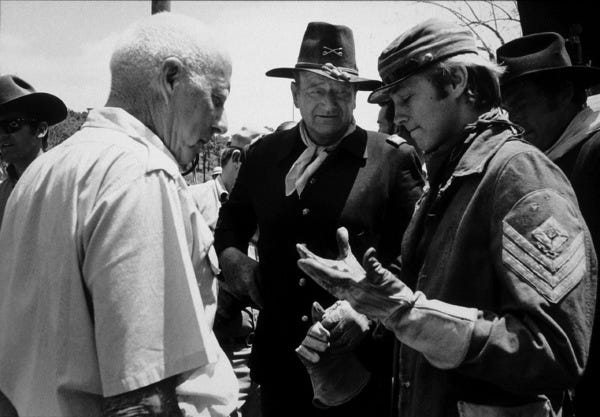
Why did Howard Hawks choose the unknown-in-the-USA Jorge Rivero to have a major role in Rio Lobo?
I have no idea. Jorge had been a Mexican champion body builder — the Arnold Schwarzenegger of Mexico — and started doing some movies. Somehow Howard ran into him and signed him for Rio Lobo [Rivero’s first American production was as the noble, albeit naive Cheyenne chief Spotted Wolf in director Ralph Nelson’s excessively violent Soldier Blue, filmed about three months prior to Rio Lobo].
Was Howard Hawks at the top of his powers as the director of Rio Lobo?
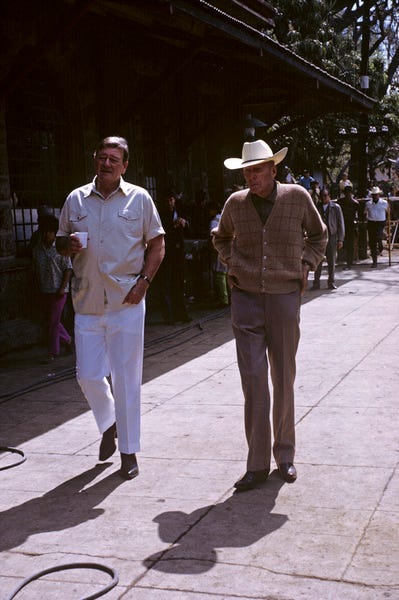
The guy was sharp as a tack. He was 73 years old during the filming of Rio Lobo. I was a young kid so to me he seemed to be 110. At lunch time he’d get on a dirt bike and go riding over the hills in Cuernavaca, Mexico [laughs]. The guy had grit. Howard insisted that I come to his hotel at the end of the day and have a slow gin fizz with him every evening, so I did [laughs].
Howard edited in his head as he shot. You would walk onto the set and Nancy Reeves, a lovely person who functioned as Howard’s girl Friday, would hand us a stack of pages for the day’s shooting.
As we would start rehearsing, we would change lines. Howard would give my line to Duke and Duke’s line to me. We would swap everything around. Until Howard said “Print,” we did not have a script. Nancy was taking shorthand and then would type up the pages. That became the script for the day after we shot it.
We’re walking on the set one day and Howard goes, “Chris, do you have a script?” “No.” “Have you ever read the script?” “No Howard, I haven’t.” “At the end of today I want to give you my script. You take it home and read it so you know what this whole story’s about.” “Okay.” “Bring it back because that’s the only script we have” [laughs].
As we continued on shooting, the suits at Cinema Center Films were terrified that if Howard died nobody would be able to edit it. They had no editing notes, no script, just nothing. Rio Lobo turned out to be Howard’s last movie.
I loved the guy. Howard said, “I discovered Montgomery Clift in Red River [1948], and I think you’re gonna be a major star. I’m gonna remake Red Line 7000 [a poorly reviewed 1965 NASCAR racing-romantic drama featuring James Caan in his debut starring role], and I want you to star in it.” “Geez Howard, that’s great.” He passed away [December 26, 1977, at age 81] before that ever got done.
[Author’s Note: Foremost Wayne biographers including Roberts / Olson and Scott Eyman paint a bleaker portrait of Hawks’ capabilities in 1970. In John Wayne: The Life and Legend, Eyman writes, “Rio Lobo began to go off the rails fairly quickly, and Hawks couldn’t bring himself to admit that he might be the problem. ‘Wayne had a hard time getting on and off his horse,’ the director complained. ‘He can’t move like a big cat the way he used to. He has to hold his belly in. He’s a different kind of person.’ Actually, Wayne was in better condition than his director. One Monday morning, the company was ready to shoot but there was no Hawks. They scoured the set and everywhere else they could think of. Finally, someone went to his hotel and found the director relaxing by the pool. He had lost track of time and thought it was Sunday”].
My favorite scene from Rio Lobo is when the rebels…
Derail the train [laughs].
Where was the train derailment filmed?
Cuernavaca, Mexico. They almost actually derailed that train. It came very close to being a travesty. It took the crew about three days to rig that thing. That was quite a shot.
Those train scenes were expertly staged. As a kid seeing Rio Lobo I was blown away when the Confederates cleverly used a beehive to steal the Union payroll.
Yeah [laughs].
[Author’s Note: As recounted by Eyman, Los Angeles Times columnist Wayne Warga interviewed the Duke at length for an ultimately unpublished autobiography that he was ghostwriting. “Rio Lobo is bad,” admitted a disappointed Duke in April 1971, five months after the western’s release. “Hawks made the mistake of doing too much of the writing. Both John Ford and Hawks could direct…but Hawks couldn’t write. He never should have tried. That was pretty obvious by Rio Lobo. He’d become sort of aloof, and I guess there have been too many showings in Paris of his films. He’s feeling that he’s a cult now”].
What was Durango like when you were filming Chisum and Big Jake? Had you been there before with your dad?
No, my dad used to go to Mazatlán and do his deep sea fishing. I’ve been to Mazatlán a few times. Durango was in the mountains, about 125 miles northeast of Mazatlán.
I don’t know how many thousands of acres Duke had. He bought this huge place with a river going through it and built a Western town. The operations he had going there were phenomenal. Everybody loved Duke. The crew stayed at the Campo Mexico Motel. The stars would rent a house, but most of the people stayed at the Campo.
I don’t think I ever went to sleep without hearing gunfire at night when I was in Durango. Ever. Pancho Villa’s son, Jose Trinidad Villa Casas, was a pistolero who stayed with us all the time to make sure everybody was safe.
Almost everybody in town, every man anyway, carried a gun. You could carry up to a .38 and be okay. Anything above that was considered a man-killer, and you had to be licensed for it. Trinidad carried a cocked, loaded to the max, .45 1911 model semi-automatic pistol in his belt.
One night Geoff Deuel [Billy the Kid and the real life younger brother of Alias Smith and Jones star Pete Duel] got into a little rowl with some of the locals in the bar at the Campo. I went over to six stunt guys sitting in the far corner and warned them, “I think we have some trouble brewing here. We’ll have to come from the back if a fight breaks out.” They said, “You got it, Chris.” “Good” Chuck Hayward and “Bad” Chuck Roberson [two of Wayne’s most prominent stunt doubles who earned their nicknames courtesy of maverick Irish director John Ford] were among them.
Sure enough, here comes seven Mexicans over to our table. They start saying something. What had happened was Geoff had asked a girl to dance. In Mexico you don’t ask a woman to dance if she’s with another man. That’s considered a major insult. Geoff said, “What are they talking about?” “The guy wants to fight you because you went over and asked his girl to dance.”
Geoff jumped up and took a swing at the guy. Just as he’s taking a swing Andy [Andrew] Prine grabbed him around the waist and pulled him back down. A little fight started. Boy, like the cavalry here comes the stunt guys. They pushed all the guys outside where the fight continued.
There was a little guy about the size of a jockey who had worked with my father a couple of times down in Mexico named Pepe. He lifted up his shirt and showed me a cocked .45 which meant he was a licensed pistolero.
Pepe said [Mitchum uses an uncanny Spanish accent], “Chris, if you want I go out and shoot them for you.” “No Pepe, let the stunt guys handle it. That’s okay.” Pepe persisted — “Okay, you just point out the ones you want shot, and I just kill them.” “No, thank you very much, Pepe” [laughs]. That’s the way it was in Durango back then. It was a tough town.
One time I was coming back to the Compo. It was early evening, still light out. The way the cops would give somebody a ticket for parking is they’d use a screwdriver and take their license plate down to police headquarters. If they found your car without a license plate, it was towed and impounded. So you had to go down and buy your license plate back from the police department.
I watched a cop kneeling down, unscrewing this guy’s license plate. The guy walked up to him, took out a .32 automatic, and put it to the cop’s head. Never a word was said. The cop looked up, screwed the license plate back in, tipped his hat, and walked away [laughs].
Have you had an opportunity to revisit Durango?
No, thank you.
Did your dad offer an opinion as to why the Duke never wanted to get back in touch with you after The Tonight Show?
No. I knew why Duke never spoke to me again. Duke and I did The Tonight Show Starring Johnny Carson [June 7, 1972]. The flawed Proposition 13 was on the ballot. It was too encompassing and wanted to cut back smog and clean up L.A. Harbor. I supported it.
Duke was very old school and believed that if you were for the environment, you were against business. If you were against business, you were a liberal, and therefore I must be a liberal. He was very rigid on that.
On The Tonight Show I told Duke, “Conservative people like clean air and clean water, too” [laughs]. He was embarrassed after fans sent him angry letters questioning why he was against cleaning up the environment. I was under a three-picture contract with him through his Batjac company, and he never exercised it.
I was living in Massachusetts when he was at Massachusetts General Hospital in Boston having risky open heart surgery to replace a mitral valve with a pig valve [April 3, 1978, 14 months before stomach cancer claimed his life].
I sent him a telegram stating, “Duke, I’m an hour away. If you wanna play chess or something, let me know.” When he was out of the hospital, he was very proud to make an announcement that he personally answered everybody who wrote him. Never responded to mine at all.
If the Duke had lived into the 1980s I’d like to imagine that he would have reached out to you.
I would like to think Duke would have. I don’t hold it against him. That’s the way he was. He helped my career a great deal…when he still liked me and we got along very well [laughs]. I went to the grand opening of the John Wayne Birthplace & Museum in Winterset, Iowa, in 2015 because I felt that I owed his legacy something because he built my career.
Even though my career ended up second city and virtually dead in the states, I ended up working on 60 films in 14 different countries around the world. I have a Chinese Academy Award and an Indonesian Academy Award. I made a good living, so I can’t complain.
Did you ever see the Duke apologize?
Yeah, he was big enough that he would state when he was wrong. He also was extremely fair. I remember one time when we were doing Chisum, the prop guy asked the cast to check their guns when they left the set as it was unsafe around Durango and he did not want them to be misplaced.
This prop guy had to go running after Geoff Deuel. He hadn’t checked his gun, and Duke saw that. Duke waited until everybody was seated having lunch. Duke stood up and ripped Geoff apart for not checking his gun. He hollered, “Everybody on the set has a job to do, and we help everybody do their job. We work as a single unit here. You were asked to check your gun. Do it and don’t make him come running!”
The next day there was an actor standing and Duke said, “Why don’t you go sit down? It’s hot.” This actor replied, “Well Duke, I don’t have a chair.” Duke had gotten his start as a prop man for Fox in the late 1920s. He called the prop guy over and just ripped him a new one for not having a chair there. Duke gave it out to everybody who was out of line [laughs].
How many film festivals do you attend?
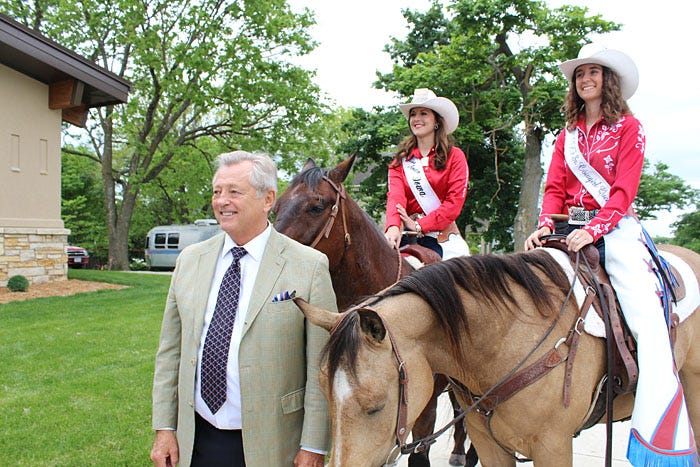
I don’t go to many at all. I might do one a year. I recently attended one in Prague and one in Central Florida. In June 2018 I was a first-time guest at the Memphis Film Festival.
I actually don’t bring anything to festivals except myself. I was told by the folks who run the MFF, “People are gonna be disappointed if you don’t bring pictures to sell.” I replied, “I’ve never done that.” “Well, you better” [laughs]. I brought some pictures so there wasn’t an angry mob [laughs].
The MFF was great. Both those who ran it and those who attended were wonderful people. I made nearly $5,000 in two days! They have already invited me back for 2019, and I have accepted.
You had a mini Big Jake reunion at the Memphis Film Festival with Patrick Wayne and stuntman-costar Dean Smith.
I’ve also worked with Memphis Film Festival guest Bobby [Robert] Carradine. As a matter of fact, Bobby lived in Santa Barbara for awhile until he had his accident [in March 2015 Carradine and estranged wife Edie miraculously survived a head on automobile collision with an 18-wheeler semi in Colorado]. I know a number of the guests who attended the Memphis Film Festival.
Would you do a movie if it was offered to you today?
In a flat second. But I haven’t had an agent for 15 years. I grew up in an era that was still the studio system. My interview for Rio Lobo consisted of talking to Howard Hawks for an hour. Now you send in a videotape of your footage and don’t even meet the casting director, producer, director, or your fellow actors. Most of my footage is 20 years old now [laughs].
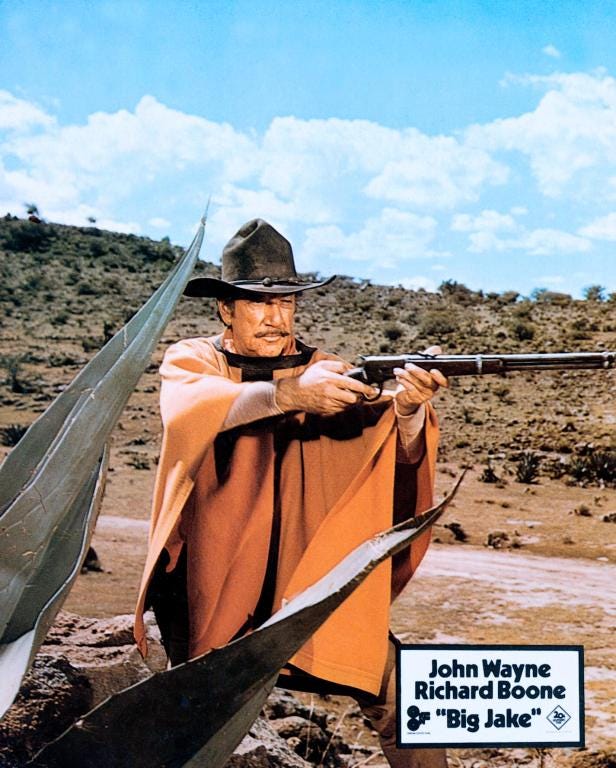
While we were filming Big Jake Dick [Richard] Boone told me that he went out on an interview. He was fairly hot off Paladin [i.e. Have Gun — Will Travel] and this 22-year-old kid says, “Tell me, Mr. Boone, what have you done?” “Chris, I looked at him and said, “Well, why don’t you tell me what you’ve done?” The business changed. It just becomes humiliating when you’ve done 60 films where you starred, and they want to know what you’ve done or if you can carry a film.
I admire Richard Boone a lot.
We got to know each other pretty well on Big Jake. He was a good man.
© Jeremy Roberts, 2018. All rights reserved. To touch base, email [email protected] and mention which story led you my way. I appreciate it sincerely.