avatarJillian Enright

Free AI web copilot to create summaries, insights and extended knowledge, download it at here

5530

Abstract

/loud-introverts-unite-5a261dfe4f40"><b>Sensory issues</b></a>: some people struggle with finding safe foods that feel enjoyable to eat. Others, like me, have difficulty noticing we’re hungry until we’re <i>hangry</i>, or have low blood sugar.</li><li><a href="https://readmedium.com/adhd-medication-trials-cfe97bf0ad6b"><b>Meds</b></a>. My ADHD medication suppresses my appetite, so in addition to struggling to even feel hunger until it’s extreme, my medication makes that even worse.</li></ol><p id="06e3">My fellow neurodivergents: we <a href="https://doi.org/10.1038/nrn2421"><b><i>know</i></b></a> we need to eat to maintain <a href="https://doi.org/10.1038/nrn2421">proper brain function</a>. I know our brains piss us off sometimes, but that’s no reason for us to starve them, so let’s all make an effort to nourish ourselves.</p><h2 id="e75c">Know your strengths and weaknesses</h2><p id="3d4d">Honestly acknowledge your own areas of strength and weakness. If you are unsure, learn more about yourself and discover your learning and working style. If you are <a href="https://readmedium.com/what-is-neurodiversity-b0e6e902ef9a">neurodivergent</a>, learn about your <a href="https://readmedium.com/how-executive-functions-matter-in-daily-living-bfdccc04162a">neurobiology</a>, how it impacts you, and what tools and strategies might be most effective.</p><p id="52d0">Be realistic about what you can and cannot do, and what is most difficult for you. That way you can make accommodations and adjustments for yourself to make your work life a little easier.</p><p id="972c">For example, I know very well that I have a terrible <a href="https://readmedium.com/how-executive-functions-matter-in-daily-living-bfdccc04162a">memory</a>. If it’s not written down somewhere, I will forget (see above, re: lists). So I make myself checklists, set reminders in my phone, and write things on my calendar.</p><p id="05b4"><a href="https://doi.org/10.1016/j.tine.2012.08.001">Research has shown</a> that physically writing something down helps us remember better than typing or entering it into a device, but the problem becomes remembering <i>where</i> you put that piece of paper or sticky note.</p><p id="a228">I use notebooks to keep my pages together, but something even more effective I’ve discovered since becoming a parent is <a href="https://doi.org/10.1177/0963721418755385">drawing</a> — wait, hear me out.</p><p id="7add">I <i>suck</i> at drawing.</p><p id="a0ca">That doesn’t matter though, fortunately for me, we don’t have to be masterful artists to take advantage of this memory aid.</p><p id="3afd">Doodling a cartoon representation of something you need to remember, or drawing out a concept you are learning about, have been shown to <a href="https://doi.org/10.1177/0963721418755385">enhance memory</a> (Fernandes et al., 2018).</p><p id="4c9c">The <a href="https://doi.org/10.1016/j.cognition.2019.04.024">physical act of drawing</a> engages more areas of the brain than typing or handwriting alone, which improves retention and recall.</p><p id="989f">I drew this little number to remind myself to pay my taxes at the end of the month:</p><figure id="84e6"><img src="https://cdn-images-1.readmedium.com/v2/resize:fit:800/1*3pGp8KIrydvDIu7xEjoG3Q.png"><figcaption>Yes, I actually drew this, not my 8 year old son.</figcaption></figure><h1 id="d68a">Follow Your Passions</h1><p id="cf85">I’ve written <a href="https://readmedium.com/a-tale-of-two-career-streams-d759e9f7eeda">previously</a> about the fact that many entrepreneurs who are unique thinkers have brains that work differently from the majority of the population.</p><p id="3230">Sometimes this makes our lives harder, but sometimes creativity and outside-the-box thinking are exactly what makes us exceptional entrepreneurs and writers.</p><p id="7ba2">People with <a href="https://readmedium.com/how-executive-functions-matter-in-daily-living-bfdccc04162a">ADHD</a> have brains that <a href="https://doi.org/10.1001/jama.2009.1308">process dopamine less efficiently</a>, making it more difficult for us to get motivated to do things that don’t interest us.</p><p id="3ccb">This is why I encourage you to be realistic and fair to yourself. Take a look at what you gravitate towards when you have free choice. What do you prefer to spend most of your time doing? What topics do you really enjoy reading and writing about?</p><p id="dfd3">As you grow professionally, structure your work so you can spend most of your time on the tasks at which you excel, and find supports for taking care of the less interesting responsibilities.</p><p id="9e1e">Above all, when writing, choose topics about which you are both knowledgeable an<i>d </i>passionate. When we take advantage of our intensity and hyperfocus, they become assets rather than liabilities.</p><h1 id="a274">Remember what I said about lists?</h1><p id="1ee2">For any aspiring entrepreneur, especially my fellow writers whose brains work a little differently, these are simple yet important tips for keeping yourself moving toward your goals:</p><ol><li>Make lists (no, this one doesn’t count).</li><li>Change your scenery regularly.</li><li>Take care of yourself.</li><li>Compensate for your weaknesses and utilize your strengths.</li><li>Follow your passions.</li><li>Drink lots of coffee.</li></ol><p id="e983">© Jillian Enright, Neurodiversity MB</p><figure id="6bd2"><img src="https://cdn-images-1.readmedium.com/v2/resize:fit:800/1*CJSg24mr-ZlpyFoVl4nCig.png"><figcaption></figcaption></figure

Options

<p id="3957"><i>When you join medium, as a member you’ll have access to unlimited reads for only $5 per month. If you use <a href="https://twoemb.medium.com/membership">my referral link</a>, I’ll earn a small commission, and you’ll earn my undying gratitude.</i></p><h1 id="885c">Related Stories</h1><div id="77ae" class="link-block">
      <a href="https://readmedium.com/a-tale-of-two-career-streams-d759e9f7eeda">
        <div>
          <div>
            <h2>My ADHD Made me a Successful Entrepreneur</h2>
            <div><h3>A Tale of Two Simultaneous Successful Start-up Businesses</h3></div>
            <div><p>medium.com</p></div>
          </div>
          <div>
            <div style="background-image: url(https://miro.readmedium.com/v2/resize:fit:320/1*kO2XEpXxfP0yrHoNngl8Xg.jpeg)"></div>
          </div>
        </div>
      </a>
    </div><div id="97a0" class="link-block">
      <a href="https://readmedium.com/adhd-qualities-of-a-successful-entrepreneur-fce3c53a9c7">
        <div>
          <div>
            <h2>ADHD Qualities of a Successful Entrepreneur</h2>
            <div><h3>Research shows us where ADHD and successful entrepreneurship overlap</h3></div>
            <div><p>medium.com</p></div>
          </div>
          <div>
            <div style="background-image: url(https://miro.readmedium.com/v2/resize:fit:320/1*P8IqzFxw41MFfGIPWc25Aw.jpeg)"></div>
          </div>
        </div>
      </a>
    </div><div id="7281" class="link-block">
      <a href="https://readmedium.com/how-executive-functions-matter-in-daily-living-bfdccc04162a">
        <div>
          <div>
            <h2>How Executive Functions Matter in Daily Living</h2>
            <div><h3>How they relate to ADHD, Autism, and other divergent brains.</h3></div>
            <div><p>medium.com</p></div>
          </div>
          <div>
            <div style="background-image: url(https://miro.readmedium.com/v2/resize:fit:320/1*W7eqkPsBXyIbkYBG-F6pig.jpeg)"></div>
          </div>
        </div>
      </a>
    </div><h2 id="5c86">References</h2><p id="891d">Fernandes, M. A., Wammes, J. D., &amp; Meade, M. E. (2018). The Surprisingly Powerful Influence of Drawing on Memory. <i>Current Directions in Psychological Science</i>, <i>27</i>(5), 302–308. <a href="https://doi.org/10.1177/0963721418755385">https://doi.org/10.1177/0963721418755385</a></p><p id="58c9">Frank, D., Kafkas, A. (2021). Expectation-driven novelty effects in episodic memory. <i>Neurobiology of Learning and Memory, 183</i>, 1074–7427. <a href="https://doi.org/10.1016/j.nlm.2021.107466">https://doi.org/10.1016/j.nlm.2021.107466</a></p><p id="ac8f">Gómez-Pinilla, F. (2008). Brain foods: the effects of nutrients on brain function. <i>Nature reviews. Neuroscience</i>, <i>9</i>(7), 568–578. <a href="https://doi.org/10.1038/nrn2421">https://doi.org/10.1038/nrn2421</a></p><p id="9e98">James, K. H., &amp; Engelhardt, L. (2012). The effects of handwriting experience on functional brain development in pre-literate children. <i>Trends in neuroscience and education</i>, <i>1</i>(1), 32–42. <a href="https://doi.org/10.1016/j.tine.2012.08.001">https://doi.org/10.1016/j.tine.2012.08.001</a></p><p id="fc24">Kocielnik, R., &amp; Hsieh, G. (2017). Send Me a Different Message: Utilizing Cognitive Space to Create Engaging Message Triggers. In Proceedings of the 2017 ACM Conference on Computer Supported Cooperative Work and Social Computing (CSCW ‘17). <i>Association for Computing Machinery</i>, 2193–2207. <a href="https://doi.org/10.1145/2998181.2998324">https://doi.org/10.1145/2998181.2998324</a></p><p id="d0a0">LaPuma, J. (2019). Nature Therapy: An Essential Prescription for Health. <i>Alternative and Complementary Therapies 25</i>:2, 68–71. <a href="https://doi.org/10.1089/act.2019.29209.jlp">https://doi.org/10.1089/act.2019.29209.jlp</a></p><p id="a593">Luna-Rodriguez, A., Wendt, M., Kerner auch Koerner, J. <i>et al.</i> (2018). Selective impairment of attentional set shifting in adults with ADHD. <i>Behavioral and Brain Functions</i> <i>14</i><b>, </b>18. <a href="https://doi.org/10.1186/s12993-018-0150-y">https://doi.org/10.1186/s12993-018-0150-y</a></p><p id="a7ce">Ozel-Kizil, E. T., Kokurcan, A., Aksoy, U. M., Kanat, B., Sakarya, D., Bastug, G., Colak, B., Altunoz, U., Kirici, S., Demirbas, H., &amp; Oncu, B. (2016). Hyperfocusing as a dimension of adult ADHD. E<i>uropean Neuropsychopharmacology, 24</i>(1)<i>,</i> S707-S708. <a href="http://dx.doi.org/10.1016/j.ridd.2016.09.016">doi:10.1016/j.ridd.2016.09.016</a></p><p id="6857">Reichardt, R., Polner, B., Simor, P. (2020). Novelty Manipulations, Memory Performance, and Predictive Coding: the Role of Unexpectedness. <i>Frontiers in Human Neuroscience, 14</i>, 152. <a href="https://doi.org/10.3389/fnhum.2020.00152">https://doi.org/10.3389/fnhum.2020.00152</a></p><p id="fb0d">Volkow ND, Wang G, Kollins SH, et al. (2009). Evaluating Dopamine Reward Pathway in ADHD: Clinical Implications. <i>JAMA,302</i>(10):1084–1091. <a href="https://doi.org/10.1001/jama.2009.1308">https://doi.org/10.1001/jama.2009.1308</a></p><p id="dbf4">Wammes, J. D., Jonker, T. R., Fernandes, M. A. (2019). Drawing improves memory: The importance of multimodal encoding context. <i>Cognition, 191</i>. <a href="https://doi.org/10.1016/j.cognition.2019.04.024">https://doi.org/10.1016/j.cognition.2019.04.024</a></p></article></body>

It’s not a superpower, but it makes me one hell of an entrepreneur

Tips for writing & working successfully when you have ADHD, attention issues, or need strategies for being more productive.

Photo by Green Chameleon on Unsplash

I’ve Run Two Very Successful Businesses

I’ve been a highly successful entrepreneur for 12 years now, and I’ve been writing for 8. I started my first business in 2010 and didn’t find out I have ADHD until 2019, so I spent nearly a decade as a successful business person with undiagnosed and untreated ADHD.

It would seem I developed excellent strategies for managing my symptoms without even realizing I had symptoms in the first place.

It certainly didn’t happen over night, I made a lot of mistakes and encountered difficulties along the way. Over the past few years, I’ve worked extremely hard to better understand my own neurobiology so that I can be the best parent, advocate, and entrepreneur possible.

To help others avoid some of the struggles I encountered, I share with you my tips for writing and working successfully when you have ADHD, attention issues, executive functioning deficits, or just need some strategies to make your daily work life more productive.

Make Lists

Write everything down. Carry a little notepad or use an app on your phone. When you think of something you need to do, or suddenly have a great idea, write it down somewhere you will be able to find it later.

Make to-do lists, then place them where you will actually see and read them. I put any important notes or reminders right on my coffee maker because making coffee is the one thing I never forget to do in the morning.

It’s important to make your reminders visually appealing, so that your eyes and brain will sit up and take notice. I use fun graphics and different colours to prevent important reminders from fading into the scenery through a process called habituation (Kocielnik & Hsieh, 2017).

Photo by author

Change Your Scenery

Speaking of scenery, when you’re working from home, it’s very easy to get distracted and off-course. It’s also easy to stagnate or zone out. It can be invigorating to work outdoors, or even in a coffee shop, if you like that sort of thing.

I love coffee, but I don’t want to sit in a crowded café. I find changing scenery even within my own house refreshing. I’ll start the morning in my office to get into a working frame of mind, then mid-day I’ll write at my kitchen table, and in the afternoon I’ll work outside if it’s nice out.

Novelty, including contextual novelty, can improve focus and memory (Frank & Kafkas, 2021).

Change of scenery can also help with set shifting, or task switching, something that many neurodivergent people find challenging (Luna-Rodriguez et al., 2018).

When I’ve spent the morning helping my son get ready for school and seeing him off to the bus, it’s easy to come back to the house and continue with household tasks.

There’s nothing wrong with doing the dishes, but sadly nobody pays me to do them, so I do need to ensure I complete my job-related tasks as well. Currently that includes trying to earn a few dollars through my writing.

Self Care

I won’t preach at you because we all know this already: getting exercise and fresh air each day is good for our health and productivity, especially for those of us with ADHD, anxiety, and other divergent brains (LaPuma, 2019).

There are additional ways we can take care of ourselves, such as:

Hydrate regularly.

I often drink too much coffee and not enough water, so I keep a water bottle within view and within reach while I’m working to remind me.

Eat. Food.

Many of us struggle with this for a variety of reasons. Some of the reasons we may forget to eat are:

  1. Hyperfixations/hyperfocus: my brain is so excited about whatever I’m doing that I cannot possibly tear myself away for the mundane task of sustaining my life.
  2. Executive functioning: making food takes way too many steps.
  3. Sensory issues: some people struggle with finding safe foods that feel enjoyable to eat. Others, like me, have difficulty noticing we’re hungry until we’re hangry, or have low blood sugar.
  4. Meds. My ADHD medication suppresses my appetite, so in addition to struggling to even feel hunger until it’s extreme, my medication makes that even worse.

My fellow neurodivergents: we know we need to eat to maintain proper brain function. I know our brains piss us off sometimes, but that’s no reason for us to starve them, so let’s all make an effort to nourish ourselves.

Know your strengths and weaknesses

Honestly acknowledge your own areas of strength and weakness. If you are unsure, learn more about yourself and discover your learning and working style. If you are neurodivergent, learn about your neurobiology, how it impacts you, and what tools and strategies might be most effective.

Be realistic about what you can and cannot do, and what is most difficult for you. That way you can make accommodations and adjustments for yourself to make your work life a little easier.

For example, I know very well that I have a terrible memory. If it’s not written down somewhere, I will forget (see above, re: lists). So I make myself checklists, set reminders in my phone, and write things on my calendar.

Research has shown that physically writing something down helps us remember better than typing or entering it into a device, but the problem becomes remembering where you put that piece of paper or sticky note.

I use notebooks to keep my pages together, but something even more effective I’ve discovered since becoming a parent is drawing — wait, hear me out.

I suck at drawing.

That doesn’t matter though, fortunately for me, we don’t have to be masterful artists to take advantage of this memory aid.

Doodling a cartoon representation of something you need to remember, or drawing out a concept you are learning about, have been shown to enhance memory (Fernandes et al., 2018).

The physical act of drawing engages more areas of the brain than typing or handwriting alone, which improves retention and recall.

I drew this little number to remind myself to pay my taxes at the end of the month:
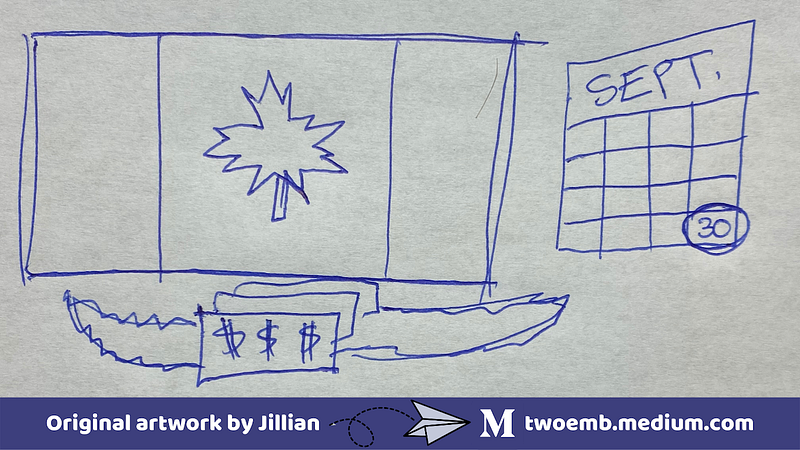
Yes, I actually drew this, not my 8 year old son.

Follow Your Passions

I’ve written previously about the fact that many entrepreneurs who are unique thinkers have brains that work differently from the majority of the population.

Sometimes this makes our lives harder, but sometimes creativity and outside-the-box thinking are exactly what makes us exceptional entrepreneurs and writers.

People with ADHD have brains that process dopamine less efficiently, making it more difficult for us to get motivated to do things that don’t interest us.

This is why I encourage you to be realistic and fair to yourself. Take a look at what you gravitate towards when you have free choice. What do you prefer to spend most of your time doing? What topics do you really enjoy reading and writing about?

As you grow professionally, structure your work so you can spend most of your time on the tasks at which you excel, and find supports for taking care of the less interesting responsibilities.

Above all, when writing, choose topics about which you are both knowledgeable and passionate. When we take advantage of our intensity and hyperfocus, they become assets rather than liabilities.

Remember what I said about lists?

For any aspiring entrepreneur, especially my fellow writers whose brains work a little differently, these are simple yet important tips for keeping yourself moving toward your goals:

  1. Make lists (no, this one doesn’t count).
  2. Change your scenery regularly.
  3. Take care of yourself.
  4. Compensate for your weaknesses and utilize your strengths.
  5. Follow your passions.
  6. Drink lots of coffee.

© Jillian Enright, Neurodiversity MB
When you join medium, as a member you’ll have access to unlimited reads for only $5 per month. If you use my referral link, I’ll earn a small commission, and you’ll earn my undying gratitude.

Related Stories

References

Fernandes, M. A., Wammes, J. D., & Meade, M. E. (2018). The Surprisingly Powerful Influence of Drawing on Memory. Current Directions in Psychological Science, 27(5), 302–308. https://doi.org/10.1177/0963721418755385

Frank, D., Kafkas, A. (2021). Expectation-driven novelty effects in episodic memory. Neurobiology of Learning and Memory, 183, 1074–7427. https://doi.org/10.1016/j.nlm.2021.107466

Gómez-Pinilla, F. (2008). Brain foods: the effects of nutrients on brain function. Nature reviews. Neuroscience, 9(7), 568–578. https://doi.org/10.1038/nrn2421

James, K. H., & Engelhardt, L. (2012). The effects of handwriting experience on functional brain development in pre-literate children. Trends in neuroscience and education, 1(1), 32–42. https://doi.org/10.1016/j.tine.2012.08.001

Kocielnik, R., & Hsieh, G. (2017). Send Me a Different Message: Utilizing Cognitive Space to Create Engaging Message Triggers. In Proceedings of the 2017 ACM Conference on Computer Supported Cooperative Work and Social Computing (CSCW ‘17). Association for Computing Machinery, 2193–2207. https://doi.org/10.1145/2998181.2998324

LaPuma, J. (2019). Nature Therapy: An Essential Prescription for Health. Alternative and Complementary Therapies 25:2, 68–71. https://doi.org/10.1089/act.2019.29209.jlp

Luna-Rodriguez, A., Wendt, M., Kerner auch Koerner, J. et al. (2018). Selective impairment of attentional set shifting in adults with ADHD. Behavioral and Brain Functions 14, 18. https://doi.org/10.1186/s12993-018-0150-y

Ozel-Kizil, E. T., Kokurcan, A., Aksoy, U. M., Kanat, B., Sakarya, D., Bastug, G., Colak, B., Altunoz, U., Kirici, S., Demirbas, H., & Oncu, B. (2016). Hyperfocusing as a dimension of adult ADHD. European Neuropsychopharmacology, 24(1), S707-S708. doi:10.1016/j.ridd.2016.09.016

Reichardt, R., Polner, B., Simor, P. (2020). Novelty Manipulations, Memory Performance, and Predictive Coding: the Role of Unexpectedness. Frontiers in Human Neuroscience, 14, 152. https://doi.org/10.3389/fnhum.2020.00152

Volkow ND, Wang G, Kollins SH, et al. (2009). Evaluating Dopamine Reward Pathway in ADHD: Clinical Implications. JAMA,302(10):1084–1091. https://doi.org/10.1001/jama.2009.1308

Wammes, J. D., Jonker, T. R., Fernandes, M. A. (2019). Drawing improves memory: The importance of multimodal encoding context. Cognition, 191. https://doi.org/10.1016/j.cognition.2019.04.024

Writing
Psychology
Neurodiversity
Mental Health
Entrepreneurship
Recommended from ReadMedium