
Machine Learning Art
It is now possible to generate high-quality videos from the text
Too hazardous to share the code, Interested in trying - sign up
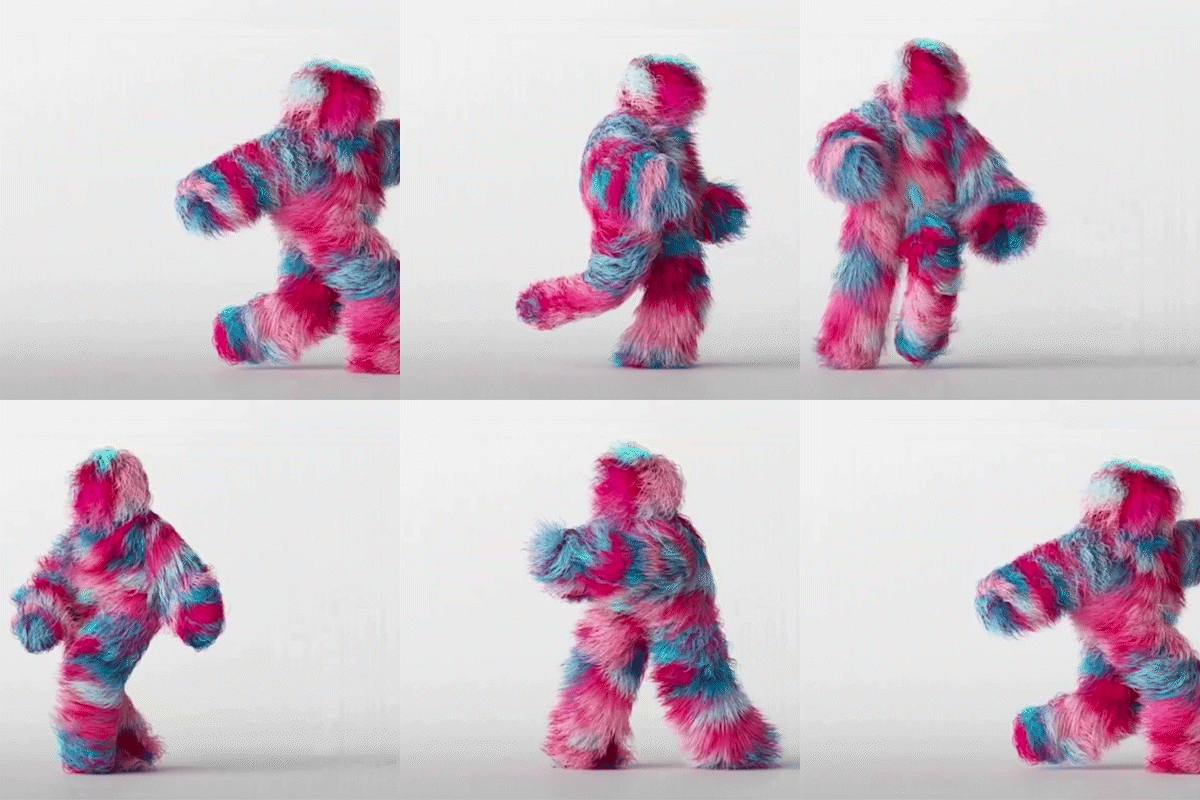
Videos are basically a series of pictures; nevertheless, this does not imply that creating a lengthy, cohesive film is simple. In fact, it is a far more complex undertaking since there is a dearth of high-quality data and the computational demands are far more stringent.
🟠 Ready to use 2 text to video methods [update 13 2023 February]
An alternative approach text-to-video
There are datasets for the creation of images. While the text-video pairings include billions of image-text pairs (like LAION-5B and JFT4B, Datasets are much smaller, for example. With just 10 million videos, WebVid is insufficient.
The more sophisticated open-domain movies are. In terms of computing, training the most advanced picture-generating models is already testing the capabilities of the most cutting-edge computing systems. Giving little to no space to produce films, especially ones with varying lengths.
Phenaki vs META
🟠 Phenaki can synthesize realistic videos from the text. A novel causal model for learning video representation compresses video into discrete tokens. This auto-regressive tokenizer works with videos of varying lengths.
Creating films from the text that may be as long as several minutes, with instructions that can alter over time
The authors use a bidirectional masked transformer to produce video tokens from the text. De-tokenizing video tokens create the video. We show how combined training on a massive corpus of image-text pairings and a smaller number of video-text instances may generalize beyond the video datasets. Phenaki can make arbitrarily lengthy films based on a time-variable text or tale, unlike earlier approaches.
🔵 Make-A-Video by META is a method for accurately translating the immense recent developments in Text-to-Video (T2V) creation from Text-to-Image (T2I) (T2V). Make-A-Video has three benefits: - it expedites teacher training by the T2V model (which does not need learning from multimodal and visual representations) - it does not require paired text-video data, - the generated videos inherit the vastness The authors devise a quick and efficient method for a unique and powerful set of spatial-temporal modules built upon T2I models.
Translation FROM TEXT TO VIDEO bypassing TEXT-VIDEO DATA
The researchers first decompose and approximate the whole temporal U-Net and attention tensors time and space. They create a spatial-temporal pipeline to produce movies with a high frame rate and quality with a video decoder and interpolation model and two high-resolution models that provide further uses T2V.
All those text-to-video models release on the same day — Sep 29th, 2022
I invite you to explore the concept of Machine Learning by reading and learning from the many articles found on 🔵 MLearning.ai 🟠
Check out my instagram with new material every week
- If you enjoyed this, follow me on Medium for more
- Want to collaborate? Let’s connect on LinkedIn
- https://linktr.ee/datasculptor
- 3D Machine Learning generated model on sketchfab
Keywords: computer vision, Artificial Intelligence, Machine Learning, AI art, art, wombo dream, digital art, Dalle 2, Imagen, wombo ai, Parti, 3D point cloud, diffusion models, generative art, wombo art, photographic quality, img by AI system, AI art generator, text to art generator, 3D, midjourney, dalle2, stablediffusion, text-to-video, Make-A-Video

PROJECT PAGE :
Phenaki: Variable Length Video Generation from Open Domain Textual DescriptionsAnonymousMeta: sign up
MAKE-A-VIDEO: TEXT-TO-VIDEO GENERATION WITHOUT TEXT-VIDEO DATA
Uriel Singer, Adam Polyak, Thomas Hayes, Xi Yin Jie, An Songyang Zhang Qiyuan, Hu Harry Yang, Oron Ashual, Oran Gafni, Devi Parikh, Sonal Gupta, Yaniv Taigman,