Machine Learning Art
65 Art datasets for AI artwork generation. Ready-to-use
How do you do AI generated art?
Why data requires your care
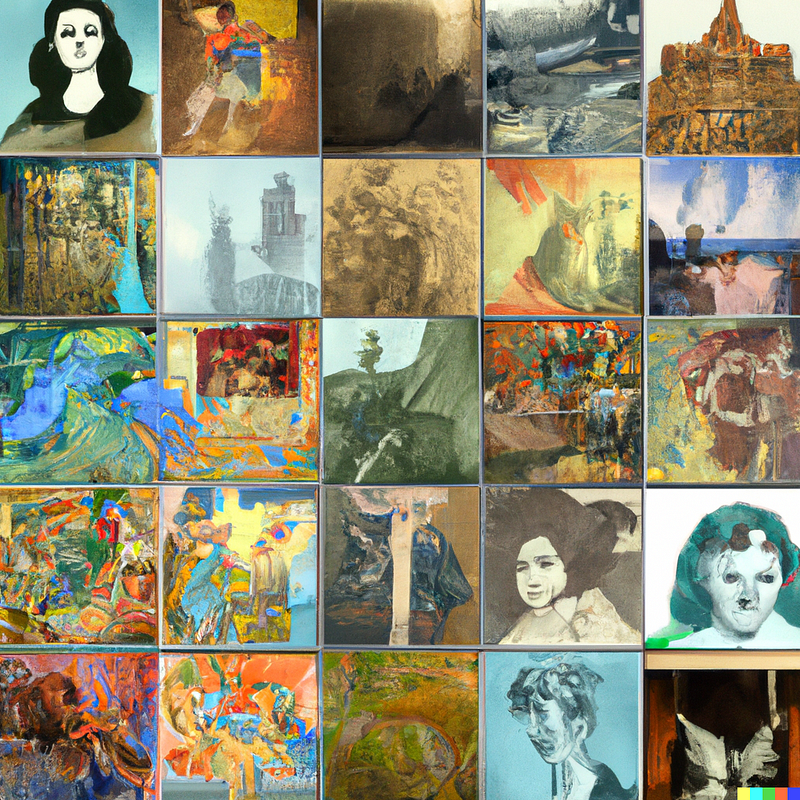
As an artist, I understand the importance of art datasets. The value of data is exponential given the advances in computing and machine learning that have been made over the last decade. The database is the most critical part of myFATHERintheCloud.ai. It is made up of a lot of pictures of sculptures. During model training, every part of the picture is significant.
- June 2022 — AI art tools update can be found ➡️ HERE ⬅️
Deep generative models can model complex, high-dimensional distributions, and one of their most important uses is to make new, high-quality images from different ones. For example, recent works can create pictures with semantic details and global composition that make sense because they were trained on curated datasets for a long time. In the meantime, many researchers and artists have been interested in how computers can understand art and what that means for art history, creativity, and human-computer interaction. In particular, making art in different styles is becoming increasingly popular.
Project Page (scroll down)
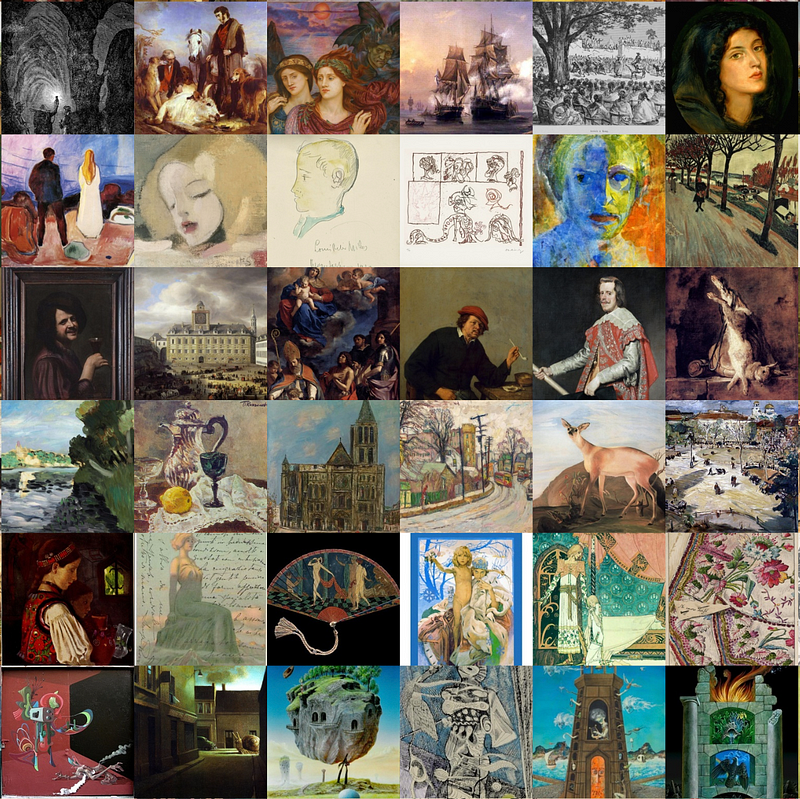
There have been standard benchmarks for image synthesis, such as CIFAR-10, ImageNet, and LSUN. However, they tend to favor photos of natural scenes or objects over art. Recent works like DALLE 2, GLIDE, Parti and Imagen that were trained on big data sets have shown that generative models can be used to make AI art. But these models are trained on a mix of photos and artworks in different styles, making it hard to do research and evaluate the creation of art in specific styles. On the other hand, people have tried to collect art datasets in the past, mostly to classify art and predict its attributes. The previous art datasets have a wide range of digital collections of art, from pictures of “the Met”exhibits to 3D scans of the Oldest Cave Paintings.
The works of art are labeled with qualities, feelings, descriptions, or examples. But because those datasets have long tails for class distributions, they can’t be used to test how well artwork synthesis methods work. Also, there were no standard processes for collecting, annotating, filtering and preprocessing data before making those datasets. This led to many problems, such as low-quality images, noisy labels, and duplicate works of art in the dataset. So, what is needed is a standard, balanced, high-quality, and clean benchmark for making AI artworks.
AI Is Baroque
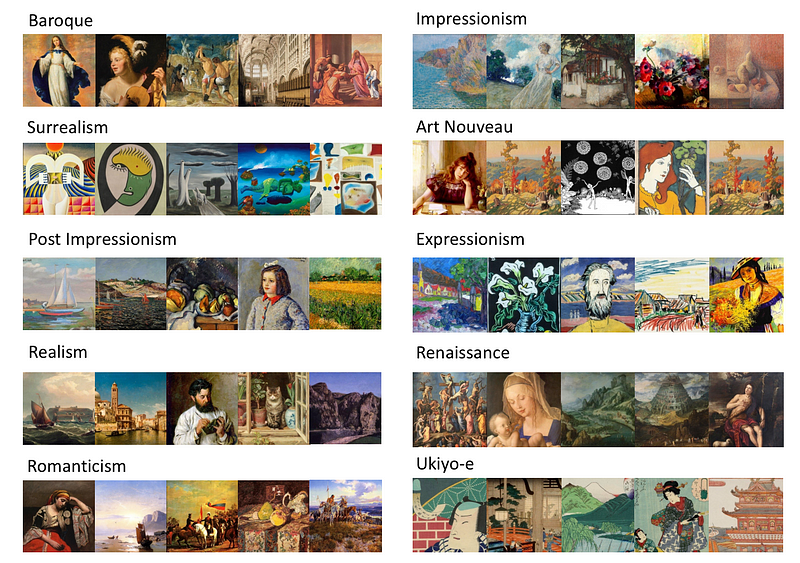
60,000 images, 10 different types of art style
ArtBench-10 is the first benchmark for analyzing class-balanced, high-quality, cleanly annotated, and standardized artworks. The above image shows that the dataset is made up of 60,000 images that have been labeled with 10 different types of art.(with 5,000 training images and 1,000 testing images per style.) The authors carefully design the standardized data collection, annotation, filtering, and preprocessing schemes to ensure that the images are of high quality and that the labels are clear and balanced. The authors give you three versions of the dataset, each with a different resolution: 32x32, 256x256, and the original. Each version is in a standard format that is easy to use with existing data loaders in popular deep learning frameworks like PyTorch and Tensorflow.
ArtBench-10 is better than previous art datasets in several ways. 🔵 it has a balanced distribution of classes, which is different from most other art datasets, which have a long tail of classes.
🔵 the images are of good quality, and the labels are clear.
🟠 ArtBench-10 is made using standard procedures for collecting, annotating, filtering, and preprocessing data.
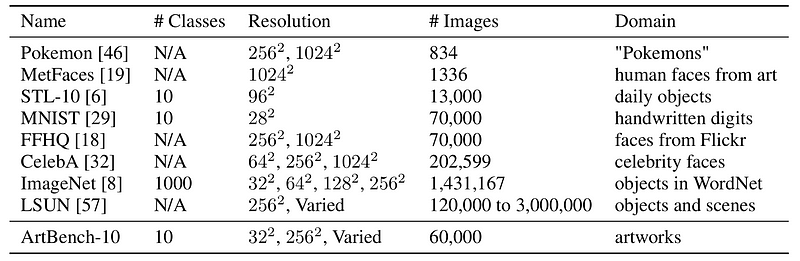
A group of existing datasets can be used to compare generative models to ArtBench. Most LSUN datasets, like LSUN Car, LSUN Bedroom, etc., are trained and evaluated per class. Therefore, each of these datasets is treated as unconditional for this comparison.
Is AI generated art copyrighted?
The dataset is mainly made up of paintings from the 14th to the 21st centuries, but it also has murals and sculptures from the same time period. The dataset is made available under a Fair Use license, which is what the image sources require. The authors also provide a subset that is in the public domain and can be used commercially in any way. This will be written in the metadata schema.
Experimenting with Art Dataset to Create AI Generated Art
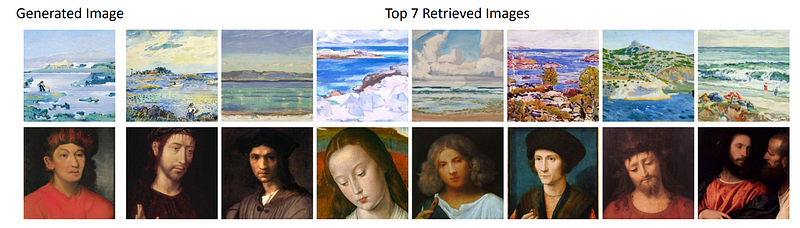
StyleGAN2 + ADA (256x256): Top 7 retrieval results. The images in the first column come from the queries, and the images in the other columns come from the training set.
Does art have bias?
ArtBench-10 is heavily skewed toward European, modern North American, and East Asian art because of the authors’ art databases. In future works, they want to deal with this problem by using art from a broader range of places and time periods, especially from Asia, Africa, South America, and Oceania. However, they also know that the dataset could be used to make fake artworks and cause copyright violations beyond what is considered “fair use.”
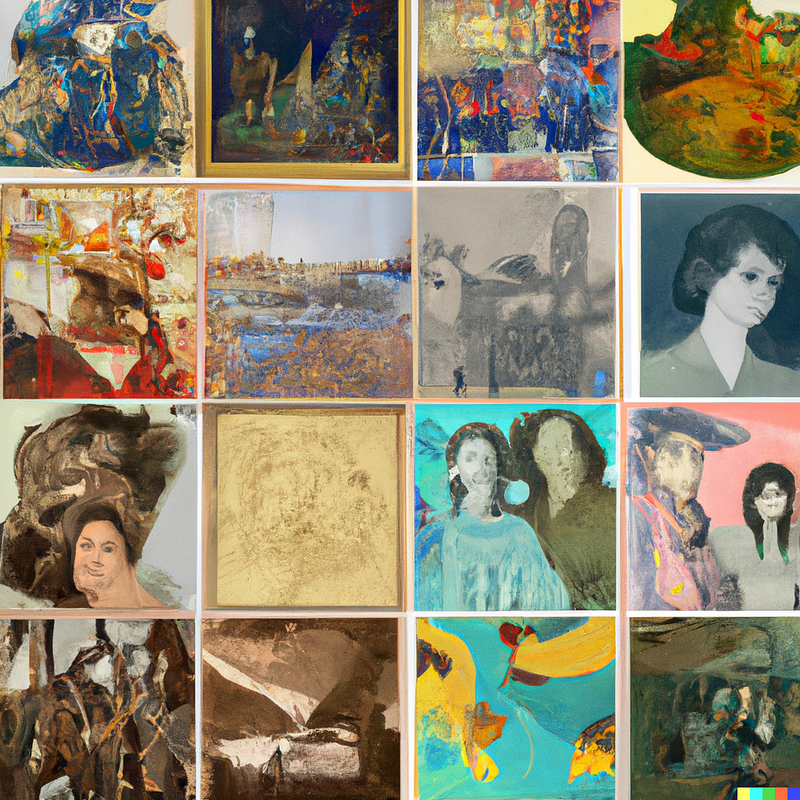
🟠 There are 64 art datasets to choose from. HERE
Keywords: computer vision, Artificial Intelligence, datasets, Machine Learning, AI art, art, digital art, Diffusion models, Text to face, datasculpting, datasculptor, Dalle 2, Dall e alternatives, CLIP, sStyleGAN, Text to Image, Art Datasets
I invite you to explore the concept of “AI creativity” by reading and learningfrom the many articles found on 🔵 MLearning.ai 🟠
- Check out my instagram with new material every week
- If you enjoyed this, follow me on Medium for more
- Want to collaborate? Let’s connect on LinkedIn
- https://linktr.ee/datasculptor
- 3D Machine Learning generated model on sketchfab
Data Scientists must think like an artist when finding a solution when creating a piece of code. Artists enjoy working on interesting problems, even if there is no obvious answer.
All our writers (members) receive the opportunity to be promoted on our social media, which increases the popularity of articles published on MLearning.ai
- Linkedin (15.2K+ ML-professionals)
- Twitter (5.1K+ followers)
- Instagram (2.2K + followers )
- Sketchfab * — individual vRooML!
- Youtube
- Apple Podcasts
- Substack
Project Page:
https://arxiv.org/pdf/2206.11404.pdf
The dataset is available at https://github.com/ liaopeiyuan/artbench

@misc{https://doi.org/10.48550/arxiv.2206.11404,
  doi = {10.48550/ARXIV.2206.11404},
  url = {https://arxiv.org/abs/2206.11404},
  author = {Liao, Peiyuan and Li, Xiuyu and Liu, Xihui and Keutzer, Kurt},
  keywords = {Computer Vision and Pattern Recognition (cs.CV), Artificial Intelligence (cs.AI), Machine Learning (cs.LG), FOS: Computer and information sciences, FOS: Computer and information sciences},
  title = {The ArtBench Dataset: Benchmarking Generative Models with Artworks},
  publisher = {arXiv},
  year = {2022},
  copyright = {arXiv.org perpetual, non-exclusive license}
}