
Run your private AI Art generator locally
AI Direct Movies in Tarantino style
Open source filmmaking toolbox + Dataset
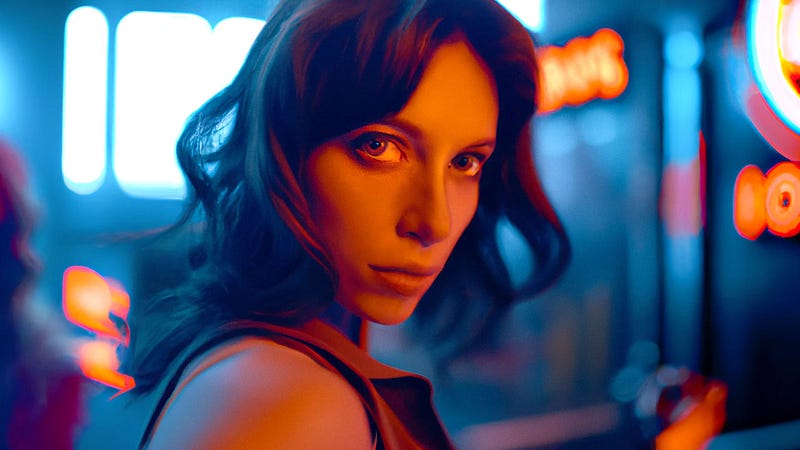
Quentin Tarantino’s shot type, scene cuts, camera movement, and action/dialogue structure. All of these elements can be mimicked by the new AI tool. So after designers, artists and musicians, it’s time for AI directors.
Experience love at first sight with an AI art platform
How many Oscars has Tarantino won?
He has worked as a screenwriter, producer, and director, and his films are recognized for their excessive profanity, dark humor, nonlinear plots, cameos, and adaptations from popular culture. Both mainstream audiences and dedicated fans have grown to love Quentin Tarantino’s films. Pulp Fiction and Django Unchained are Oscar movies by Quentin
Can AI automate the movie industry?
An open-source generative cinematography toolkit that can generate in-game sequences in the manner of renowned human filmmakers. It is built in the popular gaming engine Unity and has a unique timeline and storyboard interface for design-time editing and runtime cinematography automation. The technology creates sequences that people accurately identify with a target director using two user tests, each applying quantitative and qualitative measurements while giving above-average usability. The director impersonation dataset is open to the public and may be expanded by users and cinema fans.
Project Page (scroll down)
Is Unity used in movie industry?
In-game cutscenes are short, non-interactive parts of a video game that stop the action. They are often used to move the story along by showing important events or conversations between characters. In-game cutscenes, especially in high-quality productions, have detailed character animations, complicated scene composition, and a lot of cinematography.
To give a specific experience, you need to know much about digital cinematography and directing techniques to set up where and how many virtual cameras will move and behave. So, game companies might need to hire dedicated directors, cinematographers, and movie production teams.
AI Cinematography
On the other hand, AI can be used as a co-creative tool to help direct and manage the cameras in a semi-automated way. This can cut down on the costs and repetitive work of traditional cutscene production and give game designers the freedom to make their own cutscene ideas come to life. Research has made a lot of progress toward solving some of the biggest problems.
Can AI replace directors?
For example, some issues have been worked on automated camera placement, subject visibility, shot continuity, and scene composition. On the other hand, existing systems need to make internally consistent compositions with a consistent style. These qualities are especially clear in film cutscenes made by great human directors.
To fix this problem, the researchers made and tested Cine-AI, a set of semi-automated cinematography tools that can make cutscenes in games in the style of a famous human director and according to user instructions. For the proof-of-concept, they looked at how different cinematography techniques were used in 160 movie clips from Tarantino and Guy Ritchie.
This gave them a style description dataset that can be used in procedural cutscene generation. Cine-AI gives users control by letting them interact with an animation timeline and a storyboard during the design process: The user chooses essential parts of an animation timeline, and the system shows the user how the scene will look as an interactive storyboard that the user can then change.
The generated work closely matches the style of a chosen director in terms of camera placement, transitions, and cinematography techniques. This gives the piece a consistent look and makes up for the stylistic flaws of previous work.
Project Page (scroll down)
How Machine Learning Is Used in the Film Industry
These are the things that the authors bring to the table: 🟠 A way for a user to help make in-game cutscenes that look like the work of a specific director. 🟠 Cine-AI, a new set of open-source filmmaking tools, makes this technique possible. They put the system into the popular game engine Unity to make it as easy to use as possible and allow it to be put into production immediately. 🟠 A public dataset of style descriptions that can be added to and can be used in Cine-AI and similar projects. At the moment, it shows how two well-known directors use cinematography techniques to show their style. 🟠 A user study that shows the system can make cutscenes in the style of a specific director. 🟠 A usability study shows no major problems (System Usability Scale grade B) and points out areas that need to be fixed or studied more in the future.
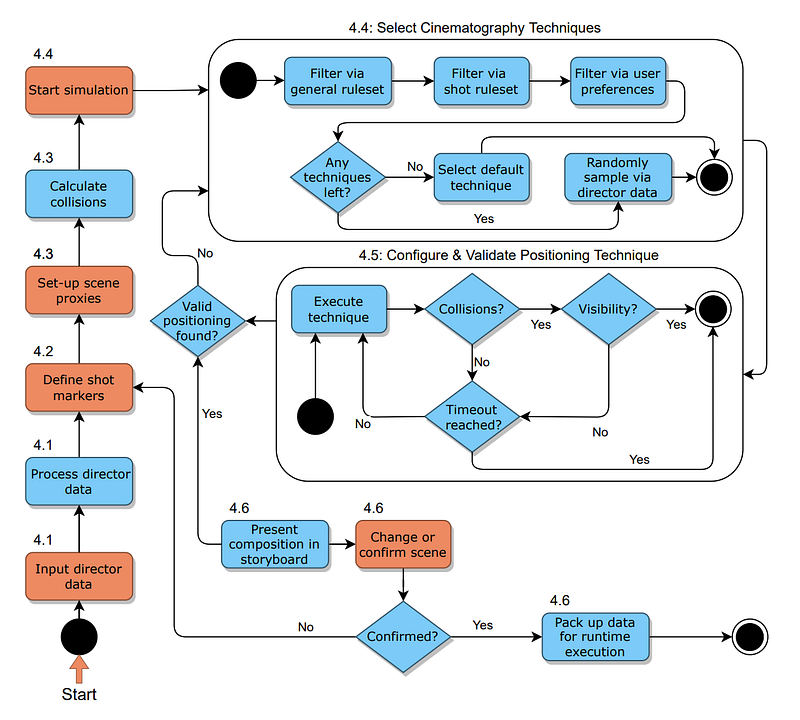
UML Activity Diagram of CineAI-design-time processes (rectangles with rounded corners represent actions, diamonds represent conditions, and circles represent the beginning and end of the overall or sub-process). Blue parts don’t need any help from the user, while orange parts do. The numbers point to the subsections, which have more information.
CineAI’s tool allows movie production teams to rapidly iterate on potential shots while adhering to a given directorial style, while the automated shot generation feature provides inspiration for fresh ideas. We’re living in the future of machine learning in films.
Project Page (scroll down)
AI is everywhere, But the question is, how much do you love it?
I invite you to explore the concept of Machine Learning Art by reading and learning from the many articles found on 🔵 MLearning.ai 🟠
Check out my instagram with new material every week
- If you enjoyed this, follow me on Medium for more
- Want to collaborate? Let’s connect on LinkedIn
- https://linktr.ee/datasculptor
- 3D Machine Learning generated model on sketchfab
Keywords: computer vision, Artificial Intelligence, Machine Learning, AI art, art, wombo dream, digital art, Dalle 2, Imagen, wombo ai, Parti, 3D point cloud, diffusion models, generative art, wombo art, photographic quality, img by AI system, AI art generator, text to art generator, 3D, midjourney, dalle2, stablediffusion, creative economy, movie industry, Tarantino,

Project Page:
https://dl.acm.org/doi/pdf/10.1145/3549486
Dataset
https://github.com/inanevin/Cine-AI
Cine-AI: Generating Video Game Cutscenes in the Style of Human DirectorsAuthors: Inan Evin Perttu Hämäläinen Christian Guckelsberger